



Medical tourism marketing: building online trust to attract international patients
Medical tourism marketing works best when it combines credibility signals with digital reach. Clinics and hospitals that win international patients online put trust first: accreditations, real patient stories, multilingual content, and transparent cost information work together to move someone from first search to confirmed booking. This guide covers the specific strategies that drive international patient acquisition and explains how each one performs in practice.
What digital marketing strategies work best for medical tourism?
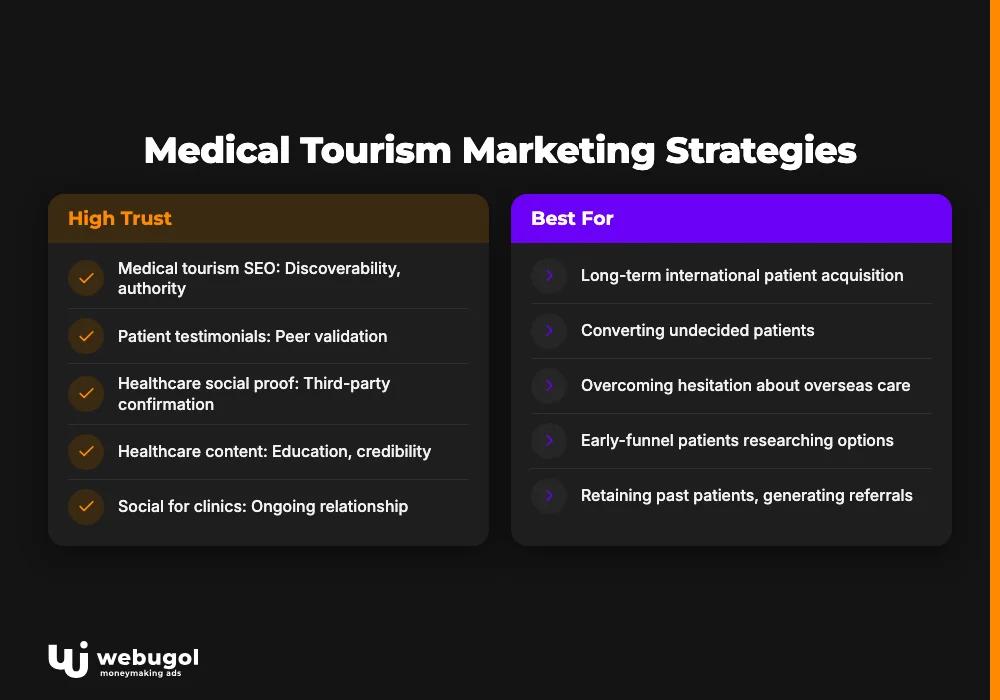
The highest-performing channels in medical tourism marketing share one trait: they reduce uncertainty for a patient making a high-stakes decision from thousands of miles away. Below are the core strategies, ranked by the trust signal they deliver.
| Strategy | Primary trust signal | Best for |
|---|---|---|
| Medical tourism SEO | Discoverability and authority | Long-term international patient acquisition |
| Patient testimonials website | Peer validation | Converting undecided patients |
| Healthcare social proof | Third-party confirmation | Overcoming hesitation about overseas care |
| Healthcare content marketing | Education and credibility | Early-funnel patients researching options |
| Digital marketing for clinics via social | Ongoing relationship | Retaining past patients and generating referrals |
| Multilingual email sequences | Personalized guidance | Nurturing leads across time zones |
Each channel reinforces the others. A solid medical tourism SEO foundation brings visitors to content that educates them, testimonials that reassure them, and a clear contact path that converts them.
How do medical facilities build trust with international patients online?
Trust comes from consistency across every touchpoint. A patient researching care abroad checks your website, Google reviews, social media, and accreditation credentials. If any of those signals contradict each other, confidence drops.
Three behaviors separate high-trust facilities from the competition.
Show credentials upfront. List accreditations such as JCI or ISO certifications on the homepage and procedure pages. International patients use accreditation status as a quick filter before reading anything else, so placing it in a buried "about" section is a missed opportunity.
Be explicit about costs. Patients choosing overseas care often cite cost as the primary driver. Facilities that publish honest price ranges or offer transparent cost consultations remove one of the biggest hesitation points in the decision process.
Staff your digital presence. A live chat staffed by real patient coordinators changes the experience. When someone asks a clinical question at 11 pm their local time and gets a real answer within minutes, that facility earns trust that no static web page achieves.
Together, these behaviors form the foundation of a medical tourism marketing strategy that earns patient confidence consistently, not just on the first visit.
Healthcare social proof amplifies all three behaviors. Every accreditation listed next to a collection of detailed patient reviews is more persuasive than either element alone. This is why engaging patients through social media channels matters beyond follower counts: platforms are where real patients share real experiences, and prospective patients read every word.
How to use patient testimonials in healthcare marketing?
Vague praise does almost nothing in medical tourism. Specific, detailed accounts tied to named procedures and outcomes are what move prospective patients toward a booking decision.
A strong patient testimonials website section includes the patient's country of origin, the condition treated, the procedure performed, and a before/after narrative. Video testimonials outperform text because they are harder to dispute and communicate emotion that written words often miss. A patient on video explaining why they chose a facility abroad over a hospital at home, what recovery actually felt like, and whether they would make the same decision again directly addresses the fears of the next person watching.
Collecting testimonials requires a systematic process. Send a follow-up request to discharged patients after they have had time to assess their outcome. A short survey with an optional video upload produces better response rates than an open-ended written request. Publish the results on dedicated procedure pages rather than a generic "testimonials" page, so the social proof appears at the moment a reader is researching that specific treatment.
Testimonials also feed into healthcare content marketing. Patient stories, shared with permission, become blog posts, short videos, and social media content that reaches audiences the facility would not otherwise encounter.
How do hospitals attract foreign patients through SEO?
Medical tourism SEO differs from local SEO in one fundamental way: the target patient is not within driving distance. They are searching in their own country, in their own language, and comparing facilities across multiple countries before deciding.
Effective international patient acquisition through search requires:
- Country-specific landing pages. A page targeting UK patients researching hip replacement abroad should address wait times, travel logistics, and recovery planning relevant to that audience. A page targeting US patients should lead with cost comparisons and what to expect from the coordination process.
- Procedure-level content. Ranking for "cardiac bypass surgery abroad" is more achievable than "medical tourism" and captures patients further along the decision path.
- Technical multilingual structure. Hreflang tags ensure search engines serve the correct language version to the correct audience.
- Authority building through links. Mentions and links from medical travel directories, expat publications, and patient community forums raise domain authority in the eyes of search engines evaluating a facility's credibility.
The compound growth that SEO builds for health and wellness practices applies with extra force in medical tourism, where paid advertising restrictions make organic rankings the more durable long-term channel.
What content convinces patients to choose overseas medical care?
Healthcare content marketing for medical tourism should map directly to where a patient is in their decision process.
Awareness stage. Patients are comparing options across countries. Content here covers procedure basics, cost comparisons in ranges rather than specific prices, and accreditation explained in plain language.
Consideration stage. Patients are narrowing to specific facilities. Content at this point should include surgeon profiles, procedure-specific FAQ pages, before/after galleries, and virtual facility tours. This is where healthcare social proof works hardest: a facility with hundreds of detailed Google reviews and a video library of real patient accounts is far more persuasive than one with a polished brochure and no third-party validation.
Decision stage. Patients are ready to book or need final reassurance. Content at this stage includes a clear "next steps" page, what is included in the treatment package, and direct contact options that feel human, not transactional.
One practical approach for the consideration stage: build a dedicated page for each country you draw significant patient volume from. A page structured around the questions that audience segment actually types into search engines concentrates the right authority signals in one place and strengthens medical tourism SEO for that specific market.
Multilingual support as a medical tourism marketing advantage
Most clinics treat multilingual content as an afterthought. It is a direct revenue driver. A patient who finds a website in their language, speaks with a coordinator in their language, and receives discharge documents in their language is less likely to feel post-procedure anxiety and more likely to refer others from their home country.
Online patient communities operate on the same logic. Many clinics now run closed groups where past and current patients exchange practical advice. This creates a referral loop: prospective patients find the community through search or word of mouth, read experiences from people like them, build confidence in the facility, and book. The facility does not need to manage every interaction; the community sustains itself once it reaches a critical mass.
Personalized follow-up: where digital marketing for clinics closes the gap
International patients often go quiet after an initial inquiry. They are comparing multiple facilities, consulting family members, and managing visa logistics. Facilities that follow up with personalized, relevant communication during this window convert at higher rates than those that send generic newsletters.
A structured patient communication program delivered through email can automate this follow-up without making it feel automated. Emails that reference the specific procedure the patient asked about, the country they are traveling from, and the concern they raised in their inquiry get read. Generic "book now" messages do not.
In a sector where the stakes are personal and medical, messages that speak to what a patient is genuinely afraid of create a different kind of connection than those that simply list services. That connection is what turns an inquiry into a confirmed booking.
Start building a medical tourism marketing system that works
If you want to attract more international patients without guessing which tactics produce results, the answer is a connected system, not isolated campaigns. Our healthcare growth system is built specifically for clinics and hospitals competing for global patients, structured around SEO, trust content, testimonial capture, and multilingual outreach working together. Book a discovery call with Webugol to identify which part of your current marketing is leaving the most opportunity untapped.
FAQ
What is the most effective trust signal in medical tourism marketing?
Accreditation from a recognized body such as JCI, combined with detailed video testimonials from past patients, is the strongest combination. Accreditation answers "is this facility safe?" and testimonials answer "will this work for someone in my situation?"
How much content does a medical tourism website need?
Each major procedure you offer needs its own page with clinical details, surgeon profiles, recovery information, cost ranges, and patient testimonials. A general facility overview alone will not rank in international search or convert patients conducting detailed research.
Does medical tourism SEO require a different approach than standard healthcare SEO?
Yes. Medical tourism SEO targets patients in other countries searching in their own language, so it requires country-specific landing pages, hreflang implementation, and content that addresses travel logistics alongside clinical information. Local SEO tactics alone will not reach an international audience.
How do patient testimonials affect international patient acquisition?
Specific, detailed testimonials tied to named procedures increase conversion rates because they reduce the uncertainty that holds most international patients back. Video testimonials from patients sharing the same nationality as the target audience are the most effective format.
What is healthcare social proof and why does it matter in medical tourism?
Healthcare social proof includes reviews, ratings, testimonials, and patient community activity that confirms real people trust a specific facility. It matters because international patients cannot visit before booking, so third-party validation from people who already made that decision substitutes for the in-person reassurance local patients receive.