



Medical device marketing: a complete guide to strategy and growth
Medical device marketing connects regulated technology to the clinicians and patients who need it. Effective campaigns balance strict FDA rules, clinical credibility, and multi-channel digital outreach. Done right, this discipline drives product adoption, builds brand authority, and sustains long-term market presence. This guide covers regulatory constraints, digital tactics, audience strategy, and reaching healthcare professionals without crossing compliance lines.
The medical device market: context for marketers
The medical device market runs on rapid technology cycles and strict regulatory oversight. Three forces shape every marketing decision:
| Force | What it means for marketing |
|---|---|
| Regulatory compliance | All promotional claims must match FDA-cleared labeling; off-label promotion is prohibited |
| Audience complexity | Purchase decisions involve clinicians, procurement teams, administrators, and often patients |
| Technology cycles | New device generations require continuous clinical education, not one-time product launches |
Market segmentation matters more here than in most industries. A cardiac device company addresses interventional cardiologists; a wound care brand targets nursing staff and procurement managers. Audience definition shapes everything downstream: channels, content, messaging, and regulatory language.
Understanding how to market medical devices means navigating two distinct buyer journeys at once. Hospital procurement is formal, committee-driven, and evidence-dependent. In ambulatory or home-use settings, the referring clinician's recommendation and patient experience carry far more weight. Separate positioning strategies address both; a single campaign pushed across every touchpoint rarely converts in either context.
Fast technology change adds another layer. A device representing a genuine clinical advance still requires market education before adoption follows. Marketing must continuously translate technical capability into clinical language that resonates with the practitioners making purchasing decisions. For teams weighing whether to manage this in-house or partner with a specialized medical device marketing agency, the regulatory and channel complexity is usually the deciding factor.
What is downstream marketing in medical devices?
Downstream marketing in medical devices covers all commercial activities after a product is developed and cleared: positioning, pricing, promotion, and sales execution. It is where clinical value converts into market presence and revenue.
Upstream marketing comes before it. Upstream work involves market research, identifying unmet clinical needs, and shaping product design before development concludes. Downstream marketing inherits those inputs and translates them into campaigns, sales tools, clinical education content, and customer relationships. A downstream campaign targeting the wrong audience typically reflects a gap in the upstream research that should have defined the market in the first place.
Device marketing teams generally operate in the downstream phase. They own product launches, distributor enablement, KOL programs, and digital channels. Understanding that distinction helps assign budget to the right activities and measure the outcomes appropriate to each stage. For teams building out downstream marketing for a medical device, this phase is where clinical value becomes revenue: campaigns, sales enablement, distributor programs, and customer education all live here.

How does FDA regulation impact medical device promotion?
FDA regulation defines the permitted boundaries of medical device marketing. No performance claim or therapeutic benefit statement is allowed unless it aligns with the FDA-cleared indication and has scientific backing. FDA medical device advertising requirements apply across the full range of promotional materials: trade show displays, printed brochures, websites, social media posts, and paid digital campaigns.
Off-label advertising is prohibited for device manufacturers. Healthcare professionals may use medical devices off-label at their clinical discretion, but manufacturers cannot promote devices for applications beyond the cleared indication. This holds regardless of how common that off-label use may be in clinical practice. It is a hard boundary, not a gray area.
FDA standards extend to websites and email. A product landing page implying a broader indication than the cleared label carries the same regulatory risk as any other promotional asset. Compliance review belongs at the brief stage, not as a final gate after production.
Practically, this means marketing teams work alongside regulatory affairs and legal from the outset of every campaign. Building review into the workflow reduces re-work and keeps timelines manageable. Companies that treat compliance as a design constraint consistently face fewer enforcement complications and shorter production cycles.
How to market a medical device effectively?
Effective medical device marketing aligns three elements: a clear picture of who makes the buying decision, a brand that earns clinical trust, and channel selection based on where those buyers actually pay attention. Generic awareness campaigns rarely convert in a category where procurement processes are structured and evidence requirements are explicit.
Brand marketing for medical device companies
Medical device branding extends well beyond a logo or product name. Brand marketing for medical device companies covers:
- Product quality and clinical evidence depth, which form the foundation of clinical trust.
- Customer support and implementation quality, since device companies are long-term partners to clinical teams, not one-time vendors.
- Website credibility and digital presence, which increasingly shape how new decision-makers evaluate vendors before any sales contact.
- Professional reputation within clinical specialties, built through publications, conference presence, and KOL relationships.
A strong brand reduces perceived adoption risk. In a category where patient outcomes are at stake, that matters directly.
Medtronic is the most referenced example of sustained brand investment in this space. Their marketing is built on thought leadership, peer-reviewed clinical data, and consistent educational content for healthcare providers. Patient testimonial videos for their diabetes management devices, built around authentic outcomes, increased trust among prospective users by making clinical results concrete rather than abstract. Documented impact, not product claims.
Brand differentiation in medical devices comes from clinical authority. Companies that have earned sustained market leadership built it through evidence-based communication with healthcare professionals over years. That trust takes time to establish and consistent effort to maintain.
Audience segmentation and analysis
Audience segmentation determines whether a campaign reaches the people who actually make or influence purchases. For capital equipment sold to hospital systems, the relevant audience includes department heads, clinical champions, procurement committees, and biomedical engineers. Each group evaluates the same device against different criteria.
Getting segmentation wrong is costly. A message that resonates with procurement but misses the clinical champion can stall a sale at committee review, even after a strong product demonstration.
CRM platforms and behavioral analytics tools identify which segments respond to which content at which stage of the evaluation process. Social listening tools surface emerging clinical discussions and market concerns before they appear in sales conversations. These inputs make downstream campaigns more precise and reduce spend on audience segments not currently in a buying position.

What are the best digital marketing strategies for medical devices?
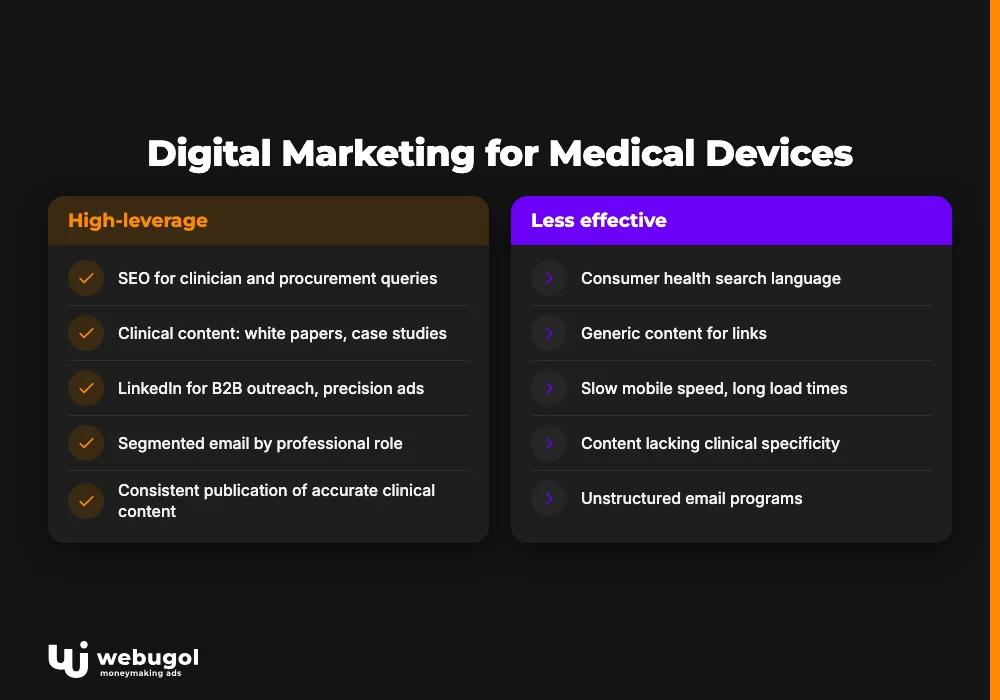
Medical device digital marketing combines search visibility, clinical content, professional network outreach, and structured email. The right mix depends on device class, primary buyer role, and sales cycle length. For most device companies, the highest-leverage channels are:
- SEO targeting the queries clinicians and procurement staff actually type.
- Clinical content marketing through white papers, case studies, and instructional video.
- LinkedIn for B2B outreach and precision professional advertising.
- Segmented email programs differentiated by professional role.
SEO for medical devices
Search optimization for medical devices starts with keyword research targeting the queries that clinicians and procurement staff actually type: clinical condition terms, procedure names, device specifications, and comparative queries. These differ in intent and language from consumer health searches. Content must address clinical specificity to rank and convert.
Search engine optimization for on-page elements covers page titles, meta descriptions, and content structured around clinical questions. Technical performance, including mobile speed and load times, affects both ranking and the experience of clinicians who access information between patient interactions. For how search builds compounding visibility for health-focused businesses, the same cumulative authority effects apply in B2B device marketing.
Domain authority in this category builds through consistent publication of clinically accurate, sourced content. Generic content does not earn links from clinical publications or professional associations. Those links carry the most weight for health-related queries.
Content marketing that earns clinical trust
Content is the primary credibility mechanism in medical device marketing. The most effective formats for clinical audiences include:
- White papers and case studies documenting clinical outcomes and operational efficiency gains, which address the evidence standards applied before purchase recommendations reach committees.
- Patient testimonial videos that show real outcomes without clinical jargon, making device benefits concrete for both prescribing clinicians and prospective patients.
- Instructional webinars that compress complex technical information into formats accessible across clinical specialties.
- Interactive tools such as clinical calculators that generate both engagement and data for sales follow-up.
Medtronic's patient testimonial video series for diabetes management devices is a strong example. The campaign led with authentic outcomes, not marketing language.
Boston Scientific has used virtual reality to let physicians interact with device capabilities before purchase. This approach educates at scale, reaches clinicians who cannot attend in-person demonstrations, and reduces the cost of individual training sessions.
Healthcare device marketing on social media
LinkedIn is the primary platform for B2B healthcare device marketing. Organic content, including clinical case discussions, regulatory updates, and peer-reviewed study summaries, builds professional credibility over time. Paid LinkedIn campaigns targeted by job title, clinical specialty, and institution type reach procurement decision-makers and clinical champions with precision that broad display advertising cannot match.
For a closer look at how social media shapes engagement and decision-making for healthcare professionals, those dynamics apply directly across medical device categories. Patient-facing devices may also benefit from platforms where patient communities gather, but all content must meet FDA standards regardless of channel.
Email in medical device marketing
Email reaches clinicians, procurement contacts, and administrators with device updates, clinical education, and product announcements in a channel they check regularly. Role-based segmentation ensures relevance: clinical updates for physicians, budget and ROI data for procurement managers, technical specifications for biomedical engineers.
Mobile optimization is necessary. Many healthcare professionals check email on mobile between patient interactions. Subject lines and CTAs must communicate value in a truncated preview. HIPAA and GDPR compliance governs any patient-related data used in email programs, and that layer must be in place before the first send. For email programs built around healthcare professional communication and retention, those frameworks translate directly into device marketing contexts.
How to reach healthcare professionals with a medical device campaign?
Reaching healthcare professionals requires more than digital advertising. HCPs make purchasing recommendations based on three inputs that marketing must address:
- Clinical evidence from peer-reviewed studies and published trial data.
- Peer endorsement from recognized experts within their specialty.
- Direct device experience from demonstrations, clinical evaluations, or sample use.
A campaign that addresses only one of these leaves most of the buying decision uninfluenced.
Key Opinion Leader programs
Key Opinion Leaders (KOLs) are recognized clinical experts whose assessments influence peers and purchasing committees. Device companies partner with KOLs to review clinical data, present at conferences, create educational content, and build awareness within professional networks. KOLs can act as brand ambassadors within specific clinical communities, reaching audiences that direct marketing does not penetrate.
Peer credibility travels differently than brand advertising. When a respected cardiologist discusses a device's clinical performance at a professional meeting, that message influences department heads and procurement advocates in a way direct sales contacts rarely can. KOL relationships require careful compliance management: disclosures must be accurate, shared information must stay within the approved indication, and the distinction between clinical education and promotion must be clearly maintained. Get these details wrong, and the program creates liability rather than value.
Strategic partnerships and clinical collaboration
Collaborations with healthcare institutions for clinical trials and research generate evidence and professional credibility at the same time. Published clinical data supports regulatory submissions, grounds marketing claims in peer-reviewed evidence, and reaches clinical audiences through journals and conferences.
The documented pattern in device industry partnerships: established companies bring distribution networks and regulatory experience, while smaller companies bring focused innovation and speed. Both sides gain market reach. Patient advocates and disease-focused organizations extend reach into patient communities, which matters most for devices that involve patients directly in purchase or daily use decisions.
Ready to build a stronger medical device marketing program?
Medical device marketing is demanding, but the structure is learnable: understand regulatory boundaries, define your clinical audience precisely, earn credibility through evidence-based content, and invest in the channels where your buyers actually evaluate options.
At Webugol, we help healthcare companies build marketing programs designed for sustainable, measurable growth. If you want to increase product visibility, reach clinical decision-makers, and expand market share within FDA guidelines, see what Webugol does and get in touch to discuss your situation.
FAQ
What is medical device marketing?
Medical device marketing is the strategy and execution of promoting regulated healthcare devices to clinical buyers, procurement decision-makers, and patients. It operates under FDA advertising and labeling requirements and demands clinical evidence to support all device performance claims.
How does FDA regulation affect medical device advertising?
FDA regulations require all promotional claims to align with the device's cleared indication. Off-label promotion by device manufacturers is prohibited. All marketing materials, including websites, digital ads, and email content, are subject to FDA oversight and require compliance review before publication.
What is downstream marketing in medical devices?
Downstream marketing in medical devices covers commercialization activities after product development and regulatory clearance: positioning, promotion, sales enablement, and customer education. It contrasts with upstream marketing, which focuses on market research and product design input before development begins.
Which digital channels work best for medical device marketing?
LinkedIn is the strongest B2B channel, reaching clinical and procurement audiences through both organic content and targeted paid campaigns. SEO, clinical content marketing (white papers, case studies, instructional video), and role-segmented email programs together form a complete digital strategy for most device categories.
What role do KOLs play in medical device marketing?
Key Opinion Leaders are recognized clinical experts who evaluate and discuss medical devices within their professional networks. KOL programs give device manufacturers access to peer-level credibility that standard advertising cannot achieve. These relationships must be disclosed and managed within applicable compliance frameworks.