



Medical practice marketing: strategies that attract patients and build lasting growth
Medical practice marketing is the structured work of reaching prospective patients and keeping the ones already in your care. It draws on healthcare SEO, digital advertising, content, and reputation management to produce consistent patient acquisition. Systems beat tactics. Practices that invest in a coordinated strategy grow faster than those waiting on word of mouth. The sections below lay out what that strategy includes and how to run it.
What should a medical practice marketing plan include?
A complete medical practice marketing plan covers six areas:
- Positioning defines why a patient should choose your practice over the nearest competitor in your specialty.
- An SEO-optimized website loads quickly, ranks in local and service-specific searches, and converts visitors into appointment requests.
- Patient acquisition channels include organic search, Google Ads, and Google Business Profile, each tuned to the stage of decision it captures.
- Reputation management is a consistent process for generating reviews post-appointment and responding to them promptly.
- Patient retention relies on email sequences, appointment reminders, and re-engagement campaigns for patients who have lapsed.
- Measurement means a monthly KPI review that confirms which channels produce new patients at an acceptable cost.
Plans covering all six compound over time. Plans that skip measurement drift, because nothing tells you what is actually working.
How do medical practices attract new patients?
Organic search captures patients actively typing your specialty into Google. Paid search handles demand that SEO hasn't earned yet. Google Business Profile delivers your practice to neighborhood-level searches. Online reviews determine whether a searcher clicks your listing or moves on.
Each channel operates on a different timeline. SEO builds over months, then compounds. Paid search converts quickly but stops when spend stops. A patient acquisition strategy that coordinates both, then layers in healthcare content marketing and social platforms, reaches patients at every stage of their decision. Practices running two or three channels in parallel consistently outperform those relying on one alone.
How do I market my medical practice online?
The most effective approach combines an optimized website, active social platforms, and a process for generating and managing patient reviews. Each element reinforces the others.
Build a website that earns traffic and appointments
The website is where every digital channel converges. A professionally designed, fast-loading site with clear service pages establishes credibility before a patient ever calls. Healthcare SEO on those pages, including keyword-optimized copy, local schema markup, and content that addresses real patient search queries, creates a traffic channel that grows more valuable over time.
Patients rarely search for a practice name first. They type symptoms, conditions, and "specialist near me" phrases. Matching service pages to those exact terms is the foundation of physician marketing ideas that actually produce inquiries. How organic search builds patient volume for health and wellness businesses explains why the SEO investment compounds through months 6 to 18 and beyond.
Use social platforms to educate and stay present
Different platforms serve distinct purposes. Facebook and Instagram reach existing patients and local community members. LinkedIn connects with professional referral sources. Consistency matters more than volume.
Content that educates, answers common patient questions, and introduces the care team performs better than purely promotional posts. Health decisions are personal. Social builds trust between appointments. For a detailed look at which social platforms reach each patient segment and what content formats convert by specialty, that guide covers platform strategy specifically.
Generate and manage online reviews
Reviews are a primary trust signal in healthcare search. Volume and recency both matter. Practices with a consistent stream of recent, detailed reviews rank higher in local results and convert more visitors into callers. Generating that volume requires a systematic post-appointment request, automated where possible.
Responding to all reviews, positive and critical alike, signals the responsiveness prospective patients evaluate before deciding to call. A well-handled complaint often earns more confidence than an unbroken run of five-star ratings.
What digital marketing strategies work best for healthcare?
The highest-performing strategies are healthcare SEO, content marketing, targeted email, and paid search. Each addresses a different part of the patient acquisition funnel.
Healthcare content marketing
Content is the long-term infrastructure of digital authority. Blog posts, condition guides, and procedure explainers answer questions patients search before calling any practice. Each optimized page becomes a durable asset that attracts traffic without further ad spend.
Effective healthcare content marketing prioritizes depth over volume. A smaller set of pages that fully answer patient questions outperforms a large collection of thin articles covering every topic at surface level. Content that genuinely informs a patient earns links, time-on-page, and return visits, all of which signal authority to search engines.
Email campaigns for patient retention
Email produces strong ROI relative to what most practices invest in it. Post-appointment follow-ups, seasonal health reminders, and re-engagement campaigns for patients absent 12 or more months drive retention without additional acquisition spending.
A structured approach to patient outreach through targeted email programs converts one-time visitors into long-term patients. Practices underinvesting in email often overspend on acquisition to replace patients who quietly leave.
Paid advertising
Google Ads and Meta campaigns generate immediate visibility for a new service or an expanding location. Healthcare advertising carries compliance constraints, especially around HIPAA, that require careful review of creative and targeting before launch. Landing page quality and offer clarity determine ROI as much as bid strategy does.
Tracking what works: KPIs for your medical practice marketing plan
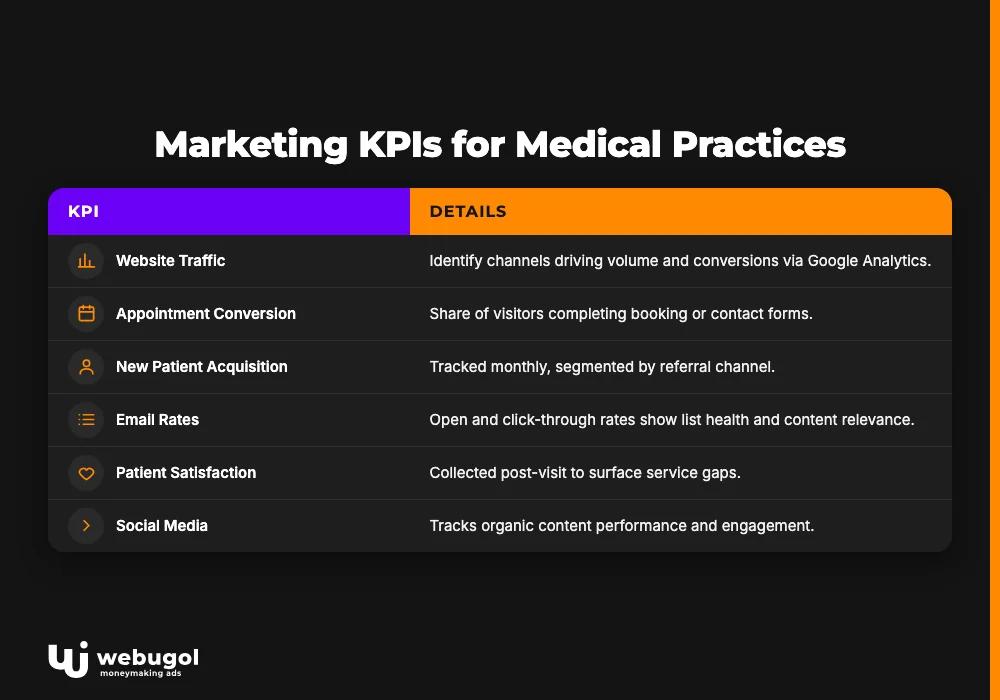
Marketing without measurement drifts. The following indicators appear consistently in well-run medical practice marketing programs:
- Website traffic and source breakdown: tracked in Google Analytics to identify which channels drive volume and which convert
- Appointment conversion rate: the share of site visitors who complete a booking or contact form
- New patient acquisition rate: tracked month over month, segmented by referral channel
- Email open and click-through rates: a proxy for list health and content relevance
- Patient satisfaction scores: collected post-visit to surface service gaps before they become public reviews
- No-show rate: a measure of how well appointment reminders are working
- Social media reach and engagement: tracks organic content performance across active platforms
Patient surveys add qualitative signal. They reveal how patients heard about the practice and how satisfied they were after visiting. That data confirms whether the marketing message and the actual care experience align.
How much should a medical practice spend on marketing?
There is no universal figure. High-volume primary care practices in competitive urban markets need higher sustained spend than rural specialists facing limited local competition. The discipline that holds across all practice types is the same: measure cost per new patient by channel, then shift budget toward what the data confirms is working.
Without that process, spending drifts toward the most visible activity rather than the most effective one. Set the KPIs. Review monthly. Let the numbers move the budget.
Build a medical practice marketing program that compounds over time
A coordinated approach produces more predictable growth than any single tactic. Webugol helps healthcare practices build strategy across search, content, email, and paid channels and execute it consistently. If you want a program that grows in value over time, explore the structured growth program for healthcare and medical practices or reach out to discuss your current situation.
FAQ
What is medical practice marketing?
Medical practice marketing is the coordinated use of digital and traditional channels to attract new patients, retain existing ones, and build a practice's reputation. It typically includes healthcare SEO, content marketing, email campaigns, paid advertising, and online review management.
How long does it take for healthcare digital marketing to show results?
Paid search and Google Business Profile updates can produce patient inquiries within a few weeks of launch. Healthcare SEO and content marketing typically take three to six months to generate measurable organic traffic growth, with results compounding after that window.
What digital channel is most effective for patient acquisition?
Google search, combining organic through healthcare SEO and paid through Google Ads, consistently produces the highest-intent patient leads. Google Business Profile amplifies that visibility in location-specific searches and costs nothing to maintain.
How do online reviews affect a practice's patient acquisition?
Reviews influence local search ranking and first-contact trust at the same time. Practices with a consistent volume of recent, detailed reviews rank higher in local results and convert more prospective patients than those with sparse or outdated review histories.
Do small medical practices need a formal marketing plan?
Yes. A written plan with two or three active channels and a monthly review process outperforms an unstructured approach. The feedback loop the plan creates allows the strategy to improve over time rather than repeat the same spend without learning what works.