



Best CRM for Healthcare in 2026: What Telehealth and Clinic Operators Actually Need
The best CRM for healthcare depends on whether you are optimizing patient acquisition or patient data storage, which are two different jobs with different platform requirements. For telehealth operators and clinic CMOs running paid media, the real test is whether the platform tracks the full path from ad click to closed consult, attributes revenue to each channel, and triggers follow-up fast enough to protect show rates. The five platforms below pass that test at different price points and operational scales.
What makes a healthcare CRM different from a regular CRM?
A healthcare CRM must enforce HIPAA-compliant data handling, require a Business Associate Agreement from your vendor, and fit into an acquisition funnel that runs through calls, intake forms, and booked consults. General sales CRMs are built for B2B pipelines where the prospect is also the decision-maker. Healthcare funnels work differently. The compliance layer adds approval checkpoints a standard CRM workflow does not anticipate, and the patient who clicks an ad is rarely the same person managing billing or insurance.
Three requirements separate healthcare-grade platforms from general sales tools. Your vendor must sign a BAA before any patient-identifiable information enters the system. The CRM must integrate with intake forms and booking tools without leaking PHI through URL parameters. The automation layer must support the kind of immediate follow-up that telehealth show rates depend on.
When choosing the best CRM for healthcare industry buyers, operators often screen for patient record features instead of acquisition metrics. That is the wrong lens. Patient data storage belongs in the EHR. The CRM's job is moving leads from ad click to booked consult and keeping them engaged through the revenue lifecycle.

What is the best CRM for healthcare? Top 5 picks
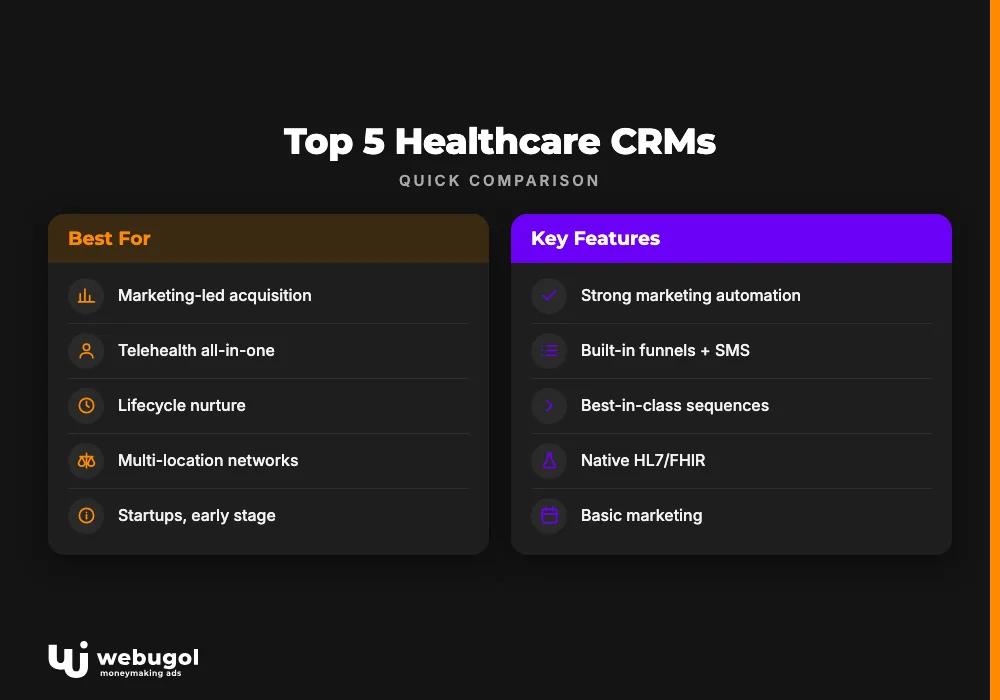
No single platform fits every healthcare operator. The right pick depends on your model (telehealth vs. clinic), team size, and whether acquisition speed or lifecycle nurture is the bigger gap. Here are five platforms that appear in real healthcare stacks, including GoHighLevel, which every competitor roundup omits despite being standard in telehealth operations.
| Platform | BAA/HIPAA | Free tier | EHR integration | Marketing automation | Best for | Starting price |
|---|---|---|---|---|---|---|
| HubSpot | Yes (paid tiers) | Yes | Via Zapier / API | Strong | Marketing-led acquisition | $15/mo |
| GoHighLevel | Yes | No | Limited | Built-in funnels + SMS | Telehealth all-in-one | $97/mo |
| ActiveCampaign | Yes | No | Via integrations | Best-in-class sequences | Lifecycle nurture | $15/mo |
| Salesforce Health Cloud | Yes | No | Native HL7/FHIR | Enterprise-grade | Multi-location networks | $300/mo+ |
| Zoho CRM | Requires config | Yes | Limited | Basic | Startups, early stage | Free |
HubSpot: Best for marketing-led patient acquisition
HubSpot puts ad attribution, form capture, lead scoring, and email and SMS lifecycle flows in one platform with a reporting layer that connects ad spend to consult revenue. It supports a BAA on paid tiers and integrates with most telehealth booking stacks natively or via Zapier. When the primary goal is tracking the full acquisition funnel from first click to booked appointment, HubSpot has the clearest reporting chain of any platform on this list.
HubSpot Starter starts at $15 per month per seat. Marketing Hub Professional, which unlocks behavioral sequences and ad attribution reporting, is where most acquisition-focused healthcare operators land.
GoHighLevel: Best for telehealth all-in-one ops
GoHighLevel combines CRM, funnel builder, calendar, two-way SMS, and automated follow-up sequences in one stack. That combination is why it dominates actual telehealth operator deployments despite being absent from every top-ten roundup on this topic.
Speed-to-lead automation and built-in pipeline stages make GoHighLevel the closest thing to a purpose-built telehealth acquisition platform at its price point. A lead submits a form, the platform fires an SMS within seconds, books a calendar slot, and moves the contact through a defined pipeline stage with no one needing to touch the system. For operators where response time within five minutes separates a booked consult from a lost lead, that automation loop is the core product. GoHighLevel starts at $97 per month.
ActiveCampaign: Best for lifecycle nurture and re-engagement
ActiveCampaign's segmentation depth and behavior-triggered automation make it the strongest option for post-consult nurture, membership renewal sequences, and win-back flows. When timing and branching logic matter more than funnel-building features, this platform handles that portion of the revenue path better than anything else on this list.
It pairs well with a separate booking or intake tool. For programs that depend on renewal revenue, membership continuity, or reactivation of lapsed patients, this is the platform where that infrastructure lives. ActiveCampaign supports a BAA and starts at $15 per month.
Salesforce Health Cloud: Best for enterprise and multi-location
Salesforce Health Cloud is purpose-built for multi-location networks that need provider relationship management, care coordination workflows, and deep EHR integration alongside the acquisition layer. The compliance footprint, including BAA, HIPAA audit trails, and consent management, is enterprise-grade. So is the implementation cost.
A Health Cloud deployment typically requires a dedicated implementation partner. For organizations managing dozens of locations and complex referral networks, that investment is warranted. For a single clinic or early-stage telehealth company, it is not. Salesforce Health Cloud starts at $300 per user per month.
Zoho CRM: Best free option for healthcare startups
Zoho's free tier is the most functional zero-cost entry point for a healthcare startup that needs basic contact management, lead tracking, and pipeline visibility. It lacks native HIPAA compliance out of the box, so teams need to scope carefully what patient data lives in Zoho versus a separate compliant intake tool. The free plan covers up to three users and includes basic workflow automation. For operators researching the best free CRM for healthcare 2025 or 2026, Zoho is the most accessible zero-cost starting point before volume justifies a paid platform.
Best CRM for Healthcare by Use Case
The five platforms above map differently depending on whether you are running telehealth at scale, managing a single-location clinic, or building the first version of a patient acquisition stack.
Best CRM for telehealth companies
Telehealth operators need speed-to-lead automation, two-way SMS, and a booking integration that fires the moment a lead submits a form. Show rates drop sharply when the response window exceeds five minutes. The CRM's automation layer is not an optional feature; it is the operational core.
GoHighLevel and HubSpot are the two platforms that close that loop without a custom integration build. GoHighLevel wins on all-in-one simplicity and lower price point. HubSpot wins on reporting depth and ad attribution visibility. If your team wants full revenue attribution from ad click to recognized revenue, HubSpot plus a dedicated booking tool is the stronger stack. If you need everything in one dashboard under $100 per month, GoHighLevel is the answer. The operational logic for reducing no-shows through scheduling integrations is covered in detail in how patient scheduling software cuts no-shows and lowers costs.
Best CRM for single-location clinics
A single-location clinic typically has one or two staff handling intake, so the CRM needs to automate appointment reminders, no-show re-engagement, and review requests without requiring a dedicated ops person to manage sequences. HubSpot Starter or GoHighLevel's base plan covers this use case without over-engineering the stack.
The key decision is whether the team has capacity to configure a more complex platform or needs something close to out-of-the-box. GoHighLevel onboards faster for non-technical teams. HubSpot's reporting becomes the stronger asset as ad spend grows past $10k per month.
Best CRM for Healthcare Startup Teams
The best CRM for a healthcare startup is the one that tracks the acquisition funnel accurately before the team invests in platform features. Starting on Zoho's free CRM or HubSpot's free tier, then migrating once volume justifies a paid platform, avoids enterprise lock-in costs the team has not yet grown into.
The minimum viable CRM setup before launching paid media covers four things: a contact record with lead source preserved, a pipeline with defined stages (lead, consult booked, show, close), a follow-up sequence that fires within minutes of form submission, and a report that connects lead source to revenue. Zoho or HubSpot free handles all four.

What a healthcare CRM must handle beyond patient data
The section every competitor article skips is the CRM's role in the acquisition funnel. The metrics a healthcare CMO actually optimizes are speed-to-lead, answer rate, show rate, and close rate. CRM configuration choices directly move all four.
Capabilities required for acquisition-focused healthcare operators:
- Speed-to-lead automation that fires within five minutes of form submission, including an SMS outreach step
- HIPAA-compliant lead capture forms that do not pass PHI through URL parameters
- Offline conversion event mapping that sends consult completion data back to ad platforms
- Pipeline stage discipline with defined transitions and required fields at each stage
- Show rate tracking broken down by lead source, not just an aggregate view
- Post-no-show re-engagement sequence with at least two touchpoints in the first 48 hours
Offline conversion setup is where most healthcare acquisition stacks break. The ad platform reports cost per lead. The CRM knows which leads became booked consults and which actually showed. Without a data connection between the two, the ad algorithm optimizes for cheap leads, not qualified patients. Setting up that connection, whether through Google Enhanced Conversions, Meta's Conversions API, or a third-party connector, is the highest-leverage CRM configuration decision for most healthcare operators.
Finding the best CRM for healthcare data attribution also requires preserving UTM parameters through every step of the intake funnel. If every lead enters the system as "web form" with no source data, the pipeline report cannot tell which campaigns produce patients worth treating. Understanding what qualifies as HIPAA-compliant analytics on paid campaigns prevents attribution gaps that take weeks of clean data to recover.
If your CRM is live but attribution is still broken, the problem is almost never the platform itself. It is the tracking and funnel layer around it. The 90-day patient acquisition sprint diagnoses and fixes that layer across CRM setup, compliant tracking configuration, and campaign attribution.

Does a healthcare CRM replace your EHR?
No. A CRM manages the patient relationship and acquisition pipeline before and between care episodes. The EHR manages the clinical record and care delivery workflow. They are not interchangeable.
The two systems connect at defined handoff points, typically via HL7/FHIR messaging or a middleware connector. The CRM holds lead status, campaign attribution, follow-up history, and pipeline data. The EHR holds diagnoses, treatment plans, prescriptions, and lab results. Collapsing them into one creates either a compliance gap in the clinical layer or a feature gap in the acquisition layer.
What breaks when clinics try to merge the two: the EHR becomes the contact database, leaving marketing automation without a usable field structure. Or the CRM gets treatment data loaded into it, which creates a PHI liability in a system not built for clinical data governance. Running both is not redundant. It is the only configuration that keeps each job done properly.
How to implement a healthcare CRM without breaking compliance
Most implementation guides skip the compliance configuration layer. This is where teams create HIPAA exposure without realizing it.
Implementation steps for weeks 1 and 2:
- Audit existing data flows to identify what patient-identifiable information currently passes through marketing tools
- Confirm BAA signature with the CRM vendor before any lead data enters the system
- Enable consent mode in Google and Meta ad accounts so that tracking respects user cookie preferences
- Map offline conversion events from the CRM back to ad platforms before the first paid campaign goes live
- Test lead routing from form submission to pipeline stage to confirm no PHI passes through URL parameters or API payloads
- Identify what data must stay out of the CRM: diagnoses, treatment details, medication history, and insurance information belong in the EHR, not the marketing stack
The stakeholder who needs to approve this configuration before the first campaign launches is your compliance officer or legal counsel, not the marketing team lead. Working with a healthcare marketing partner who owns the compliance review removes that approval bottleneck from the internal team and keeps the configuration under ongoing review as platform policies change.
A common gap: teams enable consent mode in the ad platforms but leave the CRM's web tracking script running without consent gating. Both are separate tracking surfaces with separate consent requirements. Both need to be addressed before go-live.
Ready to build a patient acquisition system around your CRM?
Choosing the right CRM is one decision. Building the tracking foundation, funnel, and ops layer around it so that every ad dollar maps back to booked consults and recognized revenue is the harder part.
Webugol's patient acquisition system for healthcare operators covers both sides: CRM setup, HIPAA-compliant tracking, campaign launch, and the weekly optimization loop that keeps acquisition metrics moving. Across 50+ healthcare clients, this approach has delivered a 3x revenue growth average and a 40% CAC reduction. Healthcare providers including Valhalla Vitality (telehealth: +287% monthly revenue, -45% CAC) and Ways2Well (wellness: $2.1M revenue in six months, -38% CPA) built their growth on this system.
Request a strategy session to map the gaps in your current acquisition stack.
FAQ
What is the best free CRM for healthcare?
Teams comparing the best free CRM software for healthcare 2025 and 2026 consistently land on the same two options: Zoho CRM or HubSpot, depending on what the team needs most. Zoho's free plan covers up to three users with basic contact management, lead tracking, and pipeline visibility; HubSpot's free tier adds a cleaner reporting layer and broader integration options. Neither is HIPAA-compliant out of the box, so teams need to scope carefully what patient data enters these systems versus a separate compliant intake tool before going live.
Is HubSpot HIPAA compliant for healthcare?
HubSpot supports HIPAA compliance on paid tiers and will sign a Business Associate Agreement with qualifying healthcare customers. The free tier does not include BAA support, which means patient data should not enter HubSpot until the team has upgraded and confirmed the BAA is active. Enabling HIPAA compliance also requires additional privacy settings beyond HubSpot's defaults; the BAA alone does not complete the configuration.
Can a CRM reduce patient no-shows?
Yes: a CRM reduces no-shows when it automates appointment reminders via SMS and email, fires re-engagement sequences after missed appointments, and tracks show rates by lead source so the team can adjust targeting upstream. The reduction comes from operational consistency in follow-up, not the platform itself. Most clinics see measurable improvement within the first few weeks of activating reminder sequences.
What is the difference between a CRM and an EHR?
A CRM manages the patient relationship and acquisition pipeline: lead source, consult history, follow-up sequences, and marketing attribution. An EHR manages the clinical record: diagnoses, treatment plans, lab results, and care notes. Both systems should exist in a compliant healthcare stack, connected at defined integration points rather than collapsed into one.