



Healthcare content marketing: A practical guide for medical practices
Healthcare content marketing is the practice of publishing educational material to attract prospective patients, build clinical authority, and keep existing patients engaged between visits. It differs from paid advertising because it informs first and converts second. Practices that invest in consistent, accurate content generate more organic search traffic, earn patient trust faster, and reduce reliance on ad spend over time. This guide covers what works, what to measure, and how to build a program your practice can sustain.
What is content marketing for medical practices?
Content marketing for medical practices means creating and distributing helpful health information, through blog posts, videos, email newsletters, and social media, to attract and retain patients. The goal is not a sales pitch. The goal is to become the most trusted source in your specialty and service area.
A family medicine clinic might publish seasonal allergy guides. A dermatology practice might post short videos explaining common skin conditions. Each piece answers a real question someone in your community is already searching for. That relevance turns searches into booked appointments.
The most effective medical practice marketing programs segment content by patient type. A cardiology clinic serves both newly diagnosed patients looking for foundational explanations and long-term patients managing chronic conditions. Content for the first group answers basic questions. Content for the second goes deeper into lifestyle management and care coordination. Knowing which group you are writing for shapes every decision, from topic selection to reading level.
What types of content work best for healthcare providers?
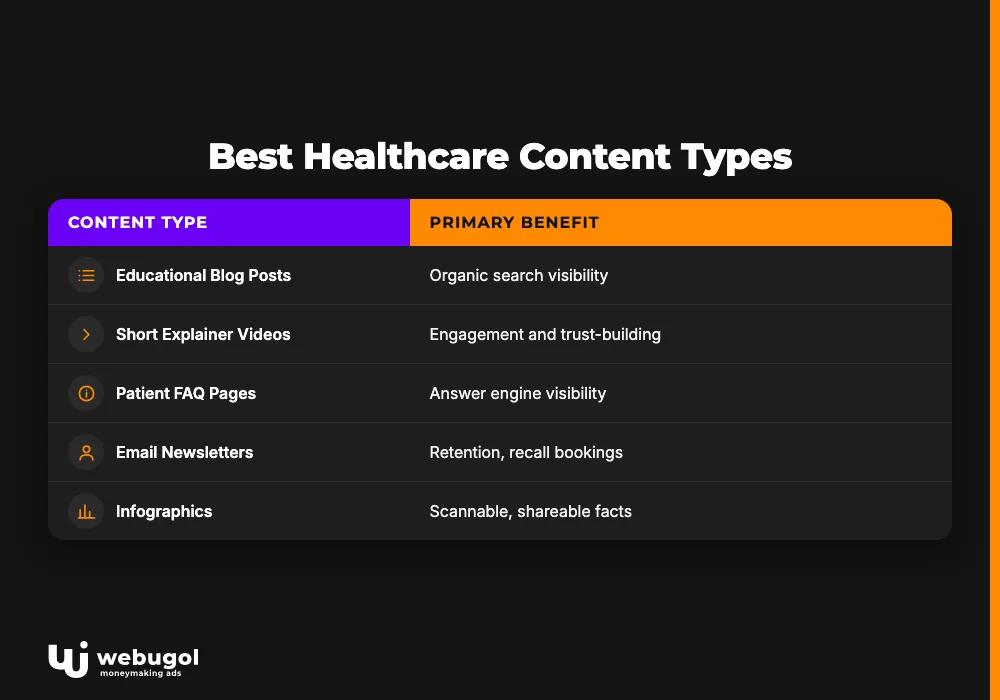
Not every format performs equally. These are the most effective content types for medical practice marketing, matched to what each achieves:
| Content type | Primary benefit | Best fit |
|---|---|---|
| Educational blog posts | Organic search visibility | SEO, patient education |
| Short explainer videos | Engagement and trust-building | Social media, homepage |
| Patient FAQ pages | Answer engine visibility | AI Overviews, featured snippets |
| Email newsletters | Retention, recall bookings | Existing patient base |
| Infographics | Scannable, shareable facts | Social posts, blog support |
Mix formats deliberately. A blog post on managing type 2 diabetes becomes a short video, which becomes a social post linking back to the original. One topic, multiple touchpoints, without rebuilding content from scratch each time.
How does healthcare content marketing improve patient engagement?
When patients find accurate, jargon-free information from your practice, they arrive at appointments better prepared. They ask sharper questions. They follow treatment plans more consistently. That shift in patient behavior is the real return on investment of healthcare content marketing.
Patient engagement strategies built on content work in two directions. First, they reduce anxiety before a visit by explaining what a procedure or new diagnosis actually involves. Second, they reinforce care after the visit through condition-specific follow-up material. An email series on post-procedure recovery or a video library on medication management keeps your practice present in a patient's daily routine, not only during appointments.
Patients who receive consistent, relevant content between visits are more likely to stay with the same practice long-term. Lower churn and stronger recall rates for preventive or elective care both follow from that ongoing relationship.
How can medical practices use SEO to attract patients?
Search engine optimization makes your content findable when patients search for symptoms, treatments, or providers near them. For a medical practice, this means three interconnected priorities: keyword targeting, local SEO, and technical site health.
Keyword targeting starts with what patients actually type. Searches like "what causes tension headaches" or "best orthopedic surgeon near [city]" represent clear intent. Publishing content that directly answers those queries puts your practice in front of patients who are actively looking for help. For the technical side of ranking in your service area, building local search visibility for healthcare clinics covers the factors that determine which practices appear first in map and local organic results.
Local SEO matters as much as content quality. Your Google Business Profile, consistent name-address-phone data across directories, and location-specific service pages determine whether patients in your area find you or a competitor. Page speed and mobile optimization form the technical floor your content needs to perform on. Without that foundation, strong content still underperforms.
Practices that invest in SEO early compound that advantage over time. A blog post published today can generate appointment requests two years from now without additional spend. That long-term return separates content-based patient acquisition from ad-based acquisition, where traffic stops the moment the budget does.

What are the best digital marketing strategies for doctors?
Doctor digital marketing works when it matches the channels where your patients already spend time. Three areas deliver consistent results across most medical specialties.
Medical social media marketing. Patients research providers on Instagram, Facebook, and YouTube before booking. Short educational videos, provider introductions, and practice-specific content build familiarity before the first appointment. Consistency matters more than production quality. A 60-second, direct explanation from a physician builds more trust than a polished promotional ad. For how specific platforms shape patient decision-making, social media for medical practices covers organic and paid tactics across major channels.
Healthcare email marketing. Email remains one of the highest-return channels for retaining existing patients. A structured program covering appointment reminders, seasonal health tips, and annual screening prompts keeps your practice top of mind between visits. A focused patient email newsletter program for clinics outlines what to send, how often, and which message types drive re-bookings from existing patients.
Patient acquisition content. SEO-optimized blog posts and educational resources form the core of patient acquisition content. New patients who find your practice through a helpful article arrive with higher baseline trust than those who click a paid ad. They have already engaged with your expertise before making contact. That pre-built familiarity lowers the barrier to booking considerably.
Content accuracy and ethics. Medical content carries constraints that general marketing does not. Every claim must be accurate and verifiable. Patient privacy must be protected. Content should reflect the diversity of the communities a practice serves. These standards are the practical conditions for building durable trust at scale, not just compliance requirements.
Tracking what your content actually does
Engagement metrics show which content earns attention and which does not. Page views measure reach. Time on page indicates whether content holds the reader. Appointment requests from content pages show conversion. Review these monthly, not quarterly.
A high-traffic page with few appointment requests signals a mismatch between topic and call to action. A low-traffic page with strong conversion is a format worth replicating. Metrics make those distinctions clear and actionable.
Analytics also reveal which patient questions you are not yet answering. A page about "what to expect during your first appointment" that earns unexpected traffic may indicate a gap in pre-visit communication across your whole practice, not just your website. That kind of insight extends the value of content marketing well beyond organic search.
Content calendars keep production consistent. Map your publishing schedule to health awareness months, seasonal conditions you treat frequently, and the questions your clinical staff hears most often before appointments. Your team's institutional knowledge of patient concerns is an editorial asset most practices underuse.
Storytelling adds a dimension that data-driven content alone cannot. Patient success stories shared with consent humanize a practice and make healthcare feel more approachable. These are not promotional testimonials; they are shared experiences that give prospective patients an honest picture of what care at your clinic actually looks like.

Start building your healthcare content marketing program
A sustainable healthcare content marketing strategy begins with a clear picture of your patients, your specialty, and the questions your community is already searching for. Webugol works with medical practices to build content programs that generate search visibility, improve patient retention, and reduce dependence on paid advertising. Explore our healthcare growth system to see how we approach it from initial audit to ongoing content execution.
FAQ
What is healthcare content marketing?
Healthcare content marketing is the strategic creation and distribution of educational health information to attract, inform, and retain patients. It includes blog posts, videos, email newsletters, and social media content designed to answer patient questions and build provider authority within a specialty or local market.
How long does it take to see results from medical content marketing?
Most medical practices see measurable organic traffic growth within three to six months of consistent publishing. Generating regular appointment requests from content typically takes six to twelve months. Email and social programs often show engagement results faster, within the first few weeks of a structured launch.
What types of content attract new patients online?
Educational blog posts targeting symptom and condition searches, short videos answering common patient questions, and location-specific landing pages generate the most consistent patient acquisition results. FAQ pages structured for answer engines also capture patients early in the research process, before they have chosen a provider.
How often should a medical practice publish new content?
One to two high-quality pieces per month outperforms irregular publishing of weaker material. Consistency matters more than volume for both search performance and patient trust. Practices on a reliable publishing schedule also accumulate content assets that compound in search visibility over time.