



Medical practice marketing: strategies that grow your patient base
Medical practice marketing is the coordinated use of digital channels to attract new patients, retain existing ones, and build measurable authority online. Done well, it combines healthcare SEO, physician website optimization, doctor online advertising, and healthcare social media into a coherent patient acquisition system. Skip one piece, and the others underperform.
This guide covers the channels that work, how to balance them, and how to tell whether results are moving in the right direction.
The core channels of medical practice marketing
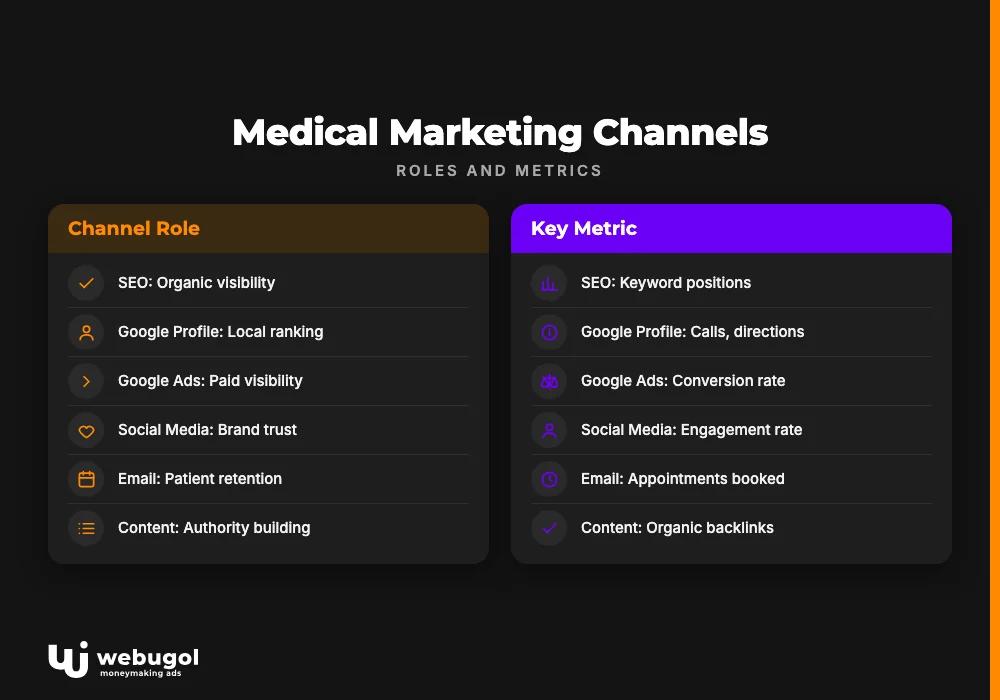
A sound plan assigns a specific role to each channel. Running them in parallel produces better results than any single channel alone.
| Channel | Primary role | Key metric |
|---|---|---|
| Healthcare SEO | Organic search visibility | Keyword positions, organic traffic |
| Google Business Profile | Local map pack ranking | Calls, direction requests |
| Google Ads | Paid visibility for high-intent searches | Conversion rate, cost per lead |
| Healthcare social media | Brand trust, community reach | Engagement rate |
| Patient retention and re-engagement | Open rate, appointments booked | |
| Content / blogging | Long-term authority building | Session duration, organic backlinks |
No single row replaces the others. The practices that grow fastest run all of them simultaneously.
How can a medical practice attract more patients online?
The fastest path is ranking where patients search, then giving them enough trust signals to book. Straightforward in principle. Achieving this requires solid physician website optimization, a verified local search profile, and a medical website design built for mobile users.
Your website is the hub of every such effort. It needs to load quickly, display cleanly on smartphones, and answer the questions a prospective patient actually types. Thin service pages with generic copy rarely rank. Detailed pages written around real patient concerns do.
Patient acquisition strategies work best layered. The first builds organic traffic over months. Doctor online advertising through Google Ads delivers it immediately for high-intent searches like "orthopedic surgeon accepting new patients near me." Together they cover both short-term and long-term patient flow. For a deeper look at how organic search compounds over time, see how growing your health and wellness practice through SEO differs structurally from paid channels.
What digital marketing channels work best for healthcare providers?
For most clinics, search and paid ads drive the most booked appointments. Healthcare social media adds the trust layer that turns a searcher into a patient.
Platform selection determines reach in doctor online advertising. Instagram and TikTok attract patients under 40 more effectively. Facebook and LinkedIn work better for older demographics and for building referral relationships with other providers. Match your platform mix to the patients your practice actually serves, not to the platform with the most total users.
Blog content anchors the whole strategy. Posts that answer real patient questions extend healthcare SEO reach, keep visitors on the site longer, and position the practice as a reliable resource. Short explainer videos on common procedures also perform consistently well across both the website and social channels. For context on how patients navigate healthcare decisions across social platforms, read our guide on how healthcare social media drives patient conversions.
Email is among the most cost-efficient of these channels. Collect addresses through your website and at patient registration, with explicit consent required by applicable privacy laws. Segment your list by patient type: post-visit follow-ups for recent patients, seasonal reminders for your full list, and re-engagement messages for anyone who has not booked in over a year.
What is healthcare SEO and why does it matter for clinics?
Healthcare SEO is the process of optimizing a clinic's website and online profiles to rank when prospective patients search for relevant services. For any medical practice marketing strategy, it is the highest-leverage long-term investment, because organic traffic costs nothing per visit and keeps building after the initial work is done, unlike paid ads that stop the moment the budget runs out.
Local SEO is the highest-priority element for most practices. When a patient types "internist near me," Google returns a local pack of three listings before any organic results appear. Ranking there requires a verified Google Business Profile, consistent contact data across directories, and a steady stream of patient reviews. Here is the setup process:
- Claim and verify your Google Business Profile.
- Enter accurate information: practice name, address, phone number, hours, and specialties.
- Upload high-quality photos of the exterior, waiting area, and treatment rooms.
- Write a description using the specialty terms and location phrases patients search.
- Respond professionally to every review, positive or negative.
- Update the listing immediately whenever hours, services, or contact details change.
On the website side, physician website optimization means placing the search phrases patients use on each relevant service page, in meta titles, and in page descriptions. Include your clinic address and a local phone number in the footer on every page to reinforce geographic relevance.
How to improve online reputation for a doctor?
Make review requests a standard step in the post-visit workflow. That one change, applied consistently, produces more reviews than any other tactic.
After each appointment, send a HIPAA-compliant follow-up by email or text. Thank the patient and ask for feedback on their preferred review platform. The message must not include any protected health information or reference the reason for the visit. Train front-desk staff to mention during checkout that reviews help other patients find the practice.
When a negative review appears, respond within 24 hours. Acknowledge the concern in general terms, avoid disclosing patient details, and invite the reviewer to contact the practice directly. A handled complaint builds confidence in prospective patients. Silence signals indifference.
Reputation is also a long-term component of this work. Publishing clear, factual health information on your blog strengthens search rankings and patient trust together, compounding both over time.
How much should a medical practice spend on digital marketing?
The right amount depends on practice size, specialty competition in your market, and whether you are in growth mode or maintaining an established patient base. There is no universal figure.
A practical framework for medical practice marketing budgets splits activity across three areas: paid channels for immediate patient flow, owned channels like your website and email list, and earned channels like search presence and reviews. Most practices underweight owned and earned. Paid advertising stops producing the moment the budget ends. These channels continue driving traffic well after the initial investment.
For doctor online advertising through Google Ads, you set a maximum daily budget and pay only when someone clicks. That structure makes testing affordable even for smaller practices. Paid social through Facebook and Instagram uses similar cost-per-click or cost-per-impression models with demographic and behavioral targeting layered on top.
Track cost per new patient booked rather than cost per click. That number connects your marketing spend directly to practice revenue.
Measuring what works
Every medical practice marketing plan needs clear success metrics from the start. Consistent tracking is what allows tactics to improve over time rather than repeat the same mistakes. Focus on these metrics:
- Website traffic: total visitors and source breakdown (organic, paid, social, direct), tracked in Google Analytics.
- Conversion rate: the percentage of visitors who book an appointment or call the practice.
- Engagement metrics: session duration, pages per session, and bounce rate reveal how well site content holds attention.
- Review volume and average rating: track these monthly to catch trends before they compound.
- Patient satisfaction: post-visit survey responses surface service gaps before they appear in public reviews.
When a metric declines, investigate the specific channel before pulling budget or changing creative. Sustained trends are what warrant action. Single data points rarely are.
Build a medical practice marketing system that compounds
Medical practice marketing compounds when the pieces connect: physician website optimization, healthcare SEO, and doctor online advertising running from a shared strategy rather than in silos. Our healthcare growth system for medical practices gives clinics a structured, repeatable approach to growing their patient base. Visit Webugol to start the conversation.
FAQ
Why does medical practice marketing matter more now than a few years ago?
Patient behavior has shifted online. Prospective patients now research providers through search, review platforms, and social media before calling a clinic. A practice without visible, credible digital presence loses those patients to competitors who have invested in theirs.
What makes healthcare SEO different from standard SEO?
Search engines apply stricter quality signals to health content, weighing accuracy, authoritativeness, and demonstrated expertise more heavily than in general niches. Local SEO also carries more weight because most patients search within a specific geography rather than nationally.
How does HIPAA affect digital marketing for a medical practice?
HIPAA restricts how patient data may be used in marketing communications. Follow-up messages requesting reviews must not include protected health information. Collecting email addresses for marketing requires explicit patient consent, and any new marketing workflow should be reviewed for HIPAA compliance before deploying it at scale.