



Inbound marketing healthcare: building personalized patient journeys
Inbound marketing healthcare is the practice of attracting patients through helpful, credible content rather than interruptive ads. Patients now research symptoms, clinicians, and treatments online before booking. A well-run approach positions a practice as a trusted authority, draws in patients already seeking help, and guides them through a personalized care journey. Trust builds before the first appointment.
What is inbound marketing in healthcare?
Inbound marketing in healthcare earns patient attention through helpful content rather than buying it through interruptive advertising. Where traditional outbound tactics push a message at a broad audience regardless of intent, inbound marketing pulls in people who are already searching for answers. They find a symptom guide or a patient story. They trust what they read. Then they book.
The core channels are SEO, content publishing, email, and social media. Each reinforces the others: a well-optimized article surfaces in search results, earns a click, builds credibility, and keeps the reader on the practice website long enough to take action. Clinical trustworthiness matters more in healthcare than in almost any other sector, which is exactly why inbound marketing healthcare fits the industry so well.
How does inbound marketing attract new patients to a medical practice?
Patients begin healthcare decisions online. They type a symptom into a search engine or scroll past a health tip on social media. Medical practice digital marketing built on inbound principles meets them at that moment, with content that answers their question and earns their trust before they ever pick up the phone.
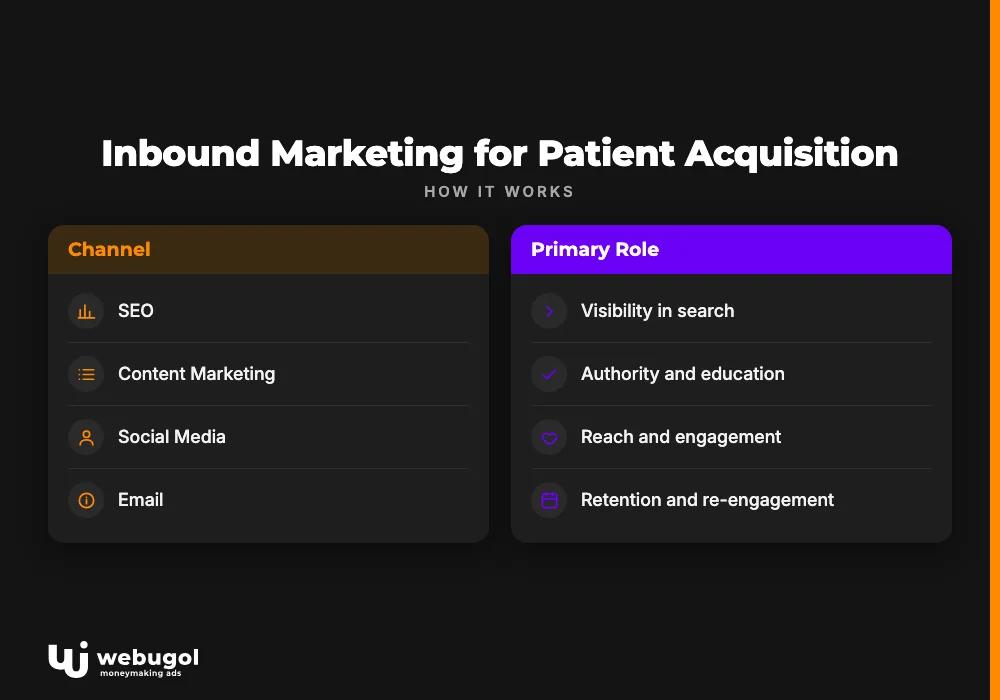
Here are the primary inbound channels and their roles in patient acquisition:
| Channel | Primary role | Patient-facing output |
|---|---|---|
| SEO | Visibility in search | Blog posts, service pages, local listings |
| Content marketing | Authority and education | Articles, guides, patient stories, video explainers |
| Social media | Reach and engagement | Health tips, Q&As, community posts |
| Retention and re-engagement | Reminders, newsletters, care follow-ups |
None of these channels works well in isolation. A practice that writes useful articles but neglects the technical side of building search authority for health and wellness loses most of the organic traffic it could otherwise earn. Strong rankings without engaging content produce high bounce rates and few conversions. The combination is what drives patient acquisition that compounds over time.
What are the benefits of personalized patient journeys?
Patient journey personalization moves inbound marketing healthcare from traffic generation to real clinical and business outcomes. A generic website attracts visitors. A personalized journey retains them.
Practices that adopt this approach consistently report three outcomes. First, stronger treatment adherence: when follow-up content and messaging match a patient's diagnosis and care stage, they are more likely to attend appointments and stick to care plans. Second, earlier detection: tailored preventive content reaches patients who would otherwise disengage from follow-up care. Third, stronger referral networks: patients who received personalized care are more likely to recommend the practice, compounding inbound results without additional spend.
The research underlying this article also shows that personalizing the patient experience increases retention and participation in marketing campaigns, because patients who feel understood are more likely to share that experience. Personalized patient experience is therefore a commercial driver as much as a clinical one.
The practitioner-patient relationship strengthens when communication is matched to the patient's situation. Patients who receive relevant information feel seen. That emotional dimension is the foundation of long-term engagement.
How to create patient personas for healthcare marketing?
A patient persona is a semi-fictional profile of a target patient segment, built from real data about demographics, health concerns, communication preferences, and digital behavior. Creating personas is the foundational step in any healthcare content marketing strategy because content written for everyone resonates with no one.
The process follows three steps. First, gather data: review appointment records, satisfaction surveys, and website analytics to identify patterns. Second, cluster by need: group patients by shared health concerns, life stage, or communication preferences rather than purely by age. Third, document and distribute: give each persona a name and a realistic profile so every team member can picture the person they are writing for.
The case studies underlying this article show how this works in practice. A pediatric clinic built a "Busy Urban Parent" persona for tech-savvy parents who preferred quick online consultations and app-based health tracking for their children. A geriatric care facility created a "Senior Independent" persona for self-sufficient older adults who valued wellness programming and early detection. A dental practice offering sedation dentistry focused on an "Anxious Patient" persona, addressing dental fear directly in content, booking flows, and in-practice communication.
Each persona shaped not just blog topics but also tone, format, and call-to-action language across every channel. That alignment converts patient journey personalization from a concept into a measurable marketing outcome.

Segmenting patient audiences for targeted messaging
Once personas exist, segmentation turns them into practical audience groups for content distribution and direct outreach. Patient engagement strategies built on segmentation outperform broadcast messaging because each group receives information relevant to its specific needs and care stage.
Effective segmentation in medical practice digital marketing uses three variables: demographics (age, location, insurance type), health status (condition, treatment stage, recency of visit), and digital behavior (how patients found the practice and which content they engaged with). Analytics tools surface these patterns from existing patient records and website data, without requiring new research budgets.
Practices that segment their audiences can send targeted email sequences timed to patient behavior and care stage, serve different website content to new versus returning visitors, and trigger proactive outreach to patients at risk of disengaging. Each touchpoint contributes to a cohesive personalized patient experience that keeps patients connected between appointments.
What content formats work best for medical practice inbound marketing?
Healthcare content marketing performs best when the format matches the patient's intent and stage in the journey. A patient researching a diagnosis for the first time needs something different from a patient managing a chronic condition. Format decisions drive both engagement and clinical trust.
Format guidance by patient intent:
- Educational articles and symptom guides reach patients in the research phase, building awareness and positioning the practice as a knowledgeable resource before a patient has ever booked.
- Patient success stories and case narratives speak to patients evaluating whether to commit to a treatment. Real experiences reduce uncertainty better than any product copy.
- Video explainers and infographics simplify complex clinical information, making them particularly effective for multi-step procedures and chronic disease management.
- Social media content and Q&As maintain engagement during the micro-moments between appointments. Understanding how patients discover and assess healthcare providers across social platforms has become central to any content plan.
Across all formats, clinical accuracy is non-negotiable. Content reviewed by a clinician before publication earns significantly more patient trust than generic marketing copy. Multimedia elements, including images and short videos, also improve comprehension and time-on-page, supporting both SEO and patient retention.

Refining your inbound marketing healthcare program with data analytics
Data analytics closes the loop between publishing content and understanding its effect on patient behavior. Practices can analyze which articles generate appointment bookings, which email sequences produce the highest re-engagement rates, and where patients drop off in the conversion journey.
Patient satisfaction data, treatment outcome records, and digital engagement metrics together produce a richer picture than any single source alone. Predictive analytics takes this further, identifying patients likely to disengage and triggering proactive outreach before that happens. These tools are no longer limited to large hospital systems; practices of any size can access them.
The practices that use analytics most effectively tie every content decision back to a patient outcome, not just a page view. That discipline separates a healthcare content marketing program that grows a practice from one that generates traffic without conversion.
Build your inbound marketing healthcare strategy with expert guidance
A complete patient journey program requires strategy, content, and technical infrastructure working together. Webugol's healthcare growth program is built for medical practices that want to attract more of the right patients, reduce churn, and build lasting authority in their market. Visit Webugol to learn how a full inbound marketing healthcare system can work for your practice.
FAQ
What is the difference between inbound and outbound marketing in healthcare?
Outbound healthcare marketing pushes messages to a broad audience through ads and cold outreach, regardless of patient intent. Inbound marketing healthcare works by publishing useful content that patients discover when they are already searching, making it more cost-effective and better aligned with how people actually make healthcare decisions.
How long does it take for inbound marketing healthcare to show results?
Inbound marketing healthcare typically produces measurable organic search traffic growth within three to six months, with patient acquisition and retention improvements visible over six to twelve months. The timeline depends on content volume, SEO investment, and local market competitiveness.
What is patient journey personalization?
Patient journey personalization means tailoring content, messaging, and clinical touchpoints to each patient's specific health needs, communication preferences, and stage in their care journey. It improves treatment adherence, increases satisfaction, and generates more referrals for the practice.
How do patient personas improve healthcare content marketing?
Patient personas give content creators a concrete profile of who they are writing for, making articles and campaigns more relevant and more likely to prompt a booking. A pediatric clinic writing for a "Busy Urban Parent" produces more focused content than one writing for a generic prospective patient.