



Healthcare email marketing: benefits every medical practice should know
Healthcare email marketing is one of the most cost-effective channels available to clinics, hospitals, and private practices. It puts targeted messages directly into patient inboxes, producing measurable ROI at a fraction of what paid advertising costs. For practices looking to retain existing patients and attract new ones, email is a practical and scalable channel. The results are measurable. This guide covers the core benefits and what it takes to run campaigns well.
What are the benefits of email marketing for healthcare practices?
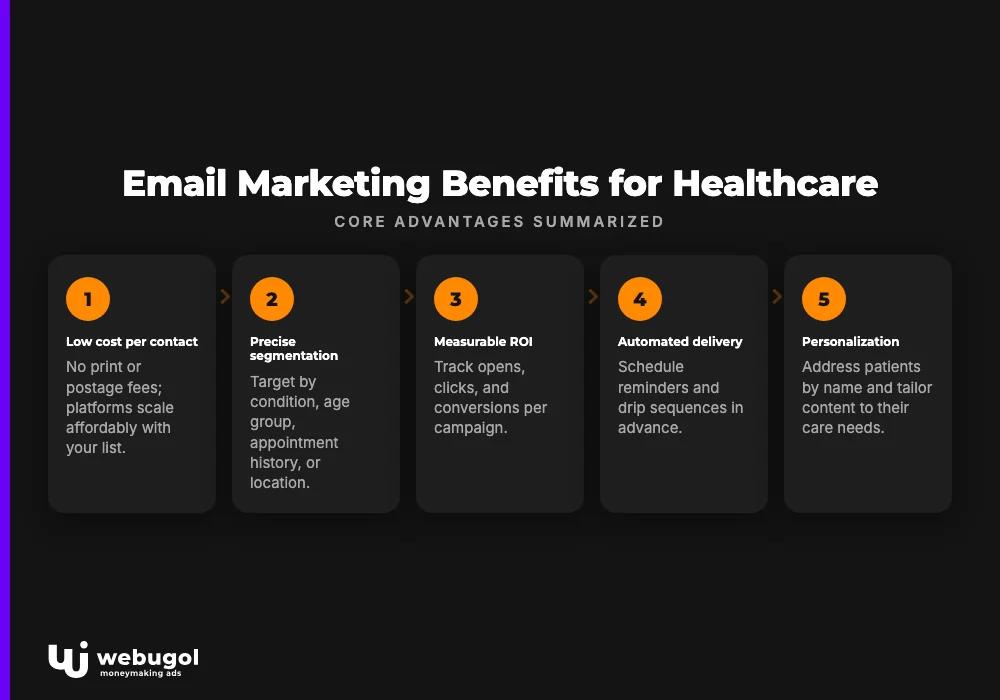
Email marketing for medical practices delivers a combination of low cost, high measurability, and precise targeting that most other channels cannot match. Here is a summary of the core advantages:
| Benefit | What it means for your practice |
|---|---|
| Low cost per contact | No print or postage fees; platforms scale affordably with your list |
| Precise segmentation | Target by condition, age group, appointment history, or location |
| Measurable ROI | Track opens, clicks, and conversions per campaign |
| Automated delivery | Schedule reminders and drip sequences in advance |
| Personalization | Address patients by name and tailor content to their care needs |
| Fast delivery | Reach your entire list within minutes |
Platforms like Mailchimp and Klaviyo make patient email campaigns straightforward to launch. The process is three steps: design a template, select your audience segment, and send. No HTML knowledge is required. Setup takes minutes. Built-in analytics then show open rates, click-through rates, and engagement patterns, giving you the data to improve every subsequent campaign.
A monthly medical email newsletter keeps your practice visible between appointments. It can cover seasonal health tips, new services, or preventive care reminders without a significant budget. The more relevant the content, the more patients look forward to receiving it.
How does email marketing improve patient retention?
Consistent, relevant communication reduces patient drop-off. Email gives practices a direct line to their audience, with no algorithm deciding who sees the message.
The most effective retention tool is drip campaigns for healthcare. A drip sequence can guide a new patient from their first appointment through follow-up reminders, annual checkup prompts, and condition-specific educational content. Each message arrives at the right point in the care journey. That timing is what makes well-structured drip sequences outperform isolated one-off broadcasts. Most practices miss this.
Personalization amplifies this effect. Using a patient's first name, referencing their care area, and sending from a real provider's email address rather than a no-reply address all lift engagement. Leaving the door open for replies lets patients ask questions, and those questions often convert into booked appointments.
Content that helps patients understand their conditions or prepare for procedures builds long-term loyalty. A practice that consistently delivers useful health information earns trust that keeps patients from drifting to competitors. For strategies on combining email with broader education goals, see how health content marketing builds patient trust and loyalty.
What is a good email open rate in healthcare?
Healthcare email lists tend to outperform many industries because they are built from real patient relationships rather than cold opt-ins. Patients who chose to receive communications from a provider they already know are far more likely to open those messages than subscribers on a generic marketing list. That gap is real.
The exact open rate for any practice depends on segmentation quality, subject line relevance, and send timing. Email marketing ROI statistics become more meaningful when you look beyond the open to what happens next: did the patient click a reminder link, book an appointment, or complete a form? Those conversions connect email activity to real practice revenue. For context on where healthcare sits relative to other industries, current email marketing performance data can help you set realistic benchmarks for your own campaigns.
Platforms like Mailchimp and Klaviyo report all of these metrics at the campaign level. Running a consistent send schedule gives you enough data points to identify which subject lines, content types, and send days work best for your specific patient base.
How to build a HIPAA-compliant email list?
Compliance starts with explicit opt-in consent. Patients should agree to receive marketing emails separately from any clinical communication consent. This protects the practice legally and produces a healthier list, since subscribers who opted in voluntarily are more likely to engage.
Email segmentation for clinics is the next priority. Dividing your list by specialty, care status, patient age, or visit frequency lets you send messages that feel relevant rather than generic. A pediatric vaccine reminder goes to parents, not your entire list. A chronic-condition management newsletter goes to that specific patient group. Better segmentation means higher open rates and fewer unsubscribes. Patients notice the difference.
Practical steps to get started:
- Collect consent at check-in or through your practice website using a double opt-in form.
- Store consent records securely within your email platform or CRM, not a general spreadsheet.
- Confirm that your email platform handles data in a HIPAA-compliant manner before uploading any patient information.
- Include a clear unsubscribe option in every message, as required by CAN-SPAM regulations.
What email marketing tools work best for medical practices?
Mailchimp and Klaviyo are two of the most widely used platforms for healthcare email marketing because they support segmentation, automation, and detailed reporting without requiring technical expertise. Both include template editors with real-time preview, so building a professional medical email newsletter takes minutes rather than hours.
For automation, drip campaigns for healthcare are straightforward to configure in either platform. You build the sequence once. Automation handles the rest. The platform then handles delivery whenever a patient meets the trigger, such as completing an intake form or missing a scheduled appointment.
The right tool depends on your practice size, existing patient management software, and budget. When your email platform integrates with your scheduling or EHR system, it eliminates manual data transfers and keeps your list current automatically. For a deeper look at structuring a full email program, see email strategy guidance for healthcare providers.
Start growing your practice with healthcare email marketing
Healthcare email marketing works best when strategy, platform, and execution align. Webugol's team helps medical practices build and manage email marketing campaigns that produce measurable results: more booked appointments, better patient retention, and clear ROI. To find out what is possible for your practice, call +1 647 490 6933 or contact us through our website.
FAQ
Does email marketing work for small medical practices?
Yes. Email marketing for medical practices scales to single-provider clinics with no significant upfront cost. Most platforms offer affordable plans based on list size, and even a modest monthly newsletter can meaningfully improve patient retention and appointment volume.
How often should a medical practice send emails?
Most practices send one to four emails per month. A monthly medical email newsletter is a reliable baseline; adding targeted appointment reminders and condition-specific patient email campaigns increases engagement without overwhelming your audience.
What types of emails perform best for patient communication?
Welcome emails, appointment reminders, and post-visit follow-ups generate high open rates because they are directly relevant to the patient's situation. A well-structured drip campaign for healthcare that sequences these touchpoints around the care journey outperforms isolated broadcast messages.
Is email marketing compliant with HIPAA?
Email marketing is not prohibited under HIPAA, but how you collect, store, and use patient data must meet HIPAA standards. Using a compliant platform, keeping marketing lists separate from clinical records, and securing explicit opt-in consent are the core requirements.
How do I measure the success of patient email campaigns?
Track open rates, click-through rates, and downstream conversions such as online bookings or form submissions. Most email platforms report these metrics per campaign. Comparing them over time shows whether your content, segmentation, and send frequency are improving or need adjustment.