



Google Ads for hotels: drive more direct bookings
Google ads for hotels are paid search campaigns that appear when travelers actively search for accommodation online. You pay only when someone clicks, not when the ad is shown. A well-structured hotel ad campaign connects your property with guests who are ready to book, bypassing OTA listing pages and putting reservation revenue back in your hands. It is also one of the fastest available channels to increase direct bookings without waiting months for organic search results.
What Google ads for hotels actually do
When a traveler types "hotels in [city]" or "boutique hotel near downtown," your hotel search ads can appear above organic results and map listings. You control who sees the ad, when they see it, and what it says. Every click is tracked. Every conversion is measurable.
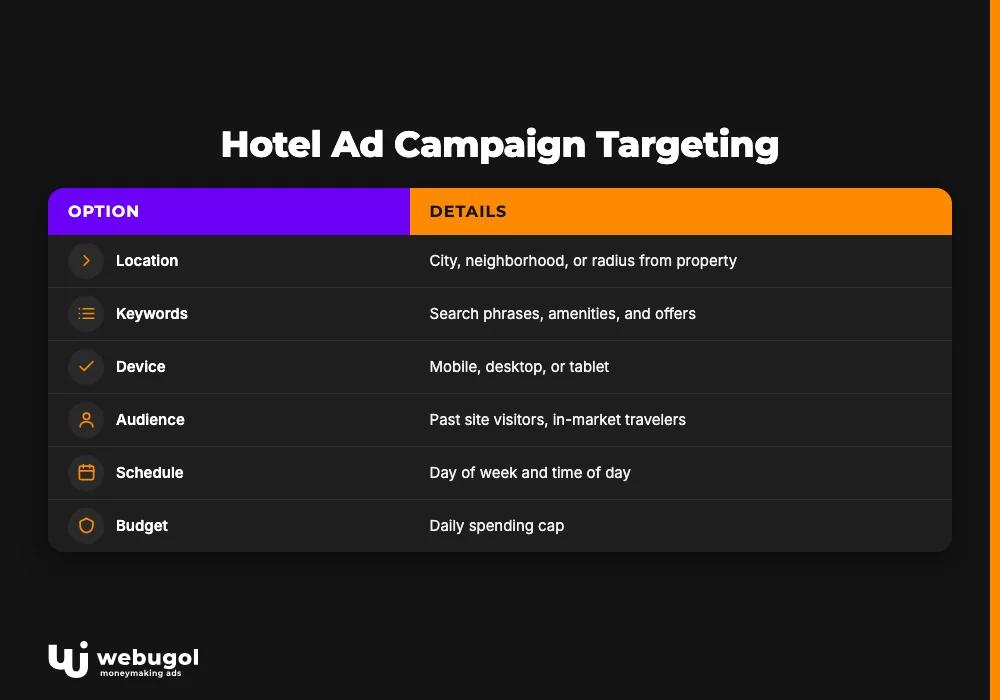
Here is what you can target within a hotel ad campaign:
| Targeting option | What it covers |
|---|---|
| Location | City, neighborhood, or radius from your property |
| Keywords | Search phrases travelers type, including amenities and offers |
| Device | Mobile, desktop, or tablet |
| Audience | Past site visitors and in-market travelers |
| Schedule | Day of week and time of day |
| Budget | Daily spending cap to protect your hotel marketing budget |
This control is what separates hotel ppc advertising from broad brand campaigns. You reach people in active search mode, not people scrolling without intent.
How do Google Hotel Ads work?
Google Hotel Ads show live room rates and availability directly in search results and on Google Maps. When a user searches for a hotel, Google pulls current pricing from your booking engine or channel manager and displays it alongside competitor rates. A click takes the traveler straight to your booking page, bypassing OTA listing pages entirely.
Standard hotel search ads work differently. They are text-based ads triggered by hotel-related keywords and do not require a live pricing feed. Both formats can run within the same account for full search coverage.
Hotel Ads specifically require a connected booking feed from a supported platform or channel manager. Standard Google Ads are available to any property immediately after account setup, with no feed required.
Should hotels use Google Ads or OTAs?
OTAs drive discovery. For travelers who have never heard of your property, that reach is real. But OTAs charge a commission on every booking they send, a cost that compounds across high-demand seasons.
Google ads for hotels run on a pay-per-click model. Your cost is fixed at the click level, not calculated as a percentage of revenue. When your landing page converts at a solid rate, the cost per direct booking is often lower than an equivalent OTA commission on the same stay.
The practical approach is to run both, with a strategy designed to shift bookings toward the direct channel over time. Use OTAs for broad exposure. Run hotel ppc advertising to intercept travelers when they search your property name or compare direct booking options. Understanding how branded search recaptures guests who already discovered your property makes this interception strategy concrete.
What is a good budget for hotel Google Ads?
There is no universal figure. Your hotel marketing budget depends on your market's average cost per click, your average booking value, and your landing page conversion rate.
The pay-per-click model gives you a firm daily cap you never exceed. Set it conservatively, collect data for 30 to 60 days, then move spend toward keywords and campaigns that produce actual bookings. Precision matters more than volume early on.
One practical principle: concentrate your hotel marketing budget during high-demand periods, peak season, local events, and holiday windows where intent is strongest and conversion rates are naturally higher. Pulling back in low-demand windows preserves budget for the moments when it earns the most.
How to set up a hotel ad campaign
Setting up a Google Ads account takes about 30 minutes. Building hotel search ads that consistently convert takes more thought. Here is the sequence:
1. Define your geographic targets. Choose the cities, regions, or radius around your property where guests typically originate. Source markets that drive high-value stays may warrant separate campaigns with adjusted bids.
2. Research keywords. Build a list around booking intent: "[city] hotel," "[neighborhood] accommodation," "hotel near [landmark]." Choosing the right search terms for your property's market is the foundation the rest of the campaign rests on. Add amenity modifiers like pet-friendly, pool, or free breakfast to reach travelers with specific requirements.
3. Set your hotel marketing budget and bids. Start with a daily cap you can sustain for 60 days. Once conversion data arrives, raise bids on keywords producing bookings and lower them on keywords producing only clicks.
4. Write ad copy with a specific offer. Lead with your strongest selling point. Include any direct-booking advantage: free cancellation, best rate guarantee, complimentary upgrade. Every ad needs a direct call to action.
5. Build a landing page for bookings. The page must load quickly, display your best available rate, and put the booking form above the fold. Guest reviews and rating scores on the page reduce hesitation and help visitors follow through on the reservation.
6. Configure conversion tracking before launch. Connect Google Ads to Google Analytics and define a conversion event for completed bookings. Without this data, you cannot distinguish keywords that produce revenue from keywords that only produce traffic.
How can hotels get more direct bookings online?
Google ads for hotels bring the right visitors to your site. What happens after the click determines whether they complete a reservation. Four factors consistently drive hotel direct bookings:
- Rate parity. If your direct rate is higher than what the OTA lists for the same room, most travelers will leave and book through the OTA regardless of how compelling your ad was. Your booking page must match or beat third-party rates.
- Direct-booking incentives. Offer something OTAs cannot provide: flexible cancellation, a welcome amenity, or a guaranteed room type. These advantages close bookings without requiring a lower rack rate.
- Remarketing campaigns. Most visitors do not complete a reservation on their first visit. Remarketing ads bring those same visitors back at a lower cost than acquiring fresh traffic. The barrier to booking is much lower the second time.
- Ongoing campaign refinement. Reviewing search term reports, pausing poor-performing keywords, and testing ad copy variations reduces cost per booking over time. A disciplined process for improving campaign performance month after month is what keeps hotel ppc advertising profitable as competitive pressure increases.
Hotels that combine targeted hotel search ads with a compelling direct-booking offer, active remarketing, and continuous optimization consistently outperform those relying on ads alone.
Run a hotel PPC campaign that converts
At Webugol we run Google Ads for hotels focused on hotel direct bookings, not traffic for its own sake. Our team handles targeting, ad copy, landing page review, and conversion tracking so your advertising spend is measured against actual booking revenue, not vanity metrics.
Contact us to build a hotel ad campaign tailored to your property's market, margins, and occupancy goals.
Frequently asked questions
What is the difference between Google Hotel Ads and standard keyword-targeted hotel ads?
Google Hotel Ads display live room rates and availability directly in Google search results and Maps, and require a connected pricing feed from your booking platform. Standard keyword-targeted hotel ads are text-based, triggered by hotel-related keywords, and available to any property without a pricing feed or additional technical setup.
How much do Google Ads cost for hotels?
Cost depends on your market's average cost per click and your booking page conversion rate. A daily spending cap protects your ad spend, so there are no unexpected overruns. Compare your actual cost per direct booking against your current OTA commission rate to judge whether the channel is profitable for your property.
Should small hotels invest in hotel PPC advertising?
Yes. The pay-per-click model lets a small independent property compete in specific keyword segments rather than bidding broadly against large chains. A tightly focused hotel ad campaign targeting your location and key amenities can produce hotel direct bookings profitably, even on a modest daily budget.
How long before hotel Google Ads produce results?
Clicks typically begin within hours of a campaign going live. Enough conversion data to make meaningful optimization decisions usually takes two to four weeks. Most hotel ppc advertising campaigns show a measurable return on investment within 60 to 90 days when conversion tracking is configured correctly from launch.