



Patient scheduling software: cut no-shows and lower your CPA
Patient scheduling software lets patients book, reschedule, and cancel appointments online without calling the front desk, and routes those bookings into your EHR, reminder workflows, and CRM automatically. For marketing teams, it is the conversion layer between ad spend and a confirmed appointment slot. Reduce one step of friction and your show rate moves. That shift changes your real cost per acquired patient faster than most marketing agency campaign optimizations will.
What is patient scheduling software?
Patient scheduling software automates online appointment booking, rescheduling, cancellation, and confirmation across web, phone, and portal channels. It syncs with EHR and EMR systems to prevent double-booking and gives patients 24/7 access to your calendar without front-desk involvement.
Most vendors position this as a staffing efficiency tool. That framing is incomplete. For a marketing team, every step a patient cannot complete independently at the moment they decide to book reduces conversion rate and raises cost per acquired patient. Choosing a medical practice scheduling platform should start with that conversion lens, not a headcount analysis.
How does scheduling software reduce no-show rates?
Every unconfirmed appointment is a marketing dollar that produced no revenue. A practice spending $120 per booked lead but showing only 65% of those patients pays $185 per seen patient. That gap between booked-lead CPA and seen-patient CPA is exactly where patient scheduling software either earns its cost or becomes a line item your healthcare marketing leadership questions.
The math is direct. Divide your cost per booked lead by your show rate to get true cost per seen patient. A 10-percentage-point improvement in show rate often produces a larger CPA reduction than the same budget redirected toward lowering CPL. Most practices are optimizing the wrong variable. Fix that first.
Calculating the cost of a no-show
A missed appointment carries two costs: the lifetime revenue per patient lost from that slot and the sunk marketing spend that produced the booking. The table below maps show rate to effective CPA at $100 per booked lead, so your team can calculate the real acquisition cost in under two minutes.
| Show rate | Effective CPA (per seen patient) |
|---|---|
| 60% | $167 |
| 70% | $143 |
| 80% | $125 |
| 90% | $111 |
At 60% show rate, you pay 67% more per seen patient than your booked-lead CPA implies. Practices running $15,000 to $50,000 in monthly ad spend typically report CPA at the booking stage, which understates the real acquisition cost by that margin.

What features does patient scheduling software need?
The features that reduce friction and protect attribution are not the ones vendors lead with in demos. For marketing-driven practices, five categories directly affect CPA, show rate, and marketing-stack performance in ways that go beyond front-desk efficiency.
Self-scheduling and 24/7 online access
Patient self-scheduling captures leads at the moment of intent, not 48 hours later when many have already called a competitor. Removing phone-only booking is a CPA fix, not a staffing decision. Key capabilities to verify before evaluating any platform:
- Mobile booking with real-time slot availability, so a patient arriving from a paid search ad can complete the booking in under two minutes on a fast WordPress website
- No-login-required flow that lets new patients book without creating an account, keeping friction at zero for top-of-funnel organic visitors
- Intake form embedded on the booking page to collect pre-screening data before the visit, so staff are prepared and the patient does not arrive with missing paperwork
- Multi-provider routing that matches patients to the right clinician based on appointment type and location
- Immediate confirmation by SMS and email that arrives before the patient closes the browser tab, anchoring the appointment while intent is high
Automated reminders and appointment confirmation system
Multi-touch appointment reminder software using SMS, email, and voice in a timed cadence reduces no-show rate by keeping the appointment visible in the days before the visit. Healthcare booking automation with branching logic escalates unconfirmed bookings rather than going silent, which is where most practices lose the most show-rate points.
A well-structured sequence confirms at booking, follows up 72 hours before the visit, sends a HIPAA-compliant text message 24 hours out, and delivers same-day instructions. If the patient has not confirmed by the 48-hour mark, the workflow should auto-escalate to a direct call or pull from a waitlist rather than holding an open slot. An unfilled slot is a revenue decision, not a scheduling one.
EHR scheduling integration
Direct EHR sync prevents double-booking, eliminates manual data entry that creates record errors, and keeps appointment data in a single system of record. For marketing teams, EHR scheduling integration also enables post-visit follow-up triggers that feed recall and retention campaigns without manual list exports.
When the scheduling system syncs at the EHR level, a no-show event can trigger a CRM re-engagement sequence within minutes of the missed appointment window. Clean integration also means conversion timestamps are reliable, which matters when you are matching a booked appointment back to the paid campaign that generated the click.
HIPAA-compliant tracking for marketing teams
Without HIPAA-compliant call and conversion tracking, booked appointments cannot be reliably attributed to specific campaigns. That makes your reported CPA an estimate. Standard pixel-based tracking creates both compliance exposure and a measurement gap when appointment data enters the booking flow.
For healthcare practices running Google Ads or Meta, compliant tracking sends server-side conversion events from your server rather than the patient's browser, avoiding transmission of protected health information through a third-party pixel. For the full analytics compliance picture, see how HIPAA shapes your conversion tracking setup. Attribution becomes auditable, not approximate.
CRM integration for pipeline visibility
When scheduling software syncs with your CRM, booked appointments become pipeline stages and no-shows automatically trigger re-engagement sequences rather than falling into a list someone checks monthly. For practices running HubSpot, GoHighLevel, or ActiveCampaign, this connection separates a scheduling tool from a revenue system.
The handoff from scheduling to CRM is where attribution breaks for most practices. A lead generated by a Google campaign books an appointment, the record lives in one system, the contact lives in another, and nobody can trace which campaign produced that patient at the revenue level. Getting your scheduling-to-CRM attribution right closes that gap before it distorts campaign decisions.
Patient scheduling software by practice type
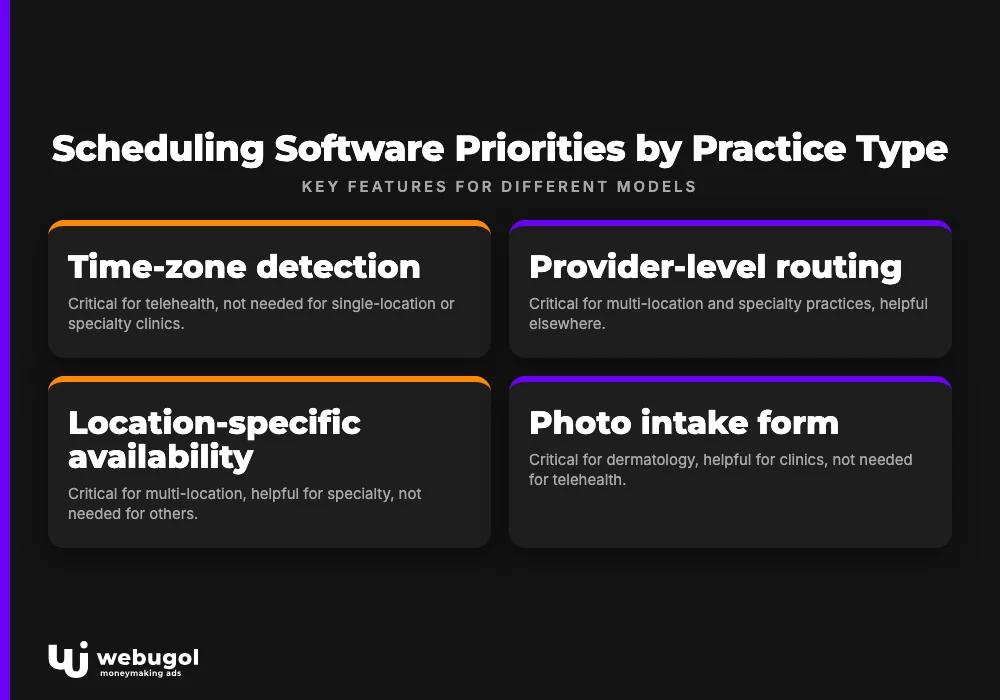
Scheduling requirements differ by care model, location structure, and patient flow. A tool built for multi-location urgent care handles telehealth intake poorly. A general clinic platform may not support the specialty-specific routing that dermatology, orthopedics, wellness center operators, or IV hydration businesses require. The table below maps critical feature priorities across four common configurations, covering practice segments most buyer guides ignore entirely.
| Feature | Telehealth | Single-location clinic | Multi-location | Specialty (derm/ortho) |
|---|---|---|---|---|
| Time-zone detection | Critical | Not needed | Varies | Not needed |
| Video-link on confirmation | Critical | Not needed | Not needed | Not needed |
| Provider-level routing | Helpful | Helpful | Critical | Critical |
| Location-specific availability | Not needed | Not needed | Critical | Helpful |
| Photo intake form | Not needed | Helpful | Helpful | Critical (derm) |
| Referral verification | Not needed | Helpful | Helpful | Critical (ortho) |
| Real-time slot caps/walk-in queue | Not needed | Helpful | Critical | Critical (urgent care) |
| Unified cross-location reporting | Not needed | Not needed | Critical | Helpful |
Telehealth scheduling software
Telehealth adds time-zone handling, video-link delivery, device-check prompts, and consent flows that HIPAA-compliant telehealth infrastructure must support natively, not treat as add-ons. Patients booking across time zones expect a confirmation showing their local time and a reminder that checks video platform HIPAA requirements and device readiness before the visit, not during it. The pre-visit experience determines whether the patient actually shows.
Clinic and multi-location scheduling
Multi-location practices need provider-level routing, location-specific availability calendars, and unified reporting across sites without requiring patients to figure out which location accepts their insurance. Booking experience inconsistency across locations shows up in campaign data as unexplained CPA variance by market. It is rarely diagnosed correctly.
A platform handling multi-location correctly keeps the patient-facing booking flow identical regardless of which location the patient selects, while giving operations location-specific dashboards behind the scenes. Consistent booking UX is a challenge that extends beyond the scheduling layer into your practice's broader online presence.
Specialty scheduling: dermatology, orthopedics, urgent care
Generic scheduling tools handle specialty intake poorly out of the box. Each specialty carries pre-screening requirements, slot durations, and routing logic that standard platforms need significant configuration to support:
- Dermatology practices need photo intake on the booking page for visual pre-screening, procedure-type routing that separates medical from cosmetic visits, and slot durations that vary by procedure complexity
- Orthopedic practices require HIPAA-compliant fax for referrals, imaging pre-authorization prompts, and the ability to hold slots pending document receipt before confirming the appointment
- Urgent care needs real-time slot caps, walk-in queue integration, and live wait-time visibility so online scheduling and walk-in demand do not create overscheduling conflicts
Is there free patient scheduling software for clinics?
Free and open-source options exist, but they carry a different cost structure than SaaS licensing. Two categories appear most often: open-source platforms that require developer configuration and freemium SaaS tools with feature or volume limits.
OpenEMR includes scheduling modules at no direct license cost. Cal.com provides an open-source foundation that developers can extend. Both shift HIPAA BAA responsibility onto the practice and require technical implementation that a SaaS vendor would otherwise own.
The real total cost includes:
- Developer setup and maintenance time that typically runs to days or weeks, depending on EHR integration requirements
- Self-hosted infrastructure costs covering servers, backups, and security patching, adding to total cost of ownership
- BAA configuration, which may require legal review if the vendor does not offer a standard agreement
- Support absence: open-source projects have community forums, not SLAs, so a scheduling outage on a Monday morning becomes your team's problem to diagnose
- Integration limits: connecting an open-source system to a commercial CRM or marketing stack typically requires custom development work
For a single-location practice with in-house technical resources, free patient scheduling software can be genuinely viable. The calculus shifts fast. For a practice without a dedicated developer, the operational risk outweighs the licensing savings within the first quarter of use.
How do I choose patient scheduling software?
A structured decision process for growing healthcare practices differs from standard IT procurement. Each step surfaces a question that affects CPA or attribution, not just operational fit.
- Map your current booking funnel and identify where drop-off occurs. Pull data on how many patients click your booking link, how many reach the confirmation page, and what percentage keep their appointment. Drop-off at each stage points to a different feature gap in your current setup.
- Verify HIPAA BAA availability and compliant tracking support. Ask the vendor directly whether they will sign a BAA and whether the platform supports server-side conversion events for Google and Meta. If they cannot answer both clearly, move on.
- Confirm CRM and marketing stack integration depth. A native integration with HubSpot, GoHighLevel, or ActiveCampaign is meaningfully different from a Zapier webhook. Confirm that booked appointments create or update pipeline records automatically, without manual mapping.
- Evaluate EHR sync and post-visit workflow triggers. The scheduling system should write appointment outcomes back to your EHR and trigger follow-up automations for no-shows and completed visits without manual steps. If that loop is not closed, retention campaigns require someone to do it by hand.
- Test patient-facing booking UX on mobile under real conditions. Use an incognito browser on a phone, start from your actual ad landing page, and complete the full booking flow. More than three minutes — often a sign of slow WordPress site performance — means patients are dropping off at that point.

What is the best patient scheduling software for small practices?
The best patient scheduling software for a small practice is the one that has native EHR integration, a vendor-signed BAA without a long negotiation, and a mobile-first booking flow that works without custom development. Product choice matters less than matching the platform to your practice's technical capacity and acquisition model.
For single-location clinics without a dedicated developer, subscription-based SaaS with per-location pricing is typically more predictable at lower volume than per-appointment models. The tradeoff is feature depth. Small-practice tiers often exclude server-side conversion tracking and advanced CRM sync. Both matter if you are running paid acquisition.
The clearest signal that a platform is right-sized: onboarding takes days, not months, and you can complete a full booking test without calling support.
Turn your booking flow into a revenue system
Most scheduling problems are funnel problems. If CPA is climbing and show rate is flat, the issue is rarely the ad creative. The more common cause is the handoff between ad click, booking confirmation, CRM record, and reminder sequence, each owned by a different system that has never been audited as a unit.
Client results from the 90-day patient growth sprint include a 38% CPA reduction (Ways2Well) and a 45% CAC reduction (Valhalla Vitality), both running functional medicine marketing programs. The sprint, run by Webugol, starts with a tracking and funnel audit that maps every handoff from ad click to confirmed appointment before any campaign changes are made. Request the patient funnel and attribution audit to see exactly where your booking spend is leaking.
FAQ
Does patient scheduling software need to be HIPAA-compliant?
Yes. Any software that stores, transmits, or processes protected health information, including appointment records, is subject to HIPAA, and the vendor must sign a Business Associate Agreement. Operating without a BAA creates compliance liability for the practice, not just the vendor.
What is the difference between patient self-scheduling and a patient portal?
Patient self-scheduling lets a new or existing patient book from any page, including a Google ad landing page, without creating an account first. A patient portal requires login to an existing account, which limits access to established patients and introduces friction that reduces top-of-funnel conversion. That friction is a direct CPA problem for any practice spending on patient acquisition.
How much does patient scheduling software typically cost?
SaaS platforms for patient scheduling typically range from $100 to $800 per month for a single-location practice, depending on feature depth, EHR integration complexity, and patient volume. Enterprise or multi-location systems are priced by contract and often bundled with broader intake or communications platforms. Pricing varies significantly based on whether EHR integration is native or requires middleware.
What is automated patient scheduling software?
Automated patient scheduling fills appointment slots and sends reminder sequences without manual staff action, using rules-based logic to route patients to the right provider, time slot, and location. Confirmations and follow-ups trigger automatically via SMS or email. The result is lower no-show rates and reduced front-desk workload at the same time.
Which patient scheduling software works best for telehealth practices?
Telehealth practices need scheduling software with built-in time-zone detection, video-link delivery on confirmation, and device-check prompts before the visit. Most clinic-first platforms treat these as afterthoughts rather than core functionality. Look for tools with native telehealth workflow support rather than a generic video conferencing integration added on top of a standard scheduling engine.