



How to build an MVP in 2026: the non-technical founder's playbook
To build an MVP in 2026, you need one decision before anything else: which build path fits your product scope. No-code tools, AI-assisted development, and custom code each produce a working product with real users in four to sixteen weeks, with costs starting at $3,000 and scaling past $40,000. This guide covers a proven six-week framework, real MVP development cost ranges, and the post-launch metrics that separate a working MVP from an expensive prototype.
What is an MVP and what it's not
An MVP (minimum viable product) is the smallest version of a product that tests one core market assumption with real users. It is not a demo, not a polished beta, and not a discounted version of the full vision. Founders who skip the MVP stage overbuild. They spend months on features nobody requested, then run out of runway before gathering any signal that guides the next decision.
The MVP's job is to answer one question cheaply enough that being wrong is recoverable. Instead of asking "what should the product have?" ask "what is the single assumption I need to test?" That reframe changes how you scope the build and what counts as success.
What is the difference between an MVP and a prototype?
The MVP vs prototype distinction shapes every early product decision. A prototype tests design assumptions with an internal team and produces a clickable mockup. An MVP tests market demand with real users who can pay and produces a deployable product. One generates design opinions. The other generates behavioral data, which is what drives the next investment decision.
A proof of concept (PoC) sits in a third category: it tests whether a technical approach is feasible before it becomes a user-facing product. Three distinct questions, three distinct outputs, three different moments in the product timeline.
| MVP | Prototype | PoC | |
|---|---|---|---|
| Purpose | Test market demand | Test design assumptions | Test technical feasibility |
| Primary audience | Real end users | Internal team / UX researchers | Engineering team |
| Output | Deployable product | Clickable mockup | Working code snippet |
| Typical cost | $3,000–$40,000+ | $500–$3,000 | $2,000–$8,000 |
Teams that launch a prototype and call it an MVP have tested preference, not demand. Getting this distinction right before any vendor conversation starts saves weeks and thousands of dollars.
How much does it cost to build an MVP?
MVP development cost ranges from $3,000 to $5,000 for no-code and AI-assisted builds, and from $15,000 to $40,000 or more for custom development. The gap comes entirely from feature scope and build path. Founders who commit to a custom build before validating the market pay a significant premium to solve the wrong problem.
The table below maps all three paths to budget and timeline.
| Build path | Typical cost | Timeline | Best for | Example tools |
|---|---|---|---|---|
| No-code | $3,000–$5,000 | 4–6 weeks | Workflows, marketplaces, booking tools | Bubble, Webflow, WeWeb |
| AI-assisted | $3,000–$8,000 | 4–6 weeks | Content tools, data-light apps, internal tools | Cursor + frameworks, Lovable |
| Custom development | $15,000–$40,000+ | 8–16 weeks | Proprietary logic, regulated industries, complex integrations | React/Node, custom APIs |
No-code and AI-assisted builds: the $3–8k range explained
No-code MVP tools like Bubble, WeWeb, and Webflow deliver a functional MVP in four to six weeks without building server infrastructure from scratch. AI-assisted development using tools like Cursor compresses that timeframe further for content-heavy or data-light products. Both cost significantly less than custom development because they reuse infrastructure that already exists.
Four cost drivers operate in this range. The number of distinct user roles matters first. Required integrations come next: each one adds specification and testing time. Whether the design uses a template or needs custom UI affects both cost and timeline.
The final driver is whether clear requirements arrive at kickoff or require a discovery phase first. That last variable alone can add two weeks and several thousand dollars.
The ceiling is real. Products that require a proprietary algorithm, more than three non-standard third-party integrations, or regulated data handling will hit that ceiling before reaching production scale. Healthcare applications are a clear example: HIPAA-compliant data architecture requires backend ownership that no-code platforms cannot provide. If you are building in a regulated vertical, the technical scoping process looks different from day one.
Custom development: when budget starts at $15k
Custom development becomes rational when three conditions align. The product requires proprietary backend logic. The integration list includes non-standard APIs without no-code connectors. Or the data architecture must be owned and auditable from production day one.
Three cost drivers control the estimate. Team composition matters first: a solo contractor versus a three-person team changes both cost and speed. Integration count follows: each non-standard API adds specification and testing time that compounds across the build. Backend complexity is third: a real-time data processing requirement is categorically different from a standard CRUD application.
Founders who receive a $30,000 estimate for a simple booking tool have typically included full-product roadmap features in the MVP scope. Remove them and the estimate changes accordingly.

How long does it take to build an MVP?
A no-code or AI-assisted MVP takes four to six weeks from kickoff to first live user. A custom build runs eight to sixteen weeks depending on scope and team availability. That gap exists because custom development must construct the infrastructure no-code platforms already provide.
The timeline question matters more than most founders expect. A four-week miss on a no-code MVP costs a fraction of what a four-week miss on a custom build costs. Getting the estimate right at scoping is as important as getting the budget right.
What drives the difference: 4-week sprint vs 3-month build
Three variables determine whether an MVP ships in a month or a quarter.
Scope clarity before kickoff. A founder who arrives with a documented problem statement, defined user roles, and a prioritized feature list cuts two to four weeks off any build. Ambiguity is billed as discovery time at every stage.
Integration count. Each third-party integration introduces a dependency requiring specification, testing, and error handling. One integration is manageable. Five is a parallel project running inside the main build.
Feedback cycle speed. Founders who review and approve milestones within 24 hours consistently ship ahead of those who take a week per round. This variable is entirely within the founder's control and costs nothing to improve.
The decision test is practical: write one sentence naming the problem, the user, and the single action your MVP enables. Clean and specific means a four-to-six-week no-code build is realistic. Multiple clauses and edge cases point to a twelve-week custom build instead.
How to build an MVP: minimum viable product steps for non-technical founders
The six-week framework maps five minimum viable product steps to a sprint schedule: problem validation (Week 1), feature prioritization (Weeks 1–2), build path selection (Week 2), build and ship (Weeks 3–5), and first-user measurement (Week 6). The steps are sequential for a reason. Each output feeds the next. Skip one and the later steps compound the error at increasing cost.
This is the approach non-technical founders use to build an MVP for startups without turning a four-week project into a four-month one. The non-technical founder's product succeeds when the validation loop stays lean and the feature scope matches the core assumption.
Step 1: lock the problem, not the feature list (Week 1)
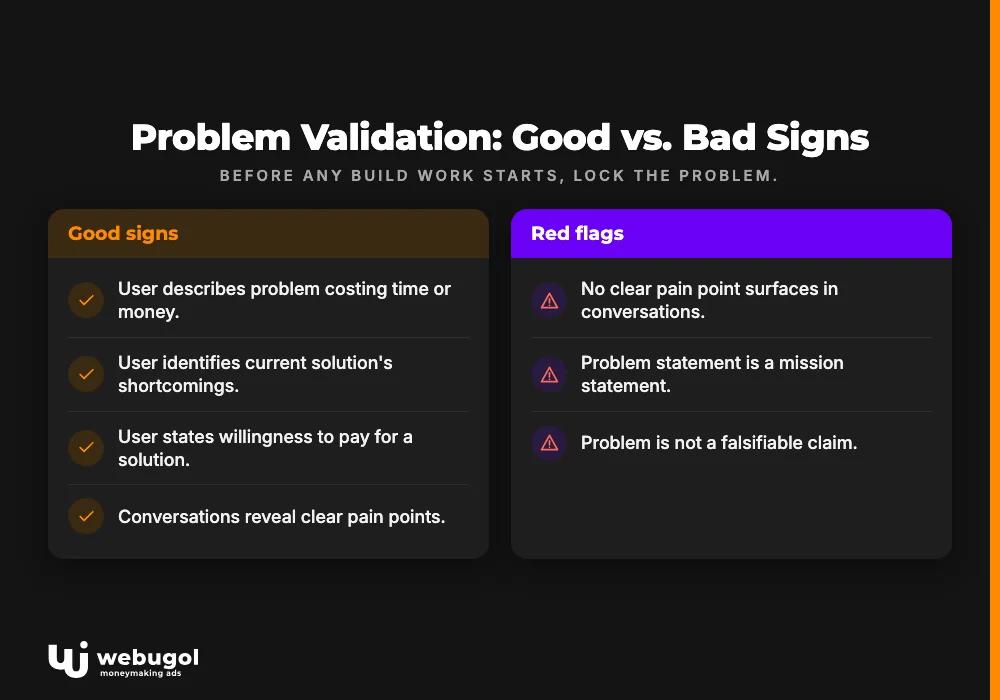
Before any build work starts, you need one sentence: the problem, the person who has it, and why existing solutions fall short. Not a mission statement. A falsifiable claim that your first ten user conversations will either confirm or destroy.
Three validation questions that produce real signal:
- "Can you describe the last time this problem cost you time or money?"
- "What are you using now to solve it, and what does that solution fail to do?"
- "If a tool solved this problem completely, what would you pay for it monthly?"
Five interview prompts that consistently reveal whether a real problem exists:
- "Walk me through the last time this problem came up."
- "What did you do to solve it?"
- "What would you have paid for a better solution at that moment?"
- "Who else in your organization has this problem?"
- "What would need to be true for you to switch to a new tool today?"
Conversations that surface no clear pain point are data. They tell you to refine the problem before spending money on the build. That outcome is as useful as a confirmed hypothesis.
Step 2: prioritize with a must-have vs nice-to-have checklist (Weeks 1–2)
Feature creep kills more MVPs than bad code. The fix is a two-column exercise run before the build starts, not during it.
For each proposed feature, ask two questions: does the MVP fail without this, and is this testable in the first-user cohort? Both yes means must-have. Everything else goes on a post-launch backlog.
| Feature | Decision | Criterion |
|---|---|---|
| Core workflow | Must-have | Without it, the MVP tests nothing |
| User registration | Must-have | Without it, no user data exists |
| Payment processing | Conditional | Must-have only if willingness-to-pay is the assumption being tested |
| Email notifications | Nice-to-have | Manual follow-up works at MVP scale |
| Admin dashboard | Nice-to-have | Founder can query the database directly |
| Mobile app | Usually nice-to-have | Web is sufficient to test most concepts |
| Multi-language support | Nice-to-have | Start with one market |
| Advanced analytics | Nice-to-have | Basic event tracking covers the MVP phase |
| Social login | Nice-to-have | Email/password is sufficient for an MVP |
| Onboarding tour | Nice-to-have | Founder can onboard the first users manually |
Exit Week 2 with a feature list short enough to build in three weeks. If the must-have column has more than five items, remove the weakest two and revisit. The goal is to build an MVP that tests one assumption cleanly, not to ship an incomplete version of the full product vision. Shorter lists ship faster and validate cleaner.
Step 3: choose your build path (Week 2)
The build path decision locks in budget, timeline, and what can actually be tested. Make it before engaging any vendor. Changing paths mid-build is expensive in every direction.
Three decision rules, one per path:
- Choose no-code if your feature list has no proprietary backend logic and all required integrations have native connectors in Bubble, Webflow, or WeWeb.
- Choose AI-assisted development if the UI is the primary product surface, the data is not sensitive, and the shortest delivery path matters more than long-term code ownership.
- Choose custom development if the product requires an algorithm you own, integrations that do not exist in no-code ecosystems, or a data architecture built for compliance from day one.
The same logic applies whether you are figuring out how to build an MVP app for mobile, a web-based SaaS tool, or an internal operations platform. The feature list drives the path. Not vendor recommendations, not assumptions about what serious development looks like.
Our MVP development services include a build path recommendation within 48 hours of scoping, paired with the growth strategy the product needs to validate with real users.
Step 4: build, ship, and watch real users (Weeks 3–5)
Shipping opens the feedback loop that makes the entire build worth running. Before the product goes live, this checklist must be complete:
- Instrument analytics on the core workflow, not just page views.
- Activate error logging before launch day, not after the first complaint.
- Open a feedback channel before go-live: a form, a Slack community, or a direct email address.
- Have someone outside the build team test the core workflow end-to-end.
- Configure DNS and transactional email on a real domain.
- Publish the privacy policy and terms of service before launch.
- Confirm and brief at least five beta users before go-live.
Launches that read cleanly in week one share a pattern: activation and early retention were defined as numbers before go-live, so the first cohort produces a verdict instead of a feeling.
One metric to check in the first 48 hours post-launch: did at least one user complete the core workflow without assistance? A yes means the product functions as designed. A no points to an onboarding problem, not a code problem. That diagnosis saves weeks of unnecessary re-architecture.
Step 5: measure before you scale (Week 6)
No pivot or scale decision should be made without data from the first real-user cohort. Five metrics form the MVP scorecard:
- Activation rate: percentage of new users who complete the core workflow in their first session. Above 40% means onboarding is working.
- D7 retention: percentage of activated users who return within seven days. Below 20% means the product is not yet solving the problem consistently enough to generate habit.
- Willingness to pay: at least one user has paid, committed to pay, or explicitly named a price they would pay. Without this, you have a product people use, not a business.
- Time-to-value: how long a new user takes to reach the moment the product delivers its promise. Shorter is almost always better, and the number is measurable from launch week one.
- Qualitative NPS: ask ten users how disappointed they would be if this product disappeared. More than 40% responding "very disappointed" is the early PMF signal benchmark established by Sean Ellis in his startup growth research, used by early teams at Dropbox and Airbnb.
What metrics show an MVP is working?
An MVP is working when activation rate exceeds 40%, at least 30% of users return within seven days, and at least one user has paid or committed to pay. All three together separate early signal from encouraging noise. Founders who know how to build an MVP understand that these MVP launch metrics must be instrumented before launch, not retrofitted after the first cohort exits.
Full KPI checklist with benchmark targets:
- Activation rate: target 40% or higher. Below 20% means onboarding needs a redesign before any other variable is changed.
- D7 retention: target 30% or higher. A drop below 20% in the first week usually indicates the product does not solve the problem on a recurring basis, not that the marketing channel is wrong.
- Conversion rate (free to paid, if applicable): target 5–10% for a B2B tool. A rate below 2% typically signals a value proposition or pricing problem, not a product quality problem.
- Support ticket volume: high volume in the first two weeks is a UX problem, not a support problem. Fix the friction before adding support capacity.
- Qualitative NPS: the 40% "very disappointed" threshold is the most reliable early PMF signal available before a statistically significant sample exists, per Sean Ellis's startup growth research.
Founders who scale too early almost always cite strong activation numbers as justification. Activation tells you the product works. Retention tells you it solves something people return for. Both are required before scaling makes financial sense.
5 MVP mistakes that waste your budget
Knowing how to build an MVP correctly means recognizing the five patterns that most reliably consume budget without producing usable signal. Each has a direct fix. None require more money to address.
Building features instead of testing assumptions. Every feature in the must-have list should map to a named assumption the product tests. Founders who build without labeling the assumption are producing output without a measurement plan. Fix: write the assumption next to each feature before the build brief is finalized.
Skipping user interviews before the build. Five conversations with real potential users before the first line of code is written prevent more rework than five weeks of QA after launch. There is no substitute for direct problem discovery. Fix: run ten user interviews in Week 1, before any scope decision is made.
Choosing the wrong build path for the actual scope. Founders who default to custom development because it feels more serious spend three to five times more and receive the same market signal a no-code build would have produced. The build path is a business decision, not a quality signal. Fix: let the feature list determine the path.
Launching to the wrong audience segment. Shipping to friends, colleagues, or anyone who gives positive feedback without real purchase intent produces false signal. Real users have the problem, are actively looking for a solution, and can pay. Fix: recruit beta users through communities where the target audience already gathers, not personal networks.
Treating go-live as the endpoint. Launch is day one of the experiment. Founders who stop gathering active feedback after the first week are running a construction project, not a product test. Fix: block time every week in the first month post-launch for user interviews and metric review.

When should you turn your MVP into a full product?
An MVP is ready to graduate when it has paying users, a repeatable activation path, and a feature backlog the current stack cannot support. All three conditions need to be present. Scaling before paying users exist means investing in an unvalidated business model.
Three signals that your MVP has outgrown its current stack:
- The no-code platform is blocking integrations your existing users are requesting.
- The data architecture cannot support the volume of users you are already onboarding.
- Compliance, security, or uptime requirements exceed what the current toolchain can guarantee.
An MVP tests the core assumption. A minimum marketable product (MMP) adds the retention and monetization loops that turn early users into repeatable revenue. A full product then adds the scale and integrations needed to serve a larger market.
Most founders move from MVP to MMP before they need a full rebuild. Attempting a full rebuild before MMP is proven is the most expensive mistake in this progression. The behavioral data and user signal from the MVP phase must be preserved through that transition, which requires development and growth strategy to operate as one system from the first architecture decision.
For founders building SaaS products who have reached the no-code ceiling, SaaS MVP development built on that combined model is how validated products scale rather than stall.
Ready to build your MVP? Start with a scoping call.
Whether you are starting from a validated idea or have already hit the ceiling of a no-code tool, Webugol pairs MVP development with the growth strategy to validate the product with real users. Development and marketing work as one system from the first scoping call, not as two separate projects handed off between teams. Request a build path assessment and receive a recommendation within 48 hours, with no commitment required.
FAQ
How much does it cost to build an MVP?
MVP development cost ranges from $3,000 to $5,000 for no-code and AI-assisted builds, and from $15,000 to $40,000 or more for custom development. The main cost driver is feature scope and build path. Founders who validate the problem first and build custom second consistently spend less than those who start with full custom development.
How long does it take to build an MVP?
A no-code or AI-assisted MVP takes four to six weeks from kickoff to first live user. Custom builds run eight to sixteen weeks depending on scope and team availability. The biggest timeline driver is how clearly the problem and feature scope are defined before the build starts.
What is the difference between an MVP and a prototype?
A prototype tests design assumptions with a small group and produces a clickable mockup. An MVP tests market demand with real users who can pay and produces a deployable product. The key difference is feedback type: a prototype generates design opinions, an MVP generates behavioral data.
When should you turn your MVP into a full product?
Three signals indicate readiness: paying users exist, a repeatable activation path is confirmed, and a feature backlog has emerged that the current stack cannot fulfill. Scaling before all three are present means investing resources in a product that has not yet proven it solves the right problem consistently.
What metrics show an MVP is working?
An MVP is working when activation rate exceeds 40%, D7 retention is above 30%, and at least one user has paid or committed to pay. These MVP launch metrics must be instrumented before launch. Strong activation without retention means the product works once but does not solve a recurring problem.

