



Minimum viable product examples: 12 real launches and what each one validated
Minimum viable product examples share one discipline: each founder named a specific assumption, built the smallest version that could test it, and set the pass threshold before launch. Amazon tested whether people would buy books from a stranger online. Airbnb tested whether strangers would pay to sleep in someone else's home. Dropbox tested whether a three-minute demo video could fill a waitlist for software that barely existed.
Understanding what each team actually validated helps you scope your own first version instead of overbuilding before the market weighs in. Each founder treated the MVP as a question, not a deliverable. Webugol works with founders on exactly this discipline: building the product and connecting it to the SEO and marketing infrastructure that turns a validated answer into a scalable acquisition channel.
What is a minimum viable product?
An MVP is a working product stripped to one testable core. Not a wireframe. Not a beta. Not a full launch. "Minimum" means the smallest version that produces a real behavioral signal from real users, not the lowest-quality product you can ship.
Every minimum viable product example in this article satisfies that standard. A real user touched a real thing, generated data, and either confirmed or challenged a specific business assumption. That distinction matters more than the technology used or the time it took to build.
What is the difference between an MVP and a prototype?
A prototype tests a design. Users interact with mockups to validate visual decisions, but no real behavioral data is produced. A beta tests a finished product at scale before a public launch. An MVP sits between them: a working product that tests a specific business assumption and generates measurable behavior from real users.
The mvp vs prototype distinction determines what you build and how much you spend. A prototype answers "does this flow make sense?" An MVP answers "will people pay for this, use it weekly, or tell a colleague about it?" Treating an MVP like a beta leads to overbuilding before any validation. Treating it like a prototype leaves you with zero real behavioral signal and no path to a decision.
7 MVP types: which format fits your assumption
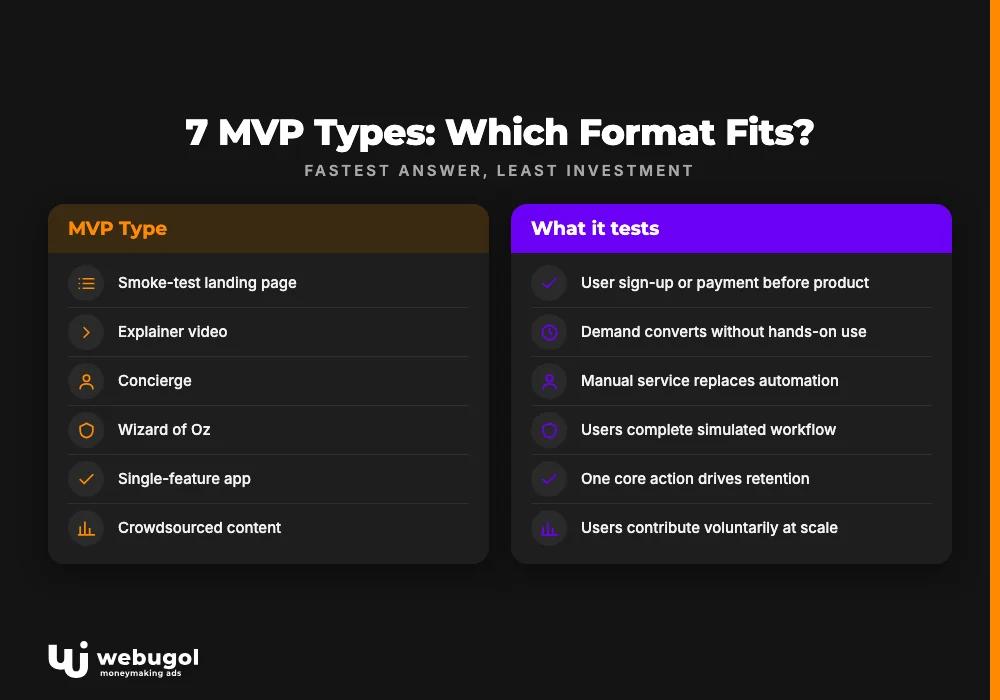
The mvp development process almost always starts with the same question: which format gives the fastest answer with the least upfront investment? Founders asking how to build an MVP without prior experience often pick the wrong format before they even get to the product. Here is a map of the seven most common types, what each tests, and where each works best.
| MVP type | What it tests | Real example | Best for |
|---|---|---|---|
| Smoke-test landing page | Whether users sign up or pay before a product exists | Buffer (pricing page) | Pre-validation of demand |
| Explainer video | Whether demand converts without hands-on use | Dropbox (screencast) | Products hard to demo live |
| Concierge | Whether a manual service replaces what the product will automate | DoorDash (phone orders) | Marketplaces and service products |
| Wizard of Oz | Whether users complete a workflow the software simulates | Zappos (manual retail) | E-commerce and workflow products |
| Single-feature app | Whether one core action drives retention | Slack (group messaging) | SaaS tools with a clear primary action |
| Crowdsourced content | Whether users contribute voluntarily at scale | Duolingo (real translations) | Content platforms and communities |
| No-code/AI prototype | Whether a workflow completes without custom code | Glide/Claude intake tool | Non-technical founders testing feasibility |
Choosing the wrong type adds weeks of build time without adding any learning. Each minimum viable product example in the section below maps to one of these seven categories. Comparing minimum viable product examples within each type before you commit is the fastest way to confirm format fit.
Smoke-test landing page
Build a page that describes the product and includes a sign-up or payment button. When a user clicks, you capture real intent before writing a line of code. Fast to build. Cheap to run.
It works best when the value proposition fits in two sentences and no hands-on experience is needed to evaluate it. It fails when users genuinely need to touch the product to form an opinion. If the decision requires direct interaction, inflated click rates will not convert to real use. Buffer's pricing experiment is the clearest real-world application: two pages, no working product, real demand signal.
Explainer video
Record a demo of the product as it should work, even if the backend is incomplete or simulated. The metric is sign-up rate and waitlist conversion, not technical polish or feature coverage.
This format works best when the product introduces a behavior users have not seen before and curiosity alone drives signup intent. It fails when the purchase decision requires hands-on testing or carries personal financial risk. Dropbox is the canonical example.
Concierge MVP
A human manually delivers what the product will eventually automate. The user receives a real outcome without knowing how it is produced. This format tests both the value proposition and the operational model at the same time.
It works best for marketplace products where both sides of a transaction need validation before investing in automation. It fails when the core value is real-time speed or when the automation itself is the product.
Wizard of Oz MVP
The product looks like software, but a human operates the backend in real time. Users believe they are interacting with a real system, which means the behavioral data they generate is authentic.
It works best when the interface needs to feel complete but the fulfillment logic is still unproven. It fails at scale, intentionally: that failure boundary tells you exactly what to build next.
Single-feature app
Build exactly one core action and strip everything else. Retention data then answers whether that single action is strong enough to anchor a full product roadmap.
It works best for SaaS tools where one recurring interaction drives daily use and users self-select based on that behavior. It fails when the core value proposition requires several capabilities to feel coherent to a first-time user. For teams building in this category, SaaS MVP development follows exactly this principle: validate one action before expanding the roadmap.
Crowdsourced-content MVP
Let users generate the content as part of using the product. Session data and return rate reveal whether users will come back without external incentives.
It works best for content or community products where user contribution is the central mechanism of value. It fails when contribution quality requires specialist knowledge most casual users cannot provide consistently.
No-code/AI prototype
Use tools like Glide, Bubble, or Claude-based automations to build a working workflow without a custom codebase. This is the format most relevant to a non-technical founder in 2026. The test is whether users complete the workflow without a human guiding them.
It works best when the assumption is about workflow fit and user experience, not security, compliance, or transaction volume. It fails when integrations or data privacy requirements demand a production-grade codebase to function at all.
12 famous minimum viable product examples: what each team built and learned
These minimum viable product examples span e-commerce, communications, logistics, and language learning. Each follows the same structure: what the team shipped, what hypothesis they were testing, and what the first signal was that the test had an answer.
Amazon: one category, manual orders
Jeff Bezos built a basic website and listed books he did not own. When an order arrived, he drove to a local bookstore, bought the book, and mailed it himself. The assumption: people will buy books from a stranger online without seeing the product in person.
Orders came in. Customers received their books. That behavioral signal was enough to justify building real inventory infrastructure.
Airbnb: air mattresses in an apartment
Brian Chesky and Joe Gebbia photographed their San Francisco apartment and posted it online to cover rent during a design conference. No platform, no payment processor, no support system. Just a simple page and direct email threads. The assumption: strangers will pay to sleep in someone else's home.
Three guests booked in the first week. The founders had not hired a developer. The signal was immediate and clear.
Dropbox: a three-minute explainer video
Drew Houston recorded a screencast showing how Dropbox would work. The product existed in an early rough state, but the video showed the complete intended experience. The assumption: would people join a waitlist based on a demo video alone.
According to Houston's public account of the launch, the waitlist grew from roughly 5,000 to 75,000 signups overnight after the video was shared on Hacker News. No production codebase was required to generate that signal. The video validated product direction before a real backend existed.
Uber: SMS dispatch in San Francisco
The first Uber was not an app. A driver received a text message when someone requested a ride. No surge pricing, no map interface, no in-app ratings. The assumption: would people pay a premium to summon a car on demand.
People did, even with the primitive interface. That behavioral data justified building the full mobile application.
Groupon: a WordPress blog with PDFs
The Groupon team emailed a daily PDF coupon for local Chicago businesses and tracked redemptions by hand. The assumption: would local businesses pay for guaranteed customer volume in exchange for a discount.
The business model validated at near-zero cost. The entire technology infrastructure came after that proof, not before it.
Slack: an internal tool nobody built for sale
Slack was not designed as a product. It grew out of the internal messaging tool built for a failed game studio called Glitch. The team used it throughout that project with no intention of selling it. The assumption: would a small team actually use persistent group chat instead of email.
Internal retention answered the question. When the game project folded, the communication tool had more consistent usage than the product it was built to support.
Zappos: photos of shoes from local stores
Nick Swinmurn photographed shoes at physical retailers without buying any inventory. When a customer ordered online, he bought the shoes at retail and shipped them at a financial loss. The assumption: would people buy shoes without trying them on first.
Conversion rate confirmed the demand. The negative unit economics were deliberate. Swinmurn was purchasing behavioral data, not chasing margin.
Buffer: a two-page landing page
Joel Gascoigne built two pages: a product description and a pricing-tier selection screen. No scheduling feature existed. Clicking a pricing tier took the user to a page stating the product was coming. The assumption: would people pay specifically for scheduled social media posting.
The click-through rate on paid tiers validated both demand and price sensitivity before a single feature was built.
DoorDash: a static website and a PDF menu
The DoorDash founders built a one-page site with scanned menus from Palo Alto restaurants. Orders came in by phone. The founders delivered the food themselves. The assumption: would suburban restaurant owners pay for delivery infrastructure they could not staff themselves.
The manual loop provided marketplace data from both sides. Restaurants agreed. Customers placed orders. The app came after that double-sided validation, not before it.
Duolingo: crowdsourced human translations
Early Duolingo had language learners translate real web content as their exercises. Learners got real-world practice; the platform collected translations it could license to publishers. The assumption: would users engage consistently enough to produce genuinely useful translations without added incentives.
Session length and daily return rate were the signals. The crowdsourcing model was later discontinued as the product evolved, but the engagement data shaped the entire product roadmap that followed.
Spotify: desktop-only, Europe-only launch
Spotify launched invite-only in six European countries with no mobile app and restricted access for new users. The assumption: would users accept a paid legal streaming model over piracy in markets where piracy had become the default behavior.
Conversion rates from invite recipients to paying subscribers answered that question. Keeping the geographic and platform scope deliberately narrow produced cleaner data than a broad public launch would have.
An AI-native MVP: no code, no team required
The newest minimum viable product pattern needs neither code nor a team. Workflow logic assembled in Claude and an interface built in Glide can take a client-intake tool from idea to testable over a single weekend. The assumption: will target users complete the full intake workflow without a human guiding them.
Put the tool in front of the first handful of real clients under real working conditions and measure one number: task-completion rate without assistance. If they finish unassisted, the assumption holds. This pattern matters most for a business owner asking whether to hire a development team before validating a core workflow. In many cases, you no longer need to.
What these minimum viable product examples have in common
Across all twelve cases, the scope decision came first. Each team defined the smallest behavioral signal that could answer their assumption, then built the minimum format needed to generate it. The technology was secondary to that discipline.
How do you know if your MVP is successful?
An MVP passes when a pre-defined signal crosses a threshold you set before launch, not after. The founders behind these minimum viable product examples did not evaluate success in hindsight. They named the question before building, then let real user behavior answer it.
That is the core discipline of lean startup methodology: the build-measure-learn loop only produces useful data when you define what "learn" means before you build. Here is a practical startup product validation checklist drawn from the patterns above.
- Activation rate: Track what percentage of new users complete the core action on their first session. A rate below your pre-set threshold signals that the onboarding or the assumption itself needs revisiting.
- Day-7 retention: Measure how many users return one week after first use. Early Slack had near-total team retention from day one; Buffer measured how many users came back to actually schedule a post after signing up.
- Qualitative interview count: Talk to at least five users who completed the core action. What they say about the problem, not about the product, is the signal you need.
- Willingness-to-pay signal: Check whether users took an action that cost them something, whether money, time, or social trust. Bezos collected payment. Houston collected an email address. Both are real behavioral signals.
- NPS proxy: Ask one question after the first meaningful use: "How likely are you to recommend this to a colleague?" A score above seven from even a small sample is meaningful; below five means the core assumption needs work before further investment.
- Funnel drop-off point: Identify where users abandon the flow. The drop-off location names the specific assumption that failed, not just the feature that underperformed.
Pick the two MVP success metrics that map most directly to your core assumption. Measuring all six at once spreads focus without adding decision-making precision.

Can a non-technical founder build an MVP without a development team?
Yes, for many assumption types. If the assumption to test does not require custom security logic, complex third-party integrations, or high transaction volume, you can validate it without writing code.
No-code tools like Glide and Bubble handle data, user flows, and basic authentication. Claude and similar AI tools can automate logic, draft copy, and connect simple backend processes without a developer in the loop. The AI-native intake tool example above demonstrates both what falls within that ceiling and where the ceiling actually sits.
The ceiling arrives at a predictable point. When you need integrations that no-code platforms do not support natively, when user data carries compliance requirements, or when transaction volume starts to expose platform performance limits, the question shifts. It stops being whether the assumption is valid. It becomes how to rebuild on infrastructure that can scale past the validation stage.
That handoff is exactly what Webugol's MVP development services is designed for: building both the production codebase and the SEO and marketing infrastructure needed to turn a validated product into a scalable customer channel.
What happens after you launch an MVP?
Once an MVP validates, a founder faces three decisions: iterate on the same MVP, rebuild on a production stack, or pivot the core assumption entirely. This is where most minimum viable product success stories stop being told, and where the real work of building a business begins.
Iterate when the core assumption validated but the user experience still has obvious gaps. Keep the same codebase or no-code platform, add the next most important capability, and re-measure the same signal with the new feature in place. Slack iterated on their internal messaging tool for months before making the decision to rebuild it as a commercial product.
Rebuild when the MVP validated but the platform can no longer support what the validated product requires. Moving from a Glide app or a manual concierge operation to a production codebase involves API architecture, database design, authentication systems, and deployment infrastructure. None of that carries over from the MVP build. The rebuild is not evidence of a problem. It is what successful validation looks like when you follow through on it.
Pivot when the signal is clear but negative. The assumption failed. The question then is whether a related assumption is worth testing, using the same minimal build discipline with a different core action or a different target user segment.
Most business owners underestimate the rebuild and treat it as a purely technical exercise. It is a product decision. What gets rebuilt, in what order, and on what infrastructure should follow directly from what the MVP actually proved, not from what it happened to be built on.

When should you not build an MVP?
Three scenarios where an MVP is the wrong tool.
When a conversation answers the question faster. If ten customer interviews can tell you whether the problem is real and whether people would pay to have it solved, do those first. Customer discovery before the MVP is faster and cheaper than even a smoke-test landing page, and it produces richer qualitative signal about why demand exists or does not.
When regulation or safety requires a complete product before any user interaction. A healthcare tool, a financial product, or any application handling sensitive personal data may need compliance architecture in place before a user can legally interact with it. Minimum viable does not mean minimum compliant. For a detailed look at how compliance shapes product scope and sequencing, building a regulated healthcare product covers the architecture requirements that must be in place before any user touches the product.
When market signal is already strong enough to skip validation. Some founders have pre-signed contracts or letters of intent that make the cost of a slow validation test higher than the cost of moving fast. If customers have already committed to paying you, the discovery phase is done.
The MVP is a validation tool. Use it when you have a genuine question about whether a specific assumption is true.
Ready to build your MVP?
You have seen 12 minimum viable product examples across every major MVP type, from Amazon's manual book orders to an AI-native workflow tool built in a single weekend. The pattern holds across all of them: define the assumption, choose the smallest format that can test it, set the signal threshold before launch, and let user behavior decide.
The Webugol team works with non-technical founders and growth-focused business owners to move from idea to working product without overbuilding, and to connect the validated product to the SEO and marketing infrastructure that turns first-user traction into a scalable acquisition channel. Book a free MVP scoping call and leave with a one-page plan for what to build first and how to connect it to a scalable customer channel from day one.
FAQ
What is the simplest example of an MVP?
Dropbox's explainer video is among the most-cited simple minimum viable product examples: a three-minute screencast of software that barely existed, posted online to generate a waitlist before any production code was written. The signal was waitlist conversion, not feature completeness.
How long does it take to build an MVP?
A no-code or AI-native MVP can be ready in one to two weeks. A custom-coded MVP typically takes four to eight weeks depending on the core feature set and the number of third-party integrations required.
What is the difference between an MVP and a prototype?
A prototype is a design artifact used to test user flows and visual decisions, usually with no real data or backend. An MVP is a working product that real users interact with and that generates measurable behavioral data. The key difference is that an MVP creates real signal; a prototype does not.
Can a non-technical founder build an MVP?
Yes, for many assumption types. No-code tools and AI-native platforms like Glide, Bubble, or Claude-based automations let a solo founder validate a workflow without hiring a developer. The ceiling appears when integrations, security requirements, or transaction scale demand a production codebase.
How much does it cost to build an MVP in 2026?
A no-code or AI-accelerated MVP with a development partner starts around $3,000 to $5,000. A custom-coded MVP with more complex integrations typically ranges from $10,000 to $30,000 depending on scope and team location.

