



Next.js vs Node.js: When Each One Actually Makes Sense
Next.js vs Node.js is one of the most common questions in JavaScript development, and the framing is almost always wrong. These are not competing options. Node.js is the JavaScript runtime; Next.js is a React framework that runs on top of it, adding routing, rendering, and API structure. The real question is whether that framework layer fits your product, and when raw Node.js is the leaner choice.
What is the difference between Next.js and Node.js?
Node.js is the execution environment that runs JavaScript outside the browser. Built on Google's V8 engine, it processes server-side code with an event-driven, non-blocking I/O model, letting a single server handle thousands of concurrent connections without spawning a new thread per request. Express, Fastify, NestJS, and Next.js all execute as Node.js processes. Node.js is always the layer underneath.
Next.js is a React framework maintained by Vercel. It wraps Node.js in a structured application layer, adding server-side rendering, static site generation, file-based routing, and API routes. It removes the need for a separate Express server in most standard product scenarios. Next.js does not replace Node.js. It is a Node.js process.
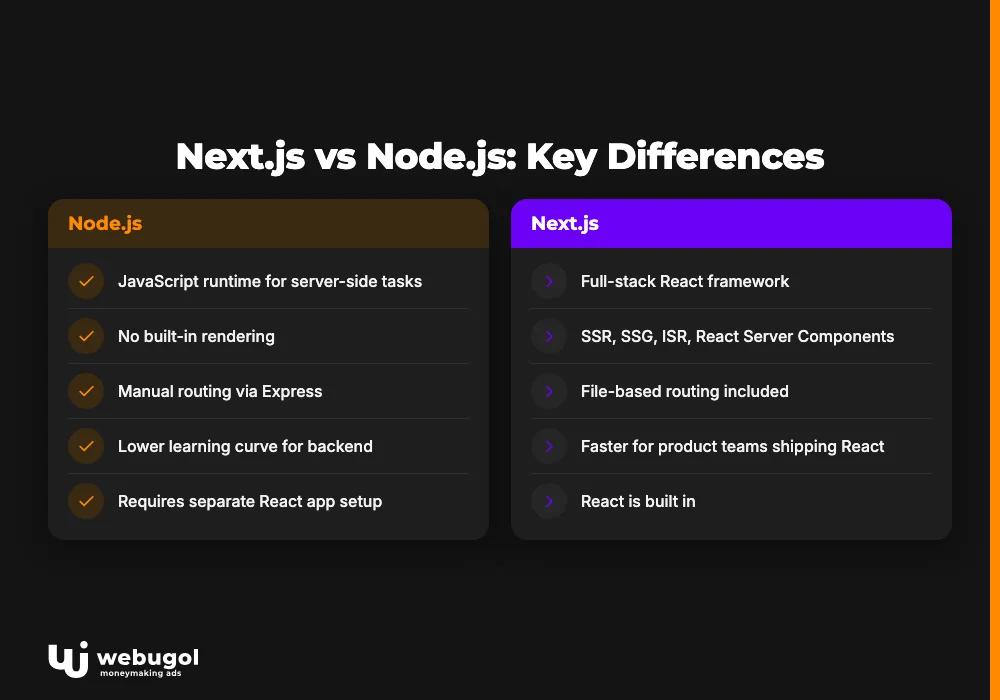
| Dimension | Node.js (standalone) | Next.js |
|---|---|---|
| Purpose | JavaScript runtime for any server-side task | Full-stack React framework |
| Rendering | None built-in; implement what you need | SSR, SSG, ISR, React Server Components |
| Routing | Manual via Express, Fastify, or custom code | File-based routing included |
| Deployment | Any server, container, or cloud function | Vercel, any Node.js host, Docker, self-hosted |
| Learning curve | Lower for backend work; higher for React UI | Higher upfront; faster for product teams shipping React |
| Use with React | Requires a separate React app setup | React is built in |
The next.js vs node.js comparison comes down to how much structure you want from the start. Standalone Node.js gives maximum control. Next.js trades some flexibility for faster product delivery, particularly when React UI and backend logic belong in the same codebase.
When should you use Node.js instead of a framework?
Node.js without a framework layer is the right call when your product has no server-rendered HTML, needs persistent connections, or runs as infrastructure code rather than a user-facing web application.
Signals that point toward plain Node.js:
- Your product is a headless API consumed by mobile apps, third-party clients, or other backend services.
- You need WebSocket or Server-Sent Event connections for live data.
- You are building CLI tools, background workers, or data-pipeline scripts.
- Your architecture uses explicit service boundaries with separate deployment cycles per service.
Pure REST or GraphQL API servers
When the entire product is a node.js api server with no server-rendered HTML, Node.js with Express or Fastify is the natural fit. Next.js API routes work well inside web applications, but for a dedicated node.js backend javascript service, the rendering pipeline adds overhead with no product return.
Containerized microservices map naturally to standalone Node.js deployments. Each service runs as its own process, scales independently, and holds a clean contract with other services. This is precisely the scenario where knowing when to use Next.js versus a minimal Node.js tool changes the architecture.
Real-time apps with WebSockets
Chat applications, live dashboards, and collaborative tools depend on persistent connections that stay open between client and server. Node.js handles this natively with its event-driven concurrency model. Next.js does not block WebSocket usage, but the rendering pipeline contributes nothing to this workload.
When the majority of traffic is connection events rather than page loads, a plain Node.js server with a library like Socket.io is the more direct solution. Match the tool to the actual traffic pattern, not to what you already know.
CLI tools and backend workers
Automation scripts, scheduled jobs, and data processors are pure Node.js territory. No routing, no rendering, no UI. They run in CI or on a server, interact with the file system or external APIs, and exit when the job is done. Attaching a full application framework to a background worker adds weight without benefit.
When Next.js is the right choice
When your project combines a React UI with backend logic, needs organic search traffic, or requires a small team to ship quickly without maintaining two separate codebases, Next.js delivers the fastest return on investment. As a javascript full stack framework, it consolidates frontend and backend into one project, one deployment, and one iteration cycle.
Signals that point toward Next.js:
- You need SEO-indexed pages alongside a React-based interface.
- You want to avoid maintaining a separate API server for standard web-app operations.
- You are building an MVP where time-to-market is the top constraint.
- Your team ships faster when frontend and backend share one deployment pipeline.
SEO-first products and React server-side rendering
React server-side rendering makes Next.js the default for any product where organic search traffic matters. Search crawlers receive fully rendered HTML rather than a JavaScript shell waiting for client-side hydration. This directly affects Core Web Vitals scores, indexability, and ranking consistency over time.
Next.js handles meta tags, Open Graph data, and structured markup through the same codebase that runs the site. No separate SEO configuration layer sits on top of a split React-plus-Node.js stack. Faster indexing and better Core Web Vitals scores come with less maintenance overhead than a split architecture requires.
Is Next.js good for building APIs?
Yes, for most web applications. Next.js API Routes and Server Actions cover standard CRUD operations, authentication flows, and third-party integrations without a separate server. A dedicated node.js api server makes sense when you need WebSocket connections, long-running background jobs, or a distinct microservice with its own scaling requirements.
With the nextjs app router stable since Next.js 13.4 and default in Next.js 15, most mutations no longer need a standalone API route. Server Actions let you write form submissions as async server functions defined inside the component that calls them. This further reduces the scenarios where a separate Node.js server adds meaningful value in a standard web application.
Next.js for MVPs
Next.js is the right foundation for most MVPs. It combines React UI, API logic, and deployment into a single project. Founders who have outgrown no-code tools find it to be the natural next step: structured enough to scale, flexible enough to integrate any external API, and fast enough to launch before the prototype becomes a constraint.
For teams building a SaaS MVP, Next.js cuts the cross-team coordination overhead. No separate backend repository to version, no cross-repo type synchronization, no second CI/CD pipeline for the API. See how we scope and ship them: Next.js development.
Does Next.js replace an Express server?
No, not fully, though for most standard web applications it replaces one in practice. Next.js API Routes handle CRUD operations, authentication flows, and data-fetching patterns. A dedicated Express or Fastify server makes sense when you need persistent WebSocket connections, heavy background processing, or an explicit microservice boundary.
Four architecture patterns and the trigger for each:
Standalone Next.js: Standard CRUD, form handling, and data fetching. API routes cover all backend logic. This fits most marketing sites, SaaS dashboards, and content-driven products.
Next.js with a Node.js sidecar: The Next.js app handles the UI and standard API surface, while one specific workload needs persistent connections or long-running compute. A small Node.js service runs alongside and owns only that workload.
Split monorepo: Next.js frontend and a Node.js backend share a repository but deploy independently. Right when the backend has significant domain logic or a team that owns it separately from the product UI.
Full microservices: Multiple Node.js services handle distinct business domains, and Next.js is the frontend calling into them. This architecture makes sense when independent deployability per domain justifies the coordination overhead, which is typically a later-stage decision.

Can you use Next.js without Node.js?
No. Next.js is a Node.js application. Running next dev or next start starts a Node.js process, and every Next.js capability, including React server-side rendering, API routes, and middleware, executes within the Node.js runtime. The Edge Runtime lets specific routes run in a V8 isolate at the CDN edge for lower-latency auth checks and redirects, but it does not replace a full Node.js service for workloads that require the complete runtime surface.
How the App Router changes the Next.js vs Node.js decision
Most next.js vs node.js comparisons still describe Next.js through the Pages Router. That framing is outdated. The nextjs app router reached stability in Next.js 13.4 and is the default in Next.js 15. Three specific changes alter the practical advice:
React Server Components run on the server by default. Data fetching happens server-side without a useEffect hook or a dedicated API call from the client layer. The traditional separation between "fetch data in Node.js, render it in React" collapses into a single component model. For the next.js vs node.js comparison, the argument for a separate data-fetching Node.js layer is now considerably weaker than it was under Next.js 12.
Server Actions let you write form submissions and mutations as async server functions defined inside the component that calls them. Most mutations no longer need a standalone API route.
Edge Runtime lets specific routes run in a V8 isolate at the CDN edge. The constraint is a restricted module surface with no access to full Node.js APIs, so it does not replace a complete Node.js service for workloads that require the full runtime.
If you are making a next.js vs node.js decision with 2022 reference points, the comparison no longer maps to the framework you will actually deploy.

Ready to choose and ship your stack?
Whether your project calls for a standalone Node.js API or a full-stack Next.js application, Webugol scopes and delivers both as part of a single growth system. The stack decision determines how fast your product launches, how well it ranks, and how efficiently your team iterates after go-live. Reach out for a free scoping call to get a concrete stack recommendation matched to your project type, team size, and launch timeline.
FAQ
Is Next.js replacing Node.js?
No. Next.js depends on Node.js and cannot run without it. Next.js adds routing, rendering, and API structure on top of Node.js; Node.js is the runtime executing all of that code. They operate at different layers of the stack.
Can I use Next.js without knowing Node.js?
You can build a functional Next.js application without deep Node.js expertise, but understanding how Node.js handles HTTP requests, environment variables, and the file system will help you diagnose problems and make sound backend design decisions. For most product use cases, Next.js abstracts enough of Node.js that you do not need to manage it directly day-to-day.
Do I need a separate Node.js server if I use Next.js?
Not for most web applications. Next.js API Routes cover standard CRUD operations, authentication flows, and third-party integrations without a separate server. A dedicated Node.js service makes sense when you need WebSocket connections, long-running background jobs, or a distinct microservice with its own deployment and scaling requirements.
Which is better for building an MVP: Next.js or Node.js?
Next.js is the better choice for most MVPs because it combines the React UI, API logic, and deployment into a single project. You ship faster, spend less on infrastructure setup, and get a production-ready, SEO-indexed product from day one. Standalone Node.js fits better for an API-only MVP with no web UI.
Does Next.js run on Node.js?
Yes. Next.js is a Node.js application. Running next dev or next start starts a Node.js process. Every Next.js capability, including server-side rendering, API routes, and middleware, executes within the Node.js runtime.

