


How to start an IV hydration business: 2026 guide for RNs and NPs
How to start an IV hydration business comes down to four essentials: a state-compliant medical director agreement with standing orders, a formed business entity with the right insurance, a stocked clinical setup, and a patient pipeline built before opening day. Startup costs run $15,000–$35,000 for a mobile operation and $50,000–$150,000 for a fixed clinic. Most founders underestimate the medical director setup cost and the lead time required to build a local patient base. This guide covers every step from business formation to your first 100 sessions, with startup cost and pricing benchmarks the top-ranked competitors do not publish.
Disclaimer: Licensing and scope-of-practice requirements vary by state. Nothing in this article constitutes legal or medical advice. Consult a licensed healthcare attorney before launching.
Providers who reach profitability fastest, and scale past the first 100 sessions with measurable acquisition costs, treat clinical compliance and patient acquisition as one integrated system from day one, not as separate vendor responsibilities. The structural problem that keeps new clinics from their first 100 bookings is the same problem that stalls established operators at a revenue plateau: no single team owns the revenue path from first contact to recognized revenue. Webugol's approach to healthcare growth is judged by what the owner stops losing: ad spend without a measurable cost per booking, inquiries dropped between disconnected vendors, and revenue no one can attribute to a channel. For a broader overview of the market and business model fundamentals, see our IV hydration business overview.
Is an IV hydration business right for you?
For most licensed clinicians, yes, but the model determines the unit economics. Before committing capital, owners need to see how revenue potential and overhead differ across mobile, clinic, and hybrid setups. The model you choose sets your startup cost floor, your daily capacity ceiling, and your breakeven timeline.
Mobile, clinic, or hybrid: which model earns more?
No single model earns more in every market. The right choice depends on capital position, local demand density, and whether you need parallel session capacity from day one.
| Model | Startup cost range | Avg sessions/day | Monthly overhead | Breakeven est. |
|---|---|---|---|---|
| Mobile | $15k–$35k | 3–5 | Lower | 3–5 months |
| Fixed clinic | $50k–$150k | 6–12 | Higher | 6–12 months |
| Hybrid | $40k–$100k | 5–10 | Mid-range | 4–8 months |
(Figures in this table and the profitability section below are illustrative market ranges, like the sourcing notes under Steps 3 and 5; model your own costs before committing.)
Mobile operations are accessible at $15,000–$35,000 to open but cap your daily session count. Fixed clinics require more capital but allow parallel sessions, upsells, and higher patient lifetime value. Hybrid operations let you test fixed-location demand before committing to a full buildout.
How profitable is an IV hydration business?
IV hydration sessions typically carry gross margins of 60–75% per session once consumables and provider time are factored in. A solo mobile operator reaching 4–5 sessions per day can break even within 3–5 months, provided the medical director cost, mileage, and insurance premiums are modeled accurately before launch.
The cost variables that compress margins if left unplanned: medical director monthly fees, per-session supply costs (which drop significantly with wholesale distributor accounts), and facility or mileage overhead. Building a pro forma with real line items before writing a business plan or approaching a lender is the step that pays for itself.
Step 1: Know the legal requirements in your state
State rules vary widely. A scope-of-practice error before day one is expensive to fix. This section covers the categories to research and the questions to bring to a healthcare attorney. It is not a substitute for that conversation.
Nurses and RNs researching how to start an iv hydration business as a nurse face the same starting point: verify your state's scope of practice for your specific license type before spending a dollar on entity formation or equipment.
Legal pre-launch checklist:
- Confirm your license type's scope of practice for IV infusion therapy under your state's current Nurse Practice Act.
- Determine whether your state requires a collaborating physician to issue standing orders before any patient is treated.
- Research facility or clinic licensure requirements beyond a general business license; some states require a separate healthcare facility registration.
- Confirm whether standing orders documentation must be drafted and reviewed by a healthcare attorney before clinical use.
Can an RN start an IV hydration business without a physician?
In most states, RNs cannot independently order IV infusions and require a collaborating physician to issue standing orders before the first patient is treated. Full-practice-authority rules in a small number of states apply to nurse practitioners, not RNs, making the license type a critical first gate.
If you are asking how to start iv hydration business as an rn, the core question is whether your state's Nurse Practice Act permits RNs to administer IV infusions under physician-issued standing orders. Most states do, with a properly structured medical director agreement in place. Verify this before committing to any setup costs.
Do you need a medical director for an IV hydration business?
A medical director is required in most states where the business owner is not an independently licensed prescriber. In collaborative-practice states, a physician who signs standing orders typically fulfills this role and provides clinical oversight.
Three questions to ask before signing a medical director agreement: Is the physician available for adverse event consultation? Does the agreement include monthly protocol review? What is their specific experience with IV infusion therapy rather than general practice oversight? Medical director arrangements typically run $500–$1,500 per month, so factor this into your monthly cost model before the first conversation. (Market rates vary by state and physician specialty; verify with a healthcare attorney before projecting this line item.)
Step 2: Form a business entity and get licensed
Entity selection between LLC and PLLC depends on your state's rules for clinician-owned healthcare businesses. Some states require licensed professionals to use a PLLC rather than a standard LLC. Confirm the correct entity type with a healthcare attorney before filing.
Business formation checklist:
- Form an LLC or PLLC (confirm the correct type for clinician-owned practices in your state).
- Obtain an Employer Identification Number (EIN) from the IRS.
- Apply for an NPI (National Provider Identifier) number through the NPPES system.
- Secure malpractice (professional liability) insurance; IV-therapy-specific policies are available and worth seeking out.
- Obtain general liability insurance for the business entity.
- Apply for DEA registration only if your formulary includes compounded or scheduled medications.
- Open a dedicated business bank account and separate it from personal finances before the first transaction.
Step 3: Estimate startup costs and write a business plan
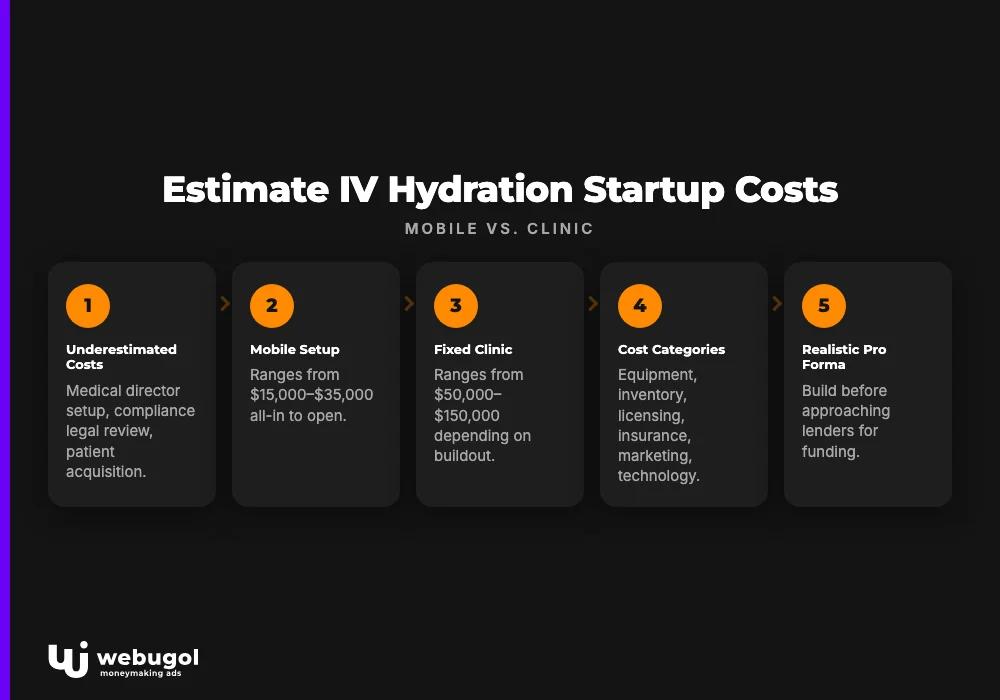
A realistic cost model must exist before approaching lenders or drafting a business plan. The categories founders most often underestimate: medical director setup fees, compliance legal review, and pre-launch patient acquisition spend.
IV hydration startup cost table: mobile vs. clinic
| Cost category | Mobile | Fixed clinic |
|---|---|---|
| Equipment (IV poles, pumps, kits) | $2,000–$5,000 | $5,000–$15,000 |
| 3-month supply inventory | $1,500–$4,000 | $4,000–$12,000 |
| Licensing and permits | $500–$2,000 | $1,500–$5,000 |
| First-year insurance (malpractice + GL) | $3,000–$6,000 | $4,000–$10,000 |
| Medical director setup (first 3 months) | $1,500–$4,500 | $1,500–$4,500 |
| Booking and EMR technology | $500–$2,000 | $1,000–$3,000 |
| Pre-launch marketing and acquisition | $2,000–$5,000 | $3,000–$8,000 |
| Working capital buffer and facility/vehicle | Variable | Variable |
(Illustrative ranges based on commonly cited industry figures; your actual figures depend on state, market, and vendor choices. Use these as a framework for your own pro forma, not as a budget ceiling.)
A mobile setup runs $15,000–$35,000 all-in to open once working capital is included; a fixed clinic ranges from $50,000–$150,000 depending on buildout scope and state licensing requirements. The line-item breakdown lets you build a realistic pro forma before approaching lenders. Not after.
Step 4: Build your clinical foundation
All clinical protocols, standing orders, and supply chain infrastructure must be fully documented before the first patient is seen. State regulators and medical directors require documented systems, not verbal assurances, before signing off on operations.
Equipment, supplies, and sourcing
Equipment and supply list:
- IV poles and administration stands, with quantity matched to your projected daily session volume.
- Drip sets: 18–22g catheters, Y-site administration tubing, and gauges appropriate for your patient population.
- IV bags: Normal Saline and Lactated Ringer's as your base fluids.
- Vitamin and additive inventory (B-complex, B12, vitamin C, magnesium, glutathione), per your approved formulary only.
- Biohazard waste disposal containers and a contracted sharps disposal service.
- Emergency anaphylaxis kit including epinephrine, required before the first patient is seen.
Wholesale medical distributor accounts reduce per-session supply costs significantly compared to retail sourcing. That margin difference matters most during the low-volume launch phase, when every session's gross profit is highest relative to fixed costs.
Written protocols and standing orders
Every IV hydration business needs documented protocols covering contraindication screening, adverse reaction response (including anaphylaxis management), documentation standards, and informed consent procedures. Standing orders must be reviewed, signed, and dated by the collaborating physician before any patient is treated.
Two documents founders commonly delay: a written adverse event response protocol and a patient intake screening form that explicitly identifies contraindications. Both are required before any state inspection and before the medical director will sign off on operations.
The digital patient intake path, from website visit to booking platform to HIPAA-compliant CRM record, belongs in this same clinical foundation documentation. Practices that defer this to a separate marketing vendor discover later that no single team owns the gap between a patient inquiry and a recognized booking. Build the tracking and intake infrastructure once, at launch.
Step 5: Price your services for profit
Pricing must cover consumables, provider time, medical director costs, and overhead while leaving margin to fund growth. Most first-time operators underprice by anchoring to a competitor's menu without knowing that competitor's actual cost structure.
IV therapy pricing by service type
| Service | Market-advertised range | Est. gross margin |
|---|---|---|
| Basic hydration drip (NS or LR, 1L) | $100–$175 | 65–75% |
| Myers cocktail | $150–$250 | 60–70% |
| NAD+ infusion | $300–$600 | 55–65% |
| Vitamin push / IM shot | $25–$50 | 70–80% |
| Custom premium drip (with add-ons) | $200–$400+ | 60–70% |
(Market-advertised ranges drawn from publicly listed clinic menus; your margins will vary by formulary and market. Use these as a competitive positioning reference, not as your cost model.)
Service mix matters as much as price point. A clinic running premium add-ons alongside basic drips carries a meaningfully higher average session value than one operating a single price tier. Build your pricing from your actual cost structure, then benchmark it against these ranges.

Step 6: Build a patient acquisition system before you open
Every top-10 article covering how to start an IV hydration business gives marketing one paragraph. This gap is not a beginner's problem: the first-100-bookings fragility (no tracking, no single owner of the path from click to booked session) is the same structural weakness that stalls established clinics at a scaling plateau. How to start an IV hydration business and how to scale one past that plateau have the same answer, because a launch built on word-of-mouth and informal referrals does not compound into a scalable acquisition system. Patient acquisition must start 60–90 days before opening, not after the first slow week erodes margin, and the tracking and CRM foundation built at launch is the same foundation that makes paid acquisition measurable at scale.
For IV therapy clinics building a sustainable SEO-driven pipeline beyond launch day, our guide to SEO for IV therapy clinics covers the full channel strategy in depth.
What Webugol clients stop losing: bookings that vanish between the ad click and the intake form, budget spent with no measurable cost per booking, and weeks of diagnostic back-and-forth because no single team answers for the revenue path from first contact to recognized revenue. If you want a known cost per booking and one accountable owner for every handoff from day one, see the Healthcare Growth System in the closing section below.
Whether to build this pipeline internally or with a specialist is a real decision at launch. See our breakdown of in-house vs. agency marketing if you are weighing that call before your opening date.
Why IV hydration businesses struggle in year one
The most common failure pattern follows three steps: opening without a patient pipeline, pivoting to discounting to fill the schedule, and never recovering the original margin. Three root causes make this predictable: no pre-launch demand generation, sole reliance on word-of-mouth, and underestimating local digital competition from clinics that have been building their Google presence for years.
Local search is more competitive than founders expect. An established clinic with 200 Google reviews and an active Google Business Profile will outrank a new location by default. The only counter is to start earlier than feels necessary.
How to get your first 20 patients
Pre-launch acquisition checklist:
- Claim and fully optimize your Google Business Profile at least 30 days before opening day.
- Build a location landing page and publish it before opening so it has time to index and gather search impressions.
- Identify three referral partner targets (gyms, spas, or sports clubs within 5 miles) and send a partnership offer with a complimentary session as an introduction.
- Launch an email waitlist with a specific launch-day offer and promote it actively for the 60 days before opening.
- Run a 30-day content cadence on Instagram or TikTok focused on education and behind-the-scenes setup, building local awareness before the doors open.
- Set a concrete pre-launch goal: 20 confirmed bookings and 100 email subscribers by opening day.
Step 7: Set up technology and operations
HIPAA compliance applies to your booking platform, intake forms, and every tool that handles protected health information. Non-compliant intake forms are one of the five most common and costly mistakes new IV hydration businesses make, and one of the easiest to avoid.
Technology stack checklist:
- HIPAA-compliant booking platform: confirm Business Associate Agreement (BAA) availability before committing to any tool.
- HIPAA-compliant intake forms: use a verified compliant solution, not a standard web form.
- EMR or EHR: look for systems built for small IV practices, with mobile access, IV-specific charting templates, and e-signature capability for informed consent.
- Payment processor with healthcare billing capability and HIPAA-appropriate data handling.
- Automated review request workflow triggered after each session completion; early Google reviews are a local SEO multiplier in the first 90 days.
For a full breakdown of what to evaluate in compliant booking tools, see our guide to HIPAA-compliant scheduling software.
30/60/90-day post-launch roadmap:
- Days 1–30: focus on gathering reviews, refining the intake process, and tracking session completion rates.
- Days 31–60: analyze which referral channels are producing bookings and allocate more time to the top performer.
- Days 61–90: update your pro forma with real session data, adjust pricing if gross margins are compressing below 60%, and evaluate whether additional service lines are warranted.
Common mistakes to avoid
- Opening without a patient pipeline leads to weeks of near-zero revenue, and margin erosion forces early discounting that is difficult to unwind once patients are anchored to that price.
- Starting patient treatments before the collaborating physician signs standing orders creates personal liability exposure and regulatory risk that no insurance policy fully covers.
- Underpricing based on a competitor's unknown cost structure locks in margins below your actual breakeven, with no clean correction path after the fact.
- Using non-HIPAA-compliant intake forms creates data breach exposure and HIPAA liability; the compliant alternative costs less than a single enforcement event.
- Ignoring Google Business Profile in the first 90 days cedes local search visibility to established competitors at the highest-stakes window for building early momentum.
Ready to build a patient acquisition system that scales past the first 100 bookings?
Practices that reach 100 bookings and keep growing treat the revenue path as one connected system, not as a media buyer plus a developer plus a CRM specialist plus an analyst with no one accountable for the handoffs between them. Webugol's Healthcare Growth System is a 90-day sprint with one accountable outcome: one team owns the revenue path from the first click to recognized revenue, with a measurable cost per booking and a single owner for every handoff. It is the same system that carries established clinics past the scaling plateau, built into your launch instead of retrofitted after a painful first year. Book a Strategy Call.
Frequently asked questions
Can an RN start an IV hydration business without a physician?
In most states, RNs cannot independently order IV infusions and require a collaborating physician to issue standing orders before the first patient is treated. Full-practice-authority rules in a small number of states apply to nurse practitioners, not RNs, and the distinction must be verified with a healthcare attorney before launch.
How much does it cost to start an IV hydration business?
A mobile IV hydration setup typically costs $15,000–$35,000 to launch; a fixed clinic ranges from $50,000–$150,000 depending on buildout scope and state licensing requirements. The largest variable costs are equipment, initial supply inventory, insurance, and medical director fees.
Do I need a medical director for an IV hydration business?
A medical director is required in most states where the business owner is not an independently licensed prescriber such as an NP in a full-practice-authority state. The medical director signs standing orders, provides clinical oversight, and must be available for adverse event consultation.
How profitable is an IV hydration business?
IV hydration sessions typically carry gross margins of 60–75% per session after consumables and provider time. A mobile operator running 4–5 sessions per day can reach breakeven within 3–5 months, depending on local pricing, medical director costs, and whether a patient acquisition system was built before opening.
What licenses do you need to open an IV hydration clinic?
Requirements vary by state but generally include a state business license, an NPI number, malpractice and general liability insurance, and a signed medical director or collaborative practice agreement. Some states require an additional healthcare facility registration separate from a general business license.

