



IV Therapy SEO: A Practical Framework for Clinic Owners
IV therapy SEO is the practice of making your clinic visible to local patients at the moment they search for infusion services. It converts passive online presence into a predictable source of appointment bookings. Clinics that own page one in their market stop losing patients to competitors who rank for the same services. That outcome is measurable.
Whether you run a single IV therapy suite or manage multiple clinic locations, the core challenge is the same. Intent-driven patients are searching right now. If your clinic doesn't appear, a competitor fills that booking. The search foundations a new practice builds to earn its first appointments are the same ones a scaling network depends on to fill every chair at every site.
Why IV therapy SEO works differently than general healthcare SEO
IV therapy sits in a specific niche: elective, wellness-driven, and geographically tight. Patients rarely travel more than a few miles for a session. Local relevance is the single most important ranking variable. It separates iv therapy seo from aesthetic clinic seo and general healthcare local seo in ways that change how you build content and claim search territory.
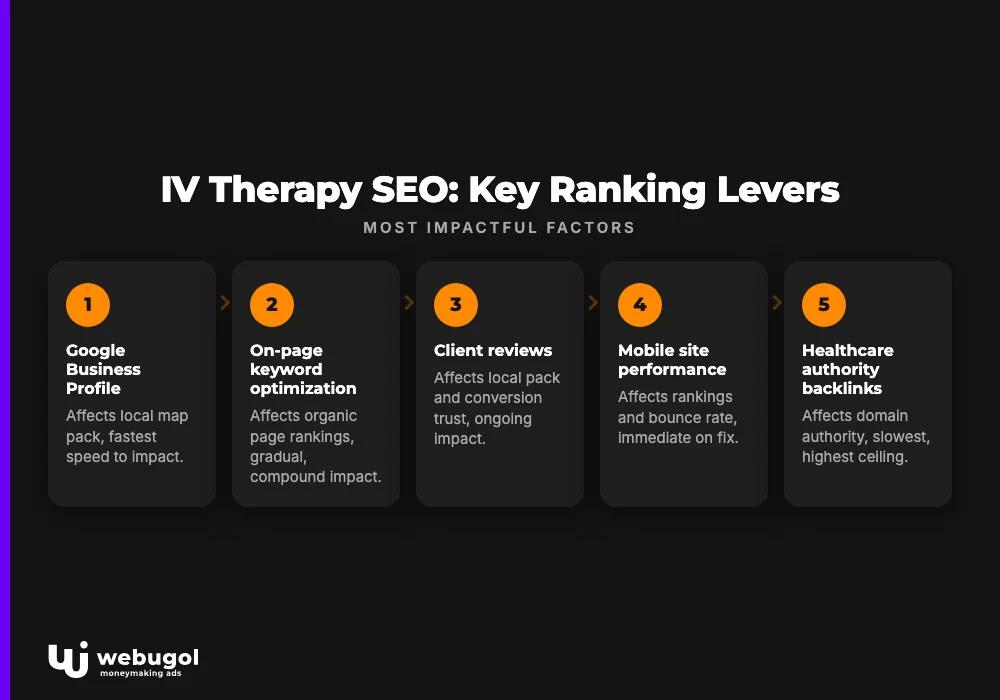
Three levers drive the most impact: local search signals, on-page keyword relevance, and reputation built through reviews. Everything else amplifies these three.
Ranking levers for IV therapy clinics:
| Lever | What it affects | Speed to impact |
|---|---|---|
| Google Business Profile | Local map pack (top 3 positions) | Fastest |
| On-page keyword optimization | Organic page rankings | Gradual, compound |
| Client reviews | Local pack + conversion trust | Ongoing |
| Mobile site performance | Rankings + bounce rate | Immediate on fix |
| Healthcare authority backlinks | Domain authority + topical depth | Slowest, highest ceiling |
How do I rank my IV therapy clinic on Google?
Ranking your IV therapy clinic on Google requires three simultaneous moves: optimize your Google Business Profile, build service pages around terms patients actually search, and collect reviews consistently. Treat these as parallel work, not a sequence. A well-executed strategy connects all three from day one.
Your Google Business Profile clinic listing is the first thing most local patients see. Fill it completely: name, address, phone, hours, service categories, and professional photos. Google rewards completeness. A sparse profile signals low activity and ranks accordingly.
Your service pages should target the specific terms patients use: "IV hydration therapy [city]," "mobile IV drip near me," "vitamin infusion [neighborhood]." Keyword relevance on the page, combined with a strong local profile, is what moves you from page two into the local pack.
For step-by-step setup and audit guidance, see the healthcare clinic GBP optimization and ranking walkthrough.
What local SEO strategies work for IV therapy clinics?
Local SEO for clinics running IV therapy services comes down to geographic signal strength. Google needs to understand where you operate, what you offer, and that real patients trust you. Three strategies produce the clearest results.
Location-specific service pages. Every service page should include your city, neighborhood, and service area in the content, not just the title tag. Mobile IV therapy providers benefit from pages targeting each neighborhood they cover. Each page extends your local ranking footprint. One page ranking in a secondary market is additional revenue at no additional overhead.
NAP consistency across directories. Your name, address, and phone number must match exactly across Google, Yelp, Healthgrades, and any local wellness directories where you're listed. Discrepancies confuse Google's local algorithm and quietly erode ranking confidence.
Locally anchored content. Publish content that ties your services to local events and seasonal demand. A post about IV hydration for athletes before a regional race captures intent that a national competitor can't match because it doesn't apply to them. That's the local content edge.
How do client reviews affect IV therapy clinic rankings?
Client reviews are a direct local ranking factor. Higher volumes of recent, positive reviews correlate with stronger positions in Google's local pack. For an elective wellness service, reviews are also a conversion tool. A patient comparing two IV clinics in the same search will almost always choose the one with more reviews and a higher score.
Build review collection into your post-appointment workflow. Send a direct link by text or email immediately after the session, while the experience is fresh. One tap to submit. Friction stops follow-through.
Respond to negative reviews within 24 hours. Acknowledge the concern, offer to resolve it offline, and keep the response brief. A handled complaint can signal professionalism more effectively than another five-star review.
Which keywords should an IV therapy clinic target?
Effective iv therapy seo keyword strategy layers three types. Service-specific terms cover what you offer. Local modifiers establish where you operate. Intent signals reflect how close a patient is to booking.
Service-specific: IV hydration therapy, vitamin drip, mobile IV infusion, NAD+ therapy, immune boost IV
Local modifiers: "[city] IV therapy," "IV drip near me," "mobile IV [neighborhood]"
Intent-based: IV therapy for hangover, IV hydration for athletes, IV drip for fatigue
Use Ahrefs, SEMrush, or Google Keyword Planner to validate search volume in your market before building content. High-volume national terms like "IV therapy" are dominated by directories and health publishers. Local and long-tail terms are where a single-location clinic actually wins the patient.
Wellness clinic seo tips: mid-funnel educational content builds topical authority that lifts all your pages. Posts answering "what is IV therapy?" or "how often should you get a drip?" capture earlier-stage interest. Ranking for educational terms reinforces authority for your higher-intent service pages too.
How does mobile SEO help IV therapy businesses?
Mobile IV therapy marketing depends on mobile search more than most healthcare verticals. A patient looking for a mobile drip service is usually on a phone, ready to book today. Lose them at a slow load screen and they book elsewhere. That's the mobile SEO problem.
Google ranks your site based on its mobile version, not desktop. This applies to every IV therapy clinic, not just mobile providers. Three mobile priorities: fast load times, one-handed navigation, and a phone number plus booking button visible without scrolling.
"Near me" searches are predominantly mobile and reflect high booking intent. Capturing them requires both a strong Google Business Profile and a site with clear location signals built into the content.
Consistent social media activity extends your local brand reach. Direct searches for your clinic name signal brand recognition to Google. Not a primary ranking factor, but one that compounds alongside everything else.
For clinics building the domain authority that makes every on-page improvement work harder, improving your healthcare site's backlink profile accelerates organic results across the board.
IV therapy SEO mistakes that stall growth
Even a well-structured clinic site can stall in local search if a few problems go unfixed.
Keyword stuffing. Repeating "iv therapy seo" in every paragraph triggers spam signals, not higher rankings. Use the phrase where it reads naturally and let service terms and location variants carry the rest.
An abandoned Google Business Profile. Claim it and stop maintaining it, and a more active competitor outranks you. Update holiday hours, post service updates monthly, and respond to every review. Profile activity is a ranking signal.
Thin service pages. A 150-word page for each treatment doesn't give Google enough to understand what you offer or who it's right for. Each major service deserves its own page with depth enough to answer the patient's real questions.
No systematic review collection. Reviews that arrive organically are inconsistent and sparse. A post-appointment request workflow changes this. Waiting for satisfied patients to volunteer reviews is a growth ceiling.
For IV therapy clinics that want to see how these strategies apply in adjacent wellness categories, see patient acquisition SEO for aesthetic and medical weight loss clinics.
Turn your clinic's search visibility into booked appointments
IV therapy SEO drives top-of-funnel awareness. What happens after the click determines revenue. Clinics that treat search optimization as a standalone tactic often find more traffic produces less revenue than expected, because gaps in the booking flow, intake response time, and follow-up absorb the gain. Fixing visibility while leaving those gaps open is the most common scaling plateau.
Webugol builds tracking-first, conversion-led patient acquisition systems for US healthcare clinics, where search is one layer of a connected revenue path, not an isolated channel. Ready to see where your growth is actually leaking? Contact us to start with a strategy call.
FAQ
How long does it take for IV therapy SEO to show results?
Google Business Profile optimization tends to produce visible movement faster than organic page rankings, which build more gradually through sustained keyword targeting, content, and backlinks. Both compound over time, so earlier action creates a larger lead over clinics that delay.
Do I need a separate SEO approach for mobile IV therapy services?
Yes. Mobile providers need location-specific pages for each service area they cover, since patients searching for on-demand IV services are almost always on a phone and ready to book the same day. A single city-level page won't capture neighborhood-level search intent.
How many reviews does an IV therapy clinic need to rank locally?
There is no fixed count. Google's local algorithm weighs both volume and recency, so a clinic with recent, consistent reviews typically outperforms one with an older, larger total. A post-appointment review request process matters more than reaching any specific number.
Should IV therapy SEO be combined with paid advertising?
SEO and paid search serve different time horizons: SEO builds compounding organic visibility, paid ads deliver immediate traffic. Running both works best when your tracking connects every channel to actual appointment bookings, not just clicks or sessions.

