



Telehealth website design: features, HIPAA, and what converts patients
A strong telehealth website design combines a HIPAA compliant architecture, a patient portal patients trust on first use, and online appointment scheduling that runs without staff intervention. When those three work together, patients book, attend, and return without calling your front desk. Getting that combination right is harder than building any individual feature.
Whether you are launching your first telemedicine platform or diagnosing why an established clinic's site is not converting at the rate the ad budget warrants, the structural problem is often the same: features were added without a coherent patient acquisition path underneath them. That gap is what this article addresses. The sections below cover the telehealth platform features that drive compliance costs, conversion rates, and long-term patient retention.
What features should a telehealth website have?
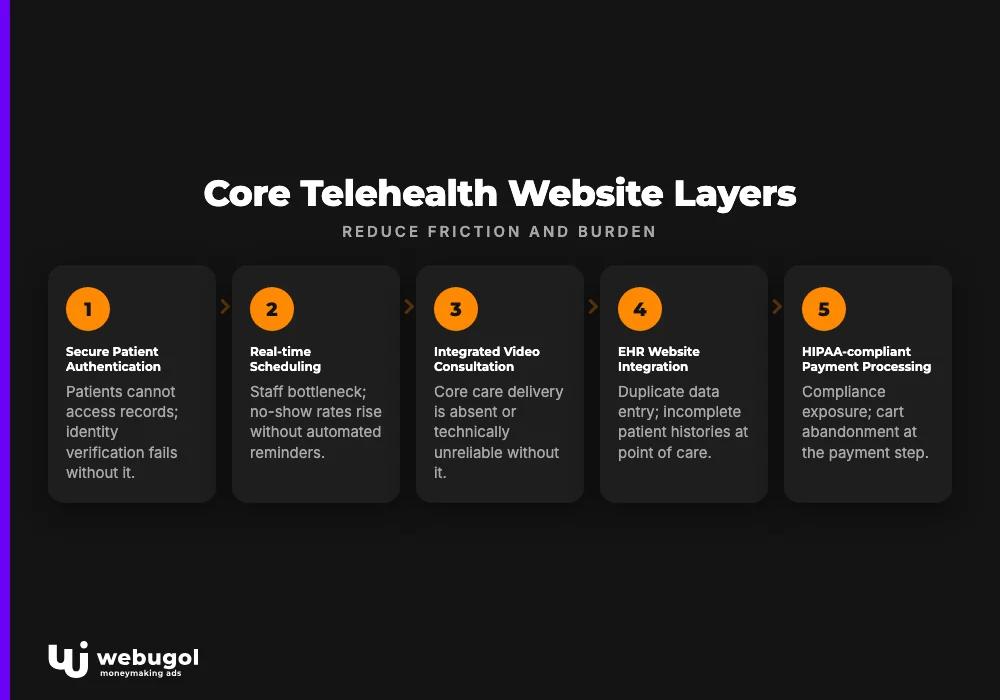
A telehealth website needs five core functional layers: secure patient authentication, real-time scheduling, integrated video consultation, EHR website integration, and HIPAA-compliant payment processing. Each layer either reduces friction for patients or reduces manual burden for the practice. A gap in any one layer creates a break in the acquisition loop. Getting those layers right is one of the central challenges in telehealth website design.
| Feature | What breaks without it |
|---|---|
| Patient portal with 2FA | Patients cannot access records; identity verification fails |
| Online appointment scheduling | Staff bottleneck; no-show rates rise without automated reminders |
| EHR website integration | Duplicate data entry; incomplete patient histories at point of care |
| Video consultation tools | Core care delivery is absent or technically unreliable |
| HIPAA-compliant payment processing | Compliance exposure; cart abandonment at the payment step |
| Mobile-responsive interface | The majority of patients book on mobile; an unresponsive site loses them at the start |
Patient portal design and secure access
Patient portal design determines whether patients return to self-serve or call staff for everything after their first visit. A portal with unclear navigation or frequent login failures creates friction at the exact point where patients decide whether your platform is worth using.
Two-factor authentication is the standard baseline. Every patient login should require a second verification step, whether via SMS code or an authenticator app. Behind that login, all communications and stored records must travel over encrypted channels. The security architecture can be complex; the experience of using it should not feel that way.
Biometric authentication, including fingerprints and facial recognition, has moved from experimental to expected on mobile health platforms. Where mobile access is a primary use case, building toward biometric login as the default path reduces the password-reset volume that quietly erodes front-desk capacity.
Online appointment scheduling
A scheduling flow that requires a phone call at any point will lose patients. Modern online appointment scheduling gives patients real-time calendar visibility, provider and visit-type filters, and a confirmation sequence that handles reminders automatically.
Self-service rescheduling matters as much as initial booking. A patient who can reschedule in under a minute stays in the panel. One who must call to change a time often cancels instead. Integrating the scheduling system with the practice CRM keeps calendar data consistent and removes the double-booking risk that manual coordination introduces.
Video consultation tools
Video consultations are the clinical core of telemedicine. The interface needs to reduce cognitive load during the call: one-click join from the confirmation email, clearly labeled mute and camera controls, and a virtual waiting room that keeps patients informed before the provider joins. Technical problems during a consultation damage confidence faster than almost any other failure type.
Low latency is a clinical requirement, not a technical preference. Perceptible delay in audio or video degrades the diagnostic interaction and tells the patient the platform is unreliable. Provider-facing features, such as screen sharing, in-session notes, and the ability to issue follow-up instructions without leaving the interface, reduce post-visit administrative work and keep providers moving between appointments.
EHR website integration
EHR website integration is where many telemedicine platforms introduce operational risk that goes unaccounted for at build time. When the telehealth front end and the core health record system operate separately, providers enter the same data in two places and consultation histories are incomplete at the moment they are needed.
Effective integration gives providers access to the patient record inside the consultation interface, with changes syncing back to the EHR without a manual transfer step. That removes data entry from the post-visit workflow and reduces the error rate that comes from transferring notes between platforms.
How to make a telehealth website HIPAA compliant?
A HIPAA compliant website encrypts all patient data in transit and at rest, restricts data access by user role, maintains a full audit log of who accessed which data and when, and requires signed business associate agreements (BAAs) with every third-party vendor that processes or stores protected health information. Compliance is an architectural requirement, not a documentation exercise.
Telehealth website design choices that define HIPAA scope
Third-party integrations are the most common HIPAA failure point. Analytics tools, scheduling widgets, payment processors, and live chat services that were not vetted for healthcare use can transmit protected health information to servers outside the compliance boundary. Every vendor that touches patient data needs a BAA and a documented data handling policy before it goes live on the platform.
Role-based access controls are a HIPAA technical safeguard requirement. A scheduling coordinator should not be able to view clinical notes. A billing team member should not have access to diagnosis history. The principle of least privilege, where each user role sees only the data their function requires, limits exposure in the event of a breach and is not optional.
Audit trails need to capture every access event: user ID, data accessed, timestamp, and device. That log is the primary evidence during a compliance investigation and the fastest way to isolate a breach to its source.
Patient consent flows require the same architectural care. Consent for telehealth visits, data sharing, and session recording must be documented and stored. A static checkbox at registration is legally fragile. A dynamic consent mechanism that updates when scope changes and stores a timestamped record of each acceptance is far more defensible in an audit.
For a technical breakdown of the infrastructure decisions that carry the most regulatory weight, this guide to scoping a HIPAA-ready healthcare site covers the foundations in practical detail.
How does telehealth website design affect patient trust?
Telehealth website design is the first clinical impression a patient forms of a practice. Before a single consultation, patients scan the site for signals that it is safe, credible, and built for people like them. A slow load, an inconsistent brand across pages, or a privacy statement buried in legal boilerplate raises doubt before any care is delivered.
Trust signals work best placed at decision points. Provider credentials, HIPAA compliance notices, and plain-language privacy explanations should appear on the homepage, in the booking flow, and on the portal login screen. Consolidating them on a "legal" page no one reads wastes those signals entirely.
Site performance also functions as a trust signal in a context-specific way. A slow loading experience on mobile, where the majority of patients will first encounter the platform, reads as a proxy for service quality. Healthcare UX design that prioritizes perceived performance, including skeleton loading screens and progress indicators during form submission, reduces abandonment at the moment patients are forming their first impression.
The Americans with Disabilities Act (ADA) requires accessible digital experiences. ADA compliance means the platform legally must be usable by patients with visual, auditory, motor, or cognitive impairments. That is not a niche concern in healthcare: older adults and patients managing chronic conditions represent a significant share of telehealth demand, and inaccessible design excludes exactly the patients who benefit most from virtual care.
What makes a good telehealth user interface?
A good telehealth user interface minimizes the number of decisions a patient must make between arriving on the site and completing a booking or visit. Navigation should be organized around patient tasks, such as book, access records, join a call, and pay, not around internal service categories.
Three patterns consistently improve completion rates in healthcare UX design. A persistent, accessible booking entry point on every page performs better than one buried in a menu. Progress indicators in multi-step flows reduce abandonment by showing patients exactly how many steps remain. Error messages that tell patients what went wrong and how to correct it, rather than just marking a field in red, keep patients moving through the flow instead of abandoning it.
Font size, tap target size, and plain language are not edge-case accommodations. They are requirements for a healthcare audience spanning age groups and technical comfort levels. Designing for the least-comfortable user improves the experience for everyone.
See how these principles connect to the broader shifts redefining healthcare platform design for additional context on what is changing across practice types.

What is the cost of telehealth website development?
Telehealth website design cost drivers
The cost of telemedicine website development is driven by four variables: compliance scope, integration complexity, custom feature requirements, and the structure of the team executing the build. None of those variables can be reduced without a direct trade-off.
HIPAA compliance adds engineering scope that standard web development does not require: encrypted databases, audit logging, BAA management, and compliance review at every design decision. That scope is fixed regardless of practice size.
EHR website integration is often the largest single cost driver after compliance. Legacy EHR systems with proprietary APIs require custom middleware to connect with a telehealth platform. Modern systems with FHIR-compliant APIs reduce integration time, but which EHR the practice uses determines which path is available.
The choice between custom video consultation infrastructure and a licensed HIPAA-compliant telehealth SDK is both a cost and a strategy decision. Custom infrastructure is justified when the clinical workflow is the product's differentiation. A licensed SDK is almost always sufficient when differentiation is in the acquisition and retention experience, not the video technology itself.
Projects that exceed initial estimates almost always do so because HIPAA compliance requirements were scoped after the build started, not before. Treating compliance as a build-phase addition rather than an architectural requirement is the most consistent cost amplifier in telehealth development.
A compliant, functional platform that still is not acquiring patients at the rate it should is a separate problem from build quality. Webugol's diagnostic process starts with end-to-end tracking and funnel analysis to find where the acquisition path actually breaks. For practices already past the build phase, the conversion factors that drive patient retention post covers what to optimize once the site is live.

Telehealth website design that acquires patients, not just one that checks boxes
A telehealth platform that is HIPAA compliant, mobile-responsive, and fully featured is table stakes in 2026. What separates practices that grow from those that plateau is whether the site functions as an acquisition system: end-to-end tracking, a booking flow that converts, and data the marketing team can actually use to adjust spend.
If the platform was built for compliance but not for conversion, or if the current site is not performing in proportion to the ad budget, the problem is structural. It needs a diagnostic before it needs a rebuild.
Webugol's healthcare growth team works with telehealth operators and clinic groups to close the gap between compliant infrastructure and measurable patient acquisition results. Book a strategy call to start with a site audit.
FAQ
What features should a telehealth website have?
A telehealth website requires secure patient portal access with two-factor authentication, real-time online appointment scheduling, integrated video consultation tools, EHR website integration, and HIPAA-compliant payment processing. These features must connect through a unified patient record rather than operate as separate, unlinked modules.
How to make a telehealth website HIPAA compliant?
HIPAA compliance requires encrypting all patient data in transit and at rest, implementing role-based access controls, maintaining a full audit log of every data interaction, and signing business associate agreements with every vendor that handles protected health information. Compliance must be designed into the site architecture before development begins, not added after launch.
What is the cost of telehealth website development?
Development cost is determined by compliance scope, EHR integration complexity, and whether custom video infrastructure or a licensed SDK is appropriate for the clinical use case. Scoping compliance requirements after the build has started is the most consistent driver of cost overruns in telemedicine website development.
How does telehealth website design affect patient trust?
Patients assess trust before they book: site speed, visible compliance notices, provider credentials, and consistent design across pages all function as trust signals before any clinical interaction takes place. A slow or inconsistent experience communicates something about service quality before the patient has spoken with a single provider.
What makes a good telehealth user interface?
A good telehealth UI organizes navigation around patient tasks rather than internal service categories and places a persistent booking entry point on every page. Progress indicators in multi-step flows and clear error messages that explain how to correct a problem consistently reduce abandonment across healthcare UX testing.

