



NAP consistency in local SEO: audit, fix, and rank higher
NAP consistency in local SEO means keeping your business Name, Address, and Phone number identical across every directory, citation site, and online profile. Google cross-checks this data to confirm your business is real and located where you claim. Matching records build ranking confidence. Inconsistencies, even minor formatting differences, erode it.
Marketing directors and practice owners who plateau in local search often look for the cause in content or reviews. The actual gap is usually structural. Fragmented citation data across local business listings stops Google from confidently ranking a business it cannot fully verify.
That same structural weakness applies whether you are launching your first location or trying to push patient and customer acquisition past a growth ceiling. The fix is the same at every stage: consistent, verifiable NAP data across every platform where your business appears. NAP consistency local SEO fundamentals apply at every scale: one location or twenty, the standard is the same.
What does NAP stand for in SEO?
NAP stands for Name, Address, and Phone number. These three data points form the identity layer of your business across every online platform, from Google Business Profile to local business listings on Yelp, Apple Maps, Bing Places, and industry-specific directories.
Google reads that identity as a fingerprint. If one directory lists your practice as "Riverside Health" and another says "Riverside Health Clinic LLC," Google may register them as separate businesses. That splits the authority that should consolidate on one verified location.
Small discrepancies compound fast. Data aggregators replicate errors across dozens of downstream directories without any action on your part. The role of local citations SEO depends on that fingerprint being consistent: every matching citation adds a trust signal, and every mismatch subtracts one.
Why is NAP consistency important for local SEO?
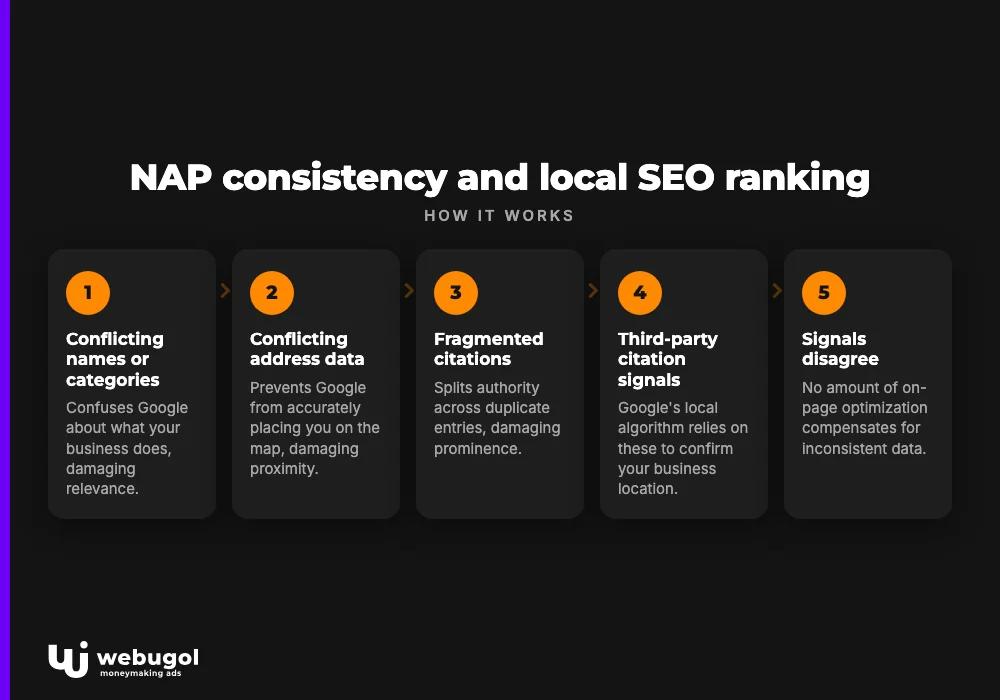
NAP consistency in local SEO directly affects the three core local SEO ranking factors Google uses to evaluate local businesses: relevance, proximity, and prominence. Inconsistent data undermines all three.
How NAP consistency local SEO signals map to ranking factors
| Ranking factor | How NAP inconsistency damages it |
|---|---|
| Relevance | Conflicting names or categories confuse Google about what your business does |
| Proximity | Conflicting address data prevents Google from accurately placing you on the map |
| Prominence | Fragmented citations split authority across duplicate entries instead of building on one verified listing |
Google's local algorithm relies on third-party citation signals to confirm that your business is where it claims to be. When those signals disagree, no amount of on-page optimization compensates. The trust layer has to be clean before ranking efforts produce their full return.
What happens if NAP is inconsistent across directories?
Inconsistent NAP across directories creates three compounding problems. Google splits its confidence between conflicting versions of your business, reducing how often any version appears in prominent local results. Customers who reach the wrong phone number or old address face friction that rarely ends in a conversion. Citation building SEO work placed on top of noisy data fights against itself.
The propagation problem multiplies the damage. Data aggregators like Data Axle and Foursquare distribute your NAP to dozens of downstream platforms automatically. One error at the aggregator level populates broadly. Correct a downstream listing today and the error may return when the aggregator refreshes next week.
Fix upstream first. Correct aggregators before you touch individual directories.
How does NAP affect Google Business Profile rankings?
Google compares your GBP NAP against external data sources. Matching records increase its confidence in your listing and improve your Local Pack rankings. Mismatches introduce uncertainty, and that uncertainty appears as lower Local Pack frequency.
Your Google Business Profile controls placement in the Local Pack, the map-and-listings block above organic results for most local queries. Getting google business profile NAP right determines how reliably you appear there.
Optimizing your Google Business Profile as a healthcare practice operates on the same principle: every field on the profile must exactly mirror what is on your website and across your major citations, down to punctuation and abbreviations.
To align your GBP NAP:
- Log into Google Business Profile and open the "Info" tab
- Compare your business name, address, and phone number against your canonical NAP format
- Edit any field that deviates, including punctuation, abbreviations, and suite numbers
- Confirm the map pin sits at your actual entrance, not an approximation
One correct GBP entry does not compensate for thirty inconsistent ones elsewhere. Both layers require attention.
How do I audit my business NAP information?
To audit your NAP, work through four source categories in order: your own web properties, major listing platforms, data aggregators, and niche or industry directories. A complete nap audit checklist covers all four.
Step 1: Set a canonical NAP
Write down the exact, official version of your business name, full address including suite or unit numbers, and primary phone number. This is your reference standard. Every other entry gets corrected to match it exactly, including abbreviations and punctuation.
Step 2: Search manually for mismatches
Search Google for your business name, phone number, and address separately. Record every result that shows a different version. Also search common name variations, with and without punctuation, to uncover listings you may not know exist.
Step 3: Run an audit tool scan
Tools like Moz Local, BrightLocal, and Yext scan major directories automatically and surface NAP discrepancies in minutes. Free-tier scans exist on all three. A prioritized correction list then guides manual outreach to platforms where automatic updates are not supported.
Step 4: Build a correction spreadsheet
Track every finding: platform, listing URL, current NAP as found, required change, and correction status. This prevents duplicate work and gives you a clear view of what remains.
Step 5: Fix aggregators before downstream directories
Correct aggregator records first. Tools like Yext and Moz Local push updates directly to major aggregators. Fixing individual downstream directories without correcting the upstream source means errors return with the next aggregator refresh.
Once the citation profile is clean, citation building SEO work, adding consistent NAP mentions on authoritative platforms, goes directly toward ranking gains rather than canceling out existing data noise.
NAP consistency local SEO: building a citation profile that holds
NAP cleanup is not a single project. Business moves, phone number changes, and name adjustments all create new inconsistencies. A quarterly NAP consistency local SEO audit catches drift before it compounds.
Structured citations in formal directories carry more ranking weight than unstructured mentions in articles or posts. Both contribute to local SEO ranking factors over time. Building local authority for healthcare practices through citation acquisition and links shows how consistent citation work, stacked on a clean NAP foundation, creates gains that competitors with noisy data cannot quickly replicate.
Add the citation audit to the same review cycle as your Google Business Profile performance check. Treat it as maintenance, not recovery.
Stop losing ground in local search
Inconsistent NAP data is invisible damage. Local Pack visibility declines gradually. Phone calls drop. The cause never appears in an analytics dashboard. By the time the pattern becomes obvious, months of ranking position are already gone. NAP consistency local SEO damage compounds the same way: each aggregator refresh spreads errors further, and recovery costs more the longer the data stays fragmented.
What you stop losing when the citation layer is clean: missed calls to disconnected numbers, visits to old addresses, and Local Pack positions ceded to competitors whose data happens to be accurate.
Fixing NAP consistency in local SEO is methodical, not complicated. Set a canonical NAP. Audit systematically. Correct from the highest-authority platforms down. Maintain the discipline quarterly, especially after any change to your primary contact information.
If you need a team to run the audit, correct the citation landscape, and connect NAP cleanup to a broader growth program, Webugol builds and markets websites for practices and businesses where local visibility needs to translate into revenue. The citation layer is one piece of that system. Reach out through the contact page to discuss where your citation data stands today.
FAQ
What does NAP stand for in SEO?
NAP stands for Name, Address, and Phone number. These three data points form the identity layer of your local business across every online platform, from Google Business Profile to directories and review sites.
Why is NAP consistency important for local SEO?
Consistent NAP data signals to Google that your business information is accurate and trustworthy. Inconsistencies split authority across conflicting listings and reduce your visibility in local search results and the Local Pack.
How do I audit my business NAP information?
Set a canonical NAP format first, then search Google for your business name, phone number, and address to surface inconsistencies. Use a tool like BrightLocal or Moz Local for an automated scan, then correct errors starting from the highest-authority platforms.
What happens if NAP is inconsistent across directories?
Google loses confidence in your business location data, which lowers your Local Pack rankings. Customers may reach the wrong number or address. Data aggregators can propagate the error to dozens of additional directories automatically.
How does NAP affect Google Business Profile rankings?
Google compares your GBP NAP against external sources. Matching records increase its confidence in your listing and improve Local Pack visibility. Mismatches reduce the frequency with which your business appears in top local results.

