



How your telehealth business model defines the ad spend ceiling
A telehealth business model is the structural combination of how care is delivered, who pays, and how revenue is recognized. That structure determines which marketing channels are available, what CAC the unit economics can absorb, and where paid acquisition breaks before the problem appears in the ad account. For operators spending $20k or more per month in paid media, the model is not a legal formality. It sets a hard ceiling on every campaign decision before a single ad runs.
A founder designing a care delivery structure and a CMO defending a $50k monthly media budget face the same constraint. Does your current telehealth business model support the CAC your funnel is generating? The answer lives in the model architecture, not the media plan.
What is a telehealth business model?
Five structural components define every telehealth business model and together determine its marketing economics:
- Value delivery method: synchronous video, asynchronous messaging, remote patient monitoring, or hybrid care delivery.
- Payment structure: patient-paid out of pocket, insurance-billed, employer-contracted, or subscription-based.
- Patient-to-provider relationship: episodic (transactional, per-visit) or longitudinal (ongoing and retained).
- Primary acquisition channel: direct-to-consumer paid advertising, B2B sales to employers or health plans, organic and referral, or platform-network distribution.
- Billing entity: who initiates and receives payment, whether the patient, insurer, employer, or health plan intermediary.
These five components interact. Swapping one changes acquisition economics across all the others. A DTC subscription model does not compete with a B2B employer contract on the same acquisition playbook because the billing entity and the patient relationship are structurally different. The comparison below makes that separation explicit.
The 5 telehealth business models compared
Model architecture sets the rules before any campaign budget is committed. Understanding the structural mechanics of each is the prerequisite for knowing what CAC is defensible and which acquisition channels are actually available to you.
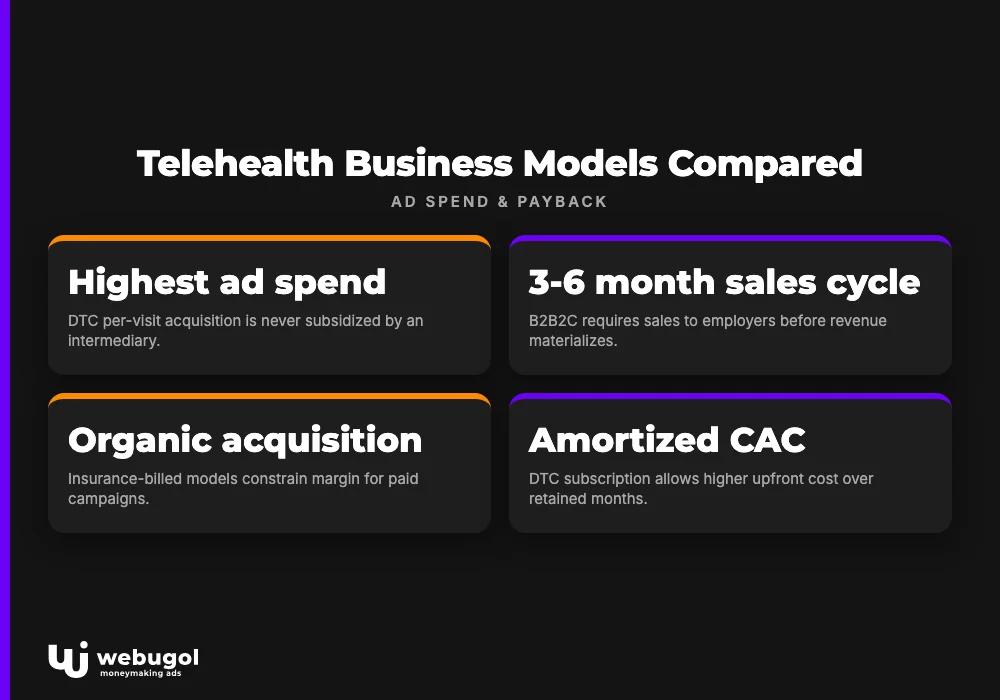
Direct-to-consumer per-visit. The patient pays out of pocket for each visit. The operator controls the full acquisition funnel from ad to booking. Telehealth ad spend is highest in this structure because acquisition is never subsidized by an intermediary. Payback must occur within the first transaction or the first two visits. If it does not, the model does not close.
DTC subscription or membership. The patient pays a recurring fee for access to care. DTC telehealth CAC is amortized over retained months, which makes a higher upfront acquisition cost viable when monthly churn is low. The acquisition strategy mirrors per-visit DTC, but the payback calculation is fundamentally different.
B2B2C via employers or health plans. An employer or benefits platform funds employee access. Consumer-level advertising is replaced by B2B sales to employers, brokers, or plan administrators. Per-member CAC drops because the contract funds access at scale rather than per-patient acquisition. The trade-off is a three-to-six-month sales cycle before revenue materializes.
Insurance-billed. The insurer reimburses the provider per visit or per episode. Acquisition is primarily organic and referral-based because reimbursement rates constrain the margin available for paid campaigns. Payback windows are compressed by claim processing cycles, which makes scaling paid acquisition difficult to model reliably.
Hybrid. Two or more revenue structures layered together. A common pattern is a DTC subscription base with an employer contract overlay. Hybrid models can expand LTV but add attribution complexity that breaks standard last-click measurement.
A structural comparison by key marketing variables:
- DTC per-visit: Patient pays. Primary channel is paid search and social. CAC must be recovered in transaction one or two. HIPAA patient acquisition compliance weight is highest.
- DTC subscription: Patient pays. Primary channel is paid search and social. Telehealth membership economics amortize CAC over subscription lifetime. Monthly retention rate is the critical variable.
- B2B2C employer: Employer or health plan pays. Primary channel is B2B outbound and broker relationships. Per-member CAC is low at contract scale. Sales cycle delays payback significantly.
- Insurance-billed: Insurer pays. Primary channel is organic, directories, and referral. CAC is difficult to measure against variable reimbursement rates. Paid acquisition is constrained by margin.
- Employer-sponsored program: Employer pays. Primary channel is enterprise sales pipeline. CAC equals total sales overhead divided by enrolled members per contract. Contract terms define the payback window.
What telehealth business model has the lowest patient acquisition cost?
DTC subscription models and employer-sponsored contracts both produce structurally lower effective CAC than per-visit DTC, but through opposite mechanisms. Subscriptions amortize acquisition cost across retained months, so a higher initial investment becomes defensible when monthly churn is stable. Employer contracts remove consumer-level acquisition entirely, replacing it with B2B sales overhead spread across hundreds of enrolled members per contract.
Per-visit DTC carries the highest effective CAC because every conversion is terminal. There is no second revenue event unless the patient rebooks, and rebooking is rarely automated or economically incentivized in early operations. Insurance-billed models are often excluded from this comparison because reimbursement rate variability makes CAC calculation structurally ambiguous before two to three quarters of claim data stabilize.
CAC dynamics by model structure:
- Per-visit DTC: CAC must be recovered in the first transaction. No LTV buffer exists unless repeat visit rate is tracked, modeled, and actively optimized through a rebooking sequence.
- Subscription DTC: CAC is recovered over the first two to four billing cycles at 70-plus percent monthly retention. Below that threshold, the payback window extends past any defensible financing horizon.
- B2B2C employer: CAC equals total sales overhead divided by enrolled members per contract. High upfront sales cost, low per-member acquisition cost at contract scale.
- Insurance-billed: CAC is difficult to compute reliably until claim reimbursement patterns stabilize. Paid acquisition modeling against projected reimbursement is high-variance at any reasonable ad budget.
Subscription telehealth revenue: the scaling engine
Continuity revenue is the structural lever that makes paid acquisition scalable at all. Without a recurring revenue layer, ad spend fills a bucket with no bottom. Every patient acquired is at risk of churning before the acquisition cost is recovered. Raising spend only accelerates that loss.
The economic logic works in a specific sequence. When monthly retention rate is known and stable, average subscriber LTV is calculable. When LTV is calculable, the maximum allowable CAC is derivable from actual revenue data rather than projections. When CAC has a ceiling grounded in real unit economics, media budgets can be set and defended with precision. This sequence converts paid acquisition from a cost to manage into a growth driver.
Operators who launch with a per-visit telehealth business model often rebuild toward a membership layer after hitting the scaling wall. The trigger is usually the same: CPA has reached a floor, revenue needs to grow, and the per-visit model cannot absorb a higher spend level without breaking the payback equation. Adding a subscription tier converts single-transaction patients into a recurring base, raises LTV on acquired cohorts, and gives the ad account room to operate at higher spend without degrading returns.
The revenue mix matters for media budget decisions. An operator with the majority of revenue in memberships can defend a higher monthly paid budget than one with the majority in per-visit fees, because the LTV base absorbs a larger initial acquisition cost. Subscription revenue is not the only lever, but it is the variable that determines whether scaling spend produces a proportional return or compounds a structural loss.
The mechanics of a functioning telehealth membership tier:
- Pricing structures: flat monthly fee, tiered by visit frequency or service scope, or program-length commitments (90 days, six months) with a lower effective monthly cost than equivalent pay-per-visit pricing.
- Renewal triggers: automatic monthly billing, quarterly check-in with an active opt-out, or milestone-based renewal anchored to clinical or outcome events in the patient's first 30 days.
- Churn-risk signals: missed appointments in month two or three, no lab kit reorder within 45 days of first prescription, no response to a 30-day check-in message. These are marketing metrics before they are clinical ones.
- Minimum retention threshold for viable paid acquisition: monthly churn above 30 percent means the subscriber base is replacing itself faster than it grows. Raising ad spend at that churn rate sustains the cycle instead of building the business.
Telehealth operators who struggle with churn measurement and retention strategy at the program level often find that model architecture, not the post-visit nurture sequence, is the actual constraint. Retention benchmarks by service type cluster around specific thresholds. Weight loss and hormone therapy programs with active clinical protocols retain at the higher end of the range when outcome delivery is consistent within the first 30 days. Async consultation models tend toward the lower end because the patient-provider relationship is less anchored to recurring, visible outcomes.
How does a subscription model change telehealth ad spend calculations?
On a per-visit model, the CAC ceiling equals the margin on the first visit. That is a tight constraint. It forces operators to keep acquisition costs low or accept short payback at thin margin.
Subscription telehealth revenue changes the math structurally. LTV becomes calculable before the first cohort completes: divide monthly subscription price by monthly churn rate. At 75 percent monthly retention, average subscriber lifetime is four months. At 85 percent, it is 6.7 months. Those two numbers produce completely different telehealth ad spend ceilings, which is why retention rate is the most important input in any subscription budget model.
The practical implication: a $300 CAC can be perfectly defensible on a $100/month subscription at 80 percent monthly retention, with payback at roughly 3.5 months, and financially indefensible on the same subscription at 60 percent monthly retention, where the subscriber churns before acquisition cost is recovered. Telehealth ad spend decisions must be made against known retention rates, not projected ones.
What unit economics should a telehealth operator calculate before scaling?
CAC, LTV, and payback period are the three required inputs before committing to a spend increase. Every other funnel optimization is secondary until these numbers are validated with actual cohort data. Clinics that scale before validating unit economics borrow against LTV they have not yet earned, and the cost becomes visible in CPA trends before anyone names it.
The telehealth business model sets hard constraints on all three inputs simultaneously. Per-visit models compress the payback window so aggressively that even a modest improvement in show rate changes the economics materially. Subscription models extend the LTV window only if churn is tracked at the cohort level, not as an aggregate number. Program models lock both revenue and churn into the program term, which simplifies LTV but introduces refund risk that per-visit models do not carry.
Unit economics formulas by model type, with the inputs that must be measured before each formula is usable:
- Per-visit DTC: LTV equals average visit price multiplied by average visits per patient per year. CAC ceiling equals LTV minus clinical and delivery cost. Payback equals first-visit net margin compared to CAC.
- Subscription DTC: LTV equals monthly subscription price divided by monthly churn rate. CAC ceiling equals LTV multiplied by your target LTV-to-CAC ratio. Payback equals months to recover CAC from net subscription margin. (Illustrative: if subscription margin per month is $80 and CAC is $240, payback is three months. Run this on your own numbers.)
- Program enrollment: LTV equals program price minus delivery cost and refund-adjusted loss. Payback is immediate when payment is upfront, spread across installments otherwise. Refund rate is the input operators most often omit from this calculation.
- B2B2C or employer contract: LTV equals contract value divided by enrolled lives. CAC equals total sales overhead divided by enrolled members per contract. Payback typically materializes at three to six months into the contract term.
The unit economics calculation also surfaces where tracking is missing. If you cannot compute your actual CAC by model because attribution visibility from ad click to paid consult is broken at the CRM stage, the payback number is a guess. Most growth-stage operators are optimizing against a guess and calling it data.
Mapping the patient journey through each stage of a telehealth funnel reveals where the unit economics actually break. The problem is often not in top-of-funnel acquisition cost but in the conversion gap between booking and first paid visit, or between first visit and subscription activation.
What is a healthy CAC for a telehealth business?
On a subscription model, CAC should be recovered within 60 to 90 days of first payment. On a per-visit model, CAC must be recovered within the first transaction or the first two visits. These are structural thresholds below which a paid acquisition strategy is financially indefensible, regardless of how strong the creative performs.
Model-specific payback calculations operators can run before increasing spend:
- Subscription model: Divide CAC by monthly net margin per subscriber. The result is payback in months. If the number exceeds three months, re-examine the LTV assumption or the churn rate before raising spend.
- Per-visit model: Compare CAC to the margin on the first visit. If CAC exceeds that margin, a defined second-visit pathway with a quantified conversion rate is required before the spend is defensible.
- Program model: Divide CAC by program enrollment price minus delivery cost and expected refund rate. Programs with upfront payment typically recover CAC faster than subscriptions, but cancellation rate collapses the math if untracked.
- B2B2C employer contract: Divide total sales cost for a contract by enrolled members at contract start. Compare to per-member-per-month revenue over the contract term. Payback is contractually predictable once enrollment count is known.
Healthy CAC is not a fixed number. It is CAC relative to LTV and a time horizon the business can finance before the next revenue event. Operators who run paid acquisition without a validated payback calculation are running a test against their current patient base as collateral.

Which telehealth business model scales best with paid advertising?
DTC subscription models scale paid advertising most predictably because the relationship between CAC, retention rate, and LTV is calculable before the first campaign launches. When monthly retention is stable, the maximum allowable CAC is derivable from real revenue data. That gives the media buyer a defensible ceiling to optimize against. Every increase in spend is a decision against a known number.
Per-visit telehealth marketing can scale with paid advertising, but only when three conditions hold: the repeat visit rate is tracked and modeled, a second-visit pathway exists with a quantified conversion rate, and the CAC-to-first-visit-margin ratio stays inside a known payback window. Most per-visit operators lack the third condition because first-visit margin is never calculated against a current cohort's actual acquisition cost.
B2B2C employer models produce the lowest absolute per-member CAC at contract scale, but they do not scale on paid advertising. They scale on enterprise sales pipeline. Conflating the two produces the most common hybrid failure pattern: running DTC paid acquisition to fund a cash gap while employer contracts are in negotiation, then discovering the DTC acquisition layer was never designed to generate the margin required to bridge a six-month sales cycle.
Insurance-billed models are the least compatible with paid acquisition at scale. Reimbursement rate variability makes LTV estimation unreliable across two to three quarters, and bid strategy becomes reactive rather than predictive.
How does HIPAA compliance limit telehealth marketing channels?
Every telehealth business model creates a distinct compliance footprint on the tracking and advertising stack. This is a live constraint on which channels are available, which optimization signals are usable, and how attribution is calculated without creating HIPAA exposure. It is not a footnote in the strategy document.
DTC models carry the full weight of HIPAA advertising rules because they operate the entire patient-facing digital touchpoint chain. When a patient clicks a paid ad, lands on a booking page, and completes a health intake form, every data handoff in that sequence requires HIPAA-compliant handling. Meta Pixel and Google Ads conversion tags, in their default configurations, transmit data in ways that may constitute impermissible disclosures under HIPAA. Consent Mode V2 and offline conversion tracking are not optional enhancements for DTC telehealth operators. They are the infrastructure that makes compliant attribution possible.
The prohibition on retargeting by medical condition surprises operators coming from non-healthcare verticals. A user who visited a weight loss consultation page cannot be retargeted with a weight loss ad under current Meta policies and HIPAA interpretations. Offline conversion tracking, which means uploading hashed CRM events back to the ad platform rather than relying on pixel-based attribution, is the HIPAA-compatible method that preserves optimization signal without transmitting protected data. Understanding HIPAA-compliant pixel and analytics configuration is a prerequisite for any DTC telehealth paid strategy, not a project for later.
Employer-sponsored models shift some compliance responsibility to the employer, who typically signs a Business Associate Agreement covering the telehealth platform. This does not eliminate HIPAA obligations on the marketing side, but it changes which data touchpoints the operator is responsible for and limits the independent retargeting available to the campaign.
Insurance-billed models face the most restrictive constraints because payer contracts often contain data use provisions that exceed standard HIPAA minimums. Paid acquisition in this model is constrained to methods that attribute performance without using protected health information.
HIPAA-compliant marketing requirements by model type:
- DTC per-visit or subscription: Consent Mode V2 activated on all tracking tags. Offline conversion import from CRM to Google Ads and Meta. No retargeting audiences built from health condition signals. Server-side tagging for any event capturing health-related intent. HIPAA Business Associate Agreements with all analytics and CRM vendors.
- B2B2C employer: Consumer-level tracking limited to pre-enrollment stages. Employer-side member data excluded from ad platform audiences. Attribution tracked at the enrollment event level, not at the condition or symptom level.
- Insurance-billed: Paid acquisition constrained to channels and attribution methods that require no PHI-based audience signals. Organic, referral, and provider directories are primary channels because data constraints make paid optimization difficult to run compliantly at scale.
The compliance layer is not a constraint on growth. It is a constraint on which growth levers are legally available and which attribution methods can be used to measure them. Operators who treat it as an afterthought discover the cost when a platform policy review removes their highest-performing audience segment without warning.

Why telehealth business models fail to scale
Structural failure in telehealth is almost always visible in the ad account before the root cause is identified. Rising CPA, declining ROAS, and flat booking volumes are symptoms. The actual cause typically sits one layer below the marketing stack, in the model architecture itself.
The six most common structural failure patterns by model type:
- Per-visit DTC: show rate collapse. Symptom in the ad account is rising CPA as booking volume increases. Actual cause is patients booking consultations and not attending, often because the booking flow is too frictionless and no pre-appointment confirmation sequence exists. The acquisition system is working. The delivery system is not.
- Subscription DTC: churn exceeds acquisition rate. Symptom is subscriber count plateauing despite rising ad spend. Actual cause is monthly churn above 25 to 30 percent, which means the acquisition engine is replacing the patient base rather than growing it.
- Per-visit DTC: no second-visit pathway. Symptom is average revenue per patient locked at first-visit price with no LTV growth over time. Actual cause is no rebooking offer, membership upsell, or follow-up product in the post-visit flow.
- B2B2C employer: sales cycle cash flow pressure. Symptom is running DTC paid acquisition to cover revenue while employer contracts are in negotiation. Actual cause is the DTC acquisition layer was not designed to bridge a three-to-six-month enterprise sales cycle and cannot generate the margin required to fund the gap.
- Insurance-billed: reimbursement rate assumption failure. Symptom is CPA appearing acceptable against projected reimbursement, then payer mix shifts and margin compresses. Actual cause is the telehealth business model was designed against a reimbursement rate that was assumed, not contracted.
- Hybrid model: attribution fragmentation. Symptom is multiple revenue streams with no unified attribution framework. Actual cause is each revenue stream has its own tracking and its own CRM stage, so the ad account optimizes for the event it can measure rather than the event that closes profitably.
The pattern that appears most often in practices that have hit a scaling wall: the ad account looks healthy by its own metrics, CTR, CPC, and booking conversion rate all appear within target, but the business metrics are flat or declining. The disconnect is always in the model-to-funnel gap. The acquisition system was built to drive bookings, not the specific type of booking that the model can close profitably at its current cost structure.
What you stop losing when the model and funnel are aligned: wrong bids against a broken payback equation, budget caps set against an LTV number nobody verified, channel allocation decisions made against attribution that does not match revenue. Each of those compounds week over week. The total cost rarely appears as a line item because it never shows up in any single report.
Audit your patient acquisition model and funnel
Your telehealth business model, unit economics, and HIPAA-compliant tracking infrastructure need to be validated together before scaling spend. Running the diagnostics separately means you fix the ad account and discover the model is the problem, or fix the model and discover the funnel is the bottleneck, or fix the funnel and discover the tracking was never measuring the right conversion events.
Webugol owns the full revenue path from ad click to recognized revenue, including model-fit analysis, funnel architecture, tracking foundation, and scaling operations as one integrated system. The Healthcare Growth System M1 sprint covers model fit, funnel economics, and tracking gaps in the first two weeks, because addressing them in sequence is the most expensive way to find out which one is the constraint.
If your current setup cannot answer what your actual CAC is by model, or what your 90-day payback looks like on the current cohort, that gap is the constraint. Book a Strategy Call to start with a structured audit of where the unit economics are breaking.
FAQ
What is the most profitable telehealth business model?
Subscription and membership models produce the highest sustained profit margin because continuity revenue allows CAC to be amortized across retained months rather than recovered in a single transaction. Weight loss and hormone therapy programs with monthly subscription pricing have shown this advantage consistently when retention holds above 70 percent monthly. Per-visit DTC can generate high revenue per transaction but requires high visit frequency per patient to produce comparable LTV.
Which telehealth business model scales paid advertising most predictably?
DTC subscription models scale paid advertising most predictably because the relationship between CAC, retention rate, and LTV is calculable before the first campaign launches. When monthly retention is stable and known, the maximum allowable CAC is derivable from real revenue data, which gives the media buyer a defensible ceiling to optimize against. Per-visit and insurance-billed models create more ambiguity because LTV is event-dependent or reimbursement-rate-dependent.
When should a telehealth company add a subscription or membership tier?
The right time to add a membership tier is when per-visit acquisition has reached a cost floor and further spend increases are not producing proportional revenue growth. That inflection signals that single-transaction LTV no longer supports the acquisition cost the market requires. Adding continuity revenue changes the unit economics and gives the acquisition strategy room to operate at higher spend levels.
How do you calculate the payback period for a telehealth patient acquisition campaign?
Divide your cost to acquire one patient by the net margin you earn per patient per month. For a subscription model, use monthly subscription price minus direct delivery cost as the denominator. For a per-visit model, the denominator is margin on the first visit, and the payback calculation only closes if first-visit margin exceeds CAC.
Can a telehealth company run retargeting ads under HIPAA?
Yes, with strict structural constraints. Retargeting audiences cannot be built from health condition signals, visit history, or any data that constitutes protected health information. Any audience that implicitly identifies a health condition or treatment context is prohibited under current HIPAA interpretations and Google and Meta platform policies. Offline conversion tracking is the compliant alternative for preserving optimization signal.

