



Customer Winback for Healthcare: The Subscription Economics Operators Miss
Customer winback is the process of re-engaging patients or members who have lapsed from active status and converting them back to paying customers. It is not a single email. It is a structured program with a defined trigger, a compliant outreach sequence, and a measurable expected value attached to every dormant name on your list. For subscription-based healthcare businesses, a churned member who reactivates costs a fraction of what a cold acquisition costs, and yet most telehealth operators still treat reactivation as something the marketing team runs once per quarter when ad spend looks high.
The operators who stop losing revenue to this gap are not running better email campaigns. They have assigned ownership, cleaned their list, and built the infrastructure so that reactivation runs before the cohort exits the window where it is still recoverable.
What is customer winback?
Customer winback is the deliberate, systematic effort to return lapsed customers to active status before the relationship degrades beyond recovery. In subscription healthcare, that window closes faster than most operators realize, typically within 60 to 90 days of the last interaction.
The goal is distinct from ongoing retention work, which focuses on preventing active members from reaching this point. For a full treatment of keeping active patients subscribed, patient retention economics covers the upstream work.
Winback approaches vary by program maturity, and understanding which stage your organization occupies determines which tactics are available to you.
- A one-time blast is a single campaign sent to all lapsed contacts, usually triggered by a revenue shortfall or a quarterly audit. It produces inconsistent results because the list is unqualified and there is no follow-up logic.
- A triggered automation sends outreach when a patient crosses a defined inactivity threshold, such as 30 days without a renewal or a missed prescription refill. It requires a clean integration between your billing system and your CRM.
- A standing reactivation program treats dormant patients as a managed asset with a named owner, a defined sequence, a compliance review cadence, and a revenue target tied to reactivation rate. This is where expected value becomes calculable and where the program compounds over time.
Most telehealth operators with over $500k in monthly revenue are stuck between the first and second stage. The move to the third is primarily an organizational decision, not a technology one.
Why your winback list is already broken before the campaign starts
The most common reason customer winback campaigns underperform has nothing to do with the email copy or the offer. The list is wrong before the first message goes out. Telehealth operators frequently launch campaigns against unaudited segments, meaning they are emailing people who canceled months ago, patients who were never properly onboarded, and contacts whose billing status does not match their CRM record.
Sending a winback customer email to someone your billing system already flagged as a hard close does not reactivate them. It creates a compliance exposure and degrades deliverability for the contacts who actually have reactivation potential.
When billing and CRM disagree about who is churned
Billing systems and CRMs define churn differently, and almost nobody reconciles them before running a customer winback campaign. Your billing platform marks a subscription as lapsed when a payment fails or a renewal is not processed. Your CRM may still show that contact as active if the last logged interaction was a support ticket that was never resolved.
A reconciled churn definition requires four things: a single timestamp standard for last active date, a shared definition of what constitutes a lapse across billing and clinical records, a suppression list that removes contacts with open disputes or formal cancellation requests, and a deduplication pass that collapses multiple records for the same patient into one row. Without these, a meaningful share of your customer winback email list contains people you should not contact, people you are already billing, or people who appear twice under different identifiers.
Who owns customer winback in a healthcare organization?
Nobody. That is the most common structural answer. Marketing owns acquisition. Customer success or care coordination owns active members. Billing owns collections. No single team holds clear accountability for the second purchase from a lapsed patient, and so the dormant list sits between departments until someone notices the revenue gap.
When a single owner is assigned to the reactivation program, the organization stops having coordination problems and starts having operational problems, which are solvable. The owner can set a reactivation rate target, pull a reconciled churn segment, and schedule the customer winback campaign without waiting for three teams to align calendars.
The following departments each touch the customer winback process in a telehealth organization, but none of them can own it in isolation.
- Marketing generates the customer winback campaigns and owns the email channel, but it does not have access to billing-verified churn data or clinical suppression flags.
- Billing knows exactly who has lapsed and when, but it does not manage outreach and often defaults to collections-style language that is inappropriate for reactivation.
- Care coordination or clinical operations holds context on why a patient disengaged, but it lacks the campaign tooling and volume capacity to run outreach at scale.
- Customer success tracks churn signals in the CRM but frequently works from a list that is not reconciled with billing, meaning it is solving for the wrong population.
Assigning a single owner, typically someone in revenue operations or growth who has read access to billing data and write access to the CRM, closes the gap. For the tactical mechanics of running a focused outreach sequence to a lapsed segment, the lapsed patient reactivation guide covers that layer in detail.
When should you run a customer winback campaign?
You should run a customer winback campaign before the cohort exits the reactivation window, not after you notice a revenue dip. In subscription healthcare, the trigger is a membership cohort approaching the point where unassisted recovery becomes statistically unlikely, typically 75 to 90 days post-lapse.
The following signals indicate that a structured customer winback program is overdue.
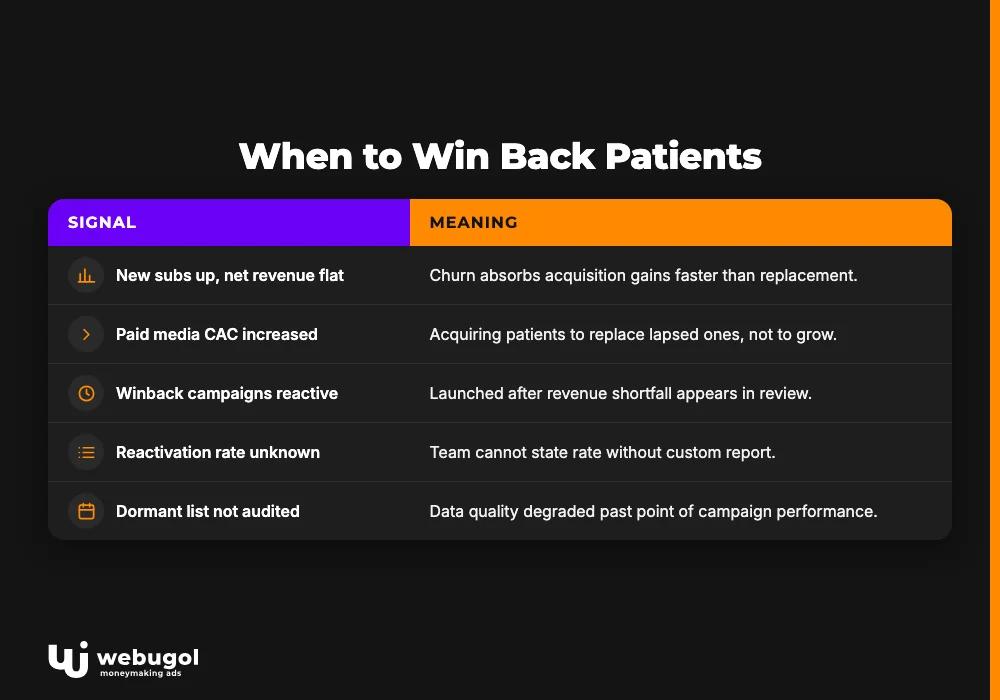
- Your monthly new subscriber count is growing but net revenue is flat, which suggests churn is absorbing acquisition gains faster than you are replacing them.
- Your paid media CAC has increased over three consecutive months without a change in targeting, which often means you are acquiring patients to replace lapsed ones rather than to grow.
- Your customer winback campaigns are launched reactively, typically after a revenue shortfall appears in a monthly review.
- No one on your team can state your current reactivation rate within 5 percentage points without running a custom report.
- Your dormant list has not been audited in more than 90 days, meaning data quality has degraded past the point where a campaign will perform.
Timing windows by patient segment: the 30/60/90-day framework
Reactivation outreach does not perform uniformly across all lapsed patients. Timing matters, and the correct timing depends on patient value and clinical context.
High-LTV patients, those whose prior subscription value places them in the top quartile of your member base, should receive outreach at 30 days post-lapse. The relationship is warm enough to reference their history, and the revenue argument for reactivation is strongest at this stage. Mid-value patients are best contacted at 60 days, where a clear value reminder and a reduced-friction re-entry offer are appropriate. Compliance-sensitive segments, which include patients in programs with clinical components such as GLP-1 management or chronic care monitoring, require separate handling regardless of LTV, because reactivation outreach in these programs must account for clinical continuity obligations.
The threshold rules per tier work as follows.
- High-LTV at 30 days: these patients qualify for direct outreach with a personalized subject line, a value recap, and a reactivation path that does not require them to restart onboarding from scratch. Exit criteria is non-response after three touches or a formal opt-out.
- Mid-value at 60 days: these patients receive a two-touch sequence with a value-focused first message and a reduced-friction offer in the second. Reduced effort means two contacts maximum before moving to passive suppression.
- Compliance-sensitive at any interval: segment these patients separately and route them through a clinical review before any outreach is sent, regardless of their LTV tier. Exit this segment immediately upon a clinical hold or an active dispute record.
For a complete breakdown of how to model these tiers against revenue impact, member LTV by cohort provides the methodology for calculating reactivation value against program cost.
How do you calculate customer winback rate?
Customer winback rate equals reactivated patients divided by total lapsed patients targeted, multiplied by 100. A realistic baseline for subscription healthcare is 5 to 15 percent, depending on list age, sequence quality, and whether the offer addresses the original churn reason.
Reactivation rate is a useful top-line metric, but revenue per reactivated patient is the number that matters operationally. If your average reactivated patient generates $240 in the 90 days following reactivation and your cost to reactivate is $18 per contact, a 10 percent reactivation rate against a 1,000-person dormant list produces approximately $24,000 in recovered revenue at a cost of $18,000 in outreach. Run those numbers with your actual figures to see whether the dormant segment is your cheapest revenue source right now.
Compliance-first winback for telehealth and clinics
Healthcare customer winback is not a B2C email marketing problem with a medical coat on. Telehealth operators face a set of constraints that make standard reactivation playbooks noncompliant by default. This is the gap most general-purpose resources miss, and it is where healthcare businesses most commonly expose themselves to regulatory and platform risk.
The operators who treat compliance as a competitive advantage rather than a constraint build reactivation programs their competitors cannot copy from a generic template.
What you cannot do in healthcare winback
Several tactics that are standard in B2C reactivation are prohibited in healthcare contexts. The restrictions come from HIPAA, from the advertising policies of Meta and Google, and from CAN-SPAM and TCPA requirements that apply when health data is involved in targeting decisions.
- Retargeting on the basis of medical conditions is prohibited under Meta's health and wellness advertising policy. You cannot build a custom audience from a list segmented by diagnosis or treatment type and run paid ads against it as part of a customer winback campaign.
- Lookalike audiences built from health data are prohibited. A lookalike audience derived from your GLP-1 or chronic care subscriber list constitutes a health data use case under Meta's policy and will be rejected or, if it runs, creates platform policy liability.
- Condition-referenced subject lines are prohibited under HIPAA's minimum necessary standard when they imply the recipient's health status to a third-party email service provider that is not a covered business associate. Subject lines that reference the patient's specific program by name in a system without a signed BAA in place are noncompliant.
- SMS reactivation without explicit re-consent after a lapse is a TCPA violation in most states. A lapsed subscription does not carry forward the original consent for marketing messages.
What a compliant winback sequence looks like
A compliant three-touch customer winback email sequence for a telehealth operator uses consent-gated channels, HIPAA-safe identifiers, healthcare-neutral subject lines, and a defined stop condition that removes the contact from further outreach without requiring manual intervention.
The required elements of a compliant sequence are as follows.
- Touch one uses a healthcare-neutral subject line that references the relationship, not the condition. An example is "We noticed you've been away" rather than a line that names a specific health program.
- Touch two introduces a frictionless reactivation path, a single-click re-enrollment link or a low-barrier consultation offer, sent over an email channel covered by a signed BAA with the ESP.
- Touch three is a final confirmation that the contact is being moved to suppression and will not receive further outreach unless they opt back in. This protects against TCPA exposure on any SMS follow-up and closes the sequence cleanly.
- Every touch includes a suppression trigger so that a response, a complaint, a hard bounce, or a formal opt-out removes the contact immediately from all active customer winback campaigns.
If your current reactivation process does not have these elements, you are running campaigns that are likely compliant by luck rather than by design. Operators who want to build this infrastructure without adding headcount can see how a 90-day reactivation infrastructure build covers list hygiene, sequence design, and compliance documentation in the first engagement phase.

5 customer winback strategies that work in healthcare
Each strategy below is adapted for the compliance and operational constraints of subscription-based healthcare, and each maps to expected reactivation economics rather than open rate alone.
1. Fix the list before the campaign
Run a billing-CRM reconciliation before any outreach goes out. Remove contacts who have open disputes, formal cancellations, or billing records that show them as fully churned with no reactivation path. The list you are left with is smaller but worth contacting. Depending on how long your lists have gone unreconciled, you may find a significant share of the original segment is either still active or already past the reactivation window, which changes both the cost and expected outcome before a single message is sent. A clean, qualified list outperforms a large, dirty one every time.
2. Segment by churn reason, not just recency
Recency-based segmentation tells you how long someone has been gone. It does not tell you why they left. Patients who lapsed because of billing friction respond to a streamlined re-enrollment offer. Patients who disengaged because they did not perceive clinical value respond to an outcome summary or a check-in from a care team member. Treating both segments with the same winback customer email template produces mediocre results from both. Churn reason segmentation requires exit-survey data or post-cancel outreach, but it moves reactivation rates measurably higher than recency-only targeting across subscription segments.
3. Build an email sequence, not a single blast
A single customer winback email generates a response spike and then nothing. A three-touch sequence with defined intervals, a value escalation from touch one to touch two, and a clear exit condition in touch three produces compounding response over the reactivation window. Customer winback email examples that perform in healthcare are structurally simple: a relationship reference, a low-friction offer, and a soft close that respects the patient's decision if they choose not to respond. The sequence also captures behavioral data that improves performance on the next cohort.
4. Reactivation over re-acquisition: the economics argument
A lapsed patient who reactivates comes with a known LTV, existing consent, and prior purchase history. That profile costs substantially less to recover than a cold acquisition at current CPL for most healthcare subscription programs above a minimum LTV floor. When ad spend rises to cover a renewal shortfall, the organization is paying full acquisition cost for patients it already paid to acquire once. Structuring a customer winback campaign before raising the media budget captures the cheaper path first. Webugol works with telehealth operators to make this shift from reactive ad spend increases to a managed reactivation system that captures the dormant list value before the ad account pays for it again.
5. Measure revenue per reactivated patient, not just open rate
Open rate tells you that the message arrived and the subject line worked. It does not tell you whether the program is worth running. Revenue per reactivated patient, calculated as total incremental revenue from reactivated contacts divided by total reactivated contacts over a 90-day window, is the metric that answers the business question. Customer winback campaigns that are measured only on open rate get optimized for open rate, which produces well-performing campaigns that do not move revenue. The three metrics that map to winback program health are reactivation rate, revenue per reactivated patient, and payback period on the reactivation investment.
The real cost of treating reactivation as a one-time blast
The cost is not just the missed reactivation revenue. It compounds across multiple budget lines.
- Incremental CAC from replacement acquisition is the most direct cost. Every churned patient who is not reactivated must be replaced by a cold acquisition, carrying your full media cost, agency fees, and onboarding overhead.
- Deliverability degradation occurs when lapsed contacts accumulate on your active list without suppression. Hard bounces and low engagement signals reduce inbox placement for your entire contact base, including active members.
- Compliance exposure accumulates with each campaign run against a dirty list. A single TCPA complaint from a lapsed patient who received a text message without current consent can cost more than the revenue from an entire reactivation campaign.
- Organizational inertia sets in when winback is nobody's job. Teams stop auditing the dormant segment because there is no incentive or accountability to do so, and the list degrades further each quarter.
- Lost compounding value from the dormant list is the least visible cost. A well-managed dormant segment retains reactivation potential for six to twelve months in most subscription healthcare programs. After that, expected value per contact drops sharply and cold acquisition becomes the only path.
You are not being conservative by skipping the reactivation program. You are paying full acquisition price to refill a bucket with a hole in it.

Build a reactivation program before you raise the ad budget
If your monthly media spend has increased in the last 90 days and net revenue growth has not kept pace, the most likely explanation is that you are using paid acquisition to fill a hole that reactivation should cover at a fraction of the cost. The lever most operators reach for first, more ad budget, is the most expensive one available.
Customer winback strategies that compound do not start with the campaign. They start with ownership, a reconciled list, a compliant sequence design, and a measurement framework tied to revenue rather than engagement metrics. Valhalla Vitality reduced CAC by 45 percent and increased monthly revenue by 287 percent by building this kind of infrastructure rather than scaling spend into a leaky funnel. Ways2Well generated $2.1M in revenue in six months through a system that treated reactivation as a deliberate revenue lever alongside acquisition.
The Healthcare Growth System is the structured program for operators ready to treat reactivation as an asset rather than an afterthought, built and operated as one accountable system covering tracking, funnel, sequence automation, and reporting.
FAQ: customer winback
What is the difference between winback and retention?
Retention keeps an active patient subscribed; customer winback re-engages a patient who has already churned. The two programs operate on different populations with different channels, messaging, and economics, and conflating them is one reason neither gets dedicated ownership in most healthcare organizations.
How do you calculate customer winback rate?
Divide the number of reactivated patients by the total lapsed patients targeted in the campaign and multiply by 100. For subscription healthcare, weight the rate by segment LTV to get revenue per targeted patient, which is the more useful metric for evaluating program economics rather than campaign delivery.
What should a winback email include?
A healthcare winback email should include a compliance-safe subject line that references the patient's prior relationship without medical condition language, a single reactivation offer or updated value statement, and a visible opt-out mechanism. The email must not reference diagnoses, treatment history, or health data in any targeting signal or subject line.
Can telehealth providers run retargeting as part of a customer winback campaign?
Retargeting audiences built from health data or segmented by medical condition violate Meta and Google advertising policies and create HIPAA exposure. Compliant alternatives include email-only sequences on BAA-covered platforms and consent-gated SMS to patients who have provided explicit current consent for marketing messages.
When should you stop pursuing a churned patient?
Stop after three contacts with no response, after a formal opt-out or cancellation request, or when the patient's lapse date exceeds your defined reactivation window, typically 90 days for most subscription healthcare programs. Continuing outreach beyond these thresholds increases compliance risk without meaningfully increasing reactivation probability.

