



Anti-Aging Clinic Marketing: Build a System That Fills Your Calendar
Anti-aging clinic marketing works when it reaches patients searching for treatments, converts that attention into booked consultations, and keeps them returning for the maintenance programs that drive most of a practice's long-term revenue. It runs as a system. This guide walks through what that structure looks like and where most clinics quietly lose growth they haven't measured yet.
The same structural weakness that stalls a new clinic on its first campaigns keeps an established practice with $20k-plus in monthly ad spend from breaking past its growth ceiling. The failure is always the same.
Nobody owns the full path from ad click to attended appointment, and that gap shows up identically whether you're three months into a hormone optimization launch or three years into scaling a medspa.
How do anti-aging clinics attract new patients?
Anti-aging clinics attract new patients through search-first visibility, consistent social proof, and educational content built for a longer-than-average research window.
Patients comparing providers for hormone therapy, aesthetic procedures, or regenerative treatments spend weeks researching before they book. They read credentials, review documented results, and often follow a clinic for months. A generic listing won't hold that attention.
What works is treatment-specific content that answers the exact questions patients type into search, an active anti-aging clinic profile on Google with current photos and service detail, and a review strategy that produces consistent, recent feedback.
Specificity is what drives wellness clinic patient acquisition at the search level. A patient typing "PRP facial [city]" or "testosterone therapy near me" needs to land on a page built around that exact query. One general services page cannot rank for, or convert, a patient who already knows what they want.
What marketing channels work best for anti-aging clinics?
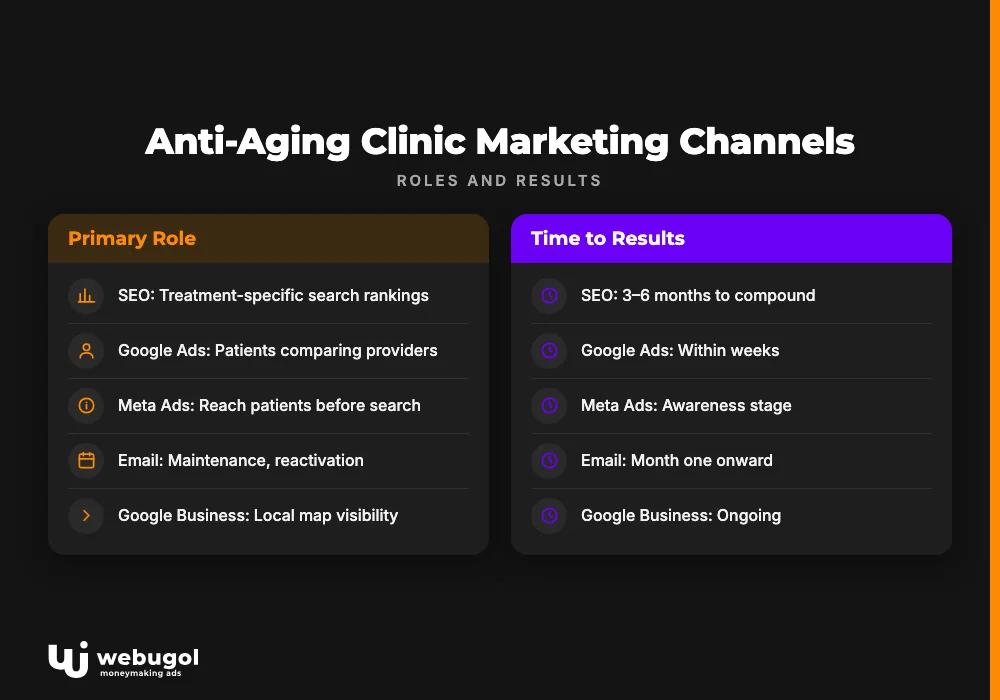
The strongest combination for anti-aging clinic marketing is search-intent capture through SEO and Google Ads, paired with social channels for earlier-stage awareness and email for repeat visits.
| Channel | Primary role | Time to results |
|---|---|---|
| Aesthetic clinic SEO | Treatment-specific search rankings | 3–6 months to compound |
| Google Ads | Patients actively comparing providers | Within weeks |
| Medspa paid ads (Meta) | Reach patients before they search | Awareness stage |
| Email marketing | Maintenance visits, reactivation | Month one onward |
| Google Business Profile | Local map pack visibility | Ongoing |
No single channel carries the whole load. Clinics that grow fastest run organic and paid search together: SEO builds compounding visibility while ads generate volume in the meantime.
Aesthetic clinic SEO and local search
Most prospective patients start with a search. Healthcare local SEO for anti-aging practices means treatment-specific service pages, consistent business profile management, and on-page signals tied to individual procedures rather than an aggregated services page. Aesthetic clinic SEO that targets specific treatments outranks and outconverts a generic "services" approach at nearly every market level.
Paid ads and anti-aging advertising
Google Ads capture patients in active comparison mode. Meta Ads work for reaching people earlier, before they have committed to a clinic. Anti-aging advertising faces stricter platform review than general wellness content because claims can edge into medical territory. Dedicated landing pages, one per treatment, consistently outperform sending traffic to a homepage.
Social media, medspa paid ads, and content
Medspa paid ads on Meta and Instagram work best when paired with organic educational content that pre-qualifies the audience before the ad is seen. Understanding how social channels shape patient decisions matters because platform algorithms actively restrict health content organic reach. Pairing educational posts with paid amplification is more reliable than posting volume alone.
Email for wellness clinic patient acquisition
Anti-aging treatments are recurring by nature. Maintenance visits, program renewals, and new treatment launches all map naturally to an email sequence. Email follow-up programs for anti-aging clinic patients that combine maintenance reminders, educational content, and reactivation messages lower the cost of growth by keeping existing patients engaged between visits.
Is before-and-after advertising allowed for aesthetic clinics?
Before-and-after advertising is permitted for aesthetic clinics in most US contexts, but platform restrictions are tight and can escalate to account-level consequences.
Google restricts before-and-after imagery in ads for medical and cosmetic procedures. Meta applies comparable rules under its health and wellness advertising policies.
What platforms generally allow: procedure descriptions, provider credentials, educational treatment content, and testimonial-format reviews within specific ad structures. What they reject: outcome-guarantee language, dramatic comparative imagery, and retargeting audiences built from health-condition signals.
Build compliance into the strategy before creative production. Clinics that fix compliance after an ad gets rejected risk account suspensions that are harder to reverse than to prevent. A compliance reviewer in the approval chain and documented patient consent for any imagery used are baseline requirements for any anti-aging advertising program.
Building your anti-aging clinic marketing strategy step by step
An effective anti-aging clinic marketing plan follows a repeatable sequence, whether you're launching a new program or diagnosing why growth has stalled:
- Define the ideal patient: specific treatments, price point, and the demographics the practice actually serves.
- Audit the current funnel: website, booking flow, and existing ad accounts. Find where patients drop off.
- Build dedicated service pages: one per core treatment, not a general services menu.
- Set up end-to-end tracking: connect ad clicks to calls, booked appointments, and attended visits. Advanced analytics that trace spend to booked-patient revenue separate optimization from guessing.
- Layer channels: run paid search while organic rankings build; start email sequences from month one.
- Fix intake before scaling: speed-to-lead, show rate, and follow-up cadence affect cost-per-patient as much as ad quality does.
- Review and reallocate monthly: reinvest what produces booked consultations; cut what doesn't.
Clinics building a hormone clinic marketing strategy will find that patient education is the core conversion lever, content and email typically do more work here than they do for faster-moving aesthetic treatments.
Common gaps that cap anti-aging clinic marketing growth
These patterns appear consistently when auditing clinics not growing as fast as their treatment quality justifies:
- One page covers every treatment, so no service can rank or convert on its own.
- Ads send traffic to a general homepage instead of a landing page built for the specific treatment someone searched.
- The practice competes on price rather than leading with provider expertise and documented outcomes.
- The existing patient list is neglected while budget chases new leads, even though maintenance visits are the lowest-cost revenue to recapture.
- Compliance is treated as a post-launch fix, creating ad disapprovals and eroding patient trust.
Fixing two or three of these gaps typically produces more booked volume than adding a new channel.
What a tracking-first approach delivers
The LifeRx MD engagement shows what happens when measurement and funnel structure are fixed before spend scales: the medical spa practice achieved a 156% increase in bookings and an 85% improvement in patient LTV after rebuilding the acquisition system around end-to-end tracking first.
The pattern holds across 50-plus healthcare and wellness clients Webugol works with: lead quality and CPA improve when the measurement layer is fixed, not when more budget is added on top of an undiagnosed funnel. That principle applies across every practice type, consistent anti-aging clinic marketing results come from structure, not spend.
Ready to build a patient acquisition system?
If your calendar has gaps that ad spend isn't reliably filling, the problem is usually upstream of the ads. Book a Strategy Call through the Healthcare Growth System to find where your patient acquisition path is leaking and what it costs to fix.
FAQ
How do anti-aging clinics attract new patients?
Anti-aging clinics attract new patients through treatment-specific search pages optimized for high-intent local queries, an active Google Business Profile that captures map pack traffic, and consistent social proof through recent reviews and documented results. Paid ads accelerate volume when they send traffic to dedicated landing pages matched to each treatment.
What marketing channels work best for anti-aging clinics?
Organic search and Google Ads produce the strongest direct return because they reach patients already comparing providers. Email and retention sequences handle maintenance visits and program renewals, which generate a large share of total revenue at a much lower cost than new-patient acquisition.
Is before-and-after advertising allowed for aesthetic clinics?
Before-and-after imagery is restricted in Google and Meta ads for cosmetic and medical procedures. Clinics can advertise treatment descriptions, provider credentials, and testimonial-format content within platform guidelines, but outcome-guarantee language and dramatic comparative visuals are typically rejected and can trigger account-level restrictions.
How much does marketing a medical spa cost?
Medical spa marketing budgets depend on market size, the number of treatments being promoted, and growth stage. Independent anti-aging practices typically see measurable results with a combined investment across SEO, paid ads, and content; clinics with $20k-plus in monthly ad spend often have more to gain from fixing funnel efficiency than from adding budget.
How to increase consultations for anti-aging treatments?
Increasing consultation volume requires improvements at both ends of the funnel: treatment-specific landing pages, faster lead response, and follow-up sequences built for the longer research cycle typical of aesthetic patients. Fixing intake speed and show rate usually reduces cost-per-booked-consultation more than raising ad spend alone.

