



SEO for Medical Weight Loss Clinics: Attract New Patients
SEO for medical weight loss is the process of improving your website's visibility in Google search so patients find your clinic before they find a competitor. It is the long-term pillar of any medical weight loss clinic marketing strategy, converting searchers who are already motivated to book. Done right, it generates consistent, compounding patient traffic that paid ads cannot replicate.
How does SEO help medical weight loss clinics get more patients?
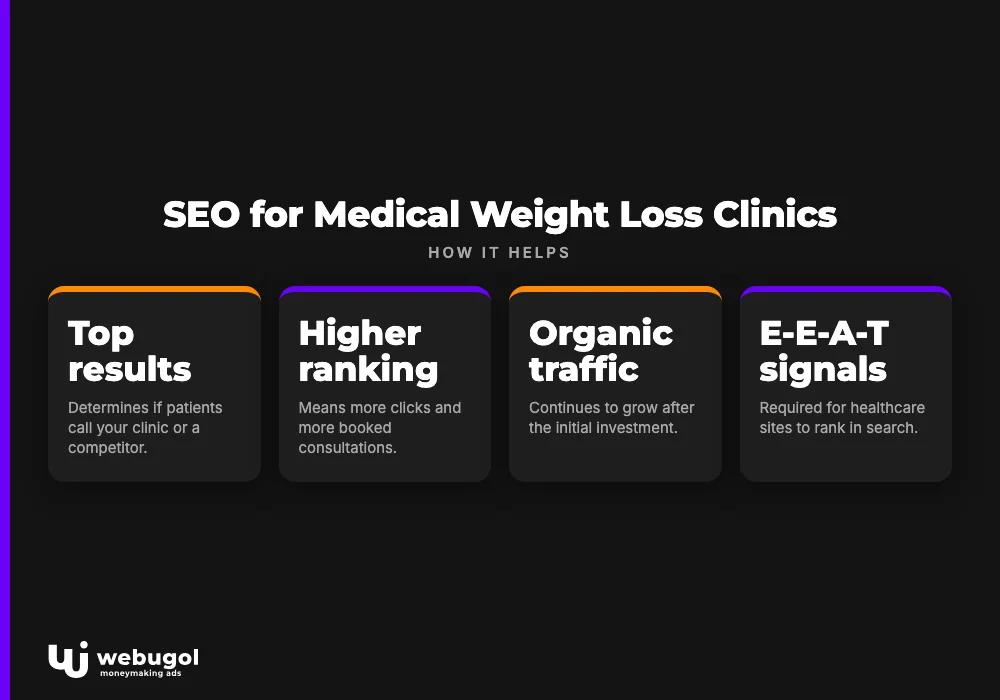
SEO connects your clinic with patients at the exact moment they search for help. When someone types "medical weight loss near me," appearing in the top results determines whether they call you or a competitor. That placement is everything.
A higher weight loss clinic Google ranking means more clicks and more booked consultations. Organic traffic continues to grow after the initial investment, while paid ad traffic stops the moment a budget runs out.
Here is what a complete SEO for medical weight loss program covers:
| SEO component | What it does | Patient impact |
|---|---|---|
| Local SEO | Ranks your clinic in Google Maps and the local pack | Drives calls and in-person visits |
| Google Business Profile | Displays clinic info and reviews in search | Builds trust before first contact |
| Content marketing | Answers patient questions throughout the funnel | Attracts decision-ready searchers |
| Technical SEO | Ensures Google can crawl and index your site | Protects all other SEO efforts |
| Link building | Earns authority signals from external websites | Lifts overall domain rankings |
| E-E-A-T signals | Demonstrates medical expertise and trust | Required for healthcare sites to rank |
What local SEO strategies work best for weight loss clinics?
The two strategies that deliver the most consistent local SEO results for weight loss clinics are Google Business Profile optimization and location-specific website pages. Most patients search within a few miles of home, so both tactics are aimed at geographic proximity and relevance.
How to optimize Google Business Profile for a weight loss clinic?
Your weight loss Google Business Profile is the highest-leverage free tool in healthcare local SEO. It appears in Google Maps and the local pack when someone searches your clinic name or "weight loss clinic near me." The three-pack captures a disproportionate share of local clicks. Getting there requires consistency and active management.
Four areas to optimize:
- Name, address, phone number. Keep these identical across your website and every online directory. Any inconsistency suppresses your weight loss clinic Google ranking.
- Photos. Upload images of your clinic, staff, and equipment. Real photos reduce patient hesitation before they ever walk through the door.
- Reviews. Request feedback ethically from satisfied patients and reply to every review. Review volume is a confirmed local ranking factor.
- Services and attributes. List every program you offer, from medically supervised diets to prescription management. Completeness signals relevance to Google.
For a step-by-step setup walkthrough, see our complete guide to healthcare profile optimization.
Beyond your GBP, weight loss website optimization requires a dedicated page for each city or neighborhood you serve. Each page needs original, location-specific content. Copy-pasted templates with swapped city names draw penalties, not traffic.
What keywords should a medical weight loss clinic target for SEO?
Effective medical weight loss clinic marketing depends on targeting the right search terms. Start with three tiers: service keywords ("medical weight loss [city]," "medically supervised weight loss near me," "weight loss doctor"), condition keywords ("how to lose weight with a doctor," "prescription weight loss options"), and program keywords tied to the specific treatments you offer.
Long-tail phrases convert better. A patient searching "medical weight loss clinic that accepts [insurance]" is far closer to booking than someone searching "how to lose weight." The supporting keyword cluster for this topic includes "patient acquisition weight loss," "weight loss clinic local SEO," and "healthcare local SEO," each mapping to a distinct stage of the patient search journey.
Before writing a page around any term, verify it has meaningful search volume in your target geography using Google Search Console or a keyword research tool.
Publish content that ranks and builds authority
Blog content is how SEO for medical weight loss practices captures the long-tail queries that service pages never address. We use the BARS framework to structure every piece:
- B: Buyer's journey. Create content at each stage: awareness, consideration, and decision.
- A: AI-proof. Include physician commentary, patient case notes, and clinic-specific data. These signals cannot be replicated from generic sources and carry strong E-E-A-T weight.
- R: Rankable. Target terms where your domain authority gives you a realistic chance of reaching page one.
- S: Search volume. Confirm that actual demand exists before writing a page around a phrase.
If your clinic offers GLP-1 programs, those pages require a separate content strategy with distinct patient acquisition economics. See our breakdown of GLP-1 clinic patient acquisition for a program-specific approach.
Pairing your content calendar with medical content writing that prioritizes both accuracy and search performance keeps clinical quality and SEO aligned at scale.
Technical SEO foundations for weight loss websites
Technical weight loss website optimization means making your site easy for Google to crawl, index, and render. Strong content cannot rank on a broken foundation. Every other SEO investment depends on this layer.
Audit four areas:
Crawl errors. Use Google Search Console to find 404 errors and coverage issues. Redirect or fix every blocked page.
Page speed. Compress images, minimize JavaScript, and use a reliable host. Slow pages raise bounce rates and suppress rankings.
Mobile experience. Most health searches happen on phones. Your site must work flawlessly on every screen size.
Internal linking. Connect service and blog pages with descriptive anchor text. Clear link structure helps Google map your site and helps patients find booking pages.
Build authority with backlinks and E-E-A-T
Google applies stricter quality standards to healthcare websites. E-E-A-T measures Experience, Expertise, Authoritativeness, and Trustworthiness. A clinic that fails these signals will not rank regardless of content volume or technical quality.
Three ways to strengthen E-E-A-T:
- Have a licensed physician author or review every clinical page, with a bio that lists credentials and professional affiliations.
- Build a thorough "About" page for each member of your medical team covering education, certifications, and experience.
- Add patient testimonials and case studies with proper consent. Video testimonials carry additional trust weight with both patients and Google.
Backlinks reinforce E-E-A-T. A citation from a local news outlet, a medical association directory, or a health resource tells Google your clinic carries recognized authority.
Effective tactics include digital PR (press releases for clinic expansions or new treatments), publishing original clinic data, and creating downloadable tools like BMI calculators or meal planners that earn organic citations. Avoid purchased links. They carry real penalty risk.
How long does SEO take to show results for a medical practice?
SEO for medical weight loss is a long-term investment, not a quick-win tactic. Paid ads deliver immediate visibility, while organic rankings build over months of consistent work.
Local healthcare SEO generally responds faster than broad organic competition because the pool of competing clinics is geographically bounded. The timeline depends on your starting domain authority, publishing consistency, and how actively you manage your Google Business Profile.
Start growing your patient base today
SEO for medical weight loss is a channel that compounds. Every page you publish and every citation you earn builds a durable asset that delivers returns without ongoing ad spend.
Webugol is a digital marketing agency focused on healthcare practices. We handle weight loss clinic local SEO, technical audits, content strategy, and GBP management under one account team with deep healthcare experience. Explore our medical weight loss SEO services and request a free audit.
FAQ
How does SEO help medical weight loss clinics get more patients?
SEO places your clinic in front of patients who are actively searching for weight loss doctors at the exact moment they are ready to decide. Higher rankings in local results and organic search translate directly to calls and booked consultations. Organic traffic also compounds over time, making SEO a more sustainable acquisition channel than paid advertising.
What local SEO strategies work best for weight loss clinics?
Optimizing your Google Business Profile and building location-specific landing pages deliver the most consistent local ranking gains. Keeping your name, address, and phone number identical across all online directories prevents suppression in local search. A steady stream of genuine patient reviews is a confirmed ranking factor for the local pack.
How to optimize Google Business Profile for a weight loss clinic?
Complete every section of your profile: services, hours, photos, and attributes. Request reviews from satisfied patients and reply to all feedback to demonstrate engagement. Keep your business name, address, and phone number exactly consistent across your website and every online directory.
What keywords should a medical weight loss clinic target for SEO?
Target service keywords such as "medical weight loss [city]," condition keywords like "weight loss doctor near me," and treatment-specific terms tied to your programs. Long-tail phrases specifying insurance, treatment type, or location convert at higher rates than broad weight-related searches.
How long does SEO take to show results for a medical practice?
SEO for medical practices builds over months of consistent work, unlike paid ads that deliver immediate but temporary visibility. Local healthcare SEO generally moves faster because geographic competition is more limited. Consistent publishing, active GBP management, and a technically sound website all accelerate the timeline.

