



Women's health marketing: strategies that drive results in 2025
Women's health marketing works when brands treat female patients as informed, research-driven decision-makers. The sector spans FemTech platforms, hormone therapy clinics, gynecology practices, menopause wellness products, and telehealth services. Each demands a distinct approach. But all share a single requirement: clinical credibility paired with transparent communication.
The investment behind this shift is concrete. Women's health startups raised $3.2 billion in venture capital in 2024, up 400% over five years, according to Rock Health's 2024 Digital Health Funding Report. That capital is reshaping competition across every segment, from independent gynecology practices to enterprise telehealth platforms. Brands that ignore the pace of change will see it in their patient acquisition numbers.
The table below maps the main service categories to the digital channels that consistently outperform:
| Service category | Top-performing channels |
|---|---|
| FemTech apps and wearables | App store SEO, content marketing, social proof |
| Hormone and menopause clinics | Local SEO, paid search, email nurture |
| Gynecology practices | Local SEO, patient reviews, telehealth listings |
| Menopause wellness products | Email, influencer campaigns, subscription flows |
| Telehealth for women | Paid search, content SEO, referral networks |
What is FemTech and how do brands market it?
FemTech covers digital health technologies built specifically for women: reproductive tracking, hormone monitoring, pelvic floor care, menopause management, and mental health support. Femtech marketing strategies that convert consistently share three characteristics. They lead with peer-reviewed clinical evidence. They treat data privacy as a product differentiator. They prioritize interfaces that reduce friction across complex, ongoing health journeys.
Period-tracking apps illustrate how this category has matured. Modern platforms layer symptom tracking, mood monitoring, and predictive analytics onto what began as a simple calendar function. The FDA cleared Natural Cycles as the first app-based contraceptive, a development that changed how regulators, investors, and marketers all think about women's digital health tools.
Machine learning now plays a direct clinical role. Algorithms analyze large health datasets to detect hormonal imbalances and predict reproductive windows with accuracy that manual tracking cannot match. Brands that build these capabilities and communicate them clearly hold a meaningful credibility advantage in a market where skepticism about health claims runs high.
Elvie (pelvic floor devices) and Modern Fertility (fertility testing) built strong market positions by anchoring every campaign to a specific, verifiable clinical outcome. Aspirational lifestyle imagery did not drive their growth. A healthcare brand digital strategy built on clinical outcomes will outperform one built on aesthetics alone.
Corporate alliances are accelerating development in this category. Established women's health companies are partnering with early-stage startups, giving startups distribution resources while gaining access to newer technology. These partnerships have driven some of the most significant product innovation in the FemTech sector over the past two years.
Data privacy is a competitive differentiator on its own. Privacy policies in plain language, visible data deletion options, and transparent disclosures about third-party data sharing convert skeptical users who have already read press coverage on health app data practices.
How to market a hormone therapy clinic online?
Hormone clinic marketing works best through a combination of local SEO, targeted paid search, and educational content that addresses the specific questions patients research before booking. Women seeking hormone therapy typically spend weeks comparing providers and reviewing clinical approaches before making first contact. The clinic that appears consistently across search and answers those questions with verifiable information will capture most of that demand.
Menopause wellness marketing is a high-priority segment within this category. Companies like Gennev and Elektra Health have normalized medical and lifestyle support for menopausal women, creating a broader addressable market than earlier generations of providers ever reached.
Conventional hormone replacement therapy is no longer the only demand driver. Adaptogenic supplements, hormone-balancing skincare formulations, and targeted nutrition programs now sit alongside clinical services. Brands like Ritual and HUM Nutrition built loyal audiences by pairing customized supplementation with deep educational content on specific hormonal conditions.
Telehealth marketing for women gives hormone clinics a reach advantage over purely in-person competitors. Remote consultation reaches patients who would not travel to a physical location for an initial appointment and removes access barriers that still prevent many women from seeking specialized hormonal care. The telehealth advertising guide for women's health practices covers the tactical specifics.
For local clinics, local SEO determines whether a nearby patient finds you or a competitor first. Structured service pages, Google Business Profiles optimized with specific treatment terms, and condition-focused content each contribute to local visibility. The healthcare local SEO guide for medical practices covers this in detail.
What women's health marketing strategies actually work?
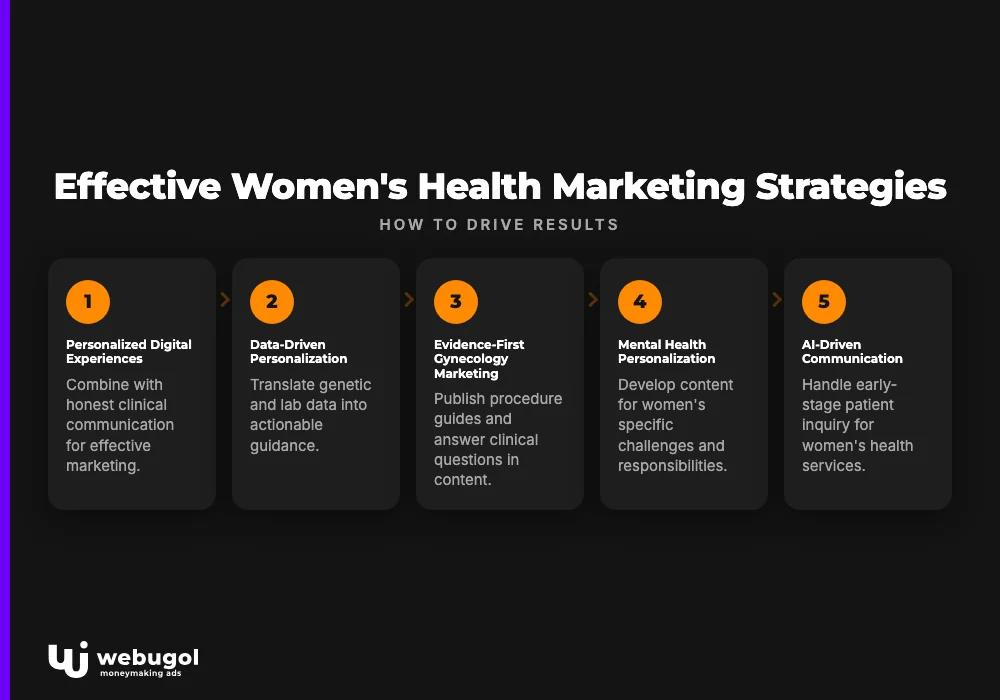
Effective women's health marketing combines personalized digital experiences with honest clinical communication. Women conducting pre-purchase research compare clinical claims, cross-reference provider credentials, and read independent patient reviews before making contact. Brands that are verifiable at every stage convert. Those relying on aspirational messaging without supporting evidence do not.
Personalization at scale works when it starts from real data. Companies like 23andMe and Everlywell built audience trust by translating genetic and lab data into specific, actionable guidance tied to individual profiles.
Care/of and Ritual applied the same logic to vitamins, creating personalized packs from detailed intake questionnaires. The subscription model sustains this long-term: monthly delivery keeps users engaged and generates feedback data that improves recommendations over time.
Gynecology marketing follows the same evidence-first logic. Practices that publish procedure guides, answer clinical questions in long-form content, and collect verified patient reviews consistently outperform those relying on brand awareness alone. A structured patient email retention approach for healthcare providers extends this advantage beyond the first visit, converting single appointments into sustained care relationships.
Mental health personalization is a fast-growing sub-category within women's health. Platforms like Headspace and Shine have developed content designed for the specific challenges women face, reflecting the reality that women carry layered responsibilities and need mental health support that addresses them directly.
AI-driven communication now handles early-stage patient inquiry for many women's health services. Chatbots answer common questions and run preliminary assessments around the clock. Many women report greater comfort raising sensitive concerns through an AI interface than with a human receptionist, which matters in gynecology and hormonal health contexts where embarrassment still suppresses direct contact.
The midlife and menopause segment is one of the clearest growth opportunities in the sector. Today's menopausal generation is more health-informed and more financially independent than any prior cohort. Cooling sleepwear, specialized skincare for changing skin needs, and metabolic nutrition programs have all grown fast. Brands like Kindra and Pause Well-Aging are building dedicated menopause wellness lines for this demographic. Declining stigma, driven by open social conversations, gives brands permission to market these categories directly and visibly.

What digital channels drive the most results for women's health services?
For most brands, the right women's health marketing channel mix starts with search and builds outward from there. Organic and paid search form the primary patient acquisition engine. Social builds reach and community. Email retains and reactivates. The sequencing is consistent: search brings patients in, content builds trust, and email keeps them returning.
Search is non-negotiable. Women researching symptoms, treatment options, and providers start with Google. Building durable organic search visibility for a women's health business requires consistent publishing of condition-specific, clinician-reviewed content that answers the exact terms patients type. One well-ranked article on perimenopause symptoms can drive qualified patient traffic for years at a fraction of paid acquisition cost.
Social platforms accelerate community formation and brand awareness, particularly in menopause wellness and FemTech. Kindra and Pause Well-Aging built substantial audiences on Instagram and TikTok by normalizing conversations that mainstream media had largely ignored. Healthcare social media strategies built around patient decision-making now account for measurable new patient acquisition in categories where stigma once suppressed organic search volume entirely.
Telehealth directories and app store placement represent a search layer that conventional SEO does not cover. FemTech companies that optimize telehealth platform listings and invest in app store ratings reach patients who never arrive through brand websites or standard search paths. This acquisition channel remains underdeveloped at most competitors.

How do healthcare brands build trust with female patients?
Trust is the primary conversion factor in women's health marketing. Women research extensively before booking or purchasing: they compare clinical claims, check provider credentials, and cross-reference patient outcomes across multiple sources before making contact. Consistency between what a brand promises in its marketing and what a patient actually experiences determines whether that patient returns and refers others.
Transparency is a differentiator. Ritual built strong retention by publishing its complete supply chain and manufacturing processes alongside clinical references for each ingredient. That level of disclosure converts skeptical consumers who have already filtered out brands making unsupported claims. The standard: name sources for clinical data, disclose known limitations, and correct earlier claims when evidence changes.
Scientific credibility without human empathy will not convert. Rigorous evidence delivered in cold clinical language misses the mark for most patients. Women's health brands that use real patient language, represent the full range of health experiences, and match marketing promises with actual care delivery earn loyalty that outlasts any product cycle.
Ethical marketing means resisting overclaiming. Women who research deeply identify exaggerated efficacy statements and share findings publicly. Brands that lead long-term in this space make conservative, verifiable claims and build credibility through consistent clinical accuracy rather than aspirational language.
Investment confirms the scale of the opportunity. The $3.2 billion raised by women's health startups in 2024 is enabling more comprehensive research, broader distribution partnerships, and accelerated product innovation from reproductive technology to menopause care.
Build a women's health brand that earns patient trust
Webugol is a digital marketing agency that builds healthcare brand digital strategies for women's health brands, FemTech platforms, hormone therapy clinics, and telehealth services. We connect clinical credibility with the search, content, and email channels that convert female patients into long-term relationships. Contact us to discuss a strategy built for your specific service category and market.
FAQ
What marketing strategies work best for women's health brands?
The highest-performing women's health marketing strategies combine educational content with clinical credibility, targeted paid search, and structured email nurture programs. Personalization through data-driven product recommendations or tailored content paths consistently outperforms generic campaigns aimed at a broad female demographic.
How do hormone therapy clinics attract new patients online?
Hormone therapy clinics perform best with local SEO to reach nearby patients, educational content answering pre-booking questions, and paid search targeting high-intent terms. Clinics offering remote options should also invest in telehealth directory listings, which reach patients who specifically prefer virtual consultation over in-person visits.
What is FemTech and why does it matter for digital marketing?
FemTech is the category of digital health products built specifically for women, including reproductive tracking apps, menopause platforms, pelvic health devices, and fertility tools. Marketing these products requires an evidence-first approach, strong data privacy positioning, and messaging that reduces the perceived barrier to first use.
How do women's health brands earn long-term patient trust?
Trust builds through consistent transparency: naming sources for clinical claims, publishing product limitations alongside benefits, and matching marketing promises with actual care delivery. Women conduct extensive pre-purchase research, so brands that publish verifiable evidence at every stage of the patient funnel earn durable, compounding loyalty.

