



Telehealth Advertising Strategies for Healthcare Growth
Telehealth advertising works when it is built as a system, not assembled as a set of channels. For owners and growth leads running telehealth operations at $500k or more per month in revenue, the question is rarely which platform to add. It is why spend keeps rising while bookings stay flat. This guide covers the platforms, compliance requirements, and measurement structure that determine whether your patient acquisition actually scales.
How to advertise telehealth services?
Advertising telehealth services requires a different structure than traditional healthcare marketing because the buying decision happens entirely online. No clinic to walk past, no referral from a neighbor, no front-desk staff to make an impression. Every step from first contact to booked consult runs through your digital infrastructure.
That structural reality is the same whether you are launching your first telehealth program or managing a platform processing thousands of appointments per month. The difference is that an established operator with a broken funnel loses more revenue per broken day than a newer provider building from scratch, which means the same question ("where is the conversion falling off?") has higher stakes.
A functional telehealth advertising program covers four layers:
- Demand capture: paid search for patients actively searching for telehealth services
- Demand creation: paid social for patients who do not yet know your practice exists
- Organic authority: SEO and content that reduce long-term reliance on ad spend
- Conversion infrastructure: landing pages, booking flows, and intake operations that close what ads open
Most telehealth companies have at least two of these layers running. Those with flat CPA and stalled growth typically have gaps at layer four. Spending more on telehealth advertising into a broken booking flow does not solve the problem. It makes the problem more expensive.
What platforms work best for telehealth advertising?
Google Search Ads and Meta (Facebook/Instagram) are the primary channels for most telehealth programs. Each solves a different acquisition problem, and most programs need both.
Telehealth Google Ads: capturing active demand
Telehealth Google Ads target patients already searching for a solution. That intent signal makes paid search the highest-intent channel in healthcare paid ads, which is why CPLs tend to be higher here but close rates are stronger.
Search campaigns perform best when keyword targeting is specific. Long-tail phrases aligned to a condition, service, or geography consistently outperform broad healthcare terms. Call extensions, sitelink extensions, and location data add patient-facing context that improves click-through rates before the patient reaches your landing page.
For telehealth programs running $10k or more per month in ad spend, structuring campaigns by service line rather than a single brand campaign improves Quality Score, reduces wasted spend, and makes performance attribution cleaner. What Google Ads can accomplish for your business goals depends heavily on that structural setup, not just the bid strategy.
Meta and paid social: building awareness before intent forms
Facebook and Instagram advertising builds awareness among patients who are not actively searching. For telehealth services with longer consideration cycles, such as weight loss programs, TRT, or men's health memberships, paid social accelerates the top of funnel and supports retargeting sequences.
Healthcare paid ads on Meta require careful audience configuration. Platform policy restricts targeting based on health conditions. Retargeting audiences must be built from behavioral signals, not inferred medical data. That is not optional compliance language. It is the difference between a running campaign and a suspended account.
LinkedIn reaches a different buyer. For B2B telehealth and employer wellness programs, LinkedIn's professional targeting provides access to HR decision-makers and benefits buyers that consumer platforms cannot match. How social platforms shape patient behavior and decision-making informs how you sequence awareness and conversion across paid channels.
Video and organic content
YouTube pre-roll and short-form video on TikTok work best as trust channels. A brief walkthrough of how a virtual consultation works, or a provider introduction, reduces the friction that keeps patients from booking. These are not standalone conversion channels. They lower resistance so that search and social close faster.
Educational content, including blog articles and clinical guides, compounds over time. An organic SEO strategy for health and wellness businesses continues delivering patient traffic without requiring a daily budget. That long-term structure becomes more valuable as your ad spend scales and your brand builds search authority that paid channels cannot replicate.
Is telehealth advertising HIPAA compliant?
Telehealth advertising can be made HIPAA compliant, but compliance requires deliberate technical setup. Standard Google and Meta tracking pixels are not HIPAA compliant out of the box.
The common failure pattern: a telehealth company installs a pixel, launches campaigns, and the pixel transmits URL parameters or form data that constitute protected health information (PHI). The campaign runs for months before anyone audits the tracking configuration.
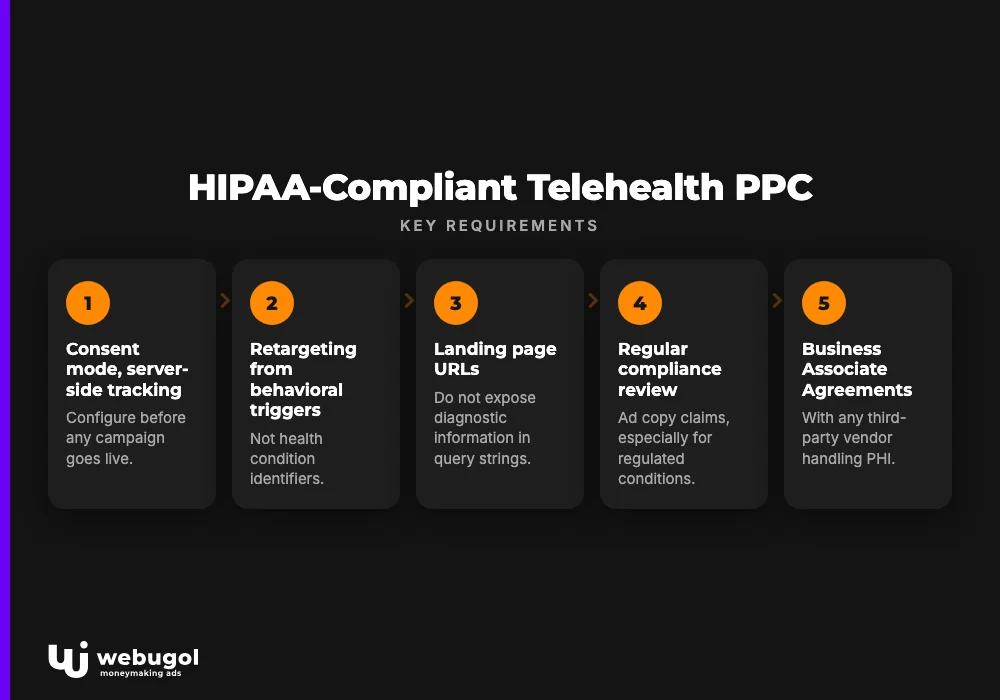
HIPAA-compliant telehealth PPC requires:
- Consent mode and server-side tracking configured before any campaign goes live
- Retargeting audiences built from behavioral triggers, not health condition identifiers
- Landing page URLs that do not expose diagnostic information in query strings
- Regular compliance review of ad copy claims, especially for regulated condition categories
- Business Associate Agreements with any third-party vendor that handles PHI
The compliance layer is also where most telehealth advertising programs are understaffed. A media buyer optimizes bids. A compliance officer reviews claims. A developer configures tracking. When these sit in separate lanes with no shared accountability, gaps form and nobody's job description covers the handoff between them.
How much does telehealth advertising cost?
There is no single benchmark because costs vary by service line, geography, and funnel efficiency. CPL alone misleads. A $45 CPL with a 15% show rate and a 20% close rate produces a different cost-per-acquired-patient than a $90 CPL with a 50% show rate and a 40% close rate.
Budget requirements scale with acquisition goals. Telehealth programs running paid search and paid social as a coordinated medical marketing strategy need sufficient monthly conversion volume per campaign for platform algorithms to optimize effectively. Below that threshold, spend becomes speculative rather than data-driven.
The more consequential cost variable is structural. Speed-to-lead, show rate, and intake conversion are marketing KPIs that live entirely outside the ad account. A telehealth program losing 40% of its leads to slow follow-up is not facing a budget problem. It is facing an ops problem. Raising ad spend without fixing the intake side raises cost without proportionally raising revenue.
What is the ROI of telehealth marketing?
ROI in telehealth depends on which output you define as the target. For programs with membership or continuity revenue, the payback window from first acquisition is typically 60-90 days. For high-ticket or one-time programs, that window compresses.
The pattern that produces the strongest outcomes in patient acquisition online: tracking is built end-to-end before significant ad spend begins, the funnel is validated at small scale, and spend increases only after unit economics are confirmed. That sequence sounds straightforward. Most telehealth programs skip it and reverse-engineer the problem after CPA has already risen.
Published results from Webugol's Healthcare Growth System: Valhalla Vitality (telehealth) achieved a 287% increase in monthly revenue with a 45% reduction in CAC; UberDoc (virtual clinic) reached 4.2x ROAS with a 120% increase in leads. Both results came from fixing tracking, funnel architecture, and intake operations before scaling ad spend, not from discovering a more effective ad format.
Telemedicine marketing ROI is also shaped by what happens after the first appointment. Renewal flows, reactivation sequences, and win-back programs contribute to revenue that acquisition spend alone cannot produce. A patient you spent $120 acquiring and then lost to a broken lifecycle program is a structural cost, not a campaign result.
Build a telehealth advertising system that measures revenue
If your spend is rising and your bookings are not, the diagnostic usually points upstream of the campaign: tracking gaps, funnel drop-offs, or intake latency that no increase in ad budget can override.
Webugol is a digital marketing agency that builds tracking-first, conversion-led acquisition systems for US telehealth providers. The Healthcare Growth System is a 90-day sprint covering market intelligence, funnel and offer development, tracking infrastructure, campaign launch, and retention automation, managed as one integrated program. Work begins with measurement and diagnostic clarity before any budget scales.
Contact Webugol to book a Strategy Call and identify exactly where your acquisition system is losing revenue.
FAQ
How to advertise telehealth services?
Effective telehealth advertising combines paid search for active demand, paid social for awareness, and a booking flow built to close what ads open. The platform mix matters less than having end-to-end tracking that shows which spend produces confirmed appointments, not just clicks.
What platforms work best for telehealth advertising?
Google Search Ads capture patients actively searching for telehealth services, making search the highest-intent channel for most programs. Meta builds awareness and supports compliant retargeting, while YouTube and TikTok strengthen trust before a patient books. Most programs run Google and Meta in parallel with video as a supporting layer.
Is telehealth advertising HIPAA compliant?
Telehealth advertising can be made HIPAA compliant with server-side tracking, consent mode, compliant audience configuration, and Business Associate Agreements with analytics vendors. Standard pixel installations are not compliant by default and require explicit technical configuration before any campaign launches.
How much does telehealth advertising cost?
Cost per lead varies by service line and geography, but CPL alone is not the right metric. Show rate, close rate, and intake speed determine the real cost per acquired patient, and improving those variables often has more impact on CPA than increasing the ad budget.
What is the ROI of telehealth marketing?
ROI depends on the service model and how well the post-click funnel converts. Programs that build tracking and validate unit economics before scaling consistently outperform those that raise spend without a measurement foundation. Telehealth programs with membership or continuity revenue typically see a 60-90 day payback window from first patient acquisition.

