



PPC for lawyers: how law firms turn search clicks into consultations
PPC for lawyers places your ads in front of people searching for legal help at the exact moment they need it, making it one of the most direct client-acquisition channels a modern practice can run. A well-configured law firm Google Ads account can generate consultation requests within days of launch. You pay only when someone clicks, so every dollar in the budget is attached to a person who demonstrated intent. Firms using pay per click attorneys campaigns can target by practice area, city, and device type, with precision that referrals and directory listings cannot match.
Law firm owners who've plateaued on referrals face the same structural gap that stalls any growing business: marketing dollars going out without attribution data coming back. Attorney PPC management closes that gap.
How ppc for lawyers works
Google Ads operates as a real-time auction. When a potential client searches "personal injury lawyer near me," Google evaluates every advertiser competing for that keyword and determines which ads to show in which order. Two factors decide placement: your bid and your Quality Score.
Quality Score is Google's measure of how relevant your ad copy, keywords, and landing page are to the search. A higher score lowers your cost-per-click and improves your position. A low score means you pay more to appear below a competitor with a sharper, more focused ad. For expensive legal keywords, that difference compounds fast.
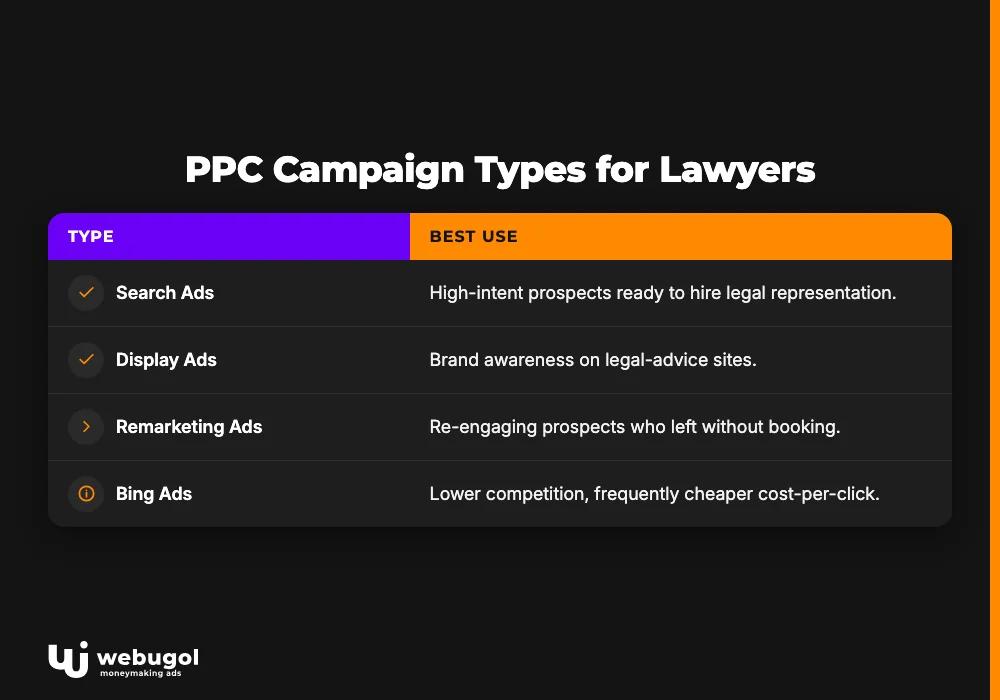
Each campaign type serves a different objective in the client acquisition funnel, so the platform you choose and the campaign type you configure depends on where the prospective client is in the decision process.
Legal PPC campaign types
| Campaign type | What it does | Best fit for law firms |
|---|---|---|
| Search ads | Text ads appear on Google when someone searches a legal keyword | High-intent prospects ready to hire |
| Display ads | Image or banner ads run across Google Display Network websites | Brand awareness; reaching visitors on legal-advice sites |
| Remarketing ads | Re-serves ads to past website visitors who did not contact you | Re-engaging prospects who left without booking |
Search ads are the core of any legal PPC campaign setup because they target people who are already searching for legal representation. Display and remarketing work as supporting layers around that foundation.
Two additional platforms are worth considering. Bing Ads has a smaller market share than Google, but competition is lower and costs-per-click are frequently cheaper, which can improve returns in highly contested markets. For practice areas tied to life events like divorce or family law, Facebook Ads can extend reach to users whose demographic patterns suggest they may need legal services soon.
What keywords should lawyers bid on in Google Ads?
Target high-intent, practice-specific phrases first. "Car accident attorney Dallas," "DUI lawyer near me," and "estate planning attorney Seattle" all signal someone ready to hire, not someone comparing law school options or researching legal salaries. That difference in intent is the difference between a click that converts and a click that costs.
Long-tail keywords convert at higher rates than broad terms because they carry more specific intent. Someone searching "what to do after a slip and fall in New York" is closer to hiring than someone searching "injury lawyer." Use Google's Keyword Planner to pull accurate search volume data for legal terms in your market and filter for commercial-intent phrases rather than informational ones.
Negative keywords matter as much as the terms you bid on. A personal injury firm should add "jobs," "salary," and "how to become" to its negative keyword list before launch to stop paying for job seekers and law students. Build the negative list before the campaign goes live and expand it weekly for the first month.
For lawyer lead generation ads to produce quality contacts, the keyword list must be specific. Generic terms generate high click volumes from people who have no immediate need for representation. Surgical targeting is what separates campaigns that generate consultations from campaigns that burn budget.
How much does PPC advertising cost for a law firm?
PPC for lawyers is one of the most competitive advertising categories on Google. Actual costs depend on practice area, geography, and how many other firms are competing for the same keywords in your market.
Personal injury and mass tort terms carry the highest competitive pressure nationally. Niche areas like immigration, elder law, and estate planning typically see lower bidding pressure and lower per-click costs. A firm competing in a major metro will generally pay more per click than one operating in a smaller market for the same practice-area term.
Your initial budget is best understood as a data purchase, not a lead purchase. Start with a modest daily spend and run the campaign for two to four weeks. Then read the performance data: which keywords produced contacts, which ad variants drove clicks, which combinations produced nothing.
Reallocate toward what converts and cut what doesn't. That cycle, applied monthly, is how google ads for attorneys compounds into a reliable acquisition channel over time.
Measure every decision against return on investment, not cost-per-click alone. A higher CPC keyword that converts to signed retainers at good margins is a better investment than a cheaper keyword that generates calls from unqualified prospects.
Setting up a legal PPC campaign that converts
A live campaign is not automatically a converting campaign. Structure is what makes the difference between attorney PPC management that grows a practice and spend that quietly drains.
Targeting settings for attorney ppc management
Location targeting is mandatory. A firm licensed in Ohio should not pay for clicks from users in California. Set geographic targeting to the cities and radius around the office where the firm can realistically take clients.
Demographic targeting adds another layer of precision. Age ranges, household income, and family status help align ads with the clients a specific practice area actually serves. A family law practice and a business litigation firm reach very different people, and their targeting settings should reflect that.
Device targeting changes ad format priorities. Mobile users searching for a lawyer often need to call right away, so click-to-call extensions need to be prominent and easy to tap. Desktop users are more likely to read and submit a form. Track conversions by device and adjust bids based on what your data shows performs better.
Landing pages that make ppc for lawyers convert
The landing page is where ad spend either converts or evaporates. Sending clicks to a generic firm homepage wastes budget regardless of how well the rest of the campaign is configured.
A converting legal landing page starts with a headline that matches the ad copy directly. The visitor should immediately recognize they arrived at the right place. A visible, low-friction contact form reduces the steps between intent and action.
Trust signals like bar admissions, client testimonials, and years of experience address the skepticism legal clients naturally bring. The page has to function on mobile, since a large share of legal searches happen on phones.
Every ad group should link to a landing page that continues the exact message that ad started. Breaking that continuity hurts both Quality Score and the visitor's motivation to contact.
No PPC campaign recovers its cost when the underlying site was not built to convert. A landing page sitting on a slow, generic firm website produces the same friction whether traffic comes from ads or organic search. The acquisition system works when site architecture and paid campaigns are built together as a single growth layer, not assembled separately.
Ad extensions for law firm Google Ads
Extensions add information to your ads without increasing cost-per-click. For attorneys, four matter most.
- Call extensions attach a phone number to the ad, letting mobile users call directly without visiting your site.
- Location extensions display your office address and map pin, which builds local credibility for users searching nearby.
- Sitelink extensions add links below the main ad directing users to specific practice area pages or a consultation booking form.
- Callout extensions insert short phrases like "free case review" or "24/7 availability" into the ad body to communicate your offer at a glance.
How long until PPC generates leads for attorneys?
Unlike SEO, which can take months to move rankings, ppc for lawyers can produce consultation requests within days of a campaign going live. That speed is the format's core advantage for firms that need new client volume now.
The first two to four weeks are rarely peak efficiency. The campaign collects performance data during that period: which keywords produce contacts, which ad variants drive clicks, which landing page versions hold attention. Google's automated bidding systems also require a learning phase before they can calibrate accurately.
Consistent, high-quality lead volume builds after the first full optimization cycle. Bid reviews, negative keyword additions, and ad copy tests run together on a weekly cadence produce the data needed to make confident budget decisions. PPC starts fast and improves as the account learns.
What is a good quality score for legal ads?
According to Google, Quality Score runs from 1 to 10 and is calculated from three signals: expected clickthrough rate, ad relevance to the searched keyword, and landing page experience.
For ppc for lawyers campaigns, improving Quality Score requires tightening the relationship between keyword, ad copy, and landing page into one coherent message. An ad for "DUI defense in Houston" should trigger from DUI-specific keywords and land on a DUI defense page in Houston, not a general criminal defense homepage. That specificity raises the score, lowers cost-per-click, and improves placement relative to competing firms bidding on the same terms.

How do law firms measure ROI from PPC campaigns?
The most useful measurement connects a click to a signed retainer. In practice, firms track ROI through three linked metrics: cost-per-lead, lead-to-client conversion rate, and average case value.
Cost-per-lead tells you what you paid for each consultation request. Multiply that by your lead-to-client conversion rate to arrive at cost-per-client. Divide average case revenue by cost-per-client to see return on investment. That chain works only when conversion tracking is configured correctly.
Google Analytics connects to your law firm Google Ads account to show which campaigns, keywords, and ad variations generate form submissions and calls. Configure conversion tracking before launch. Without it, you're making budget decisions without performance data.
For a structured approach to tuning a law firm's Google Ads account for sustained returns, the review process covers bid adjustments, Quality Score levers, and the compounding efficiency gains that build month over month.
A consistent monthly review cadence catches wasted spend early and surfaces reallocation opportunities before they cost more. ROI-based measurement is what separates a ppc for lawyers account that compounds from spend that quietly bleeds out.
Attorney PPC management mistakes that drain budget
Even well-structured campaigns lose money through predictable errors. These four account for most of the waste in legal PPC.
Bidding on low-intent broad terms. "Lawyer" and "legal help" generate high click volumes from people who have no immediate need for representation. Target specific practice-area phrases that signal someone is ready to hire now, not browsing.
Skipping the negative keyword list. Without negatives, your ads appear for job seekers, law students, and general researchers. A personal injury firm adding "jobs," "salary," and "law school" to its negative list eliminates that waste immediately. Negative keywords are what make the rest of the keyword list work.
Disconnecting ads from landing pages. When an ad about immigration law lands on a general firm homepage that covers every practice area, the relevance chain breaks. Quality Score drops and so does the visitor's motivation to contact. Match each ad group to a landing page that continues the same specific message.
Treating PPC as a set-and-forget channel. PPC for lawyers requires continuous management. Bids shift as competitors enter and exit the auction. New irrelevant search terms appear and need to be negated. Ad copy needs testing. Google Analytics makes that weekly review systematic rather than guesswork.
Start building a legal PPC campaign that converts
Law firms that treat ppc for lawyers as a managed growth channel, rather than a one-time experiment, consistently outperform competitors running the same generic ads month after month. The structure covered here gives you the framework, from keyword selection through ROI measurement. Execution compounds from there.
Webugol builds law firm websites engineered to convert PPC traffic and manages the campaigns that drive it, so practices gain a complete growth system rather than a standalone ad account. To build a campaign structure specific to your firm's practice areas and target markets, reach out to the team.
FAQ
How much does PPC advertising cost for a law firm?
Legal PPC sits among the most competitive advertising categories on Google, with costs varying significantly by practice area and location. Personal injury and mass tort keywords carry the highest competitive pressure, while niche areas like immigration and estate planning see lower bidding costs. Treat the first month's budget as a data-collection investment and reallocate toward what converts once you have performance signal.
What keywords should lawyers bid on in Google Ads?
Bid on practice-specific phrases that combine the type of case and the service location, since those terms signal someone is ready to hire rather than just researching. Long-tail phrases like "what to do after a car accident in Phoenix" convert at higher rates than broad terms like "injury attorney." Build a negative keyword list at the same time to filter out job seekers, students, and informational searchers.
How do law firms measure ROI from PPC campaigns?
Track cost-per-lead, lead-to-client conversion rate, and average case value, then chain those numbers together to calculate return on investment. Google Analytics integrates with Google Ads to show which keywords and ads produce consultation requests and calls. Set up conversion tracking before the campaign launches so every optimization decision is grounded in actual performance data.
How long until PPC generates leads for attorneys?
A well-configured law firm Google Ads campaign can produce consultation requests within days of going live, making it one of the fastest client-acquisition channels available. The first two to four weeks function as a data-gathering phase while automated bidding calibrates and the account identifies which combinations convert. Consistent lead volume builds after the first complete optimization cycle.
What is a good quality score for legal ads?
Google evaluates Quality Score based on expected clickthrough rate, ad relevance to the search term, and the experience users have on the landing page, scoring ads from 1 to 10. Improving your score in legal PPC comes down to tightening the relationship between each keyword, the ad copy triggered by it, and the landing page it points to. Higher Quality Scores lower your cost-per-click and improve placement relative to competing firms bidding on the same terms.

