



SEO Traffic Forecast: How to Predict and Plan Organic Growth
An SEO traffic forecast uses historical keyword data, search volume trends, and competitive benchmarks to estimate how much organic traffic your site will generate over a given period. Done correctly, it converts vague growth ambitions into a budgeted plan with measurable milestones, so marketing directors and business owners can make resource decisions based on numbers, not instinct.
Even if you are building your first organic channel, the forecasting gap looks the same as the one blocking a scaling business: no system that connects keyword search volume to revenue projection. That gap is exactly what this guide closes.
Why is SEO traffic forecasting important for business?
Without a forecast, SEO becomes a cost center that leadership tolerates rather than funds. A documented seo traffic forecast reframes organic search as a revenue line: you can show the expected traffic lift, map it to conversion rates, and defend the budget before a single ranking changes.
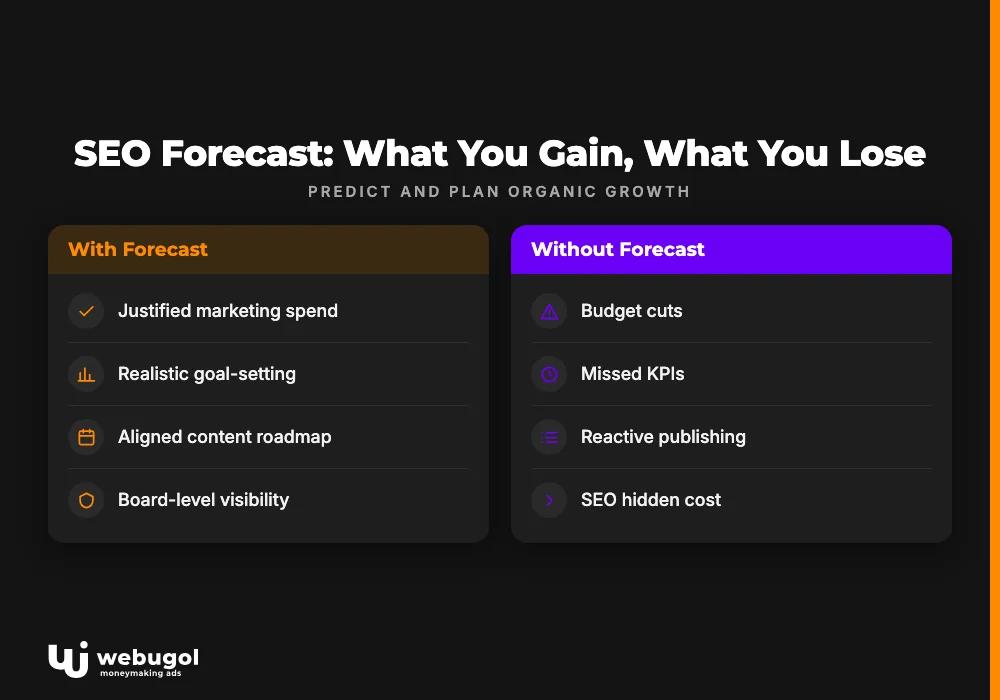
Here are four concrete returns from a working SEO growth projection:
| Benefit | What it prevents |
|---|---|
| Justified marketing spend | Budget cuts based on "we don't see results" |
| Realistic goal-setting | Missed KPIs caused by arbitrary targets |
| Aligned content roadmap | Reactive publishing that chases trends rather than compounds |
| Board-level visibility | SEO treated as a hidden cost instead of a growth asset |
Each benefit maps to something you stop losing: misallocated spend, stakeholder credibility, content that goes nowhere. Organic search prediction turns SEO from a background function into a tracked investment.
What factors affect the accuracy of an SEO traffic forecast?
Several variables determine whether your website traffic prediction lands close to reality or badly misses.
Keyword search volume data
Your keyword search volume forecast is only as good as the data behind it. Search volume figures from tools like Ahrefs and SEMrush are statistical estimates, not exact counts. High-volume keywords carry more uncertainty because competition is stiffer and click-through rates shift with featured snippets and AI Overviews.
Competitive landscape
When a competitor publishes a resource that quickly earns a large batch of new backlinks, your ranking for a shared keyword can drop regardless of your own activity. Build competitor monitoring into your organic search prediction model from the start, not as an afterthought.
Backlink profile growth
Search engines treat quality backlinks as endorsements. A steady acquisition pace strengthens your seo growth projection; a sudden drop signals that rankings are at risk. Both directions need to appear in your model. The technical health of the site, including page speed and crawl architecture, belongs in the same forecast model. A projection built on a slow or structurally weak site will consistently under-deliver because the technical floor limits how far organic rankings can climb.
Seasonality and content cadence
Many industries have predictable demand cycles. A B2B software site may see traffic dip in August; a retail brand may spike in November. Layering a seasonality index onto your baseline prevents the forecast from treating peaks and troughs as anomalies.
How do I forecast SEO traffic for my website?
Follow these five steps to build an seo traffic forecast grounded in real data rather than optimism.
Step 1: Pull your traffic baseline
Open Google Search Console and Google Analytics. Extract the last 12 months of organic sessions. Calculate your average monthly traffic and note the year-over-year growth rate. This baseline is the anchor for every projection that follows.
Step 2: Build your keyword list with volume data
Identify the terms you want to rank for. For each keyword, record monthly search volume, keyword difficulty, and an estimated click-through rate based on its target ranking position. A keyword with 3,000 monthly searches and a projected CTR of 4% at position five contributes roughly 120 sessions per month if you reach that rank.
Step 3: Model competitor benchmarks
Use Ahrefs or SEMrush to audit competitors already ranking for your target keywords. Look at their organic traffic, total linking domains, and publishing frequency. These data points give you a realistic picture of what it takes to compete, and they anchor your keyword search volume forecast to achievable positions rather than aspirational ones.
Step 4: Adjust for seasonality
Compare monthly traffic figures to the annual average to create a simple seasonality index. A month that historically runs 20% above average gets a 1.20 multiplier; a slow month gets a figure below 1.0. Apply this index to your baseline forecast to predict organic traffic month by month rather than relying on annual averages.
Step 5: Estimate cumulative growth and build the projection
Apply a Compound Annual Growth Rate (CAGR) model to your current baseline, then add the incremental traffic each new keyword ranking is expected to generate once you reach the target position. The result is a month-by-month seo growth projection you can present to leadership with explicit assumptions rather than gut feel.
What tools are best for SEO traffic forecasting?
The right seo forecasting tools depend on your existing stack. These four cover the full workflow for most teams running website traffic prediction at small-to-mid scale:
- Google Search Console: free, authoritative click and impression data for your own domain
- Google Analytics: connects organic sessions to downstream conversion events
- Ahrefs: keyword search volume forecasting, competitor traffic estimates, and backlink monitoring
- SEMrush: keyword difficulty scores, organic search prediction charts, and keyword gap analysis
No tool produces guaranteed numbers. Treat all third-party volume and traffic figures as directional inputs, not exact outputs. Cross-referencing two data sources reduces the margin of error and produces a more reliable seo traffic forecast.
How accurate can SEO traffic predictions be?
Accuracy depends on how stable the variables are. Short-range forecasts on established, low-volatility keywords tend to track actual results more closely than long-range projections on competitive targets. Longer projections are noisier. Algorithm shifts, new competitors, and changing search intent all add uncertainty as the time horizon extends.
A more useful framing for your stakeholders: the forecast is not a promise. It is a structured bet with stated assumptions. When actual results diverge, the gap tells you which assumption was wrong. That is itself a data point. The goal is a model good enough to inform resource decisions, not one precise enough to replace reporting.
Running a site-wide content and performance check before you build the forecast sharpens accuracy: you remove ranking blockers that would cause the model to under-perform on keywords where you should realistically compete.
Understanding how SEO budget compares to paid search investment also refines the forecast by clarifying which traffic gains compound over time and which evaporate when the budget stops.
Build your forecast before the next planning cycle
A credible seo traffic forecast is a planning tool, not just an SEO deliverable. It gives marketing directors the numbers to defend organic investment, helps founders allocate content budgets ahead of growth milestones, and turns SEO from a vague long game into a quarter-by-quarter projection the whole business can track.
Webugol pairs the SEO forecast with the technical foundation to deliver it, connecting keyword data to traffic models within a site built to rank and convert. If your current plan lacks a structured organic growth projection, reach out to start a data-driven forecast for your domain.
FAQ
How do I forecast SEO traffic for my website?
Start with 12 months of historical data from Google Search Console, then layer in keyword search volume estimates for the terms you plan to target. Model expected click-through rates by ranking position, apply a seasonality index, and project cumulative growth using a CAGR or trend-line method.
What tools are best for SEO traffic forecasting?
Google Search Console and Google Analytics cover your own domain data for free. Ahrefs and SEMrush add competitor benchmarks, keyword difficulty scores, and volume estimates that make your organic search prediction more reliable when cross-referenced.
Why is SEO traffic forecasting important for business?
It converts organic search from an opaque cost into a budgeted revenue line. With a documented seo traffic forecast, marketing teams can justify spend, set measurable goals, and show leadership a quarter-by-quarter growth trajectory tied to real keyword data.
How accurate can SEO traffic predictions be?
Short-range forecasts on stable keywords track actual results more closely than long-range projections on competitive new terms. Longer projections carry wider margins because algorithm changes and competitive moves add noise. The forecast is designed to inform resource decisions, not replace post-campaign reporting.
What factors affect the accuracy of an SEO traffic forecast?
The main drivers are data quality of keyword search volume, stability of the competitive landscape, your backlink acquisition pace, content publishing cadence, and seasonal demand patterns. Controlling these variables tightens the prediction range.

