



Medical SEO Copywriting Services for Healthcare Practices
Medical SEO copywriting is the practice of creating search-optimized content for healthcare websites, built around what patients type into Google before they schedule a visit. It combines targeted keyword strategy with medically accurate writing to put your practice in front of high-intent searchers. The outcome goes beyond rankings. Done correctly, it generates consistent appointment requests that grow in value long after a paid campaign stops running.
The same structural gap that keeps a new clinic invisible in search also limits an established practice running real ad spend: without a coordinated content foundation, organic and paid channels produce results independently instead of compounding each other.
What makes healthcare SEO different from regular SEO?
Healthcare content falls under Google's YMYL (Your Money or Your Life) classification. Pages covering treatments, conditions, and clinical outcomes face stricter quality evaluation than most other content categories. The bar is genuinely higher. Thin service descriptions, unsupported outcome claims, and generic text that would pass on a retail site get held back in healthcare search results.
Patient trust adds another layer. A prospective patient comparing two weight loss clinics reads your content differently than someone choosing a software subscription. They're evaluating whether your practice is credible enough to trust with their health. Specific clinical detail, clear authorship signals, and accurate language all factor into that assessment, for the patient and the algorithm alike.
The compliance dimension is not optional. Google and Meta restrict how healthcare providers can describe clinical outcomes in advertising. Your SEO copywriting for medical websites must work within those same guardrails: no unapproved medical claims, careful language around diagnoses and conditions, and data handling approaches that align with HIPAA requirements.
How does medical SEO copywriting attract more patients?
It attracts patients by matching your content to what they search for before booking. Patients search. Your content appears or it doesn't. The depth beneath that binary is where most practices consistently lose patient volume without knowing exactly why.
Effective healthcare SEO services cover the full patient search journey. Early-stage queries ("what causes fatigue in men over 40") and decision-stage queries ("TRT clinic near me") are both patient acquisition surfaces. A practice targeting only decision-stage terms captures a fraction of available demand and misses the trust-building that turns research into a booked appointment.
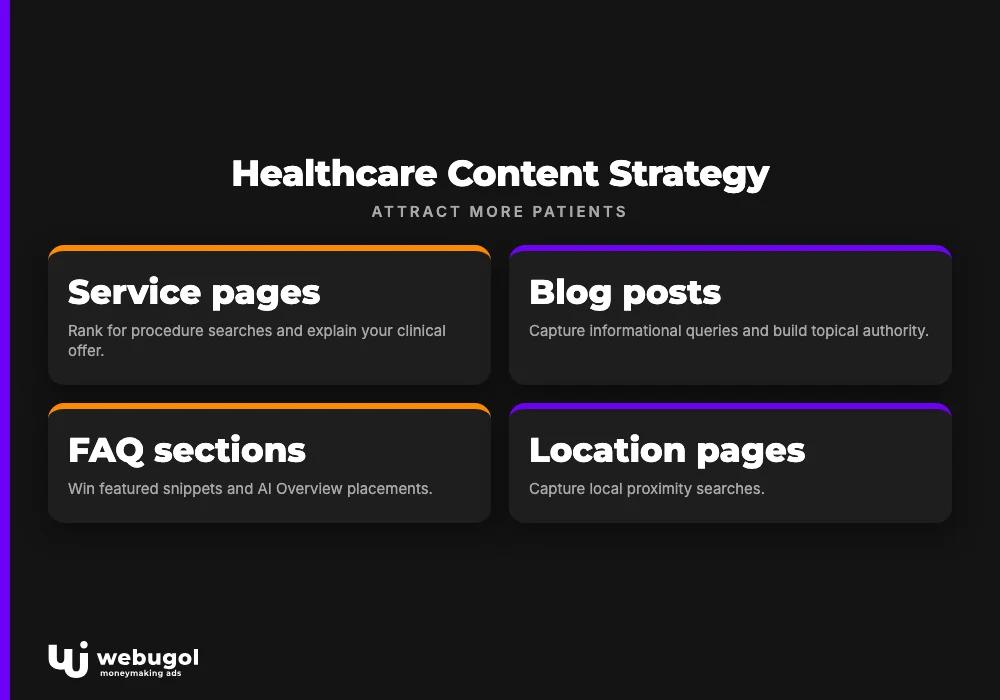
A complete healthcare content strategy covers:
| Content type | Primary function |
|---|---|
| Service pages | Rank for procedure searches; explain your clinical offer |
| Blog posts | Capture informational queries; build topical authority |
| FAQ sections | Win featured snippets and AI Overview placements |
| Location pages | Capture local proximity searches |
| Patient resource guides | Reduce pre-appointment friction; establish clinical credibility |
Each type requires this approach, not generic web copy. Each addresses a distinct stage of the patient decision process.
The most common problem for established practices is fragmentation: a developer manages the site, a copywriter produces posts, an agency runs paid campaigns, and no one owns the relationship between search content and actual patient acquisition outcomes. Healthcare content marketing that converts is built around that accountability, not assembled from separate deliverables.
Patient acquisition SEO and local search
For most clinics, local SEO is the primary organic acquisition channel. Patients prefer nearby providers, and proximity signals drive the local pack that appears above organic listings in Google. Your local search profile visibility determines whether your practice appears before competing practices when a patient searches for providers in your city.
Medical website optimization for local search goes beyond your map listing. It includes location-specific service pages, schema markup, and consistent business name, address, and phone data across directories. A clinic that publishes condition-specific local content, such as a page on type 2 diabetes care for patients in a particular metro area, captures intent that a map listing alone cannot address.
Local SEO for doctors compounds over time. Each correctly structured location page, each blog post targeting a city-specific health query, and each verified patient review narrows the ranking gap between your practice and whoever currently sits above you.
Building authority: content and links
Content quality alone is not sufficient for competitive seo for healthcare providers in saturated markets. Search authority accumulates through two parallel levers: the quality of your content and the credibility of external sites that link to it.
Earning authoritative backlinks for your healthcare site is a distinct discipline from content production. It involves editorial placements in medical directories, health publications, and relevant industry outlets, all within professional and platform compliance standards. Domain authority determines whether your medical SEO copywriting reaches the patients searching for your services or sits invisible on page three.
Without a link-building program running alongside content, a practice can publish well-optimized pages for months and still rank below competitors with stronger domain authority. The two levers work together, or neither works as well.
How long does medical SEO take to show results?
Meaningful organic traction for a healthcare practice typically appears within 90 to 180 days of a well-executed campaign. Growth compounds beyond that window.
The timeline typically shortens under these conditions:
- Technical issues such as crawl errors, slow load times, and broken site structure are resolved before content is published.
- Content targets specific, answerable queries rather than broad head terms.
- Your Google Business Profile is complete and actively maintained.
- Link acquisition runs alongside content production from the start, not months after it begins.
Practices running paid patient acquisition alongside SEO should treat medical SEO copywriting as a parallel acquisition system that reduces cost-per-lead over time. A page that ranks for your specialty and generates consult requests next quarter doesn't bill you again the quarter after that. Paid ads do.
Ready to stop losing patients to competitors in search?
Most established healthcare practices are not losing patients because they lack content. They lose patients because their content, ads, and patient intake systems are not connected, and no single team is accountable for what happens across those handoffs.
Webugol builds tracking-first, conversion-led patient acquisition systems for US healthcare providers. It is part of an integrated acquisition program, not a standalone deliverable. To understand exactly where your current content is losing patient volume, book a strategy call.
FAQ
What is medical SEO copywriting?
Medical SEO copywriting is the creation of search-optimized content for healthcare websites, written to rank for patient queries while maintaining clinical accuracy and compliance. It covers service pages, blog posts, FAQ sections, and location pages, each built to appear in search and convert visitors into booked appointments.
What makes healthcare SEO different from regular SEO?
Healthcare content falls under Google's YMYL guidelines, which apply stricter quality standards to medical information than to most other content categories. It also requires alignment with HIPAA-compatible data practices and platform advertising policies, and must establish clinical credibility through specific, accurately attributed content.
How does SEO help healthcare practices attract more patients?
SEO places your practice in front of patients actively searching for your services at the moment they're making a decision. It covers the full search journey from early-stage research to appointment intent, and generates patient inquiries without requiring ongoing ad spend.
How long does medical SEO take to show results?
Most healthcare practices see measurable organic growth within 90 to 180 days of a consistent program. Results compound over time, with well-optimized pages continuing to generate patient inquiries long after publication, unlike paid campaigns that stop producing the moment ad spend stops.
How much does medical SEO copywriting cost?
Cost depends on scope: a standalone content plan costs differently from a full patient acquisition system that includes technical SEO, link building, and integrated campaign management. The more useful question is what patient volume you're currently losing to competitors who outrank you, and what closing that gap is worth each quarter.

