



Healthcare SEO tips that stop the patient drain
The most impactful healthcare SEO tips cover four areas: technical health (page speed, mobile-first indexing, crawl access), local authority (Google Business Profile, NAP consistency, reviews), content credibility (E-E-A-T signals and patient-language targeting), and off-page signals (backlinks, citations, ADA compliance). Get these right and your rankings reflect your clinical reputation. Miss them and even a healthy ad budget fights an uphill battle from behind.
This applies at every scale. The structural gaps that keep a new clinic invisible on Google are the same ones that cap acquisition growth for a $500k/month telehealth operation. The fix sequence is the same. So is the revenue at stake.
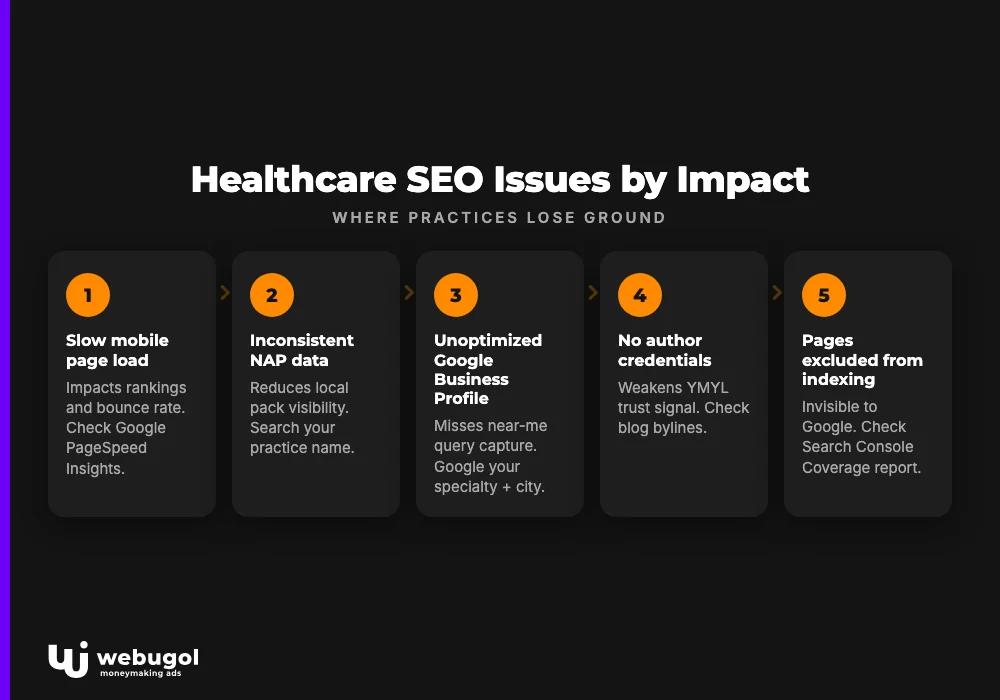
Most common healthcare SEO issues by impact
Before going deep, here is a quick diagnostic of where practices lose the most search ground:
| Issue | Impact | Quick test |
|---|---|---|
| Slow mobile page load | Rankings and bounce rate | Google PageSpeed Insights |
| Inconsistent NAP data | Local pack visibility | Search your practice name |
| Unoptimized Google Business Profile | Near-me query capture | Google your specialty + city |
| No author credentials on content | YMYL trust signal | Check blog bylines |
| Pages excluded from indexing | Invisible to Google | Search Console Coverage report |
| Thin or duplicated service pages | Keyword relevance | Word count + unique value check |
Applying healthcare SEO tips in this order keeps resources focused where the return is highest: technical foundation first, local signals second, content third. A good medical seo strategy starts at the technical layer. Everything else sits on top.
Why is my healthcare website not ranking on Google?
The most common cause is a stack of small technical failures that together signal to Google the site is not ready to be a trusted result.
Page speed. A patient searching for a specialist or urgent care will not wait for a slow load. Google PageSpeed Insights is free and direct from the source: it surfaces compressed-image failures, unused JavaScript, and render-blocking resources.
Tools like TinyPNG handle image compression without visible quality loss. This matters for health website technical seo because healthcare sites frequently carry large staff photos and unoptimized hero images that drag Core Web Vitals scores.
Mobile-first indexing. Google indexes the mobile version of your site first. If the mobile experience is broken, healthcare google rankings reflect that immediately. Test on actual devices, not a resized desktop browser.
E-E-A-T and YMYL. Health pages fall under Google's "Your Money or Your Life" category, meaning they face stricter quality signals than general content. A blog post authored by "Admin" with no credentials is an E-E-A-T failure. Add author bios to every clinical article: name, degree, license type. This is not optional for patient search optimization at scale.
Crawl and indexing errors. A site accidentally left in "noindex" mode from development is a silent killer. The Coverage report in Google Search Console shows exactly which pages are excluded and why. Orphaned pages not reachable from any other page waste crawl budget and rank for nothing. Run a clinic seo audit quarterly and confirm every page is reachable from the homepage within three clicks.
What are the most common SEO mistakes healthcare websites make?
Keyword mismatch with patient language. Doctors use clinical terminology. Patients describe symptoms and locations. A service page optimized for "bilateral knee arthroplasty" will not capture "knee replacement surgeon near me." Tools like Google Trends and AnswerThePublic surface actual patient phrasing. Medical practice seo requires bridging that vocabulary gap, not picking one side.
Copy-pasted service descriptions. Many practices use vendor-supplied or generic content across service pages. Google identifies and discounts duplicate content. Each service page needs location-specific detail, staff context, and something a competitor cannot copy: your protocol, your pathway, your clinical approach.
Missing meta descriptions. A meta description does not change rankings directly. It determines whether a qualified patient clicks. Write a unique 140-150 character summary for each major page: lead with the value, include a clear action.
No FAQ content on service pages. Patients search in questions. A service page with no FAQ section misses keyword coverage and the conversational format that surfaces in AI Overviews.
How do I fix local SEO for a medical practice?
For most practices, the highest-ROI work in local seo for doctors sits in two places: NAP consistency and Google Business Profile quality.
NAP consistency. Your practice name, address, and phone number must match exactly across your website, Google Business Profile, and every directory listing. Even minor variations (Street vs. St.) fragment local authority. A structured audit of your clinic's local directory citations is often the fastest fix with the clearest ranking lift.
Google Business Profile. Your GBP is frequently the only thing a patient sees before choosing whether to call. An unclaimed profile, outdated hours, or missing service categories costs you patients you already paid to attract through ads or organic work.
For a full breakdown of fields and posting cadence, the guide to healthcare GBP setup and optimization covers the specific signals that move local pack visibility.
Reviews. Reviews are a ranking factor and a trust signal. Set a weekly schedule to respond to all of them. For positive reviews, a brief acknowledgment works. For complaints, stay HIPAA-compliant: "Please contact our office manager directly so we can resolve this." Never discuss patient care details in a public response.
Healthcare SEO tips for off-page authority
Off-page signals matter as much as on-page work for medical practice seo, and in healthcare they carry compliance constraints that make the standard "get more backlinks" advice incomplete.
High-quality backlinks. Links from medical associations, local chambers of commerce, and healthcare nonprofits carry more weight than generic directory links. Ask for links from organizations you already work with. The right approach to healthcare authority building focuses on relevance over volume and keeps you inside platform guidelines.
Citation consistency. Citations are mentions of your practice name and address on other sites, with or without a link. Inconsistent citations dilute local authority. A citation management tool finds and flags discrepancies across the healthcare directory ecosystem.
ADA compliance. Accessible websites satisfy both a legal requirement and an SEO signal. Add descriptive alt text to all images. Run your site through WAVE, free and browser-based, to surface accessibility errors that also affect crawlability.
Privacy policy. To run analytics and advertising effectively while remaining HIPAA-compliant, a transparent privacy policy linked in your footer is required. It covers data usage, cookie tracking, and your compliance approach for website visitors.
What SEO tools work best for healthcare websites?
The free toolkit covers most of what a clinic needs:
- Google Search Console is the definitive source for indexing errors, mobile usability issues, and query data; the Coverage and Performance reports answer most diagnostic questions about why a page is not ranking.
- Google PageSpeed Insights delivers Core Web Vitals data and speed diagnostics directly from Google.
- Google Business Profile is the control layer for local presence and near-me query capture.
- AnswerThePublic maps patient questions by symptom, condition, and location, feeding your content calendar with queries people actually use.
Applying these healthcare SEO tips through the right tools turns diagnostic work into a repeatable system rather than a one-time audit.
At Webugol, the highest diagnostic value comes when organic and paid data share a single source of truth. A dip in organic branded traffic surfacing in the same dashboard as a CPA spike makes root cause analysis faster. Healthcare SEO tips only create ROI when the measurement infrastructure exists to attribute the outcome.
Put these healthcare SEO tips to work for your practice
Technical health, local authority, content credibility, and off-page signals form the structural foundation of healthcare google rankings. A solo practitioner can run through this checklist in an afternoon and find at least one material gap. For a clinic at $500k/month, the same gaps compound silently against acquisition efficiency every week they go unaddressed.
If your practice is at the stage where tracking, SEO, and paid acquisition need to work as one system rather than separate line items, the Healthcare Growth System is built for that transition. Book a strategy call to identify where your biggest structural gap sits.
FAQ
What are the most common SEO mistakes healthcare websites make?
The most common mistakes are inconsistent NAP data across directories, missing E-E-A-T signals on clinical content (no author credentials), copy-pasted service descriptions, and slow page load on mobile. Each one suppresses rankings independently; together they compound the problem.
How do I fix local SEO for a medical practice?
Start with a NAP audit: confirm your name, address, and phone number are identical across your website, Google Business Profile, and major directories. Then complete and verify your GBP, add service categories, and build a weekly review-response habit. Those three steps move local pack rankings faster than any other action.
Why is my healthcare website not ranking on Google?
The most likely causes are technical: a slow mobile experience, E-E-A-T deficiencies on clinical content, or pages accidentally excluded from indexing. Run the Coverage report in Google Search Console and score your largest pages in PageSpeed Insights before assuming the problem is content.
How long does it take to see SEO results for a health business?
Technical fixes and GBP improvements can show local ranking movement within two to four weeks. Competitive organic keyword rankings typically take three to six months of consistent work. The quickest returns for most practices come from local search optimization, where patient intent is highest.
What SEO tools work best for healthcare websites?
Google Search Console is the most important tool: free, authoritative, and direct from the source. Add Google PageSpeed Insights for speed diagnostics and AnswerThePublic for patient-language keyword discovery. All three are free and cover the majority of diagnostic needs for a single-location or multi-location practice.