



Marketing for Oral Surgeons: Full Practice Growth Guide
Effective marketing for oral surgeons means building a system that turns patient searches into booked consultations. The right combination of oral surgery SEO, targeted paid search, and a conversion-ready website creates a measurable path from ad spend to chair-fill. This guide covers what works, what to prioritize, and where most practices lose patients before they ever book.
The same structural gap that limits a solo oral surgery practice is what stalls a multi-location clinic at the edge of its next growth phase. Each marketing channel runs in its own silo. Nobody owns the path from first click to signed consent form. Growth stalls as a result.
What are the best advertising channels for oral surgeons?
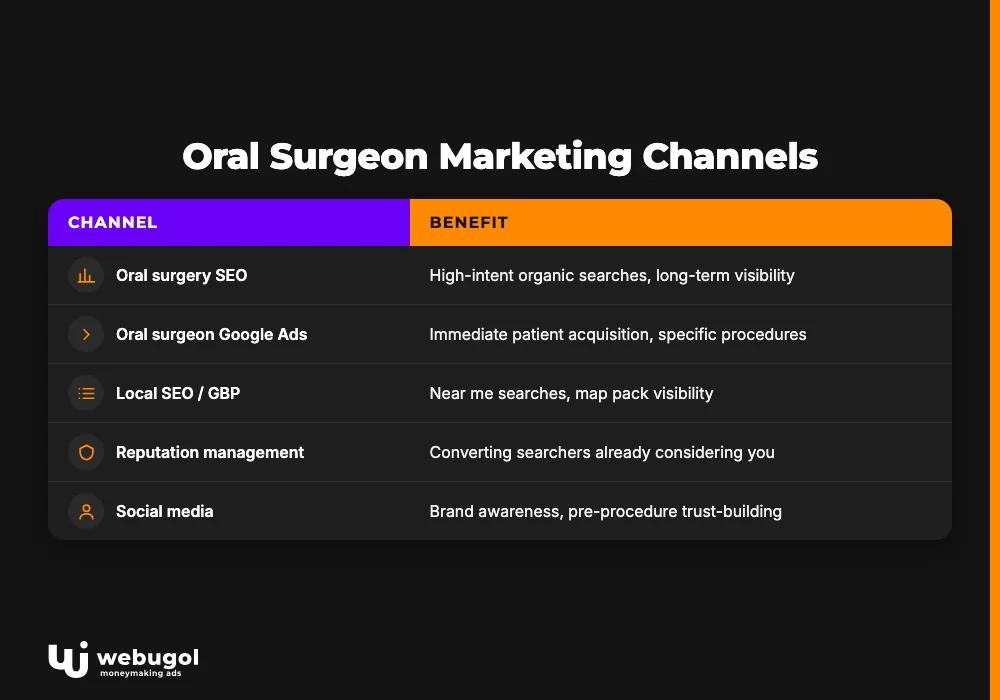
The best advertising channels for oral surgeons are local SEO, Google Ads, reputation management, and social media, used together rather than in isolation. The right mix depends on your procedure range, market size, and existing referral base. Here is how the core channels compare:
| Channel | Best suited for | Timeline to impact |
|---|---|---|
| Oral surgery SEO | High-intent organic searches, long-term visibility | 3-6 months |
| Oral surgeon Google Ads | Immediate patient acquisition, specific procedures | Active while spend runs |
| Local SEO / GBP | "Near me" searches, map pack visibility | Ongoing |
| Oral surgeon reputation management | Converting searchers already considering you | Ongoing |
| Social media | Brand awareness, pre-procedure trust-building | 2-4 weeks per campaign |
Most practices need three to four of these running simultaneously before they see compounding returns.
How to grow an oral surgery practice online?
An oral surgery practice grows online through local SEO, a conversion-focused website, and procedure-specific paid search working together. Getting found is the first step. Converting the visitor into a booked appointment is where most practices leave the most growth on the table.
Oral surgery SEO: ranking when patients search
Local search drives the majority of new patient inquiries. When someone searches for a wisdom teeth removal or implant provider, they check the top three map results and rarely scroll further. Ranking there requires a complete, actively managed Google Business Profile, consistent name-address-phone data across directories, and location-specific content that matches what local patients actually search.
Procedure-level pages matter more than a single "services" page. A dedicated page for "dental implant surgeon [city]" ranks for that term in a way a generic page cannot. For a full breakdown of how oral and medical practices earn those local rankings, the local SEO guide for oral surgery and medical practices covers the technical requirements in detail.
Oral surgeon website design that converts
Your website is the first clinical impression. A slow or disorganized site sends prospective patients to the next practice on the list. Mobile page speed, clear procedure navigation, and a friction-free booking path are the minimum bar.
Organize content by procedure, not by department. Patients searching for corrective jaw surgery do not know your internal structure. Put testimonials close to call-to-action buttons, not on a separate page. Before-and-after photos, displayed with patient consent, reduce anxiety and move hesitant patients toward booking.
How do oral surgeons get more patients online?
Paid search and local SEO working together is the fastest path to a consistent new-patient flow.
Oral surgeon Google Ads and oral surgery PPC
Oral surgeon Google Ads campaigns give immediate visibility while organic rankings build. Campaign structure is the deciding factor: one campaign per core service, not one for the whole practice. Wisdom teeth removal, dental implants, and jaw surgery attract patients with different urgency levels and cost sensitivities. Mixing them into one campaign obscures what is working.
Create dedicated landing pages for each procedure. The page a patient lands on after clicking an ad should match what the ad promised, with the same procedure name, specific details, and a clear next step. Sending paid traffic to a generic homepage is one of the most common reasons oral surgery PPC underperforms.
Track conversions at the appointment level, not the form submission level. Form fills that never become bookings inflate your apparent conversion rate and mislead budget decisions. For the full campaign structure, paid search for oral and medical practices covers the architecture in detail.
Google and Meta both have specific health advertising policies governing how oral surgery services can be targeted and what outcome claims are permissible. Any maxillofacial surgery advertising campaign needs compliance review before launch.
Does social media marketing work for oral surgery practices?
Yes, with realistic expectations. Patients do not casually scroll and decide to book jaw surgery. What social media does well is reduce the anxiety patients carry before they contact you.
Behind-the-scenes content, team introductions, and post-care explainer videos help prospective patients understand what to expect. That familiarity shortens the decision cycle once a patient is already searching. Patient testimonial videos, posted with explicit written consent and in line with HIPAA guidelines, consistently outperform promotional content on reach and saves.
For oral surgery practices, social media works best as the second touch in a sequence. A patient finds you through Google, then checks your Instagram before deciding to call. How social media influences patient decisions in healthcare explains where paid social and organic content fit across the full acquisition path.

Oral surgeon reputation management
Reviews are where patients who already found you decide whether to contact you. A practice with strong local SEO and weak reviews loses patients to competitors ranking below it.
Oral surgeon reputation management is not damage control. It is a systematic ask-and-respond process.
Build review requests into your post-procedure workflow. A satisfied patient who receives a timely, personalized message is far more likely to leave a review than one who gets a generic email weeks later. Respond to every review, positive or negative. How you handle a complaint publicly tells prospective patients more about your practice than the complaint itself.
Feature strong reviews near scheduling prompts on your website, not only on a separate testimonials page.
Sustainable marketing for oral surgeons: building the full system
This is the real constraint most practice owners hit. Running marketing for oral surgeons across SEO, paid search, review management, and content requires consistent time and expertise. Twenty-plus hours per week is a realistic estimate for a system running properly.
The practices that grow consistently do not do more marketing themselves. They build a connected system where tracking links ad spend to booked appointments, the website converts the traffic that SEO and PPC send, and reputation management runs as a standard post-procedure step. Each part feeds the next.
Webugol's Healthcare Growth System is designed around this structure: a 90-day engagement that installs conversion tracking, launches procedure-specific campaigns, and optimizes toward confirmed appointments. It is built for practice owners who want measurable growth without taking on the coordination load themselves.

Ready to stop losing patients before they book?
If your practice is not converting search traffic into a consistent patient flow, the gap is usually not the channel. It is the absence of a connected, tracked system. Book a strategy call to find out exactly where your acquisition pipeline is leaking.
FAQ
How do I start marketing for oral surgeons with a limited budget?
Start with an optimized Google Business Profile and procedure-specific pages on your website. These two steps improve local search visibility without requiring ongoing ad spend. Add Google Ads for one or two high-value procedures once your website converts traffic reliably.
How long does oral surgery SEO take to show results?
Local SEO improvements typically begin showing measurable ranking changes within three to six months. Google Ads can produce appointment inquiries within days of a well-structured campaign launch. Running both simultaneously covers the short and long term without waiting for organic results to compound.
What compliance rules apply to maxillofacial surgery advertising?
Google and Meta restrict health-related targeting and require that treatment outcome claims be substantiated. Retargeting based on inferred health conditions is restricted, and consent tracking requirements apply under applicable HIPAA guidelines for US practices. Every ad campaign needs a compliance review before launch.
Does online reputation management affect patient acquisition for oral surgeons?
Yes. Patients routinely consult reviews before choosing a specialist, and a practice with five or fewer reviews in a competitive market loses to competitors with thirty or more, regardless of clinical quality. A systematic post-procedure review request process directly affects new patient volume.