



How a membership renewal revenue leak silently inflates your acquisition costs
A membership renewal revenue leak occurs when members stop renewing and the resulting revenue gap is absorbed by the acquisition budget rather than addressed at its source. The result looks like a paid media problem: CPA climbs, ROAS drops, and more spend appears to be the fix. The actual cause is a hole in renewal revenue that billing, CRM, and the ad platform each measure differently, so no single report shows it as one number. Until you reconcile those three systems, you are funding a growth ceiling, not a growth engine.
The quiet math no dashboard shows
Rising acquisition CPA and a growing ad budget are downstream symptoms. The upstream cause, in most practices, is membership attrition that never triggered an alert because it fell between systems, between teams, and between reports that each tell a different story.
When churn becomes an acquisition budget problem
When a fixed share of members does not renew in a given cohort, the revenue shortfall requires a calculable number of new acquisitions at the current CPA to hold revenue flat. Each non-renewing member costs more to replace than to retain. That gap compounds across cohorts.
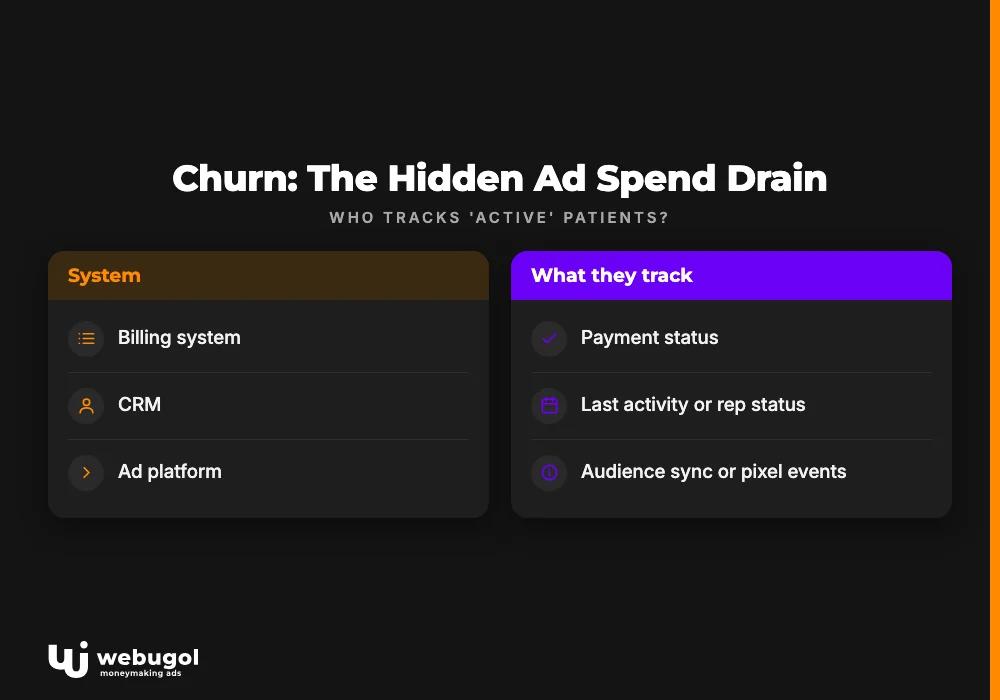
| Who counts this patient as "active"? | What they track | When they notice a problem |
|---|---|---|
| Billing system | Payment status | At the next failed charge |
| CRM | Last activity or rep-archived status | When a rep manually updates the record |
| Ad platform | Audience sync from CRM or pixel events | Never, unless explicitly excluded from audiences |
The three systems agree on the same patient as "active" only by coincidence. Payment current with no recent appointment, payment lapsed with an un-archived CRM record, a patient retargeted after their billing lapse, none of these states produce an alert in any single report. The gap between them is where revenue disappears without leaving a trace in any dashboard you currently check.
How much of my ad spend is going toward covering membership churn?
The calculation requires comparing revenue from new acquisitions against revenue lost from non-renewing members in the same period. Most practices have never run this reconciliation, which is why the leak stays invisible while the ad budget climbs. The reconciliation also reveals how many "new patients" in the acquisition report are reacquisitions of lapsed members the practice already paid to acquire once.
Red flags that a membership renewal revenue leak is already under way:
- Acquisition CPA is rising without a clear media cause.
- New-patient cohort records overlap with the lapsed-member list by more than 15%.
- Billing and CRM active-patient counts diverge by more than 10%.
- No defined touch sequence exists between the last appointment and the renewal date.
- Ad spend increased two or more consecutive months with no corresponding revenue lift.
Where the membership renewal revenue leak actually happens
The leak concentrates in three structural gaps. None appear on a standard dashboard because each falls between two systems or two teams, and no individual system is designed to surface the space between itself and the next one.
Does your billing system and CRM agree on who is an active patient?
Billing marks a patient active until a charge fails; CRM marks them active until a rep archives the record. These are different events, often weeks or months apart. The space between them is where renewal revenue disappears without triggering an alert in either system.
The mismatch also corrupts paid retargeting. If the ad platform syncs from a CRM that has not yet reflected a billing lapse, the practice pays to reach patients who have already churned. The structural conditions that create this billing-CRM gap are the same ones that make building systematic retention across membership cohorts impossible to run consistently, every cohort starts with an unreliable baseline, and programs built on bad counts produce results nobody can explain.
The gap between "active" and "engaged"
A patient can be current on billing and entirely absent from the CRM: no recent appointments, no open conversations, no upcoming renewal trigger logged. Silent attrition accumulates in this space. By the time billing reflects the churn, reactivation costs more than retention would have. The acquisition campaign is already running to fill a gap the practice did not know existed.
This is the defining feature of membership churn in healthcare: it goes quiet before it goes formal. The patient stops engaging weeks before the payment fails, and that pre-failure window is the cheapest moment to intervene. After it closes, every option gets more expensive.
Renewal windows nobody owns
Most practices have no defined owner for the renewal touch sequence. Marketing assumes CRM handles it. CRM assumes billing sends a notice. Billing sends an automated payment reminder and considers the job done. The window where a direct conversation could save the membership passes without outreach, and the patient lapses without anyone knowing it was preventable. The result is not a staffing problem. It is a scope problem.
Why healthcare renewal leaks differently
Healthcare membership renewal operates under constraints that standard DTC subscription frameworks do not address. That difference matters for how the leak is closed and who needs to be in the room when you close it.
Compliance constraints on renewal communications
HIPAA, platform SMS and email policies, and the clinical relationship each shape what renewal outreach is permissible. A win-back sequence that works for a DTC supplement brand is not directly portable to a GLP-1 or men's health program without a compliance review. Any renewal or reactivation sequence that references a patient's specific program or condition requires an approver in the chain before deployment.
Building a compliant win-back program for lapsed members requires a different compliance posture than a standard nurture sequence. The structure of consent collected at intake determines what channels are available for renewal outreach, and practices that discover this constraint mid-build lose weeks they did not budget for.
Who should own membership renewal in a healthcare practice?
In most practices, nobody explicitly owns renewal. The responsibility falls between marketing, CRM, and billing without being claimed by any of them. The result is that every system does its assigned job correctly and the renewal still fails, because the gap between systems is nobody's designated scope.
Renewal ownership requires three things operationally: a defined touch sequence with named triggers, a decision rule for escalation when a patient does not respond, and read access across billing, CRM, and the ad platform. Ownership does not require a new hire. It requires a role scope that crosses the existing silos.
This ownership gap is what Webugol's diagnostic process consistently surfaces first, not an underperforming ad campaign, but a structural gap in who is accountable for what happens between the last purchase and the renewal date. The handoffs between billing, CRM, and acquisition belong to someone. When they belong to no one, the acquisition budget absorbs the cost of that vacancy, and the membership renewal revenue leak keeps compounding quietly across cohorts.
What a renewal audit looks like in practice
A renewal audit produces four concrete outputs: the size of the billing-CRM gap, the fraction of "new patients" who are actual reacquisitions, a complete map of the touch sequence per membership tier, and a responsibility matrix for the next renewal cohort. Each step requires specific data pulls, not a general commitment to "improve retention."
Reconcile billing and CRM first
Pull active-patient counts from billing and from CRM for the same date range. The gap between the two numbers sets the floor for the accountability problem. Then match the acquisition report against the lapsed-member list: any patient who lapsed within the previous 6 to 18 months and reappears as a new paid lead represents a reacquisition cost, not a true new-patient cost. This reconciliation typically produces the most uncomfortable number in the entire audit.
Getting to that number requires read access across systems that most marketing teams have never formally mapped. The same access gaps that complicate a billing-CRM reconciliation show up in a marketing access audit, the diagnostic work is structurally the same, and the blockers are usually the same too.
Map the touch sequence
For each membership tier, trace every communication a patient receives between their last purchase and their renewal date. Most practices find a payment reminder and nothing else. The map identifies every window where a retention touchpoint could have changed the outcome and currently does not exist. That list of gaps is more actionable than a general directive to improve retention, it names the specific moments where intervention was possible and nobody was there.
Assign owners before the next renewal cliff
Each touchpoint in the sequence needs a person, a deadline, and a decision rule for escalation. Without explicit assignment, the audit produces a list that nobody acts on before the next cohort lapses. This step converts findings into a responsibility matrix that is actionable on the current renewal timeline.
Renewal audit checklist:
- Reconcile billing vs. CRM active-patient counts for the same date range.
- Run an overlap analysis on the acquisition report vs. the lapsed-member list.
- Map the touch sequence per membership tier from last purchase to renewal date.
- Identify every window in that sequence where no outreach currently exists.
- Assign an owner, a deadline, and an escalation rule for each touchpoint.
If your practice has a renewal cohort reaching a cliff in the next 60 to 90 days, a system audit now costs less than a reacquisition campaign later. This 90-day growth program is built to close exactly these gaps before they compound into a media budget problem.
Stop plugging renewal holes with ad spend
Raising acquisition spend to offset renewal attrition is a compounding problem. Each additional patient only partially offsets the ongoing leak. The CPA denominator keeps climbing. The underlying structural gap never closes.
The math only improves when the renewal path is owned, the billing-CRM gap is closed, and the touch sequence has an accountable person behind it. A membership renewal revenue leak is not a media buying problem, and it does not respond to media buying solutions. More spend treats the symptom while the cause continues draining revenue from the cohort that just lapsed, and the one after that.
Webugol owns the handoffs between billing, CRM, and acquisition. If you are not certain how much of your current ad spend is covering a renewal hole rather than buying genuinely new patients, a diagnostic conversation is the first step. Book a Strategy Call through the Healthcare Growth System to start with a full billing-CRM reconciliation.
FAQ
Why is my patient acquisition cost rising even though my campaigns have not changed?
Rising CPA without a clear media cause is one of the most reliable signals of a membership renewal revenue leak. When renewal attrition accelerates, the acquisition budget must replace lapsed members in addition to growing the base, which raises the effective CPA across the account even if the campaigns themselves are performing normally.
What is the difference between billing churn and CRM churn?
Billing churn occurs when a payment fails or a subscription cancels in the billing system. CRM churn occurs when a patient stops engaging, often weeks before billing reflects it. The gap between the two represents patients who are technically current on payment but have already stopped participating, and that gap is where most renewal leaks form undetected.
How do I know if my "new patients" are actually lapsed patients I am paying to reacquire?
Match your acquisition records against the lapsed-member list in your CRM and billing system for the same date range. Any patient who lapsed within the previous 6 to 18 months and reappears as a new paid lead represents a reacquisition cost, not a true new-patient cost. Practices running this reconciliation for the first time consistently find the overlap higher than expected.
Who should handle the membership renewal sequence in a telehealth practice?
Renewal ownership should sit with whoever controls the patient communication sequence between last purchase and the renewal date, typically a marketing or CRM role rather than billing. The key requirements are read access across billing, CRM, and the ad platform, plus authority to trigger outreach without a developer sprint for every touchpoint.
How do I build a HIPAA-compliant win-back sequence for lapsed members?
A HIPAA-compliant win-back sequence starts with a review of the consent collected at intake to confirm what can be communicated via SMS and email under HIPAA. Platform advertising policies for healthcare add a second constraint layer. Any sequence that references a patient's specific condition or program requires compliance review and approver sign-off before deployment.

