



Alternative medicine marketing: grow your holistic practice
Alternative medicine marketing is the structured effort to put your holistic practice in front of patients who are actively searching for what you offer, convert website visitors into booked appointments, and keep those patients returning. The core channels are local SEO, paid search, social media, email, and retargeting. Each one solves a different part of the acquisition problem, and results depend on how well they connect.
That connected approach matters at every stage. The same fragmented channel management that makes growth unpredictable for a solo practitioner is the structural bottleneck that keeps an established holistic clinic's patient acquisition cost high at scale: channels run in isolation, tracking cannot explain what drives bookings, and the handoffs between marketing, website, and intake belong to nobody.
How do you market an alternative medicine practice?
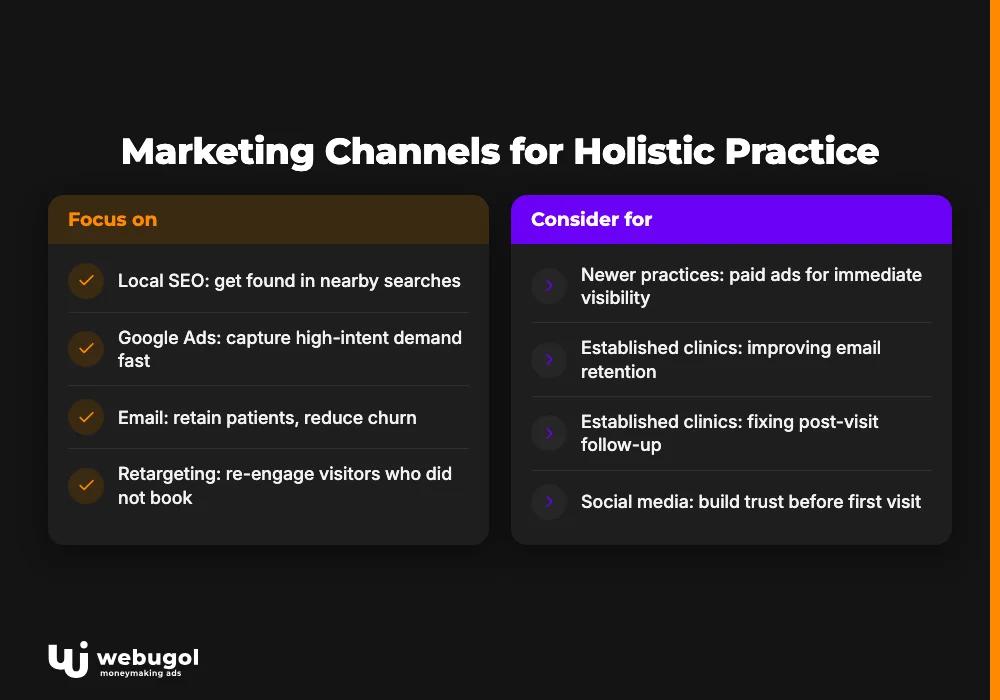
Effective alternative medicine marketing starts with a clear channel map. Here is the core breakdown for holistic practice promotion:
| Channel | Primary job | Key metric |
|---|---|---|
| Local SEO | Get found in nearby searches | Maps ranking, organic traffic |
| Google Ads | Capture high-intent demand fast | CPL, booking conversion rate |
| Social media | Build trust before the first visit | Engagement, referral bookings |
| Retain patients, reduce churn | Appointment reactivations | |
| Retargeting | Re-engage visitors who did not book | Cost per booked appointment |
The right balance depends on your stage. Newer practices lean on paid ads for immediate visibility while SEO builds over months. Established clinics often find that improving email retention and fixing post-visit follow-up cuts acquisition costs faster than increasing ad spend.
Effective alternative medicine marketing is not about running every channel at once. It is about knowing which gaps to close first.
How does local SEO help alternative medicine clinics?
Local SEO ensures your practice appears in Google Maps and organic results when someone nearby searches for a naturopath, acupuncturist, or integrative medicine provider. For most holistic practices, the majority of patients come from within a few miles. Natural health clinic SEO is what makes those services visible.
Local SEO for clinics starts with four practical building blocks:
- Claim and fully complete your Google Business Profile, including services, hours, photos, and your primary service category
- Create individual pages for each treatment or modality you offer, using location-specific language in headings and body copy
- Build citations on health-specific directories with identical name, address, and phone details across every listing
- Collect and respond to patient reviews, which function as both a ranking signal and a trust signal for first-time visitors
What most practitioners underestimate is the depth required behind each page. A homepage and a contact form alone cannot compete in a local search result. Each service page needs enough content to signal topical authority and answer the questions a first-time visitor actually has.
For a full technical and content checklist, the local SEO guide for holistic and wellness clinics covers how health practices rank in competitive local markets.
What social media platforms work best for holistic practitioners?
Instagram and Facebook are the primary channels for wellness practice social media. Patients use both to research providers, read testimonials, and decide whether to book, often before visiting the practice website. LinkedIn works well for building professional referral relationships with other health providers.
The goal on social is not broadcasting a service list. It is giving potential patients a reason to trust your practice before they ever call. Specific formats that work reliably for alternative medicine marketing on social:
- Short-form video showing what a first appointment looks like, which reduces the anxiety barrier to booking
- Live Q&A sessions on Facebook or Instagram addressing common questions about specific treatments
- Patient testimonials with explicit written consent, reshared as authentic social proof
- Stories with direct-response polls that push your content to wider audiences
For a detailed review of social media content and campaigns for healthcare practices, including which platform features produce the highest consultation conversion rates, see the linked guide.
The compliance note applies: review platform advertising policies before running condition-specific targeting or making treatment outcome claims in ad creative.
Is email marketing effective for wellness practices?
Yes. Email marketing for practitioners outperforms social reach for one structural reason: you own the list. Social algorithms cap how many followers see any given post. Email lands directly in the inbox of every opted-in subscriber.
The highest-ROI uses for a holistic practice are:
- Appointment reminders and pre-visit education to reduce no-shows and improve intake quality
- Post-visit follow-up sequences that ask for reviews and reinforce treatment plans
- Re-engagement campaigns for patients who have not booked in 60 to 90 days
- Educational content that keeps your practice relevant during the gaps between visits
Segmenting by treatment type or visit history lets you send relevant content instead of generic newsletters. Subject lines that reference a specific past appointment or pose a direct question consistently outperform broadcast messaging.
Mobile optimization matters. A large share of patients open health-related emails on a phone, so subject lines should be short, text concise, and booking CTAs large and tappable.
For a full framework on structuring and automating these sequences, the email nurture and reactivation guide for health practices covers segmentation logic, automation triggers, and re-engagement cadences.

Paid advertising in alternative medicine marketing: Google Ads and retargeting
Paid advertising accelerates patient acquisition when SEO is still building momentum. Google Ads for alternative health targets people actively searching for specific treatments, so purchase intent is already high. Social ads target by demographics and behaviors, which works better for top-of-funnel awareness.
Three tactics matter most when combining paid advertising with local SEO for clinics:
Audience segmentation adjusts messaging to different patient groups. Existing patients see retention offers. New visitors see introductory appointment offers. Local residents within a defined radius see location-specific copy.
Retargeting for health clinics re-engages visitors who reached your booking page but did not complete the form. This audience already knows your practice. A low-commitment offer, such as a free initial consultation or a discounted first visit, typically converts them at much lower cost than cold acquisition.
Ad scheduling concentrates budget during the hours your audience actually books. For most clinics, that window is identifiable from two to four weeks of campaign data.
The compliance layer is not optional. Google and Meta enforce health advertising policies that restrict condition-specific targeting and certain types of claims. Any campaign running for more than a few months should have a compliance review pass, particularly if the original creative pre-dates recent policy updates.
For a detailed walkthrough of campaign architecture and bidding logic, the paid search and display guide for health practices covers the full setup.
How to get more clients for a holistic clinic?
Most holistic clinics do not have a lead generation problem. They have a conversion problem. Traffic arrives, visitors look at the website, and they leave without booking. It is a quiet drain.
Your website is where alternative medicine marketing either pays off or wastes every dollar spent upstream. Three factors determine whether a visitor books or bounces: load speed, clarity of the offer, and ease of booking.
A slow mobile site kills conversion. So does a contact page that requires a phone call, or a homepage that lists modalities without explaining patient outcomes. These issues cut conversion regardless of how well every other channel performs.
Practical fixes: a single clear CTA on every service page, a booking widget that does not require a callback, mobile-first design loading under three seconds, and service-page FAQs that address the objections a first-time visitor typically has.
The deeper lever is what happens after the first appointment. Retention, renewal, and reactivation determine whether your acquisition cost is sustainable. A clinic that sees most patients once and loses them is raising ad spend to cover a churn problem, not a demand problem.
Webugol builds acquisition systems for health and wellness clinics that cover the full patient path, because patching the top of the funnel without owning the bottom is what keeps CAC permanently high.

Ready to build a patient acquisition system that scales
If your alternative medicine marketing is running but results have plateaued, the gap is usually a tracking problem, a conversion bottleneck, or a retention leak, not a channel problem.
The Healthcare Growth System is a 90-day direct-to-patient acquisition sprint built for health and wellness clinics: tracking foundation first, then conversion-led campaigns, then systematic scale.
Across 50-plus healthcare clients, the program has produced 3x revenue growth and reduced cost per acquisition by 40% on average. Specific results include Valhalla Vitality (telehealth, +287% monthly revenue, -45% CAC), Ways2Well (wellness, $2.1M revenue in six months, -38% CPA), and LifeRx MD (med spa, +156% bookings, +85% LTV).
Book a strategy call to find out exactly where your acquisition system is losing patients before they book.
FAQ
How do you market an alternative medicine practice?
Effective marketing combines local SEO, Google Ads, social media, email, and retargeting into a connected system where tracking runs end-to-end from first click to booked appointment. Most underperformance comes from running these channels in isolation rather than missing a channel altogether.
What social media platforms work best for holistic practitioners?
Instagram and Facebook are the primary platforms because patients use them to research providers and read testimonials before booking. LinkedIn is useful for building professional referral relationships with other health providers.
How does local SEO help alternative medicine clinics?
Local SEO ensures your clinic appears in Google Maps and organic results when nearby patients search for your services. The foundation is a complete Google Business Profile, location-specific service pages, and consistent directory citations.
Is email marketing effective for wellness practices?
Yes, because you own the subscriber list and are not subject to algorithm reach limits. The highest-ROI uses are post-visit follow-up sequences, appointment reminders, and re-engagement campaigns for patients who have not booked in 60 to 90 days.
How to get more clients for a holistic clinic?
The fastest gains typically come from fixing conversion rather than adding more traffic. A friction-free booking flow, faster page load times, and a retention program that reduces churn can lower cost per acquisition significantly without increasing ad spend.