



SEO and Social Media: How Integration Drives Organic Growth
SEO and social media operate on different mechanics. Different platforms, different metrics. But treating them as separate channels is what quietly stalls growth for most marketing teams. Social platforms do not directly change how Google ranks a page. What they create is a distribution chain: wider content reach leads to more backlink opportunities, backlinks move organic rankings, and stronger rankings reduce dependence on paid traffic. For a marketing director managing both channels, the gap between them is the most underused growth lever available.
If you are just beginning to coordinate SEO and social media, that challenge is not a beginner problem. It is the same structural gap that keeps established businesses stuck on a scaling plateau: no shared keyword data, no feedback loop between channels, no compound effect. The fix is structural, and it applies at any stage of growth.
Does social media affect SEO rankings?
Social media does not directly determine your Google rankings. In 2014, Google's Matt Cutts confirmed that likes, shares, and follower counts are not used as primary ranking signals, and that position has not changed since. The indirect path is where the leverage lives.
High engagement on social expands content reach. Wider reach puts your material in front of journalists, bloggers, and industry writers who have websites. That exposure generates backlinks. Backlinks are a confirmed direct ranking factor. Social media is an amplification system for the content that earns those links, not a ranking factor itself.
What social media signals does Google consider?
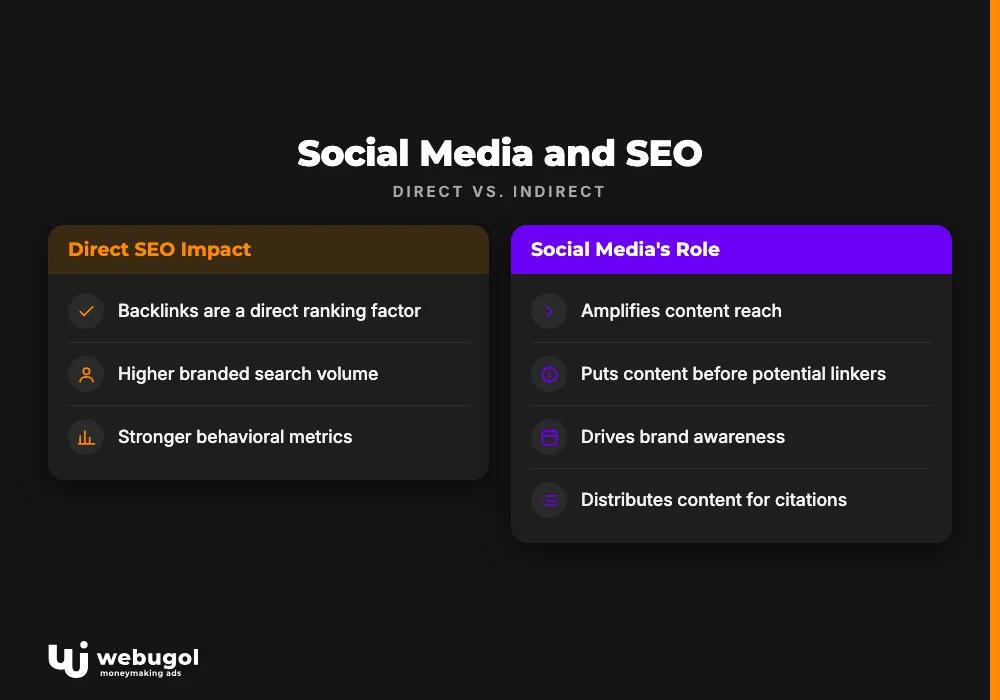
The relationship between social signals and ranking in Google's algorithm is entirely indirect. Google does not process likes, shares, or follower counts as ranking data. What it registers are the downstream effects: earned backlinks from content that spread widely, higher branded search volume as more people discover a brand through social, and stronger behavioral metrics from warmer audiences who already know the brand before clicking through from search.
Do social media shares improve Google rankings?
A share on LinkedIn or X does not add authority to your domain. What it does is distribute content to people who might choose to cite it on their own sites. Optimizing for shares is worthwhile, but only as a distribution mechanism for content that can earn real links, not as a direct ranking lever.
| Factor | Social media's role | Direct SEO impact |
|---|---|---|
| Backlinks | Puts content in front of potential linkers | Indirect: links earned from people who discover content via social |
| Brand search volume | Social campaigns drive awareness and branded queries | Indirect: brand query growth signals category relevance to Google |
| Crawl frequency | Rapid sharing signals content freshness to crawlers | Indirect: faster indexing of new content |
| User engagement | Social audiences arrive pre-warmed, reducing bounce rate | Indirect: behavioral signals influence perceived content quality |
| SERP real estate | Optimized social profiles appear in branded SERPs | Direct: occupies more page-one positions for your brand name |
How does social media help with link building?
This is where the seo and social media connection pays off most concretely, and where most teams leave the most on the table.
Distribution to link-worthy audiences. A well-researched article posted in the right LinkedIn group, niche subreddit, or industry newsletter reaches the specific people who have websites and reason to cite your content. Cold email outreach targets the same people, but it requires them to find your content first. Social distribution makes the content discoverable passively, compressing the timeline from publication to first backlink.
Building repeat relationships. Engaging consistently with journalists, analysts, and bloggers in your niche on social means that when you publish something worth citing, those people already recognize your brand. That recognition converts to citations at a meaningfully higher rate than outreach to cold contacts.
Retargeting for link acquisition. You can use paid social to push your highest-quality content specifically to custom audiences built from site owners and content creators in your industry. This applies a social media link building budget directly toward measurable SEO outcomes, with attribution back to specific content assets.
The approach is not about shortcuts. It is about putting substantive content in front of the people who can amplify it in ways that Google directly measures.
How to use social media to boost organic traffic?
Five tactics produce consistent results when seo and social media are run as a single system.
1. Build a shared keyword database. Your SEO keyword research reveals what your audience searches for before they encounter your brand. That list should inform your social content calendar. When social posts address the same informational needs as your SEO content, the audience that finds you on social converts at a higher rate because the message is consistent with what brought them to the topic.
2. Use content atomization. A single pillar page built for organic search can generate multiple LinkedIn posts, short-form videos for TikTok or Reels, and a newsletter segment. Each social piece points back to the core page, multiplying traffic and behavioral signals without creating separate content from scratch. One content investment earns SEO authority and social reach at the same time.
3. Optimize social profiles for search intent. Your LinkedIn bio, Twitter/X description, and Facebook About section should read like a meta description, not a tagline. Descriptive, keyword-relevant profiles help your social pages rank in branded SERPs and in platform-native search, capturing audiences who discover you outside Google entirely.
4. Tag every social link with UTM parameters. Without tracking, you cannot distinguish which social channel drives traffic that actually converts. UTM tagging closes the measurement gap. It shows which content drives sessions with strong behavioral signals, the kind Google factors into its quality assessment of your pages.
5. Run the feedback loop. When a topic goes viral on social but generates almost no organic traffic, that gap is diagnostic. It likely means the on-page SEO is weak despite strong content. When a high-ranking page generates no social engagement, the content is likely technically correct but packaged purely for search, not for sharing. Measuring both channels together surfaces these gaps. That is the fastest path to improving both simultaneously.
Content distribution strategy and brand search volume
Two mechanisms connect seo and social media more directly than most marketing teams realize.
Content distribution strategy determines whether the investment in SEO-rich content reaches the people who can amplify it. Without a distribution layer, a well-researched article sits indexed but largely unread for months, waiting for organic authority to accumulate. Social channels compress that timeline. They put content in front of real audiences within hours of publication, generating the engagement signals that accelerate indexing and attract the early backlinks that matter most for ranking velocity.
Brand search volume is the more undervalued signal. When social campaigns grow brand awareness, more people search directly for your company name. Those branded queries tell Google that your brand is a recognized entity in its category. As a result, the site becomes more visible in related non-branded searches because brand query volume is part of how Google establishes topical relevance. For a deeper look at how branded search drives long-term organic performance, see how growing brand search volume translates to sustainable rankings.
The social media ranking factors that matter most are not platform-native metrics like reach or impressions. They are the downstream SEO effects: earned links, brand recognition, and improved behavioral engagement from audiences who already know the brand before they arrive from search.

How Webugol integrates seo and social media for scaling businesses
Businesses that reach a growth plateau on organic search are frequently running a good SEO program and a separate social program with no shared infrastructure. Each channel optimizes for its own metrics. Neither channel benefits from the other's data. That is the structural problem that integrated digital marketing solves.
At Webugol, we treat seo and social media as one growth system. The integration starts at strategy: shared keyword research informs both the SEO content calendar and the social post schedule. It continues through execution: every content asset is planned for distribution across both channels from the beginning, not adapted for social as an afterthought. It closes through measurement: UTM-tagged social traffic feeds directly into SEO strategy, so topics that over-perform on social get prioritized for deeper organic coverage.
For marketing directors who have already invested in both channels separately, the opportunity is not to rebuild from scratch. It is to install the feedback loop between the channels that already exist. That single change typically unblocks growth neither channel can generate independently.
Before integrating, it helps to understand where organic search actually stands today. Our analysis of search trends through 2025 covers the shifts that matter most for businesses running both channels.
Webugol builds this shared infrastructure: a website SEO strategy designed from the start to work with your social channels, amplify content distribution, and feed behavioral data back into organic performance.
Stop losing growth to disconnected channels
Every backlink not earned because the right person never saw your content, every branded search not triggered because social campaigns had no keyword alignment, every content asset that performed in only one channel instead of both: that is what a disconnected approach loses. The loss compounds quietly over months.
The starting point is an audit. Map what your SEO content calendar and your social content calendar actually have in common. If the overlap is thin, that gap is the first thing to close. After the audit, the structural fix is straightforward: shared keyword data, UTM-tagged links, and a monthly cross-channel review where both programs report to the same performance criteria.
Webugol works with marketing directors and business owners to build that integrated system. Contact our team through our consultation page to map the gaps and build the feedback loop your channels are missing.
FAQ
Does social media directly improve Google rankings?
No. Google does not use likes, shares, or follower counts as ranking signals, as confirmed by Google's Matt Cutts in 2014. Social media influences rankings indirectly by increasing content distribution, earning backlinks, and growing brand search volume.
What social media signals does Google consider for SEO?
Google does not process social engagement metrics directly. The indirect effects it registers are earned backlinks from widely distributed content, higher branded search query volume, and improved behavioral metrics from social audiences who arrive familiar with your brand.
How does social media link building work in practice?
Social media link building works by distributing high-quality content to audiences that include bloggers, journalists, and site owners who can link to it. Consistent engagement with those audiences builds brand recognition that converts to citations without requiring cold outreach.
How does brand search volume connect to organic rankings?
When social campaigns grow brand awareness, more people search directly for your brand name. That growth in branded query volume signals topical relevance to Google, which improves visibility for related non-branded searches in your category over time.
How often should I audit the connection between SEO and social media?
A quarterly review is enough for most marketing teams. Check whether your top-performing social content aligns with your highest-traffic organic pages, and whether your best SEO content is actively distributed on social. Gaps between the two identify the fastest optimization opportunities.

