



Bing vs Google SEO: Key Ranking Differences and What to Do in 2026
Bing vs Google SEO is not a matter of one engine being larger. The two algorithms apply different logic: Google rewards topic authority and user experience depth, while Bing weights exact-match keyword placement, social engagement signals, and trust in older established domains. If your site ranks on Google but ignores Bing, you are leaving a segment of high-intent users unserved, particularly those on Windows devices and Microsoft Edge. Understanding where the strategies diverge is the starting point for a website SEO strategy that works across both.
Whether you are running your first site audit or managing traffic for a business at scale, uncertainty about which engine deserves your optimization budget is not a novice problem. It is the same structural gap that holds scaling marketing teams back when their traffic plateaus and they cannot trace which engine is quietly bleeding their organic efficiency.
What are the main differences between Bing and Google SEO?
Google and Bing share the same surface goal: return the most relevant result for every query. Their methods differ substantially. Google treats keywords as signals within a broader topic model; Bing treats them as literal instructions. Google devalues exact-match overuse; Bing rewards precision placement in titles, H1 tags, and meta descriptions.
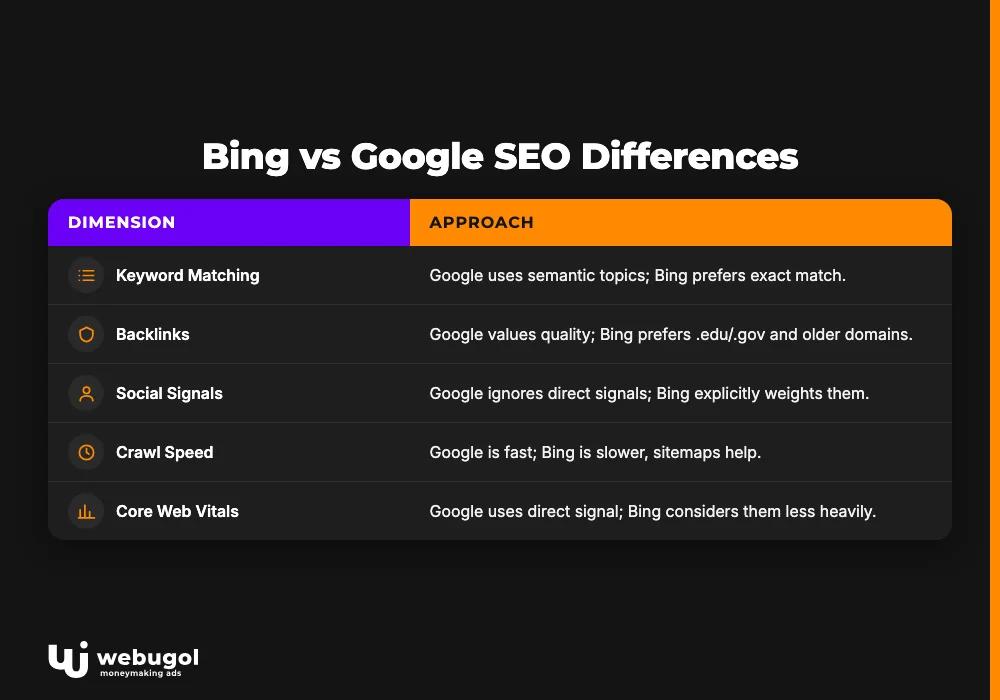
The table below maps the core differences across five dimensions of Bing vs Google SEO:
| Dimension | Bing | |
|---|---|---|
| Keyword matching | Semantic, topic-based; synonyms handled automatically | Exact-match preferred in structural elements |
| Backlinks | Quality and topical relevance of linking domain | Quality plus preference for .edu/.gov and older domains |
| Social signals | Not a direct ranking factor | Explicit weighting: shares and likes on Facebook and Twitter/X matter |
| Core Web Vitals | Direct ranking signal (LCP, INP, CLS) | Considered but weighted less heavily than Google |
| Crawl and indexing speed | Hours to minutes for new content | Slower; sitemaps in Bing Webmaster Tools accelerate the process |
These five dimensions shape how you write content, build links, and configure your technical setup. The gap is wide enough that a page optimized purely for Google will regularly underperform on Bing without specific adjustments. That consistent gap is what makes bing vs google seo a subject worth revisiting as algorithms evolve, not a one-time audit.
Google's SERP features extend beyond standard results. Its Knowledge Graph and featured snippets attempt to answer queries directly on the results page, which means competing on Google sometimes requires targeting the answer-box position, not just a ranked link. Bing's SERPs are visually oriented, with dedicated surfaces for image search, video search, and vertical categories including news, retail, and travel. Those vertical results represent traffic channels that standard Google SEO tactics do not cover.
One additional practical difference: Bing displays longer meta descriptions than Google. This means you have more visible real estate in Bing's SERP to communicate your content's value. Write your meta description to be informative at both Google's shorter display length and Bing's longer one, with the most critical information in the first sentence.
How Does Bing vs Google SEO Work at the Ranking Level?
Bing's ranking logic is more literal than Google's. It looks for the query phrase in predictable structural locations: the title tag, H1 tag, meta description, and the opening paragraph. A page that places its primary keyword in those locations with a clear heading hierarchy has a measurable structural advantage on Bing. That same page may not achieve the same lift from semantic signals alone.
Exact-match keywords and on-page placement
Where Google uses natural language processing to infer topic relevance from surrounding content, Bing favors direct signal placement. If your target keyword appears exactly in your title and H1, Bing registers that alignment as a primary relevance indicator. Synonyms and related terms do not substitute for the exact phrase on Bing the way they do on Google.
This creates a tactical split in how you write titles. For Google, a title that signals depth and intent match can outperform a bare-keyword title. For Bing, the keyword itself in the title carries direct ranking weight. The bing ranking factors 2026 reward specificity in structural elements. This does not mean abandoning good writing; it means leading with the topic before adding framing or creative phrasing.
Social signals as authority markers
Bing has stated that social signals, specifically engagement on platforms like Facebook and Twitter/X, factor into its rankings. Shares, likes, and comments are interpreted as external validation of content quality. Google has not incorporated social signals as a direct ranking input.
For bing seo best practices, this means content promotion is not just a distribution tactic. Active social sharing can lift Bing rankings in ways that do not apply to Google. That divergence is one of the clearest examples where a unified content distribution workflow earns double value: direct reach and engine-specific ranking signals at the same time. It is also one of the most actionable insights that bing vs google seo analysis surfaces for teams that have already plateaued on a Google-only content calendar.
Domain trust and backlink preferences
Both engines value backlinks, but their trust models differ at the margins. Bing gives additional weight to links from .edu and .gov domains and from older, long-established websites. Google weighs the relevance and topical authority of the linking domain more broadly. A link from a ten-year-old industry publication may carry different relative weight on each engine, which is why a link-building program that targets established sources serves both engines well, not just one.
What ranking factors does Bing prioritize over Google?
Bing SEO prioritizes three factors that Google either ignores or weights differently: exact keyword placement, social engagement signals, and established domain trust. Each one offers a distinct optimization lever, and each requires a specific action rather than a general content improvement.
Keyword precision over semantic breadth
Google's algorithm is built to understand intent, synonyms, and context. It can rank a page for a query even when the exact phrase never appears in the text. Bing works closer to the surface. Using your exact target phrase in the title, H1, meta description, and first paragraph is not optional for Bing; it is the baseline of bing search optimization.
This matters most for pages targeting competitive queries. On Bing, a technically clean page with strong on-page keyword placement can outrank a semantically rich page that buries the keyword or relies on variations throughout.
That dynamic is reversed on Google, where natural language variation signals depth rather than evasion. The same content can rank very differently on each engine without any technical defect on either side.
Social signals and older domain trust
Bing's weighting of social engagement is a genuine differentiator in google vs bing differences. For businesses with active social media profiles, Bing optimization and social distribution become the same effort. Publishing content and actively promoting it on Facebook and LinkedIn does double duty: direct audience reach and a Bing ranking signal simultaneously.
Domain age and link provenance also matter more on Bing. If your link-building effort targets institutional and long-standing sources, Bing rewards that more visibly than Google does. Both engines benefit from quality signals at their core; the margin is in what Bing explicitly weights that Google does not.
Multimedia content and site architecture
Bing has strong image and video search capabilities. Many seo for bing 2026 guides underweight this. Optimizing multimedia with relevant file names, accurate alt text, and descriptive captions creates ranking opportunities in Bing's visual search results alongside standard web results. For sites with significant image or video content, this represents a material traffic source separate from standard keyword rankings.
Bingbot also responds well to clear site architecture. A logical URL structure, clean internal linking, and an XML sitemap submitted through Bing Webmaster Tools reduce the crawl friction that Bing's slower bot encounters on poorly organized sites. Bingbot's slower indexing speed makes structural clarity more urgent on Bing than many teams account for in their technical priorities.
Is Bing vs Google SEO Worth Your Time in 2026?
Yes, as a secondary priority with a clear business rationale. Bing has built a meaningful user base, particularly among Windows device users and those using Microsoft Edge as their default browser. That audience is real. In some categories it converts at high rates.
The strategic case is not that Bing replaces Google optimization. It is that the marginal cost of extending your existing SEO work to cover Bing is small relative to the potential return.
If your content is well-structured, your on-page signals are strong, and your site is technically sound, the Bing-specific additions are: exact-match keyword placement in structural elements, sitemap submission to Bing Webmaster Tools, and active social promotion. That is hours of work, not months.
Where Bing becomes genuinely worth deeper investment is when your analytics show Bing traffic converting at higher rates than Google traffic. That pattern is not uncommon in B2B, enterprise, and professional services categories where the audience demographic skews toward Windows environments. When you see it, invest more deliberately rather than treating Bing as an afterthought.
Before committing to a full dual-engine effort, it makes sense to forecast your search traffic by engine so you understand the ceiling on Bing's contribution to total organic growth before you allocate resources.
There is also a forward-looking argument. Bing powers Microsoft's AI-assisted search features. Users interacting with Copilot on Windows increasingly get answers drawn from Bing's index. That organic presence is a pathway to AI-assisted visibility beyond the traditional SERP.
Bing SEO and AI search visibility are becoming harder to separate, which strengthens the case for a multi-platform seo strategy rather than treating Google as the only engine worth optimizing for.

How to optimize a website for both Bing and Google
A unified approach starts from what the two engines share: they both reward quality content, clean technical structure, and genuine backlinks from relevant sources. The divergence is in emphasis. The adjustments are specific rather than structural, and one content workflow with engine-specific additions at the on-page and distribution layer handles both.
Technical foundation: shared and divergent needs
Both engines require a crawlable site, an XML sitemap, and clean internal linking. The difference is in tooling and speed. Googlebot indexes new content within hours; Bingbot can take days or weeks. Submitting your sitemap to both Google Search Console and Bing Webmaster Tools is not optional if you want timely indexing on both platforms. That difference in crawl speed is one of the most underestimated technical divergences that bing vs google seo practitioners encounter in the first month of a dual-platform effort.
For Core Web Vitals, Google uses LCP, INP, and CLS as direct ranking signals. Bing considers load speed and mobile-friendliness but weights them less heavily. Optimizing to Google's Core Web Vitals thresholds still benefits Bing users indirectly, since faster pages retain users regardless of which engine delivered them.
If your site was built on a stack that struggles with performance, that is a structural problem affecting both engines. It is a reason to address the platform, not to deprioritize speed optimization because Bing's threshold appears lower.
Schema markup is one of the highest-leverage technical actions that benefits both engines simultaneously. Structured data helps Google surface rich snippets in SERPs and helps Bing understand content categories for its visual and vertical search results. After implementing schema, test it in both Google's Rich Results Test and Bing Webmaster Tools' schema validator to confirm correct parsing on both sides.
Content strategy for dual optimization
Write for humans first, then adjust for each engine's preferences. Start with comprehensive topic coverage that satisfies Google's E-A-T requirements. This means citing credible sources, demonstrating expertise through depth, and covering the topic completely.
Making author expertise visible also matters for Google: author bios, credentials, and institutional affiliations contribute to trust signals in ways that Bing does not weight as heavily. Then review your title, H1, and meta description to ensure the exact primary keyword appears in each structural element, satisfying Bing's on-page signal requirements.
Both engines reward structured content. Use H2 and H3 tags logically. Keep paragraphs short. Answer questions directly before supporting them with detail. These practices improve user experience and satisfy the structural signals each engine looks for in slightly different ways.
For Bing specifically, longer content that is well-structured and keyword-consistent can outperform shorter content. This is not an argument for padding; it is an argument for complete coverage. Bing does not penalize length; it rewards thoroughness when the keyword signals are intact, which differs from Google's nuanced quality signals that can devalue long-but-thin content.
Google's featured snippet format and Bing's visual SERPs create two different optimization targets in parallel. For Google, optimizing the opening paragraph of each section as a direct, quotable answer improves snippet eligibility. For Bing, ensuring images have descriptive alt text and videos have clear metadata creates visibility in visual and multimedia search results that Google's standard web SERP does not surface in the same way.
Link building and social promotion as one workflow
Quality backlinks matter on both engines, but the signals differ at the margin. Prioritize links from relevant, authoritative domains for Google. For Bing, links from established domains with longer track records and institutional sites carry additional weight. The overlap is large enough that one link-building workflow serves both; the difference is in prioritization within that workflow.
Social promotion is a direct ranking input on Bing in a way it is not on Google. When you publish content, distributing it actively on Facebook, LinkedIn, and Twitter/X is part of the Bing optimization workflow, not a separate marketing activity. For businesses already running active social channels, this requires no additional content creation, only deliberate distribution at publish time.
Reviewing how search engine signals shifted last year before planning your next content cycle helps you allocate effort against the signals that currently matter most on each platform, rather than following guidance written for a prior algorithm state.
Practical Bing vs Google SEO checklist: 8 quick wins for dual optimization
Before committing to a full dual-engine SEO overhaul, run your highest-priority pages against this list. Each item addresses a Bing-specific requirement while remaining compatible with Google's.
- Title tags: Confirm the exact primary keyword appears in the title. Bing treats this as a primary relevance signal; Google treats it as one signal among many.
- H1 tags: Ensure the H1 matches or contains the exact primary keyword. Bing reads structural elements literally, and the H1 carries significant weight.
- Meta description: Place the keyword early in the meta description. Bing displays and reads it; Google may not display it but still processes it. Write for Bing's longer display length.
- Meta keywords tag: Add your primary keyword here. Google ignores it entirely; Bing treats it as a minor signal. The effort is minimal.
- Sitemap submission: Confirm your sitemap is active in both Google Search Console and Bing Webmaster Tools. Bingbot's slower crawl speed makes this more urgent than most teams realize.
- Image optimization: All images should have descriptive alt text with relevant keywords. Bing's visual search surfaces this more directly than standard Google web results.
- Social sharing buttons: Make social sharing buttons visible and accessible on each page. For Bing, content that earns social engagement gains ranking signals that Google does not register in the same direct way.
- Link profile review: Confirm your link-building effort includes established, long-standing domains. Bing's trust weighting toward older sites and .edu/.gov links differs from Google's broader authority model.
These eight items require no content production and no major technical rebuild. They are placement and configuration decisions that create a durable, Bing-compatible baseline on top of any Google-first SEO workflow.

Take your multi-platform SEO strategy further
A Bing vs Google SEO strategy that delivers does not require two separate content operations. The core content, structure, and technical foundation serve both engines. The adjustments are specific and additive: exact-match placement for Bing, topic depth and E-A-T signals for Google, structured data for both, and active social distribution that earns Bing ranking signals as a byproduct of content promotion.
If your site is built on a stack that slows crawling, blocks indexing, or fails Core Web Vitals, those structural gaps cost you on both engines. At Webugol, we build sites with the technical foundation that lets SEO compound rather than fight the platform. Contact us to discuss how your current site performs on both engines and what structural changes would have the highest impact.
FAQ
What are the main differences between Bing and Google SEO?
Google uses semantic search and topic modeling, so exact keyword placement matters less than content depth and E-A-T signals. Bing relies more heavily on exact-match keywords in titles and H1 tags, weights social engagement from Facebook and Twitter/X as a ranking factor, and gives additional trust to older domains and institutional backlinks.
How does Bing rank websites compared to Google?
Bing ranks pages by evaluating exact keyword placement in structural elements, social engagement signals, and backlink trust with a preference for .edu and .gov domains. Google weighs topic authority, Core Web Vitals, and broader quality signals including user behavior. Both engines reward quality content and clean technical structure at the foundation.
Is Bing SEO worth investing time in 2026?
Yes, as a secondary priority. Bing has a real user base among Windows and Edge users, and the marginal cost of extending Google SEO work to Bing is small. The key additions are exact-match keyword placement in structural elements, sitemap submission to Bing Webmaster Tools, and active social promotion at publish time.
What ranking factors does Bing prioritize that Google does not?
Bing explicitly weights social signals (shares, likes, comments on Facebook and Twitter/X) as ranking inputs, while Google does not. Bing also favors exact-match keywords in structural elements and gives additional trust to older domains and .edu/.gov links. The meta keywords tag is a minor signal on Bing; Google ignores it entirely.
How do you optimize for both Bing and Google without doubling your workload?
Write comprehensive content that satisfies Google's E-A-T requirements, then ensure exact primary keywords appear in titles, H1 tags, and meta descriptions for Bing. Submit your sitemap to both Search Console and Bing Webmaster Tools, add schema markup, and promote content actively on social media. One content workflow with engine-specific adjustments at the on-page and distribution layer is enough.

