



Link building strategies: how to earn backlinks that grow your authority
Link building strategies are the methods you use to earn links from other websites, signaling to search engines that your content is credible and worth ranking. Without them, organic visibility has a hard ceiling. You can publish excellent content and still land on page four because your domain carries little external authority. Whether you launched your site last month or have been online for years without breaking through a traffic plateau, the underlying weakness is the same: not enough referring domains from trusted, relevant sources.
This guide covers the backlink acquisition tactics that work in 2026, the sequence that makes sense at each stage, and the quality signals that separate links worth earning from links worth avoiding.
What makes a backlink valuable
Before choosing your tactics, understand what makes a link count. Google's ranking systems evaluate links on context and quality, not raw numbers. A single in-content link from a relevant, trusted site consistently outweighs dozens of low-authority footer or sidebar links. That quality-over-quantity principle underlies all effective link building strategies, from foundational citations through to high-stakes digital PR campaigns.
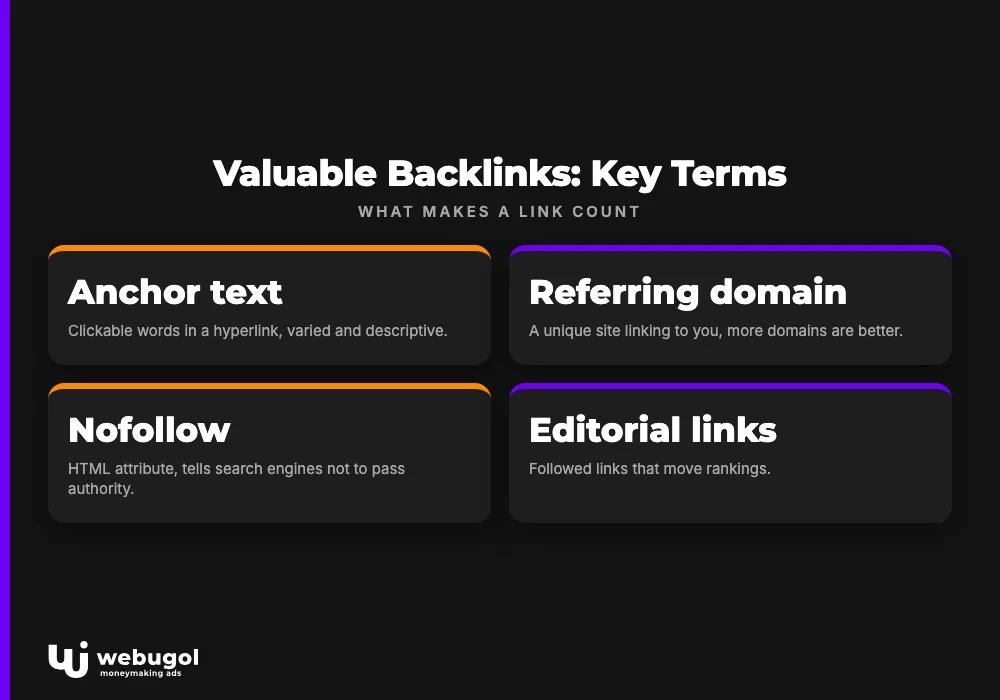
Three terms you need:
- Anchor text refers to the clickable words in a hyperlink; varied, descriptive anchors signal natural linking patterns and help Google understand the linked page's topic.
- Referring domain means a unique site linking to you; 100 links from 5 domains do far less work than 100 links from 100 different domains.
- Nofollow is an HTML attribute that tells search engines not to pass ranking authority through a link; editorial, followed links are the ones that move rankings.
Choosing the right link building strategies for your stage
The table below organizes tactics by difficulty and timeline, but sequence matters as much as selection. New sites benefit most from starting with the lowest-friction options before moving to outreach-intensive approaches. The sections that follow build on that progression.
Link building tactics at a glance
| Tactic | Difficulty | Typical timeline | Authority potential |
|---|---|---|---|
| Branded profiles and citations | Low | 1 to 2 weeks | Low to medium |
| Partner and supplier links | Low | 1 to 4 weeks | Medium |
| Testimonial links | Low | 1 to 3 weeks | Low to medium |
| Broken link outreach | Medium | 4 to 8 weeks | Medium to high |
| Guest posting for SEO | Medium | 6 to 12 weeks | Medium to high |
| Digital PR backlinks | High | 8 to 16 weeks | High |
| Annual statistics pages | Medium | 3 to 12 months | High |
| Image attribution recovery | Low | 2 to 6 weeks | Varies |
Foundational link building strategies: weeks one and two
Every site needs a base of clean, credible links before more competitive tactics produce meaningful results. These foundational moves are fast, low-risk, and build the identity signals search engines use to categorize your domain.
Branded profiles and citations
Create profiles on the platforms that matter most: Google Business Profile, LinkedIn, and Facebook at minimum. Citations are web listings of your business name, address, and phone number. They confirm your site's identity and generate low-risk, followed links.
Checklist for this stage:
- Find the 5 to 10 most relevant directories in your specific niche, not just generic business listing sites.
- Ensure your name, address, and phone number are identical across every listing.
- Link from each profile back to your homepage, not a subpage.
- Write a consistent, short brand description for all profiles.
Partner, supplier, and association links
Use existing business relationships before you reach out cold. Vendors often maintain "Where to Buy" or "Our Partners" pages. Local business associations and chambers of commerce typically list members with a link.
Email 10 to 15 partners directly. Be specific: tell them which page you want to be listed on and what anchor text to use. The ask takes a few minutes; the link can remain for years.
Testimonial links for early authority
Do you use a software tool or service you genuinely value? Offer a short written testimonial. Most businesses link back to the customer's homepage from their client showcase pages, since social proof with a real company link converts better. This tactic requires no negotiation and typically closes within one to two weeks.
How do I get backlinks to a new website?
Start with the three foundational categories above before anything else. New sites have minimal domain authority, so cold outreach will mostly fail until you have some existing signals in place. Understanding how to get backlinks at this stage means starting with what you already have: vendor relationships, software tools you use, and communities you are active in. Build your profiles, claim partner links, and write a handful of genuine testimonials first.
Once you have a modest base of referring domains from foundational sources, your email response rate for content-driven outreach rises substantially. Editors and journalists check a site's existing link profile before deciding whether to link to it. A clean, modest profile with a few real referring domains reads as credible. A blank slate does not.
Content-driven link building strategies
Building website authority through earned links is the most durable approach to SEO because it compounds over time, unlike paid placements that stop the moment you pause spend. Foundational links establish your site's identity. Content-driven links build on that foundation at scale and remain the most sustainable approach over time.
Digital PR backlinks
Digital PR means creating newsworthy stories or original data and presenting them to journalists and bloggers. For newer sites, reactive PR is the faster entry point: monitor trending topics in your niche and write a short expert comment in the first day or two after a relevant news event. Email it to relevant journalists with a clear, direct subject line.
A single media placement can earn a high-authority link that no volume-based outreach campaign could produce. The approach becomes more effective as your track record grows.
Annual statistics and trends pages
Content producers constantly search for data to support their claims. Build a dedicated "Topic Statistics 2026" page, cite every statistic with its original source, and refresh the data at the start of each year. Include a copy-paste attribution block so readers can grab a stat and link back without friction.
Tips for executing this well:
- Title the page with the year in the name, e.g., "E-commerce Statistics 2026," so it ranks for current-year queries.
- Cite the primary source for every number; your page becomes a useful relay station, not a source of unverified claims.
- Add a formatted citation block below key stats to reduce effort for bloggers and journalists who want to reference your page.
- Update the data at the start of each year to maintain freshness and rebuild inbound links as old citations break.
Statistics pages accumulate backlinks passively once they rank. They take upfront effort but compound over time.
Broken link outreach
One of the most reliable backlink acquisition tactics available: find a 404 error on another website, create a resource that genuinely replaces what was lost, and notify the site owner. Response rates run higher than cold pitches because you are solving a real problem, not requesting a favor.
How to execute:
- Use an SEO crawler to identify relevant pages in your niche that contain broken external links.
- Create a resource on your site that replaces the dead content in quality and scope.
- Send a short, direct email: you spotted a broken link, here is a suitable replacement.
A first campaign of 20 to 30 targeted outreach emails is a manageable starting volume and reflects the scale most new sites use in their initial push.
Unlinked brand mentions
When someone mentions your brand name without linking to your site, a brief, friendly email typically converts well. Set up a Google Alert for your brand name and review it weekly. When a new mention appears, email the writer: they already know you exist, and you are asking them to make the reference clickable.
Image and asset attribution
If you publish original graphics, charts, or data visualizations, others may use them without attribution. Make your assets easy to download and share. Run a reverse image search once a month to find who has used your images. Email a short request for an attribution link back to your original content.
Relationship and community tactics
Some link building strategies generate the best results through direct relationships rather than mass outreach:
- Podcast guesting: find niche podcasts actively seeking guests; appearances almost always earn a link in the show notes; link back to a resource page, not just the homepage.
- Expert roundups: invite several industry voices to contribute a short quote to a roundup post on your site; contributors frequently share and link to the final piece when it publishes.
- Event sponsorships: when supporting an event, choose tiers that include an in-content summary blog post rather than just a logo on a sponsor wall.
Is guest posting still effective in 2026?
Yes. Guest posting for SEO remains one of the most reliable ways to earn contextually relevant, editorial backlinks, provided the host publication is genuinely relevant and draws real readers. Guest posting SEO results depend less on a host domain's raw authority than on its topical relevance and the quality of content you contribute. The tactic developed a poor reputation from link farm abuse: low-quality posts on sites with no real audience, published solely to extract a link.
The version that still works:
- The host publication has real organic traffic and an engaged readership in your niche.
- Your pitch covers a topic that genuinely serves the publication's audience.
- The content you write is among the best the publication has run on that topic.
- You link back to a resource page on your site, not just the homepage.
Topical relevance matters more than domain authority alone. A mid-authority site deeply relevant to your niche often passes more meaningful ranking signal than a high-authority general publication with no topical overlap.

Anchor text best practices
How you receive and manage anchor text affects how Google reads your entire link profile. A healthy anchor distribution signals that links were earned organically, not manufactured.
Guidelines for a balanced profile:
- Exact match anchors (your primary keyword used verbatim as the clickable text) should account for a small share of your total distribution; a high concentration signals manipulation to Google's systems.
- Branded anchors (your company or site name) should be among the most common anchor types, reflecting how genuine editorial linking actually happens.
- Partial match and descriptive anchors ("comprehensive guide to outreach for SMBs") fill the healthy middle of your profile and protect against over-optimization.
- Generic anchors ("click here," "read more") occur naturally in the wild; minimize them in your own internal linking strategy.
For internal links, always use specific, descriptive anchor text. A clear anchor tells both readers and search engines exactly what the linked page covers, which determines how authority flows across your site.
How long does link building take to show results?
Expect ranking improvement over several months, not weeks. Individual links get indexed relatively quickly once the referring page is crawled. Meaningful organic traffic changes require consistent link building strategies applied over time, not a burst of activity followed by months of inaction.
Foundational links from business profiles and citations typically appear indexed within one to four weeks. A guest post or broken link placement may start contributing to ranking signals within four to twelve weeks of going live. The compounding effect, where a growing referring domain profile steadily lifts multiple pages, takes longer still.
Sites that try to accelerate with low-quality or manipulated links typically trigger a quality review and lose rankings they had already earned, resetting the clock. Consistent quality over time beats short-term volume.
What link building tactics should you avoid?
Avoid link farms, private blog networks, paid insertions on irrelevant sites, and automated link schemes. These either violate Google's guidelines directly or produce links that Google actively devalues.
Specifics:
- Link farms and private blog networks (PBNs) are networks of sites built purely to sell links; Google devalues or penalizes sites caught using them.
- Paid link insertions on irrelevant sites add your URL to articles with no topical connection to your domain; the link carries no relevant signal and the pattern is identifiable at scale.
- Automated link swapping generates reciprocal links programmatically; the patterns are straightforward for Google's systems to flag.
- Mass, undifferentiated outreach sends hundreds of identical emails from the same domain; it triggers spam filters and can draw a manual review.
Use the rel="nofollow" attribute for sponsored links, user-generated content, or any link you don't editorially endorse. This signals to Google that the link is not a quality vote from your site.

90-day link building framework for new websites
This sequence puts the link building strategies above in order: it builds credibility before you pitch, then layers content-driven tactics on top. Following the order increases response rates at each stage.
Days 1 to 14
- Set up all branded profiles and key citations: Google Business Profile, LinkedIn, Facebook, and the most relevant niche directories.
- Publish one linkable asset: a checklist, a brief how-to guide, or a curated resource list on a topic your buyers search.
- Email 10 to 15 partners, vendors, or association contacts to request a link.
Days 15 to 45
- Pitch one reactive PR story tied to a current trend in your industry.
- Find and reclaim 5 unlinked brand mentions using Google Alerts.
- Run a broken link outreach campaign targeting 20 to 30 relevant pages.
Days 46 to 90
- Publish one data study or a simple free tool in your niche.
- Appear as a guest on one podcast or webinar.
- Review your internal linking: make sure external links you've earned point to pages that also have strong internal links supporting them; this distributes the authority you've built across the site.
Link building strategies at scale: what changes when you're growing
If your site already has foundational authority and you're working to break through a traffic ceiling, the same link building strategies apply but the priorities shift. Competitor backlink analysis becomes the highest-leverage starting point. Map the backlink profiles of pages ranking above you for target keywords, identify their referring domains, and focus outreach on those same source types.
For established businesses, digital PR backlinks carry the highest upside per campaign. A single feature in an industry publication, or a data study picked up by trade press, can generate a cluster of high-authority links from one content piece. For a detailed view of how this plays out in a competitive vertical, see how established B2B sites structure their SEO campaigns.
Understanding how earned backlinks translate into branded search traffic completes the picture: the referring domains you build today turn into branded queries tomorrow, and branded searches convert at meaningfully higher rates than generic keyword traffic.
Stop losing organic traffic to competitors who outrank you
If your site publishes consistent content but organic traffic has stalled, the missing piece is almost always external authority. The organic rankings you're not capturing today are compounding for whoever earns them first. Webugol builds websites that grow: the site, the content, and the website SEO program that takes you from a thin link profile to the referring domain count that makes rankings compound, run as one system by one accountable team. To discuss what that looks like for your stage of growth, get in touch for a consultation.
FAQ
How do I get backlinks to a new website?
Start with business profiles (Google Business Profile, LinkedIn) and direct requests to existing partners or suppliers. These foundational moves build your first referring domains with almost no outreach risk. Once you have a modest base, move to content tactics like broken link outreach and guest posting.
Is guest posting still effective in 2026?
Yes, when the host publication has real organic traffic and you contribute genuinely useful content. Posting on low-traffic or topically irrelevant sites produces links that carry little ranking signal and can indicate manipulative patterns to Google's ranking systems.
How many backlinks does a new website need to rank?
There is no universal number. A local service business might rank for its target keywords with a few dozen referring domains. A competitive national query may require several hundred. The practical benchmark is to match or exceed the referring domain count of the pages currently ranking above you.
How long does link building take to show results?
Individual links appear indexed within weeks, but meaningful organic traffic movement requires consistent activity over several months. Domain authority builds gradually, and ranking improvements compound over time rather than arriving in a single step.
What link building tactics should I avoid?
Avoid link farms, private blog networks, paid insertions on irrelevant sites, and automated link swap schemes. Any tactic that scales link volume without scaling relevance or editorial quality will eventually be detected and discounted or penalized.

