



AI marketing trends 2026: what growing businesses must know
Gartner projected that AI would drive 95% of customer interactions by 2025. In 2026, that projection is playing out across every marketing channel. For marketing directors and business owners, AI marketing trends 2026 represent a structural shift: campaigns built on historical averages are giving way to systems that learn, personalize, and optimize in real time. The question is no longer whether these capabilities belong in your strategy; it is which ones are costing you revenue right now.
If you are exploring these capabilities for the first time, that instinct is well-placed. The structural gaps that limit a first campaign are the same ones that hold a scaling business at its growth ceiling. The stakes differ; the diagnosis is identical.
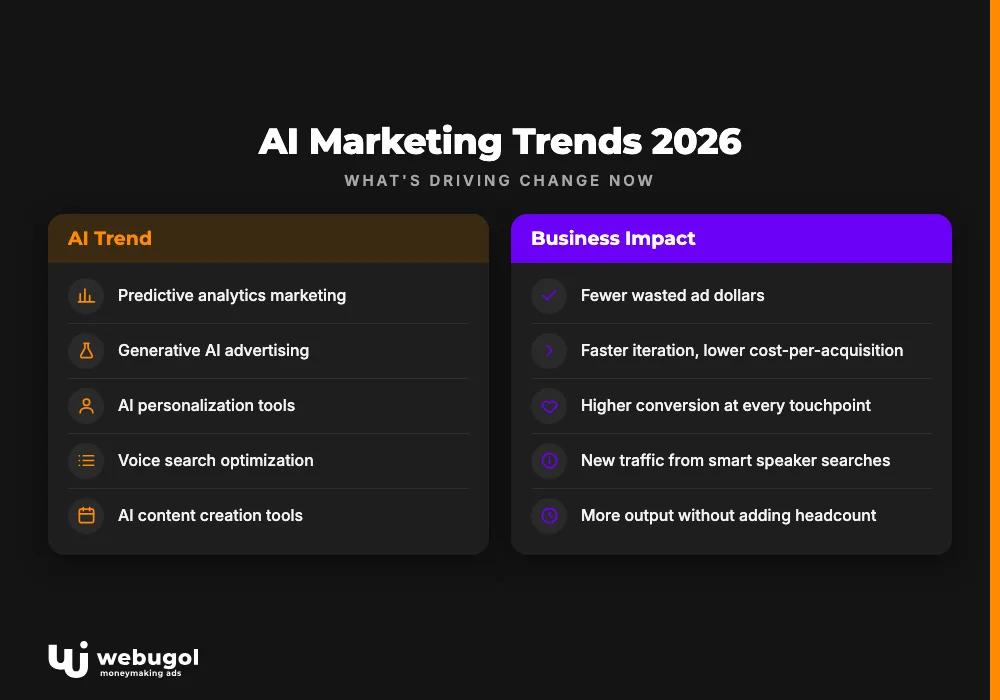
AI marketing trends 2026: what's driving change now
| Trend | What changes | Business impact |
|---|---|---|
| Predictive analytics marketing | Shifts from reactive to proactive targeting | Fewer wasted ad dollars, higher retention |
| Generative AI advertising | Scales creative testing across audiences | Faster iteration, lower cost-per-acquisition |
| AI personalization tools | Adapts content per user in real time | Higher conversion at every touchpoint |
| Voice search optimization | Captures conversational, intent-rich queries | New traffic from smart speaker searches |
| AI content creation tools | Accelerates production across formats | More output without adding headcount |
| Machine learning marketing automation | Optimizes bids, timing, and messaging continuously | Lower overhead, stronger ROI |
How is AI changing digital marketing in 2026?
AI is restructuring the mechanics of marketing at every stage of the customer journey. Campaigns that once required large teams to monitor now optimize through machine learning without constant human intervention. The clearest changes are in audience prediction, creative at scale, and automated media buying. Each affects revenue directly, not just operational efficiency.
Predictive analytics marketing
Predictive analytics marketing converts raw customer data into forward-looking intelligence. Machine learning models scan historical behavior to forecast what specific customers will do next, whether that means churning within 30 days, upgrading a plan, or responding to a particular offer format.
This changes audience segmentation at its foundation. Platforms like HubSpot AI and Salesforce Einstein identify behavioral micro-segments rather than demographic groups. A paid acquisition team can then concentrate budget on customers most likely to convert at a target price point, rather than broadcasting to broad audiences and hoping the averages hold.
Trend forecasting is a second capability. AI systems scanning social signals, search trends, and purchase behaviors surface emerging market opportunities weeks ahead of what manual analysis detects.
Generative AI advertising
Generative AI advertising lets marketing teams produce and test dozens of ad variations without proportional increases in headcount. Large language models generate copy variants. Image generation tools produce visual assets at scale.
The business value is iteration speed. A team testing four ad concepts per month can now test forty. Performance data arrives faster, underperforming creative gets cut sooner, and winning variants receive more budget earlier in the cycle. That compression shortens the path from launch to profitable scale.
How to use AI for customer personalization?
The most effective way to use AI for customer personalization is to connect your customer data to a real-time personalization engine that adapts what each customer encounters based on live behavioral signals. AI personalization tools process browsing history, past purchases, session context, and device type simultaneously, updating per user without manual intervention.
E-commerce platforms use this to serve individualized product recommendations based on time of day and recent browsing, not just a static purchase history. Email systems with machine learning marketing automation adjust send time, subject line, and content blocks per individual recipient. For marketers running email programs, the email marketing industry's shift toward AI-first personalization is visible in every open rate benchmark.
Dynamic landing pages extend this further. These pages adjust headlines, calls-to-action, and visual emphasis based on traffic source and prior brand engagement. A paid visitor sees different framing than a returning organic reader. Conversion improves because the page speaks to where each visitor actually is in the decision process.
What AI tools do marketers use for content creation?
Marketers most commonly use large language model platforms that generate drafts, social copy, and email sequences aligned with documented brand voice guidelines. AI content creation tools have moved from experimental to operational infrastructure, with teams running both volume production and variation testing within the same workflows.
Teams use these capabilities in two patterns. Volume scaling: produce more content without expanding the team. Variation testing: generate multiple framings of the same message and let performance data decide which wins. Both patterns apply whether the team is two people or twenty.
Machine learning marketing automation in content workflows
Machine learning marketing automation extends into content operations beyond ad creative. Readability scoring, sentiment analysis, and predicted performance scoring run at the draft stage, before publication. Platforms surface gaps against top-performing benchmarks so editorial decisions are backed by data.
For SEO specifically, AI SEO platforms that lift search rankings now analyze search engine results pages, identify structural content gaps, and recommend changes that align content with search intent more precisely than manual audits allow.
Voice search optimization and conversational AI
Voice search optimization is one of the AI marketing trends 2026 that most marketing teams underestimate. Voice queries look structurally different from typed searches. A user typing enters "best CRM 2026." The same user speaking to a smart speaker asks "what is the best AI-powered CRM for a small marketing team?" The intent is identical. The query structure is not.
Optimizing for voice search means structuring content around full questions rather than short keyword fragments. FAQ sections, direct definitions, and location-specific content all improve performance. Conversational AI chatbots using natural language processing now handle lead qualification, product recommendations, and guided purchase decisions in real time, extending a small team's marketing reach without adding headcount.

What is AI-driven advertising automation?
AI-driven advertising automation uses machine learning to control bidding, targeting, and creative selection in real time based on conversion probability signals, replacing static rules set by a human. Performance Max on Google and Meta Advantage+ on Meta are the most widely deployed examples among AI marketing trends 2026.
These systems evaluate millions of signal combinations per auction: user context, creative variant, placement, time of day, device, and predicted conversion probability. They set a bid and select creative that maximizes the campaign objective for that specific impression. Smart bidding outperforms manual management on high-volume campaigns because the signal volume exceeds what any analyst can process in a session.
The critical constraint is input quality. Clear campaign objectives, strong creative assets, and accurate conversion tracking are prerequisites. Without them, the algorithm optimizes for the wrong signal. Human strategy and oversight remain essential.
AI, SEO, and generative engine optimization
Search behavior is splitting. Traditional results now share space with AI-generated answer summaries in Google AI Overviews. Ranking inside those summaries requires a different approach than traditional page-one optimization. Generative engine optimization (GEO) addresses this directly: structuring content to appear as the source material AI answers draw from, not only as a link in the ten results below.
For any business that depends on organic search for lead generation, this matters. A page that feeds an AI Overview generates visibility even when a user never clicks through to the site. Topical depth, structured direct answers, and authoritative sourcing are what the systems selecting that content prioritize.
Will AI replace digital marketers?
No. AI replaces specific tasks, not the judgment required to allocate budget, read a shifting market, and understand what customers value. The teams facing displacement are not those using AI. They are teams competing against teams that do.
Execution tasks including keyword research, bid adjustment, A/B test setup, and performance reporting are increasingly automated. Demand for strategic clarity, brand judgment, and customer understanding is growing. A marketing director who knows which AI capabilities to deploy, toward which objective, and in which order holds a compounding advantage over one who does not.

Ethical AI and data privacy
GDPR and CCPA set legal requirements for how customer data is collected, processed, and used in AI marketing systems. Transparency about data collection and automated decision-making is a compliance obligation in most markets, not an optional positioning choice.
First-party data strategies are replacing third-party behavioral tracking as privacy regulations continue tightening. Businesses that build robust first-party data assets now will face less disruption as external tracking mechanisms are further restricted. Preventing algorithmic bias and disclosing automated customer interactions are additional requirements as AI personalization tools grow more capable. Webugol builds websites with integrated marketing systems that account for these constraints from the architecture stage, not after deployment.
Start closing the growth gap in 2026
AI marketing trends 2026 reward the businesses that act on the right capabilities in the right sequence. Identify where the gap between your current results and your revenue target is widest: conversion rate, cost per acquisition, content output, or organic visibility. Apply the AI workflow that directly addresses that specific gap. Measure the result with precision.
Businesses taking category leadership through 2027 are making those moves now. If you want a clear assessment of where your website and marketing system are losing revenue and which AI capabilities close those gaps fastest, contact the Webugol team for a strategy session.
FAQ
How is AI changing digital marketing in 2026?
AI marketing trends 2026 are automating audience targeting, content production, and campaign optimization in real time. Machine learning handles decisions that previously required manual analysis, so marketing teams can redirect attention from routine execution to strategy and creative judgment.
Will AI replace digital marketers?
AI replaces specific execution tasks, not strategic roles. Bid management, reporting, and A/B test setup are increasingly automated, but demand for brand judgment and market reading is growing. Teams using AI effectively will outperform those that do not.
What AI tools do marketers use for content creation?
The most widely used AI content creation tools are large language model platforms that generate drafts, social copy, and email sequences aligned with brand voice guidelines. Teams use them to increase content volume and test message variations faster than manual production allows.
How to use AI for customer personalization?
Connect AI personalization tools to your customer data platform so they can process real-time behavioral signals. Start with email personalization, where performance lift is measurable within weeks. Expand to dynamic landing pages once baseline data quality is established.
What is AI-driven advertising automation?
AI-driven advertising automation uses machine learning to set bids, select creative, and target audiences based on real-time conversion probability signals. Performance Max and Meta Advantage+ are the primary implementations in 2026. Strong campaign objectives and accurate conversion tracking are required for the system to optimize correctly.

