



AI SEO tools 2026: top platforms to boost your rankings
The best ai seo tools 2026 span content generation, keyword research automation, technical site analysis, and generative engine optimization. Platforms like Surfer SEO, Clearscope, Jasper, and Rankscale.ai now handle tasks that once required entire teams working across research, content scoring, and technical auditing. The right tool depends on your gap. This guide covers ten platforms with a direct look at what each one actually does for your search rankings.
Which AI tools are best for SEO in 2026?
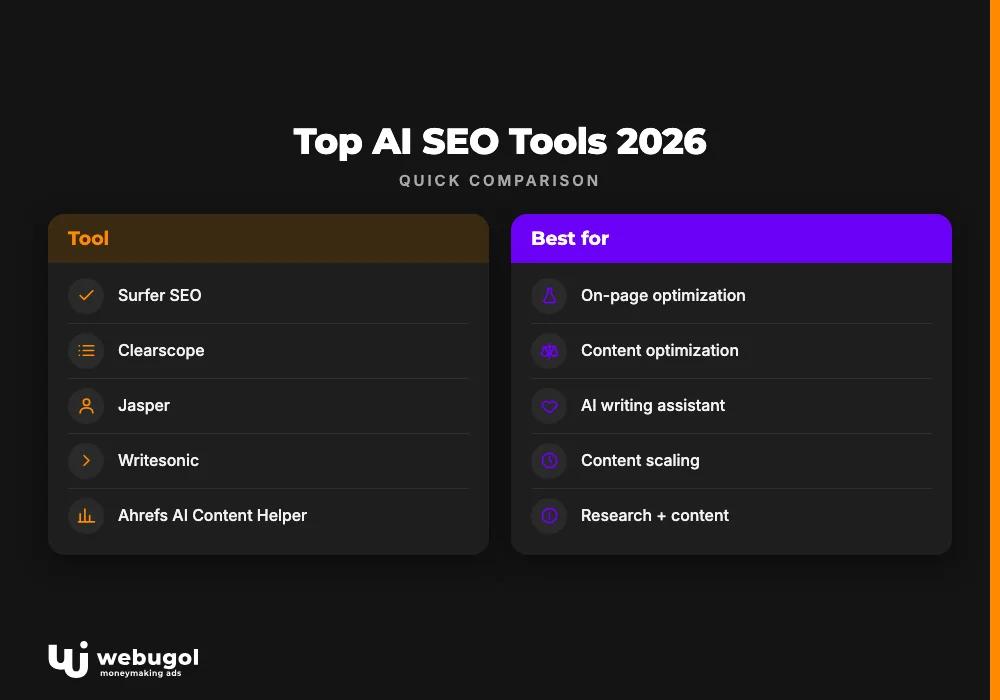
The top ai seo tools for 2026 are Surfer SEO, Clearscope, Jasper, Writesonic, Ahrefs AI Content Helper, Rankscale.ai, AI Search Grader, AirOps, AIOSEO, and Paraphrasingtool.ai. Each targets a distinct part of the SEO workflow. The table below is a quick seo software comparison across all ten.
| Tool | Best for | Standout capability |
|---|---|---|
| Surfer SEO | On-page optimization | Scores pages against 500+ on-page signals |
| Clearscope | Content optimization | Keyword grading with topic coverage scoring |
| Jasper | AI writing assistant | 50+ templates, brand voice, plagiarism checker |
| Writesonic | Content scaling | Blog articles, ads, landing pages, multi-language |
| Ahrefs AI Content Helper | Research + content | Drafts grounded in Ahrefs keyword and backlink data |
| Rankscale.ai | GEO tracking | Brand visibility in Google AI Overviews, Perplexity, ChatGPT |
| AI Search Grader | AI search readiness | Grades content for generative search formats |
| AirOps | SEO workflow automation | Custom AI pipelines connected to Search Console |
| AIOSEO | WordPress on-page | TruSEO scoring, smart schema, XML sitemaps |
| Paraphrasingtool.ai | Content refinement | Eight paraphrasing modes, processes image and audio |
AI SEO tools 2026: content, research, and on-page
These five platforms handle content creation, ai content optimization, and on-page technical work. That covers the bulk of most SEO workflows.
Jasper offers more than 50 content templates, brand voice and tone customization, a plagiarism checker, and grammar correction. Publishing consistent, high-quality content across channels is where it excels. As an ai writing assistant built for teams with defined brand guidelines, it handles the execution layer so writers can focus on strategy.
Writesonic generates SEO-friendly blog articles, ad copy, and landing pages in multiple languages. For teams that need content volume without losing focus on search intent, it ranks as one of the more practical ai seo tools 2026 for day-to-day production.
Clearscope analyzes top-performing content for a target keyword and returns a keyword report covering relevant terms and topics, plus a grading system that reveals where your content falls short relative to what currently ranks on page one. It integrates with Google Docs and WordPress. Use it when topic completeness matters more than speed.
Surfer SEO evaluates your page against more than 500 on-page signals in real time, delivering a content editor with live optimization feedback, a SERP analyzer, and integrated keyword research tools. Clearscope tells you what to cover. Surfer shows exactly how your page scores right now.
Ahrefs AI Content Helper generates blog titles, outlines, paragraphs, and complete drafts inside the Ahrefs platform, drawing on Ahrefs' keyword database, competitor analysis, and backlink data. Research and writing stay in one step. For teams already using Ahrefs for keyword research automation, that removes a significant context-switching cost.
AIOSEO covers the WordPress on-page layer. It provides a TruSEO score, smart schema markup for rich snippets, XML sitemap generation, and social media integration. Non-technical teams can follow its guidance to address the technical seo audit tools dimension of each page without touching code.
Generative engine optimization and workflow automation
Search is shifting toward AI-generated answers. These four tools address that layer.
Rankscale.ai is built for generative engine optimization specifically. It tracks brand visibility across Google AI Overviews, Perplexity, and ChatGPT, and provides competitor and citation analysis, brand sentiment scoring, and AI-driven site audits with actionable recommendations. If your content does not surface in AI-generated answers, Rankscale shows where the gap is.
AI Search Grader focuses on readiness. It grades your website on preparedness for generative search formats, tracks SERP and keyword visibility, and returns an actionable score. As Google integrates AI Overviews more deeply into results, that readiness score reflects real discoverability.
AirOps is the seo automation software choice for teams that need flexibility. It builds custom AI workflows for meta description generation, keyword analysis, content briefs, and other repeatable tasks. Integration with Google Search Console and other data sources makes it adaptable to existing processes.
Paraphrasingtool.ai handles content refinement. Eight modes including Standard, Fluency, and Simplify let you adjust register and clarity. The tool processes text from images and audio, and allows formal, casual, and professional tone selection. It is practical for updating older articles, removing duplicate phrasing, and improving readability scores without rewriting from scratch.
How do AI tools improve search rankings?
AI tools improve rankings by removing the analysis steps that slow teams down. They surface content gaps, flag technical issues, and score pages against ranking benchmarks faster than manual review allows.
Clearscope and Surfer SEO tell you exactly what a page is missing compared to what currently ranks. AirOps and AIOSEO remove manual schema and meta work. Rankscale.ai and AI Search Grader extend that into AI-generated results, where ranking signals interact differently.
Together, these tools turn seo automation software from a quarterly task into a continuous process. This matters especially for SaaS products and platforms, where keyword competition is high and content velocity is a real competitive advantage.
What is the best AI tool for keyword research?
For keyword research automation, Ahrefs AI Content Helper leads because it generates outlines and drafts directly from Ahrefs' keyword and competitor dataset, combining research and writing in one step. Surfer SEO's SERP analyzer and keyword research module are a strong alternative for teams focused on on-page execution. Clearscope is the better pick when topic completeness matters more than raw keyword discovery.
How to choose an AI SEO tool for a small business?
Start with your biggest bottleneck. That question narrows a crowded market faster than any feature comparison.
If content production is the constraint, Jasper or Writesonic deliver immediate return. Pages that rank low despite decent content point to Surfer SEO or Clearscope. Absent from AI Overviews or ChatGPT answers? Rankscale.ai addresses that directly.
Ease of use matters for small teams. Most platforms here offer free trials, which is the most reliable way to test fit before committing. Check integration with your existing stack: most tools connect with WordPress, Google Docs, or Google Search Console, reducing setup friction significantly.
Pricing ranges from affordable monthly subscriptions to enterprise contracts. Match the cost to the specific return you expect. Working with a digital marketing agency that has already evaluated these tools across client projects can shortcut both the selection and the setup process.
Can AI tools replace traditional SEO strategies?
No. AI tools automate the analytical and execution layers. They do not replace strategic judgment on content priorities, link-building targets, or audience positioning.
What ai seo tools 2026 eliminate is the manual bottleneck. Keyword analysis, schema generation, content scoring, and technical audits now run with far less human time.
What they cannot replace is judgment about what to prioritize and what your brand should represent in search results. AI tools for SEO operate much the same way AI tools function in email marketing automation: they handle the execution layer while strategy stays human. The strategy still needs people. The tools make it executable at scale.
Start your AI SEO strategy in 2026
The ai seo tools 2026 market gives teams more leverage than any previous generation of SEO software. Webugol identifies the tools that fit your specific gaps, integrates them into your workflow, and tracks what actually changes in your rankings. Contact Webugol to get a focused recommendation based on your current performance and goals.
FAQ
Which AI tools are best for SEO in 2026?
The strongest options are Surfer SEO for on-page scoring, Clearscope for topic coverage, Jasper or Writesonic for content production, and Rankscale.ai for generative engine optimization. The right choice depends on whether your bottleneck is content output, technical gaps, or visibility in AI-generated search results.
How do AI tools improve search rankings?
AI tools speed up ranking by automating keyword analysis, content gap scoring, and technical audits. They help teams publish more relevant content faster, building topical authority over time. Tools covering generative engine optimization also help content appear in AI-generated answers, not just traditional search results.
What is the best AI tool for keyword research?
Ahrefs AI Content Helper leads because it generates briefs and drafts from Ahrefs' keyword and competitor dataset, combining research and content generation in one tool. Surfer SEO's SERP analyzer is a capable alternative for teams focused on on-page execution and keyword density signals.
How to choose an AI SEO tool for a small business?
Identify your biggest bottleneck first: content volume, on-page gaps, or AI-search visibility. Check that the tool integrates with your current stack and use free trials before committing. Most tools on this list offer affordable monthly plans well-suited to smaller teams.
Can AI tools replace traditional SEO strategies?
AI tools automate the analytical and production layers of SEO but do not replace strategic judgment. Decisions on content priorities, link-building, and audience targeting still need human direction. The best results come from teams that apply AI to repetitive work and reserve human effort for strategy.

