


The complete Facebook ads guide: build campaigns that convert
This Facebook ads guide walks you through every campaign layer: goal structure, audience targeting, format selection, budget decisions, ad copy, and performance tracking. Facebook reaches 2.9 billion monthly active users (Meta, 2023) and lets you filter that audience by demographics, behavior, and interests with a precision most paid channels do not match. That accessibility makes it relevant for businesses at any budget level. Work through each section, and you will know what to build before your first ad goes live.
What makes Facebook ads effective for small businesses?
Facebook ads work for small businesses because the barrier to entry is low, the targeting is specific, and every dollar spent is accounted for. You do not need a production studio or a media agency. A clear offer, a defined audience, and a direct message can generate measurable results at $10 per day.
Three things separate Facebook from most other paid channels:
Reach matched with precision. Facebook's 2.9 billion monthly active users (Meta, 2023) give businesses an audience that once required broadcast budgets. More usefully, that audience can be filtered down to a specific age range, a five-mile radius, or a list of interests relevant to your product. A local gym can target adults aged 25 to 45 within a specific zip code who follow fitness-related pages. That level of control is what makes facebook ads for small business campaigns genuinely competitive with larger advertisers who spend ten times more.
Scalable spending. You set the ceiling. Facebook will not spend beyond what you allow. A campaign that starts at $300 per month can grow to $3,000 when results justify it, without switching platforms or rebuilding your campaign structure from scratch.
Visible performance. Facebook Ads Manager shows click-through rate, cost per result, and return on ad spend in real time. That feedback loop lets you identify what is working before you have spent a significant amount. Traditional channels rarely offer that kind of transparency at any budget level. This facebook ads guide covers how to use each of these advantages across every campaign layer.
How Facebook ads compare to Google Ads
Google Ads captures people who are already searching for a product. Facebook Ads reaches people based on who they are, what they care about, and how they behave online. That makes Facebook stronger for creating demand and building recognition with audiences who have not yet discovered your brand, while Google is stronger for converting buyers already in the market. Many businesses run both: Google to capture existing intent, Facebook to build the audience that will eventually convert there. For top-of-funnel reach and demand generation, this Facebook ads guide focuses on Facebook.
Setting campaign goals before you build
A facebook ads guide that skips campaign objectives is a list of tactics without a strategy. Every campaign belongs to one of three objective categories, and that choice determines how Facebook's algorithm delivers your ads and which users it prioritizes.
Awareness campaigns put your business in front of people who have never heard of it. Facebook optimizes for reach and, at higher spend levels, for ad recall. Brand campaigns and product launches typically start here.
Consideration campaigns ask users to engage: visit your website, watch a video, fill out a lead form, or start a conversation. Facebook delivers these to users who are more likely to take an action based on past platform behavior. Building an email list, driving traffic to a detailed product page, and generating interest in a service are common consideration objectives.
Conversion campaigns optimize for a specific action on your site, such as a purchase, a sign-up, or a form submission. This is where the Meta Pixel becomes essential. It tells Facebook which users converted after clicking, and that signal is what the algorithm uses to find more people likely to do the same.
Selecting the wrong objective is a structural problem. No creative improvement will fix a Traffic campaign that should be a Conversion campaign. Match the objective to where your audience sits in the funnel. Cold audiences rarely convert on the first interaction. Running awareness or consideration campaigns to cold traffic first, then retargeting those users with a conversion objective, produces better outcomes than sending cold traffic directly to a purchase campaign. Every section of this facebook ads guide is structured around that funnel logic.

What is the best Facebook ad format for conversions?
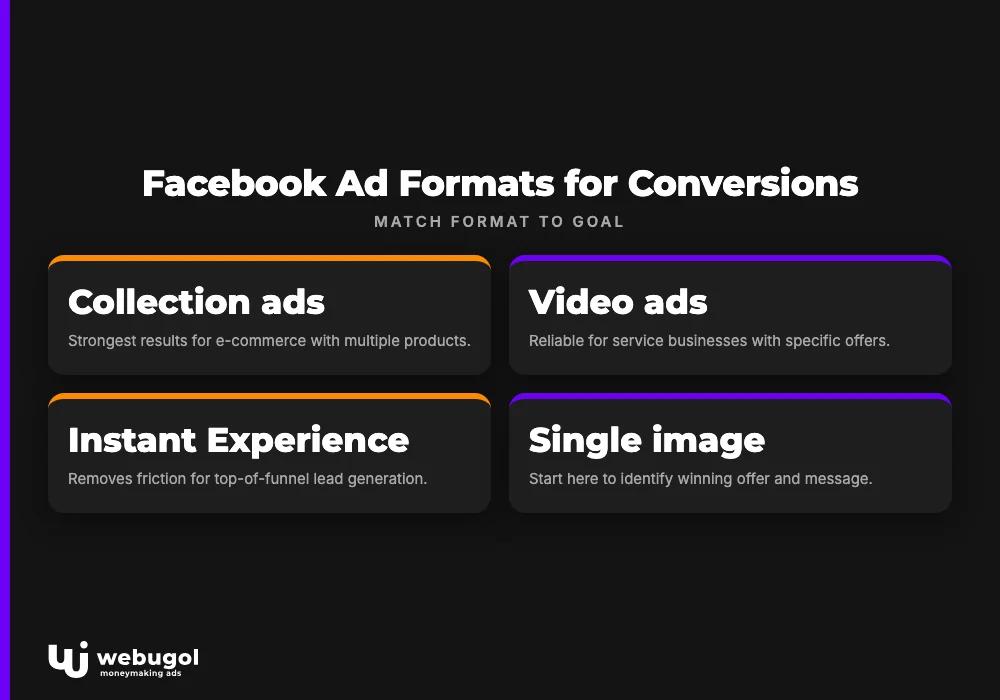
The answer depends on your product and funnel stage. Context always wins. For e-commerce businesses with multiple products, Collection ads typically produce the strongest results because they open a full-screen shopping experience inside the Facebook app. For service businesses, short video ads paired with a specific offer tend to convert more reliably than static formats. For lead generation at the top of the funnel, Instant Experience ads remove the friction of leaving the platform entirely.
One of the most consistent social media advertising tips across budget levels is this: start with single image ads to identify a winning offer and message, then scale into richer formats once you know what resonates. Do not produce expensive video before testing whether the premise of the ad works.
Here is how the main facebook ad formats compare:
| Format | Best for | Key advantage |
|---|---|---|
| Single image | Brand awareness, direct offers | Fast to produce, low cost to test |
| Video | Storytelling, product demos | Highest engagement on mobile |
| Carousel | Multiple products or features | Users browse within the ad unit |
| Collection | E-commerce product catalogs | Full-screen in-app shopping |
| Instant Experience | Lead capture, interactive content | Loads inside app, no external page |
Single image ads are where most campaigns start. They are fast to build and require only a clean visual and a focused headline. When the offer is simple and the creative is strong, no other format is more cost-efficient to test.
Video ads consistently outperform static formats for engagement on mobile, which is where the majority of Facebook users scroll. The first two seconds determine whether anyone keeps watching. A 15 to 30-second clip showing the product in use or featuring a real customer typically outperforms a polished brand video with no strong hook.
Carousel ads let users swipe through multiple panels inside a single ad unit. Use this format when you have several products to compare, a step-by-step process to illustrate, or a story that benefits from sequential display. Each panel carries its own link, which generates useful data about which product or message earns the most clicks.
Collection ads open into a full-screen browsing experience inside the Facebook app. For e-commerce, this removes the friction of navigating to an external site, the point where many mobile users exit the conversion path. The format works best when paired with a well-organized product catalog.
Instant Experience ads load inside the app entirely. They capture form submissions without requiring a site visit and perform well for lead generation campaigns where audiences are likely to drop off on slow-loading external landing pages.
One rule applies to all formats: optimize every ad for mobile before it runs. An ad that displays well on desktop but breaks on a phone wastes budget regardless of how precise the targeting is.
How do I target the right audience on Facebook?
Target the right audience on Facebook by layering three building blocks: a Core Audience filtered by demographics and interests, a Custom Audience built from your existing customers or site visitors, and a Lookalike Audience modeled on your best customers. That combination is what makes meta ads targeting efficient at both the testing and scaling stages.
Facebook's paid social media management tools give you four audience types to work with:
Core audiences are built from scratch using demographics, interests, and behaviors. Demographics cover age, gender, location, education, and income. Interests draw from pages followed, content engaged with, and activity patterns. Behaviors include purchase history, device usage, and travel patterns. This is the starting point for campaigns targeting people who have never interacted with your business.
Custom audiences let you upload a customer list, retarget website visitors, or reach users who engaged with your content on Facebook or Instagram. These are warm audiences who already know your brand, which typically translates to a lower cost per conversion compared to cold traffic.
Lookalike audiences take an existing custom audience and find Facebook users who share similar characteristics. A 1% lookalike is tight and higher cost. A 5% lookalike is broader and cheaper. Start with a 1% to 2% lookalike of your highest-value customers and expand from there once you have data to guide the decision.
Location targeting filters by country, state, city, or a radius from a specific address. For local businesses, this is often the first filter applied before any interest or behavior layer is added.
Understanding these four audience types is one of the most practical applications in this facebook ads guide, because audience quality determines campaign efficiency more than any other variable.
The Meta Pixel underpins all of this. Install it on your website before your first campaign and it begins building website visitor audiences automatically. Without it, you cannot retarget site visitors, build lookalike audiences from converters, or accurately calculate return on ad spend. Setup takes under ten minutes through Meta Business Suite, and it is the single most important technical step in this entire Facebook ads guide.
Targeting mistakes that drain budget
- Over-targeting shrinks the audience to a size where Facebook's algorithm cannot optimize reliably. Audiences under 100,000 people tend to produce inconsistent delivery and higher costs per impression.
- Under-targeting exposes your ads to people with no relevant interest in your offer. Running no interest filters on a cold audience is the fastest way to exhaust a budget without meaningful results.
- Skipping retargeting leaves money on the table. People who visited your site or engaged with your content are measurably closer to converting than any cold audience you can build.
- Setting the audience once and never adjusting leads to fatigue. For campaigns running more than four to six weeks continuously, refresh targeting before click-through rates begin to fall.
How much budget do I need to start Facebook ads?
You can start with as little as $5 per day. The number that actually matters is not the daily spend but what a conversion is worth to your business and how that compares to what Facebook charges to deliver one.
Before settling on an amount, understanding how spend levels affect optimization speed helps avoid common early mistakes. Planning your Facebook ad budget before launch breaks down how different daily amounts affect delivery timelines and learning phases. Then choose between two structures:
Daily budget sets a fixed amount Facebook can spend each calendar day, distributed across the hours when your audience is most active. This is the right choice when you are still in the testing phase and want predictable, controllable spending. Changes take effect immediately.
Lifetime budget gives Facebook a total amount to allocate over the full campaign period. The algorithm decides how to distribute spend day by day, concentrating more on days with predicted higher conversion rates. This works best for campaigns with a fixed start and end date, such as a product launch or a promotional event.
Bidding strategy by campaign stage
| Strategy | What it does | When to use it |
|---|---|---|
| Lowest cost | Maximizes results per dollar automatically | New campaigns, testing phase |
| Cost cap | Targets a specific average cost per conversion | After you know your target CPA |
| Bid cap | Hard ceiling on the maximum bid per action | When margins are very tight |
Lowest cost should be the default for any new campaign. Facebook's algorithm optimizes delivery automatically while you gather data on what a conversion actually costs. Once you have consistent results and a reliable cost per conversion, move to cost cap to keep average costs within a sustainable range.
Bid cap is the most restrictive option. It limits how much you bid per action, giving tight cost control but risking throttled delivery when your cap falls below what the market clears for your audience. Use it when a conversion above a specific price point would be unprofitable, not as a general setting.
For situations where costs begin to exceed targets despite proper structure, the strategies in keeping Facebook campaign costs under control offer additional levers worth knowing.
A useful rule for new campaigns: plan to spend two to three times your target cost per conversion before drawing any conclusions. If your target acquisition cost is $30, expect to spend $60 to $90 gathering enough signal. Cutting campaigns before that threshold is one of the most common reasons facebook ads budget decisions look wrong even when the underlying strategy is sound.
The facebook ads budget structure that works across most situations: start modest, run for seven to fourteen days without changing settings, then reallocate spend toward the ad sets hitting your target cost per result.
Facebook ad copy writing that moves people to act
Strong facebook ad copy writing starts before you open the ad editor. The core question is: what does this audience already believe about the problem you solve, and where do they think they currently stand? Your ad should meet them at that point before asking them to take any action.
Several principles hold across formats and audience types:
The first line determines everything. The opening sentence appears before the "see more" cutoff in the feed. If it does not earn attention, the rest of the ad is never read. A specific statement, a direct question, or a concrete number consistently outperforms a generic opener.
Clarity over cleverness. Ads that try to be clever often sacrifice specificity. A reader who has to interpret what your ad means will scroll past it. Tell them exactly what you are offering, who it is for, and what to do next.
One call to action per ad. Multiple CTAs divide attention and reduce the chance that any single action gets taken. Pick one next step. Make it impossible to miss.
Match copy to audience temperature. Cold audiences have never heard of your business and need context before they can evaluate your offer. Retargeted audiences already know you and need a reason to return, not an introduction. Writing identical copy for both groups is one of the most consistent errors in facebook ad copy writing. Warm audiences respond to specificity. Cold audiences respond to recognition of their problem.
Social proof closes hesitation. A specific testimonial, a review count, or a measurable outcome reduces friction far more than a vague benefit claim. "4.9 stars from 1,200 customers" lands differently than "the best solution available."
Tell people who the ad is for. A headline that names a specific type of person filters out irrelevant impressions and raises click-through rates among the right audience. Facebook's algorithm rewards high engagement by lowering your delivery cost. Specificity is a structural advantage in the auction.
Use urgency only when it is real. Time-limited copy works when there is an actual deadline: a promotional window, an enrollment cutoff, a supply limit. Manufactured urgency erodes trust and undermines future ads to the same audience.
What this facebook ads guide recommends for copy testing
Test one variable at a time. Change the headline while holding the image constant. Change the image while holding the headline constant. Running both changes simultaneously makes it impossible to know which element drove the difference.

How do I measure Facebook ads performance?
Measure Facebook ads performance by tracking three core metrics in Ads Manager: click-through rate, cost per click, and return on ad spend. These three numbers tell you whether your creative is working, whether your audience is engaged, and whether the campaign is profitable. Everything else in Ads Manager supports those three.
Click-through rate (CTR) measures the percentage of people who saw your ad and clicked it. A low CTR signals a problem with the creative or the offer. A CTR below 0.5% on a cold audience typically means the ad needs to change before you increase budget.
Cost per click (CPC) shows what each click costs in the auction. A CPC that rises over time with no targeting changes usually indicates audience fatigue. The same users have seen your ad repeatedly and stopped engaging. Refreshing the creative typically brings CPC back down without requiring a full targeting rebuild.
Return on ad spend (ROAS) compares revenue attributed to the campaign against what was spent on it. A ROAS of 3.0 means $3 returned for every $1 spent. This is the metric that determines whether Facebook advertising is actually profitable for your business. CTR and CPC are diagnostic tools. ROAS is the decision metric.
Install the Meta Pixel on your site before any campaign launches. It fires when users take actions on your site after clicking an ad, connecting those actions to specific ads in Ads Manager. Without it, ROAS cannot be calculated accurately and optimization decisions rely on proxy metrics that can mislead. Pixel setup is a prerequisite this facebook ads guide treats as non-negotiable.
For practical guidance on improving CTR on Facebook ads, the most reliable lever is the creative itself. Strong visuals and a compelling hook in the first two seconds of video consistently outperform copy changes alone.
Using A/B testing to sharpen results
Facebook's split testing tool runs two versions of an ad to a randomly divided audience. Each version receives equal traffic and Facebook identifies which performed better. Let each test run for at least seven days and reach a meaningful audience size before drawing conclusions. Test one element at a time. That constraint turns testing into learning rather than guesswork.
Facebook campaign optimization: from launch to scale
The first two weeks of any campaign are a data collection phase. Keep the budget stable. Resist making changes every day. Facebook's algorithm needs approximately 50 conversion events per ad set per week to exit the learning phase and optimize delivery reliably. Touching settings during that window resets the process.
Once past learning, facebook campaign optimization follows a consistent pattern:
- Identify which ad sets have the lowest cost per result.
- Increase budget on those ad sets by no more than 20% every three to five days. Larger increases push the ad set back into learning.
- Turn off ad sets that have not hit your target cost per result after spending two to three times the target conversion value.
- Refresh creatives every four to six weeks, or sooner if CTR is declining.
How this facebook ads guide approaches scaling and overlap
Watch for audience overlap. When two ad sets target significantly overlapping audiences, they compete against each other in the auction and drive up your own costs. Facebook's Audience Overlap tool in Ads Manager identifies this before it becomes expensive.
Monitoring frequency matters as well. Check campaigns every two to three days early on, then weekly once they exit the learning phase. Daily intervention creates an impulse to adjust settings before sufficient data has accumulated. Ad sets that get disrupted too early rarely recover to their potential performance.
Campaign objective accuracy is not cosmetic. Facebook optimizes for exactly what you ask. A Traffic objective produces clicks from people likely to click. A Conversion objective produces results from people likely to buy. The difference in downstream outcomes can be significant, and no creative change corrects a misaligned objective.
Put this Facebook ads guide into practice
Every effective campaign shares the same foundations: a clear goal defined before anything is built, an audience shaped by real data rather than assumptions, a format matched to the objective, copy that addresses one specific person's situation, and a measurement setup that separates signal from noise.
Most underperforming campaigns share the same pattern. Too many variables changed too fast. No clear definition of success before launch. Decisions made before enough data has accumulated. Fix those three and most campaigns improve before the creative is ever touched.
If you want campaigns built, managed, and optimized by a digital marketing agency that runs this process every day, schedule a consultation. We review what you currently have before recommending any changes.
FAQ
What is the best Facebook ad format for conversions?
Video and Collection ads tend to produce the strongest conversion results, though the right choice depends on your product and funnel stage. E-commerce businesses with multiple products typically perform best with Collection ads, while service businesses often see stronger returns from short video ads paired with a specific offer.
How much budget do I need to start Facebook ads?
You can begin testing with $5 to $10 per day. The key constraint is not daily spend but whether you can generate approximately 50 conversion events per ad set per week, the threshold Facebook's algorithm needs to optimize delivery reliably. Below that level, results are less predictable and the learning phase takes longer.
How do I target the right audience on Facebook?
Start with core audience targeting using demographics, interests, and behaviors relevant to your offer. Once you have existing customers or site visitor data, build a Custom Audience from that group and a Lookalike Audience from your best customers. Those warm and similarity-based audiences consistently outperform cold interest-based targeting on cost per conversion.
What makes Facebook ads effective for small businesses?
The combination of low minimum spend and precise meta ads targeting makes Facebook accessible at every budget level. A local business with a modest monthly budget can reach exactly the right neighborhood and demographic, generating measurable results that most traditional advertising channels cannot match at that price point.
How do I measure Facebook ads performance?
Track click-through rate, cost per click, and return on ad spend consistently from the start of each campaign. Install the Meta Pixel before launch so Ads Manager can connect clicks to actual conversions on your site. These three metrics together show whether the creative is performing, whether the audience is engaged, and whether the campaign is profitable. This facebook ads guide returns to these three metrics throughout because they are the foundation of every optimization decision.