



AI digital marketing: how to grow your business faster
AI digital marketing uses machine learning, predictive analytics, and automation to plan, target, and optimize campaigns at a scale that human teams cannot match manually. The results are tangible. Companies report faster campaign cycles, lower acquisition costs, and better retention when these systems are integrated into their programs. That gap between AI-powered and conventional marketing approaches only grows wider over time.
How does AI improve digital marketing?
AI replaces guesswork with data. Platforms analyze customer behavior, purchase history, and browsing patterns to surface insights that would take human analysts weeks to compile. Campaigns built on that foundation are faster to deploy, cheaper to run, and more precise at converting.
Three core improvements drive most of the lift:
- Audience segmentation. Machine learning tools like Salesforce Einstein and Segment identify micro-segments based on behavioral signals and intent data that broad targeting misses entirely.
- Predictive accuracy. Predictive analytics marketing models anticipate customer needs before a search happens, enabling proactive outreach rather than reactive response.
- Automation at scale. Marketing automation tools handle keyword bidding, email timing, and content scheduling automatically, freeing teams to focus on strategy.
What are the best AI tools for digital marketing?
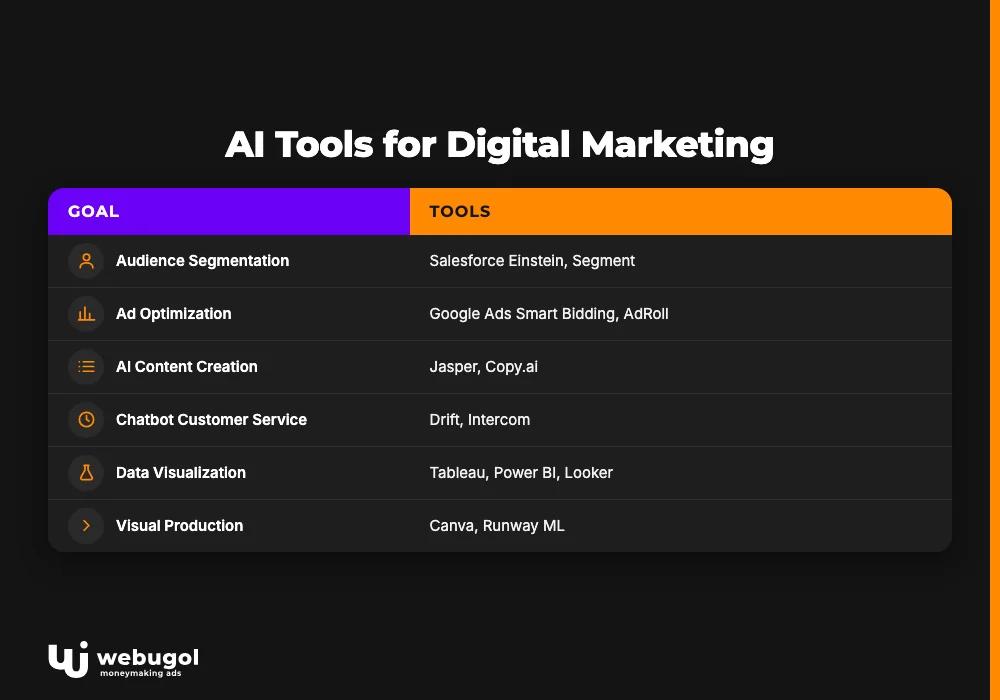
The right tools depend on what you need to solve. Here is a practical breakdown by use case:
| Goal | Tools | What they do |
|---|---|---|
| Audience segmentation | Salesforce Einstein, Segment | Identify micro-segments from behavioral and demographic data |
| Ad optimization | Google Ads Smart Bidding, AdRoll | Adjust bids in real time to maximize conversions within budget |
| AI content creation | Jasper, Copy.ai | Draft blog posts, ad copy, and social content at speed |
| Chatbot customer service | Drift, Intercom | Field inquiries, book appointments, and guide purchase decisions 24/7 |
| Data visualization | Tableau, Power BI, Looker | Turn AI-generated insights into readable dashboards |
| Visual production | Canva, Runway ML | Automate graphics, animations, and video editing tasks |
No tool works without clear strategy behind it. These platforms amplify whatever direction you bring to them.
How to use AI for marketing personalization?
AI personalization maps individual customer preferences and reflects them back across every touchpoint. Connect your CRM, web analytics, and email platform first, so the system has a complete behavioral picture of each user.
Then layer in a personalization engine like Dynamic Yield, which adjusts product recommendations and content blocks in real time based on what it knows about the visitor.
Real deployments show how high the ceiling is. Sephora's Virtual Artist app uses AI to let customers try products virtually and receive tailored recommendations based on their history. Spotify's Discover Weekly playlist applies machine learning to serve a personalized music feed each week, and it became one of the platform's strongest retention drivers.
Smaller businesses can achieve comparable results through Dynamic Yield without building proprietary models from scratch.
The limit of automation is editorial judgment. AI personalization surfaces patterns. Your team decides which patterns align with brand voice and audience values.
What is the role of AI in SEO?
The role is structural. Google's RankBrain ranks content by contextual relevance and natural language intent, not keyword frequency. Content must address the question behind the query, not just the words in it. That shift changes how teams approach everything from topic selection to page structure.
Voice search SEO sharpens that pressure. As Amazon Echo and Google Home adoption grows, more queries arrive in conversational form. Brands that optimize for natural speech patterns and question-based content capture traffic that standard keyword targeting misses.
Visual search extends the same logic further: Pinterest Lens lets users search with images instead of words, connecting them to relevant resources based on what they see. For brands building organic search visibility over time, competitive keyword and content discipline compounds into a durable search presence that paid channels cannot replicate.

How does AI help with marketing automation?
Automation handles the repetitive work that drains campaign teams. Google Ads Smart Bidding evaluates auction signals in milliseconds and adjusts bids to hit conversion targets without manual oversight. AdRoll does the same across display and social retargeting. Email platforms use AI to determine the optimal send time for each subscriber based on individual open history.
Chatbot customer service is where automation delivers some of its most visible returns. Drift and Intercom deploy bots that field inbound questions, book appointments, and guide prospects through purchase decisions without a human agent available.
Support and sales staff shift their focus to cases that genuinely require judgment. For teams mapping paid activity to measurable business outcomes, understanding how AI bidding strategies connect to conversion goals at each funnel stage clarifies where automation earns its keep.
AI content creation: speed with editorial control
AI content creation tools like Jasper and Copy.ai produce clean, grammatically sound drafts fast. The risk is not quality. It is convergence: when every brand in a category uses the same tool with similar prompts, the output starts to look identical and loses any competitive edge.
The fix is a deliberate editorial layer. Use AI to generate the first draft, then apply human judgment to inject brand-specific perspective, real customer examples, and directional opinion that no model can produce from training data alone.
Canva and Runway ML extend this logic to visual assets. Canva gives non-designers access to professional templates. Runway ML automates background removal, color grading, and animation work that previously required specialist software. Both are standard components of a modern marketing stack.

AI digital marketing: benefits and real trade-offs
The gains from AI digital marketing are measurable. Faster campaign execution, sharper audience targeting, and personalization at a scale that human teams cannot sustain manually. Predictive analytics marketing models also move teams from reactive to proactive, catching demand signals before they peak and enabling early action.
The trade-offs are real. AI tools carry upfront costs that create genuine barriers for smaller operations. Automated personalization can tip into feeling intrusive if targeting logic is not calibrated with care.
Data privacy requirements around how customer data is collected and used demand ongoing legal and ethical oversight. Brands that treat AI as infrastructure, not as a shortcut, build programs that compound returns rather than producing one-time gains.
Start using AI digital marketing with expert support
Integrating AI into your marketing requires more than picking the right tools. It requires a strategy that connects each system to measurable business outcomes.
As a digital marketing agency that integrates AI across content, targeting, and campaign execution, Webugol builds programs designed to grow with your business. Contact us to discuss where AI digital marketing fits your current goals and what a practical roadmap looks like.
FAQ
What is AI digital marketing?
AI digital marketing is the use of machine learning, automation, and predictive analytics to plan, target, and optimize marketing campaigns. It enables businesses to personalize content at scale, automate time-consuming tasks, and make decisions based on real behavioral data rather than assumptions.
How does AI improve marketing personalization?
AI personalization analyzes customer behavior, purchase history, and browsing patterns to tailor content, recommendations, and messaging to each individual. Platforms like Dynamic Yield and Salesforce Einstein apply these models across email, web, and advertising in real time.
Which AI tools are most useful for small businesses?
Small businesses typically see the strongest returns from chatbot customer service platforms like Drift or Intercom, content drafting tools like Jasper, and Google Ads Smart Bidding for paid search. These tools automate high-frequency tasks without requiring large technical teams or custom model development.
Does AI replace human marketers?
No. AI processes data and automates repetitive tasks at a speed humans cannot match. Human marketers provide strategic direction, brand voice, creative judgment, and the ethical oversight that no model generates from training data alone.
What is voice search SEO and why does it matter?
Voice search SEO is the practice of optimizing content for queries spoken aloud through devices like Amazon Echo or Google Home. These queries tend to be longer, more conversational, and question-based, so content optimized for natural speech patterns captures growing traffic that standard keyword targeting misses.