


Facebook ads optimization: fix budgets, signal, and cost per result
Facebook ads optimization is the process of adjusting campaigns, audiences, budgets, and creative to produce more conversions at a lower cost. Most campaigns that stop performing share a short list of identifiable problems: incomplete conversion tracking, audiences that have grown fatigued, or budgets distributed toward the wrong placements. This guide works through each failure mode, starting with how to spot the problem and ending with the fix that moves cost per result in the right direction.
Warning signs your campaigns need attention
Effective facebook ads optimization starts with diagnosis before any changes are made. These patterns reliably signal that a campaign needs work:
| Signal | Likely cause | First action |
|---|---|---|
| Cost per result rising week over week | Audience fatigue or increased bid competition | Refresh creative; test new audiences |
| Delivery dropping with budget unchanged | Declining ad relevance | Introduce new ad variations |
| High click volume with near-zero conversions | Broken pixel or iOS 14 signal loss | Audit Event Manager, enable Conversion API |
| Frequency above 3.5 with flat click-through rate | Ad fatigue | Rotate creative immediately |
| ROAS below break-even for 7+ consecutive days | Wrong audience or offer mismatch | Pause and rebuild targeting |
Always review cost per result alongside frequency and delivery pace before making changes. A single metric in isolation produces the wrong diagnosis more often than not.
Why are my Facebook ads not working?
When facebook ads not converting is the problem, the root cause is almost always one of four things: audience fatigue, signal loss from iOS 14 tracking restrictions, targeting drift into unqualified traffic, or an offer that does not match where the audience sits in their decision process.
Audience fatigue occurs when the same users see the same ad four or more times without acting. Click-through rates fall, cost per result rises, and increasing the budget only accelerates the problem. The fix is creative rotation. Introducing two or three fresh ad variations and retiring the original typically stabilizes delivery within a week without requiring any targeting changes.
Signal loss became a systemic problem for Meta advertisers after iOS 14.5. Conversion events that previously reached Meta's servers automatically stopped arriving from a large portion of users who declined tracking. Campaigns appear to be spending without result, but in many cases conversions are happening and simply are not being attributed. Implementing the Facebook Conversion API, covered in detail below, is the most effective way to restore measurement.
Targeting drift happens when broad interest-based targeting pulls in users who are curious but not ready to buy. If you are seeing click-through rates above 2% alongside low conversion rates, the audience is engaged but unqualified. Reviewing audience breakdowns by age, gender, and placement in the Ads Manager reporting panel reveals which segments consume budget without converting. Those are the ones to exclude or replace with better-qualified pools.
Offer mismatch is the most overlooked cause of facebook ads not converting. Cold audiences who have never encountered your brand respond to low-commitment entry points: free resources, trial offers, or social proof from existing customers. Sending cold traffic directly to a high-ticket offer rarely converts regardless of how well the rest of the campaign is set up. Retargeting audiences already know your brand and respond to urgency or direct discounts. Mixing these two approaches causes conversion rates to collapse across both audience types.
Understanding which of these four problems you have determines the correct fix. Changing creative when the problem is offer mismatch, or refining targeting when the problem is a broken pixel, wastes time and budget on the wrong variable.
Sequence your tests to find the actual problem
Test in the right order to avoid spending budget on solutions that do not match the problem. Most advertisers change targeting first because it feels like the most direct lever, but targeting changes rarely fix campaigns failing because of weak creative or a poor offer.
Start with the offer. If cold-traffic campaigns are not converting, test a lower-commitment version of your primary offer before redesigning anything else. Once the offer converts in testing, move to creative format: video, carousel, or static image. Change targeting only after offer and creative are confirmed, because Meta needs audience volume to run its delivery algorithm. Audiences below 500,000 users frequently stall in the learning phase, locking campaigns into inconsistent delivery.
Change one variable per test and allow at least seven days before evaluating. When offer, creative, and targeting all shift simultaneously, there is no reliable way to attribute the performance outcome.

How do I control my Facebook ads budget?
Meta ads budget control works at two levels: how the budget is allocated across ad sets, and how the platform is permitted to pace spending over time.
Campaign Budget Optimization (CBO) lets Meta distribute spend dynamically toward whichever ad set is producing the best results in real time. This works well when you have multiple ad sets competing for the same objective. For advertisers who need predictable spending by audience segment, manual budgets at the ad-set level with bid caps give tighter control at the cost of some efficiency.
The choice between daily and lifetime budgets affects delivery rhythm. Daily budgets produce consistent day-to-day spend but can spike when Meta's algorithm predicts high intent on certain days. Lifetime budgets with ad scheduling are better for time-sensitive promotions, because the platform can front-load or back-load spend based on predicted audience behavior at different hours of the week.
Frequency capping slows cost growth before it becomes a problem. Setting a maximum of three to four impressions per person per week prevents the platform from repeatedly targeting the same user. This preserves brand perception and stops the cost-per-result spikes that come with audience fatigue. Meta's delivery insights tab shows hourly and daily frequency trends, making it easy to set a cap before costs begin rising in earnest.
Ad scheduling narrows delivery to the hours when conversion intent is highest. Most e-commerce and lead generation campaigns benefit from excluding overnight hours in the advertiser's primary market. The hours when your audience is most active are visible in the Ads Manager breakdown by time of day, and cutting dead-traffic windows reduces wasted impressions without touching targeting.
To reduce facebook ad spend without cutting results, run a budget audit every two weeks: pause the lowest-performing 20% of ad sets by cost per result and reallocate that budget to the top performers. This redistribution, repeated consistently over a quarter, produces meaningful efficiency gains without requiring structural changes to the campaign. Budget pacing is one of the most accessible levers in facebook ads optimization, and compounding small allocation improvements over time consistently reduces average cost per result.
For a detailed breakdown of per-campaign spend control and pacing strategies, see the guide on managing Facebook ad budgets across campaign types.
How did iOS 14 change Facebook advertising?
ios 14 facebook ads changed permanently when Apple launched the App Tracking Transparency (ATT) framework with iOS 14.5. The update requires every app to ask users for explicit permission before tracking them across other apps and websites. A large share of users declined. For Meta advertisers, this removed automatic access to the conversion signals the platform had always used to optimize delivery.
Apple replaced the Identifier for Advertisers (IDFA) with the SKAdNetwork API as the measurement mechanism for in-app campaigns. Under SKAdNetwork, each impression window is capped at 24 hours after a user taps an ad or opens an app. This replaced Meta's previous standard of a 28-day click attribution window. Advertisers who measured conversions over multiple weeks found their reported numbers shrinking even when actual conversion behavior had not changed.
The operational impact of ios 14 facebook ads changes includes several compounding problems:
- Meta reports fewer conversion events per campaign, causing the algorithm to optimize against incomplete data and overestimate cost per result.
- Reports can arrive up to three days late, making daily performance comparisons an unreliable basis for decisions.
- Lookalike Audience quality weakens because the pixel fires on fewer events and builds smaller source pools.
- Aggregated Event Measurement restricts each verified domain to eight prioritized conversion events.
Meta responded by requiring domain verification and asking advertisers to rank their eight most important conversion events. Businesses tracking dozens of granular micro-events had to consolidate. The prioritization decision became strategically significant: events ranked highest receive the most measurement precision, so they must match the campaign's actual optimization goal.
The strategic response that ios 14 facebook ads demanded is a shift from third-party pixel data to first-party data sources. Website visit logs, CRM records, customer email lists, and app usage data are not subject to ATT restrictions because they do not depend on cross-app tracking. These sources became the primary inputs for audience building after 2021, replacing the broad pixel-based behavioral segments that had worked before.
Meta's delivery algorithm also shifted during this period. Ad relevance and predicted engagement began outweighing bid amount as the primary factor in winning auction placements. Campaigns with creative that generates genuine engagement from the right users started outperforming high-bid campaigns with generic copy. This change rewarded investment in creative quality over bid escalation and permanently altered what effective facebook ads optimization looks like in practice.

What is Facebook Conversion API?
Facebook Conversion API (CAPI) is a server-side data connection that sends conversion events directly from your web server or CRM to Meta's servers. The Meta Pixel fires a JavaScript tag from the user's browser, which ATT opt-outs and ad blockers can prevent. CAPI bypasses these restrictions entirely because the data moves server-to-server without touching the user's browser at all. For this reason, CAPI has become a central element of facebook ads optimization for advertisers navigating post-iOS 14 attribution.
CAPI tracks purchase events, form completions, phone calls, consultation bookings, and any other action that your server can record. Each event carries matching parameters: hashed email addresses, hashed phone numbers, IP addresses, and browser user agents that Meta uses to identify the person behind the conversion. The stronger the match between these parameters and Meta's user database, the more accurately the platform attributes the conversion to a specific ad exposure.
The recommended implementation runs the Meta Pixel and Conversion API simultaneously with event deduplication. Since both systems can capture the same conversion, matching event IDs tell Meta to merge duplicates rather than count them twice. This dual setup recovers a significant portion of the attribution that disappeared after iOS 14.5 without inflating the reported conversion count.
Custom conversion events are configurable through CAPI. Advertisers can send events for specific page views, content downloads, appointment bookings, or any server-side action that matters to the business. These events become available as optimization signals for campaigns and as conditions for custom audience membership, giving advertisers far more control over what the algorithm learns to optimize toward.
Offline conversions are another capability the pixel alone cannot provide. In-store purchases, phone-based sales, and in-person appointments can be imported through CAPI and matched to prior ad exposures. This produces a more complete picture of actual return on ad spend than online attribution generates on its own, particularly for businesses where a meaningful share of conversions happen away from the browser.
From a bidding perspective, automated strategies like cost cap and value optimization perform better with more complete conversion data. A campaign receiving full CAPI events with strong event match quality gives the algorithm accurate signal to optimize delivery, which consistently produces lower facebook ads cost per result over time compared to pixel-only setups that lost coverage after iOS 14.
For more on how ad setup decisions affect click-through performance, see the guide on Facebook ad performance benchmarks and how to improve CTR.
How can I lower my Facebook ads cost?
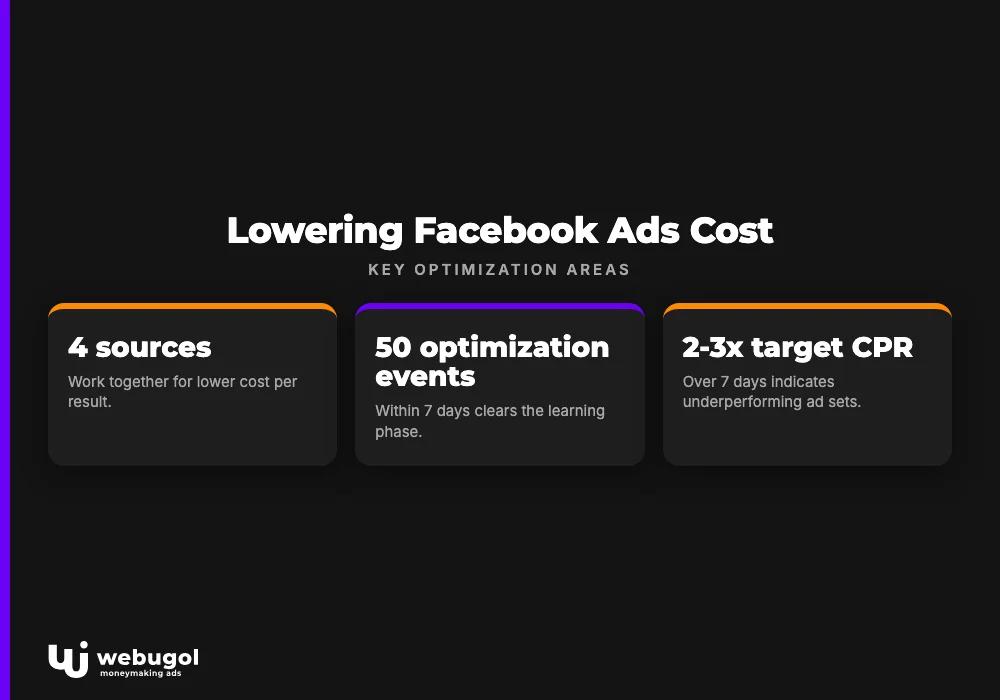
Lower cost per result comes from four sources working together: tighter audience matching, higher-quality creative, smarter bidding strategy, and consistent campaign hygiene.
Audience matching is where most budget waste begins. Interest-based audiences often include a large proportion of users who are browsing without intent to act. Building Custom Audiences from customer email lists, website visitors with purchase intent signals, and Conversion API events produces pools that convert at much higher rates. Lookalike Audiences built from your highest-value customers, rather than all purchasers, outperform those built from general visitor lists in most account types.
Creative quality directly affects what Meta charges for delivery. The platform's auction factors in estimated action rate alongside bid amount. An ad Meta predicts will generate more conversions wins placement at a lower effective CPM, meaning stronger creative costs less to run at the same volume. Testing video against static images, direct offers against social proof variations, and short copy against long copy gives the algorithm multiple signals to find the best-performing combination.
Bidding strategy matters more as campaigns mature beyond the learning phase. Lowest-cost bidding maximizes conversion volume during early stages when the algorithm needs data. Once a campaign clears the learning threshold, which Meta's guidelines set at approximately 50 optimization events within seven days, switching to cost cap or bid cap bidding provides tighter control over cost per result without forcing volume reductions.
Campaign hygiene prevents budget from leaking into underperforming ad sets. An ad set that has spent two to three times the target cost per result over seven days without a conversion is a reliable candidate to pause. Keeping underperformers running dilutes the campaign-level data the algorithm uses to find new converters, making overall performance worse over time, not just in the short term.
Facebook ads optimization checklist: lower cost per result
A practical checklist to reduce facebook ad spend without restructuring campaigns entirely:
- Pause ad sets where cost per result exceeds 2x the target for seven or more consecutive days.
- Retire individual ads with frequency above 4 and click-through rate below the account average.
- Verify Conversion API events are deduplicating correctly in Event Manager.
- Confirm Aggregated Event Measurement priorities still match current campaign objectives.
- Rebuild any Lookalike Audience older than 30 days if the source customer list has grown meaningfully.
How often should you run a facebook ads optimization review?
Reviewing campaigns too frequently is one of the most common mistakes in Meta advertising. The platform's delivery system operates on learning cycles, and changes made within the learning window reset the process, extending the time before campaigns reach stable delivery. Waiting 24 to 48 hours after a creative change before checking performance is a minimum, not an option.
A weekly review cadence works for most campaigns:
- At the start of each week, check cost per result, frequency, and delivery pace for each ad set.
- Midweek, review creative performance at the ad level and pause any ad with frequency above 4.
- At the end of the week, run a full audit: turn off ad sets that missed cost targets across the full seven days and reallocate their budget to top performers.
When a campaign genuinely requires mid-week intervention, change only one variable at a time. Adjusting audience, creative, and bid strategy simultaneously makes it impossible to identify which change drove the outcome.
For campaigns running significant spend, Meta's Delivery Insights feature provides breakdown reports by auction overlap, audience saturation, and external competitive factors. These reports are more reliable than manual day-by-day observation for diagnosing delivery problems, particularly when cost increases do not have an obvious cause.
Structured review cycles and Conversion API maintenance are standard parts of our Meta advertising services, where we run weekly audits alongside audience rebuilds and creative testing rotations for managed accounts.
Ready to fix your Facebook ads optimization?
Ongoing facebook ads optimization is not a one-time setup. The platform shifts, audiences refresh, and creative fatigues on a regular cycle. The post-iOS 14 measurement environment adds another layer: Conversion API integrations need maintenance, Aggregated Event Measurement priorities need revisiting as campaign goals change, and Lookalike Audiences need rebuilding as source lists grow.
The Webugol team manages Meta advertising campaigns across multiple industries and runs structured optimization processes as standard practice. We implement Conversion API integrations, rebuild audience segments after signal loss, and maintain weekly review cadences so your campaigns stay efficient without requiring your team to monitor dashboards every day.
If cost per result has been rising, conversions have dropped, or you are unsure whether your measurement setup reflects actual performance, contact us to discuss what a structured optimization engagement would look like for your account.
FAQ
Why are my Facebook ads spending but not converting?
The most common causes are audience fatigue, an inactive Conversion API, or iOS 14 signal loss that prevents Meta from seeing your actual conversion events. Start by checking Event Manager for event match quality and confirming that Conversion API events are both active and deduplicating correctly alongside your pixel.
How long does Facebook ads optimization take to work?
Meta recommends allowing at least seven days and 50 optimization events before evaluating a campaign's performance. Changes made before that threshold resets the learning phase and extends the time before the campaign reaches consistent, stable delivery.
What is a good facebook ads cost per result?
There is no universal benchmark. The only meaningful target is a cost per result that falls below the maximum you can afford while remaining profitable. Industry averages vary too widely across offer type, audience size, and campaign objective to serve as reliable reference points.
How does the Facebook Conversion API differ from the Meta Pixel?
The Meta Pixel fires JavaScript from the user's browser and can be blocked by iOS 14 ATT settings or browser-based ad blockers. The Conversion API sends data directly from your server to Meta's servers, bypassing browser-level restrictions and recovering conversion attribution that the pixel can no longer capture.
Should I use CBO or ad-set-level budgets?
Campaign Budget Optimization works best when you have multiple ad sets and want Meta to allocate spend dynamically toward the best performer. Ad-set budgets give more control when you need guaranteed spending for specific segments, such as a high-value retargeting audience that would otherwise lose budget to a larger cold audience.