



Google Ads for wellness: a complete guide for health brands
Google Ads for wellness is a paid search channel that connects health businesses with people actively searching for services like nutrition coaching, fitness programs, mental health support, and spa treatments. Campaigns target users by keyword, location, age, and interest, so your ad appears at the moment a potential client is ready to act. Run with the right structure, health and wellness advertising on Google produces qualified leads rather than scattered impressions.
Can health and wellness companies run Google Ads?
Yes. Health and wellness companies can run Google Ads across Search, Display, Shopping, and Performance Max campaigns. Google applies stricter review standards to health-related content, particularly around unverified claims and regulatory certifications, so ad copy that passes in other categories may be flagged for health advertisers.
Understanding those limits before launch saves time and budget. Google Ads for wellness businesses is accessible to most health-related services, including gyms, yoga studios, nutrition coaches, mental health practitioners, spa and beauty services, supplement brands, and fitness equipment retailers.
What Google Ads types work best for wellness brands?
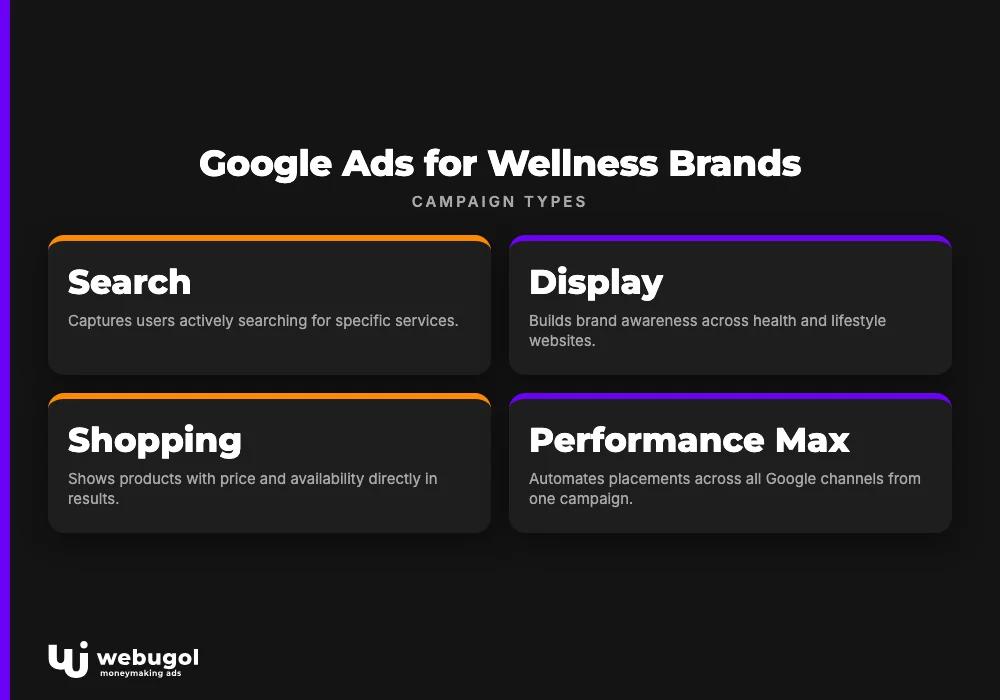
Four campaign types address most wellness business marketing goals. The right choice depends on whether you sell products or services, serve a local or national audience, and how much manual management your team can sustain.
| Campaign type | Best use for wellness brands |
|---|---|
| Search | Capturing users actively searching for your specific service |
| Display | Building brand awareness across health and lifestyle websites |
| Shopping | Showing supplement or equipment products with price and availability |
| Performance Max | Automating placements across all Google channels from one campaign |
Search campaigns are the most direct form of health and wellness advertising. When someone searches "sports massage near me" or "online nutritionist," a Search Ad places your business ahead of organic results. Keywords drive targeting here, making research the most important setup step.
Display campaigns place image ads across Google's partner network. They work well for introducing your brand to users who browse health and fitness content but have not yet searched for your specific services. Display builds awareness rather than capturing immediate intent.
Shopping campaigns let product-based wellness businesses show an image, price, and store name directly in results. A user comparing protein powders sees your listing without visiting your site first, which shortens the path from search to purchase.
Performance Max uses machine learning to serve ads across Search, Display, YouTube, Gmail, and Maps from one campaign. It adjusts bids automatically toward your conversion goal, which reduces the manual work of managing individual placements.
For wellness brands with video content, YouTube TrueView ad solutions offer an additional placement option. According to Google's product documentation, TrueView ads run only when a viewer watches the full ad, delivering stronger engagement than formats that display regardless of whether the viewer stays.
How do I advertise a wellness business on Google?
The foundation of any successful Google Ads for wellness campaign starts with three decisions: selecting the right campaign type, choosing keywords that match your actual services, and setting a daily budget you can sustain long enough to gather meaningful data.
A standard wellness advertising strategy on Google follows this sequence:
- Define your goal. Lead generation (calls, form submissions) and e-commerce (direct sales) require different campaign structures from the start. Mixing goals in one campaign muddies performance data.
- Research keywords. Focus on terms your clients use: "yoga classes near me," "online therapist," "corporate wellness program." Avoid broad generic health terms that attract too wide an audience.
- Set geographic targeting. Most wellness services are local. Restricting ads to the cities or radius where you serve clients prevents budget going to areas you cannot reach.
- Write specific ad copy. Match the headline to the search term. A user looking for "stress relief massage" should see an ad that addresses exactly that and land on a page about that service, not a general homepage.
- Install conversion tracking. Without tracking, you cannot identify which keywords or ads generate actual bookings versus unqualified clicks.
- Review health ad policies before launch. Wellness and health claims face additional scrutiny from Google's review team. Understanding which ad copy patterns trigger disapprovals for medical advertisers prevents wasted time on rejected campaigns.
Custom intent targeting adds a useful layer for Display and Performance Max. It reaches users who have recently searched for specific health topics, even when they are not actively searching at that moment, making it practical for services people research over time before booking.
What keywords should a wellness business target in Google Ads?
Keyword strategy for Google Ads for wellness depends on your service type, but three categories cover most purchase scenarios.
Service keywords target users looking for exactly what you offer: "sports massage," "personal trainer," "nutrition consultation," "meditation classes." These carry the strongest intent to book and typically convert best.
Condition and goal keywords target users describing their situation: "back pain relief," "weight loss program," "anxiety support near me." These users know their problem but may not know your solution, so ad copy needs to bridge that gap clearly.
Comparison and review keywords reach users close to a decision: "best yoga studio [city]," "top wellness coach reviews." These convert well because the user is already evaluating options.
Long-tail phrases, three to five words or more, generally cost less per click than short generic terms and attract more qualified traffic. A search for "corporate wellness program for remote teams" signals a much more specific buyer than someone typing "wellness."
Negative keywords matter equally. Adding terms like "free," "DIY," "how to," and "certification" prevents budget going to users who are researching rather than buying.
For a fuller look at keyword structure and campaign architecture for healthcare PPC management, that resource covers the full planning process for health-focused advertisers.
How much does Google Ads cost for a wellness business?
Google Ads runs on a pay-per-click model: you pay only when someone clicks your ad. There is no platform minimum spend, and advertisers set and control budgets on a daily basis.
Costs vary by how competitive your target keywords are. A local yoga studio targeting "yoga classes [small city]" faces less competition and lower cost per click than a supplement brand bidding on "weight loss" nationally. Geographic market size plays a role too: advertising in a large metro typically costs more per click than the same campaign in a smaller market.
Campaign quality affects cost efficiency directly. A poorly organized campaign with broad-match keywords burns budget quickly on low-intent traffic. A tightly built campaign with specific terms, matched ad copy, and relevant landing pages extracts more conversions from the same spend.
Healthcare PPC management from a specialist agency reduces wasted spend rather than simply increasing ad volume. Webugol's Google Ads services are built around health and wellness clients who want measurable returns, not just clicks.
Ready to run Google Ads for wellness?
Running effective Google Ads for wellness requires more than setting a budget and writing headlines. The health category has specific policy requirements, and campaigns built without that knowledge waste money on disapproved copy or traffic that does not convert.
Webugol is a health ads agency working with wellness and healthcare businesses on Google Ads from initial strategy through ongoing management. The team handles keyword research, ad copy that clears Google's health advertising review, conversion tracking setup, and regular performance analysis. For businesses ready to reach more clients without managing ad accounts themselves, contact Webugol to discuss your wellness advertising strategy.
FAQ
Can Google disapprove wellness ads?
Yes. Google reviews health and wellness ads closely for unsupported claims, misleading language, and policy violations specific to health advertisers. Keeping ad copy factual and aligned with Google's health advertising guidelines significantly reduces disapproval rates.
What is the minimum budget for a wellness business on Google Ads?
Google Ads has no required minimum spend. Most local wellness businesses start with a modest daily budget and increase it as campaign performance data accumulates. Starting conservatively and scaling based on results is a standard approach for new accounts.
Do wellness businesses need a dedicated landing page for Google Ads?
Yes. Sending ad traffic to a general homepage rather than a specific landing page reduces conversions. A page matched to the search term and ad headline gives users the information they need to book or buy without navigating away.
How long does it take for a wellness Google Ads campaign to show results?
Search campaigns can deliver clicks immediately after approval, but reliable performance data typically takes two to four weeks to accumulate. Optimization decisions made before sufficient data exists tend to reduce performance rather than improve it.