



Local SEO for multiple locations: strategy and best practices
Local SEO for multiple locations means building a separate, optimized web presence for each city or address your business serves, rather than relying on a single homepage to rank everywhere. Done right, it surfaces your business in front of high-intent local searchers in each market independently. Done wrong, it produces overlapping pages that search engines cannot differentiate and choose not to rank. This guide covers the complete multi location SEO strategy, from initial site architecture through Google Business Profile management and duplicate content prevention. Effective local SEO multiple locations work requires treating each address as an independent local presence, not a variation of the same homepage.
What is the difference between local SEO and multi-location SEO?
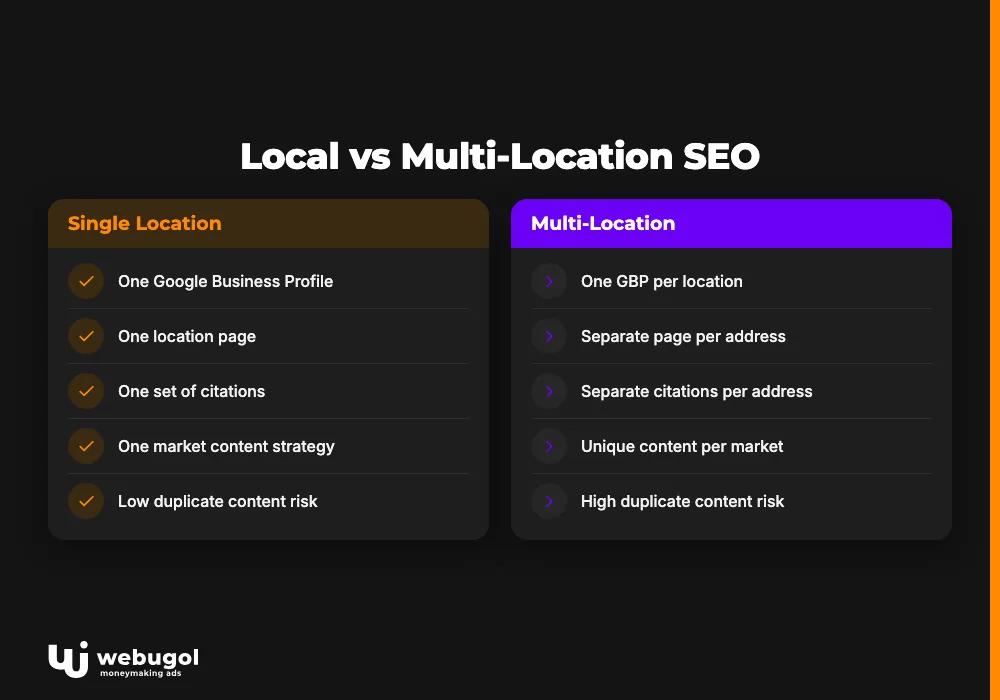
Single-location local SEO concentrates all effort on one address, one Google Business Profile, and one set of local citations. Multi-location SEO applies every one of those tasks to each address your business operates, with the added requirement that each location's content, profile, and citations remain distinct.
The core difficulty is not volume. It is differentiation. Search engines cannot rank five near-identical pages for five different cities. Each location needs genuinely different content, its own verified GBP listing, and its own citation footprint to signal geographic relevance in each specific market.
| Factor | Single-location SEO | Multi-location SEO |
|---|---|---|
| GBP listings | 1 | 1 per location |
| Location pages | Homepage or 1 page | Separate page per address |
| Citation building | One citation set | Separate citations per address |
| Content strategy | One market | Unique content per market |
| Duplicate content risk | Low | High without a clear plan |
For SEO for franchise businesses, this table represents the minimum viable scope. A franchisor managing dozens of locations faces every row multiplied by total location count, which is why franchise SEO programs require centralized governance alongside local execution.
How do you do local SEO for multiple locations?
Local SEO for multiple locations follows seven core steps: create a dedicated page for each location, optimize each page for its specific market, set up separate Google Business Profiles, develop unique localized content, establish local citations per address, earn backlinks pointing to each location page, and maintain consistent NAP (name, address, phone) data across all platforms.
These steps compound each other. A well-structured location page ranks better in map pack results; a verified GBP listing supports that page's local authority; location-specific reviews strengthen both. The interconnected nature of these signals is what makes local SEO multiple locations a system rather than a checklist. The sections below cover each step in practice.
Local SEO multiple locations: core principles
Every tactic in a multi-location campaign traces back to the same principle: search engines evaluate geographic relevance at the individual page level, not the domain level. Structuring your program around that understanding from the start prevents the most costly architectural mistakes.
Create a dedicated page for each location
Every address your business operates deserves its own page on your website. That page should include the full NAP data, hours of operation, a description of services available at that specific address, customer reviews from that branch, and an embedded map.
URL structure carries real weight here. A path like /locations/chicago/ or /cities/new-york/ gives both users and search engines an explicit geographic signal. Generic paths like /location-1/ carry no relevance at all.
Each location page should link back to your main site so users can navigate without friction. Where it makes contextual sense, location pages can also cross-link to related locations, particularly when they share service areas or serve customers who visit multiple branches. This internal linking within your location pages SEO structure builds topical authority across the entire set.
Optimize each page for its specific market
Geo-specific optimization goes well beyond inserting a city name into a title tag. Research what search terms your customers in that specific area actually use. A store in New York City may rank for "NYC" queries while the same brand in Chicago ranks on neighborhood-level terms specific to that city.
Include local signals on every page: area codes in phone numbers, references to nearby landmarks or neighborhoods, and content about local events relevant to your business. These details reinforce geographic relevance without requiring keyword stuffing.
Page titles, meta descriptions, H1 tags, and the opening paragraph of each location page should all name the city or area clearly. Adding LocalBusiness schema markup gives search engines structured data to surface your address, hours, and phone number directly in results.
Build local citations for each location separately
A local citation is any online mention of your business name, address, and phone number. Citation consistency across platforms like Yelp, Google, Bing Places, and Apple Maps is a foundational local ranking signal.
Each location needs its own separate citation profile. Using the same phone number across locations or mixing addresses confuses both search engines and customers. Audit existing citations first, then build new ones location by location, completing every available profile field: categories, hours, website link, business description, and photos.
Earn location-specific backlinks
Backlinks remain among the strongest ranking signals in search, and for multi-location businesses, the goal is to earn links pointing directly to individual location pages rather than only to the homepage.
Local directories, community event sponsorships, local press coverage, and partnerships with other businesses in each city all produce location-specific links. A Yelp business profile, built specifically for local businesses, links back to your location page when configured correctly. Press releases about location-specific events can generate coverage from local news outlets, which carry strong local authority signals because of their geographic focus.
Writing blog content related to services offered at a particular location also builds credibility while giving search engines fresh, relevant material indexed against that specific address. For a broader breakdown of which backlink sources work best by location type, the guide to building local SEO backlinks covers the full range of tactics.
Should each business location have its own page?
Yes. Each location should have a dedicated page because search engines rank individual pages, not entire websites, for local queries. This is the foundational principle behind all local SEO multiple locations strategy: geographic relevance is evaluated at the page level, not the domain level. A single consolidated page cannot signal geographic relevance for multiple cities at the same time.
There is one practical exception: two locations in the same city serving identical audiences. In that scenario, consolidating both on one page works, provided the content genuinely distinguishes each address and includes NAP data, photos, and reviews for both locations. For locations in different cities, states, or countries, separate pages are always the right approach.
The minimum content threshold for a standalone location page is a unique service description for that address, complete NAP data, location-specific photos, and at least a selection of customer reviews from visitors to that branch. A page that meets none of these requirements does not justify a separate URL and will rarely rank.
How to avoid duplicate content with multiple location pages?
Duplicate content across location pages is the single most common failure mode in multi-location SEO. When pages are near-identical except for a swapped city name, search engines cannot determine which page to rank and typically suppress all of them.
Keeping each page genuinely distinct requires deliberate effort across four areas:
Unique service descriptions. Each location page should describe what makes that specific branch different, whether that is the services it specializes in, the staff members who work there, the neighborhoods it covers, or its particular history in the local community.
Location-specific customer reviews. Reviews from customers who visited a particular branch contain naturally local language and detail that cannot be replicated across pages. They also build trust with prospective visitors considering that specific location.
Photos of the actual location. Images of the real storefront, interior, or team at each address are inherently non-duplicatable. They confirm to users they have found the right branch and signal to search engines that the page represents a distinct physical place.
Local context references. Nearby landmarks, events your business participates in at that location, or area-specific partners cannot be copy-pasted across pages because they are inherently specific to one place. Even a brief reference to the local neighborhood makes a page more geographically distinct.
Never build location pages from a single template with only the city name substituted. That pattern triggers precisely the duplicate content location pages problem that causes ranking suppression. A regular full-site location content audit helps identify pages that have drifted toward near-duplication over time, particularly when multiple contributors manage content across a large portfolio of addresses.

How to manage Google Business Profile for multiple locations?
Each physical location needs its own verified Google Business Profile (formerly Google My Business). For businesses with 10 or more locations, Google's Business Profile Manager accepts bulk uploads via spreadsheet, making large-scale updates significantly more manageable. At this scale, local SEO multiple locations management benefits from a centralized profile ownership policy before expanding further.
For google business profile multiple locations, the setup priorities are:
Verify each listing. An unverified GBP listing carries substantially less weight in local search than a verified one. Google typically sends a verification postcard to the business address, though other methods are available for qualifying businesses.
Complete every profile field. Business name, address, phone number, website URL, hours, category, and service area all contribute to how well a listing ranks. Incomplete profiles consistently underperform against fully completed competitors.
Upload current photos. According to Google's own published data, profiles with photos receive more clicks than those without. Add exterior, interior, and service photos for each location, and update them when the location changes.
Respond to all reviews. Active review responses signal that the listing is managed and maintained. Google's guidance states that businesses that respond to reviews are viewed as more credible by prospective customers.
Use location-specific posts. GBP posts highlighting events, promotions, or updates relevant to a particular branch demonstrate that each listing is actively managed, not just set up and left unattended.
Avoid keyword stuffing in the name field. Do not add keywords or city names to the business name unless they are part of your registered name. Google's guidelines explicitly prohibit this, and violations can result in listing suspension.
For SEO for franchise businesses managing many profiles, decide before you start who owns each listing. Document clearly whether individual franchisees or the central team controls each GBP profile and who can edit what. Conflicting access from multiple users is a leading cause of listing suspensions, which take significant time to resolve and cost local visibility while they remain active.
Multi-location SEO for e-commerce: when local still matters
E-commerce businesses that ship anywhere might assume location-based SEO does not apply to them. That assumption misses a meaningful opportunity.
If you have physical warehouses, showrooms, or pickup locations, those addresses can be optimized like any local business. Localized landing pages targeting specific states or cities help an e-commerce brand rank for high-intent queries such as "buy X in [city]," which are often less competitive than their generic equivalents.
For international e-commerce, local signals carry even more weight. Search engines use country-code domain extensions (.uk for the UK, .de for Germany), local phone numbers and addresses, and content in the local language as ranking signals for country-specific results. A business targeting UK customers ranks better with a .co.uk domain and a UK address than with a US-focused homepage serving all international visitors from one URL.
Schema markup extends this advantage. Structured data using LocalBusiness or Product schema can surface location-specific details, including availability, hours, and address, directly in search results without requiring a click-through.

Local SEO tips for small businesses with multiple locations
Small businesses face a specific constraint with local SEO multiple locations: limited team capacity. Executing a multi location SEO strategy manually across ten or twenty locations becomes unmanageable quickly without a repeatable system in place.
Practical local SEO tips small business owners can act on immediately:
- Centralize NAP data. Keep one document as the source of truth for each location's name, address, phone number, and hours. Update that document first, then push changes to all platforms from there.
- Batch citation updates. When hours or contact details change, update all directories in a single session rather than correcting them one by one as you discover errors across platforms.
- Set review alerts. Use GBP notification settings to catch new reviews at all locations promptly. Delayed responses affect local ranking signals.
- Standardize page structure, differentiate the content. A consistent page layout reduces build time and helps users navigate your site. The written content, photos, and local references on each page must still be unique.
- Audit quarterly. Citations drift, GBP listings lose verification, and location pages go stale. A structured review of all your location pages each quarter catches problems before they turn into ranking losses.
Page load speed also affects how well location pages rank and convert. A location page that loads slowly loses users before they read the address or click to call. Running regular performance checks across your location pages keeps the technical foundation solid as your location count grows.
Managing reviews across multiple locations
Reviews are among the strongest local ranking signals, and for multi-location businesses, each location needs its own review profile, its own aggregate rating, and a consistent flow of new reviews over time. In a well-run local SEO multiple locations program, review acquisition is treated as a location-level activity, not a brand-wide one.
Do not mix reviews across locations. A customer who visited your Chicago branch and leaves a review on the Chicago GBP listing provides location-specific social proof for that address. That review strengthens the Chicago listing specifically, not your overall brand rating.
Encourage reviews at the point of service at each location. Staff can mention the GBP page at checkout; follow-up emails can include a direct link to that location's review page. Displaying location-specific reviews on each location page adds unique content, builds trust with prospective visitors, and gives search engines additional text signals tied to that address.
Review volume across all locations is worth tracking separately. A location with few reviews relative to competitors in that city is a clear priority to address, independent of how well other locations are performing in their own markets.
Ready to rank in every market you operate in?
Managing local SEO for multiple locations is a structured, repeatable discipline. Each location needs its own page, its own GBP listing, its own citations, its own backlinks, and content that is genuinely distinct from every other location page. The website SEO foundation supporting those pages needs to be technically sound, with clean URL structure, correct schema markup, and fast load times across every address.
If you are building a multi-location presence from scratch, or auditing an existing one that is not ranking as expected, the Webugol team can assess your current setup and develop a strategy matched to your specific locations and markets. Reach out to start the conversation.
FAQ
How do you do local SEO for multiple locations?
Create a separate, optimized page for each location, set up a verified Google Business Profile for each address, build location-specific citations, and develop unique content for every page. Consistent NAP data across all platforms is what holds the entire strategy together.
Should each business location have its own page?
Yes. Each location needs a dedicated page with unique content, complete NAP data, location-specific photos, and customer reviews from that branch. A single page cannot rank for multiple cities because search engines evaluate geographic relevance at the individual page level.
How do you avoid duplicate content with multiple location pages?
Write distinct service descriptions for each location, use location-specific photos and customer reviews, and include local context, such as nearby landmarks or community involvement, that cannot be replicated across pages. Never build location pages by substituting only the city name in a single template.
How do you manage Google Business Profile for multiple locations?
Create and verify a separate GBP listing for each physical address, complete all profile fields, upload photos, respond to reviews, and publish location-specific posts to signal active management. Businesses with 10 or more locations can use Google's bulk management tools for batch updates and edits.
What is the difference between local SEO and multi-location SEO?
Single-location local SEO focuses all effort on one address, one GBP listing, and one citation set. Multi-location SEO applies those same tasks to every address you operate, with the additional challenge of ensuring each location's content and profile remain distinct enough to avoid duplicate content issues.