



Local SEO backlinks: complete guide to building local authority
Local SEO backlinks are links to your website from geographically relevant sources, and they are the strongest external signal that tells Google your business belongs at the top of local search results. On-page optimization tells Google what you do. Backlinks from local sources confirm that the community trusts you.
Businesses with consistent top-three local pack positions carry a stronger, more location-specific backlink profile than their competitors. Building that profile deliberately is what separates businesses that dominate local search from those that stall just outside the pack.
That stall has a structural cause. The same gap that keeps a new local business out of Google Maps also keeps an established owner from holding a top-three position on higher-stakes, more competitive queries.
What are local SEO backlinks?
A backlink is a hyperlink on an external website pointing to yours. For website SEO, backlinks pass domain authority and signal that your content is worth referencing. Local SEO backlinks do the same, with one critical addition: geographic relevance.
A link from an Austin neighborhood organization sends a location-specific trust signal that a nationally focused publication cannot. Google reads that as confirmation your business is prominent in the Austin market. That geographic layer is what makes local link building a distinct discipline from general backlink acquisition, and it is why a strategy built only around domain authority underperforms in local search.
Why local SEO backlinks affect three ranking signals at once
Local search rankings depend on three factors: distance, relevance, and prominence. Distance and relevance come from your on-page data and Google Business Profile. Prominence is built through external signals. This is where they do their most important work: they are the primary, most controllable driver of how prominent Google considers your business within a specific geographic area.
Local organic rankings. When regionally trusted websites link to your business, Google reads that as community validation. That validation raises your position in organic results for location-specific queries, including those with geographic modifiers and implicit local intent.
Google Maps and the local pack. The three-pack that appears above organic results considers the authority of sites linking to a business. Earning strong, locally relevant backlinks directly correlates with higher local pack positions, particularly in competitive markets where Google Business Profile optimization alone no longer differentiates.
E-E-A-T and ranking stability. Google's quality framework assesses Experience, Expertise, Authoritativeness, and Trustworthiness. A link from a recognized local chamber of commerce, a regional news outlet, or a city government resource page confirms that established local institutions regard your business as credible. That credibility holds through algorithm updates in a way that manipulated links never will.
What types of backlinks help local SEO the most?
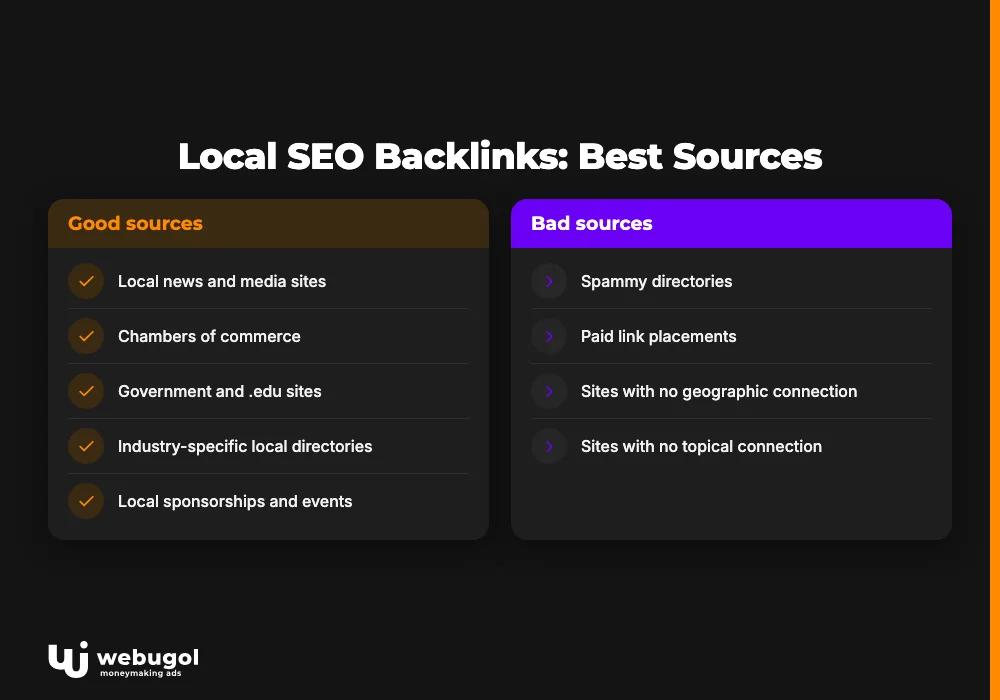
The most effective local SEO backlinks combine geographic specificity with genuine authority. Here is how the major source types compare:
| Source type | Why it works | Common examples |
|---|---|---|
| Local news and media | High domain authority, geo-specific context | City newspapers, regional broadcast station sites |
| Chambers of commerce | Authority plus local trust signal | City chamber directories, regional business associations |
| Government and .edu sites | Highest trust, hardest to earn | City resource pages, university supplier or partner lists |
| Industry-specific local directories | Relevance matches location signal | Houzz for contractors, Avvo for attorneys |
| Local sponsorships and events | Editorial placement, community context | Event sponsor pages, nonprofit partner sections |
| Quality citation directories | NAP consistency, citation building | Yelp, BBB, Apple Maps, Bing Places |
| Partner and vendor pages | Natural, contextual, relationship-driven | Supplier "trusted partner" pages, referral network sites |
Links outside this range, including spammy directories, paid link placements, and links from sites with no geographic or topical connection to your market, carry penalty risk without ranking benefit.
Are local citations the same as backlinks?
No, but they work together. Treating them as identical leads to an incomplete strategy.
A citation is an online mention of your business name, address, and phone number, regardless of whether a link is present. A Yelp listing is a citation with a link. A local news article that mentions your business name without hyperlinking to your site is a citation without one. Both register as local SEO ranking factors. Neither transfers domain authority unless an actual hyperlink is included.
A backlink passes link equity from the linking domain to yours. High-quality editorial links from these sources raise your domain authority in a way citation mentions alone cannot.
You need both. Citations without backlinks build foundational local presence but cap out quickly as a ranking driver. Backlinks without accurate citation data create conflicting signals: if your NAP data is inconsistent across directories, the authority those backlinks build is partially offset.
Maintaining consistent contact data across your local directory listings is as important as earning the backlinks themselves. NAP citations, local SEO directories, and editorial links each serve a distinct role, maintaining consistent citations is a prerequisite, not a substitute for editorial link building.
How do I get local backlinks for my small business?
Earning these links for a small business comes down to becoming genuinely embedded in your local community online, the same way you are already embedded offline. These tactics produce durable results because they are grounded in real relationships, not technical shortcuts.
Local directory submissions
Start with the highest-authority directories: Google Business Profile, Yelp, Bing Places, Apple Maps, and the Better Business Bureau. Each listing contributes to local citation building while generating a link back to your site. Move to niche directories and local business association listings once the major ones are complete and verified.
Local news and media outreach
Identify local journalists, community bloggers, and regional news sites that cover your industry. Reach out when you have a genuine story: a business milestone, a community initiative, or an expert perspective on a local issue. A single editorial backlink from a regional newspaper outweighs dozens of directory listings in ranking impact.
Chamber of commerce and association memberships
Joining your local chamber of commerce and relevant trade associations almost always results in a member listing on those organizations' websites. These listings are among the most natural links a local business can earn. They combine the citation signal of local directory submissions with the domain authority that comes from established, community-trusted institutions.
Sponsorships and local events
Sponsoring a local charity run, a youth sports team, or a community festival typically earns a link on the event's sponsor page. These links are editorial, geographically specific, and tend to persist long after the event itself. Businesses building a local search presence in service-area markets find that a consistent sponsorship pipeline produces geographically relevant backlinks that directory submissions cannot replicate.
Partner and vendor backlinks
Suppliers, referral partners, and complementary businesses you work with regularly are natural backlink sources. A supplier might list you as a certified installer; a complementary business might feature you in a "trusted partners" section. These placements require no cold outreach and produce exactly the kind of organic, relationship-driven backlinks for local business that are hardest to manufacture at scale.
Local resource pages
City websites, universities, and local nonprofits often maintain community resource pages. If your business legitimately belongs on one, contact the site administrator with a concise, specific request. These are often .gov or .edu domains, which carry significant weight in any local SEO backlink profile.

Do Google Business Profile links count as backlinks?
Google Business Profile (GBP) does not function as a traditional editorial backlink. The links within a GBP listing are not passed as link equity to third-party crawlers the way an editorial hyperlink is.
What GBP provides is a direct, authoritative data source for Google: your NAP data, your business category, your reviews, and a link to your website that Google can credit internally. That internal reference supports your local pack presence in ways that parallel a backlink's function, but the mechanism is different from external link building.
Your GBP is the foundation. Local SEO backlinks from external community sources are what you build on top of it. A business with a fully optimized GBP but no external local backlinks will consistently lose to a competitor that has both.
How many backlinks does a local business need?
There is no universal answer. The right number depends on your market, your industry's competitive density, and what the businesses currently occupying the local top three actually carry.
In lower-competition markets, a small set of high-quality, locally relevant backlinks can support a top-three position. Competitive urban markets, particularly in industries with many local providers targeting the same queries, require a more developed profile before rankings shift.
Quality always outweighs quantity. One link from a city government resource page or a regional newspaper carries more ranking weight for local SEO than dozens of links from obscure, low-traffic directories. The benchmark that matters is not an absolute count but the current gap between your backlink profile and what the top-ranked competitor in your specific category and location actually has.
Anchor text strategy for local SEO backlinks
Anchor text, the clickable text of a hyperlink, sends a relevance signal to search engines. The distribution of anchor text across your local SEO backlink profile matters as much as the individual links themselves.
Branded anchors use your exact business name. Most of your local SEO backlinks should carry branded anchors. They build brand authority without creating the over-optimization pattern that draws algorithmic review.
Geo-modified anchors combine your service with your location. A handful of well-placed geo-modified anchors support rankings for location-specific queries. Too many in a short window looks artificial and can attract scrutiny.
Generic anchors like "click here" or "visit our site" carry no relevance signal. A small proportion keeps your profile looking natural, but minimizing them is standard practice.
A healthy local SEO backlink profile mixes all three types. If every incoming link uses the same keyword-rich anchor text, that uniformity signals optimization to Google's algorithm, regardless of how the links were earned.

Backlinks that damage local SEO rankings
Not every link helps. Some patterns suppress rankings rather than improve them, and recognizing them early costs less than cleaning them up later.
Spammy directories exist to sell link placements. They carry no editorial standards, minimal traffic, and frequent appearances in Google's spam signal data. A profile heavy with these links dilutes the authority of legitimately earned local SEO backlinks.
Irrelevant or foreign links from sites with no logical connection to your geographic market or industry type signal manipulation. One or two may be ignored; a consistent pattern draws closer review.
Over-optimized anchor text occurs when a disproportionate share of incoming links use the same exact keyword phrase. Google's guidelines treat this as a link scheme regardless of whether money changed hands.
Paid link placements exchanged for ranking benefit, without an editorial basis, violate Google's link spam policies. This is different from legitimate sponsorships, where a link is a natural result of community participation rather than a transaction designed to manipulate rankings.
If you identify harmful links in a profile audit, Google's Disavow Tool lets you request that specific URLs be excluded from ranking calculations.
How Webugol approaches local link building
Building a local backlink profile that holds requires competitor analysis, source identification, relationship management, outreach, and content that gives publishers a reason to link. Each of those steps depends on judgment, not automation.
At Webugol, local link building begins with a full audit of your current backlink profile and a competitive gap analysis: which high-authority local sources link to your top-ranked competitors but not to you? That gap becomes the prioritized outreach roadmap.
Manual outreach follows. Every contact is a real conversation with a journalist, an association director, a community organization, or a partner business. Content creation runs alongside to give potential linking sites original material to reference. The result is a local SEO backlink profile that accumulates genuine authority over time and becomes progressively harder for competitors to replicate, because it is rooted in real community relationships. Local link building is one layer of a growth system we build alongside the site itself: technical foundation, on-page structure, and off-page authority that compounds.
Start building local SEO backlinks that compound
If your business is absent from the local pack despite a complete Google Business Profile and solid on-page optimization, your backlink profile is the most likely limiting factor. A targeted local link building campaign closes that gap systematically, building the geographic authority that keeps top-three rankings stable across algorithm updates.
Webugol works with local businesses to build websites that grow, with local link building as one layer of a complete system that covers technical foundation, on-page structure, and off-page authority. Contact us to see how local SEO backlinks fit into a website that grows your market share.
FAQ
What types of backlinks help local SEO the most?
The highest-impact local SEO backlinks come from local news and media sites, chambers of commerce, and city or county government resource pages. Editorial links placed within relevant content outperform profile-only directory listings. Industry-specific directories that include your location also carry strong relevance when paired with accurate citation data.
Are local citations the same as backlinks?
Citations and local SEO backlinks are not the same. A citation is a mention of your business name, address, and phone number, with or without a hyperlink. A backlink passes domain authority to your site. Both contribute to local rankings, and consistent citation data forms the foundation that editorial backlinks build on.
How do I get local backlinks for my small business?
Start with major directories, your local chamber of commerce, and any industry associations with local chapters. Then pursue sponsorships, partner page listings, and targeted outreach to local news outlets when you have a real story. Geographic relevance and editorial context produce better long-term results than chasing link volume.
Do Google Business Profile links count as backlinks?
Google Business Profile does not generate a traditional editorial backlink that passes authority across the web. It provides Google with direct business data, including a link to your website, that supports your Maps and organic presence. External local SEO backlinks from community sources build on top of that foundation.
How many backlinks does a local business need?
The number depends on your market and competition level. The real benchmark is the backlink gap between your site and the top-ranking competitors in your category and location, not an absolute count. Quality and geographic relevance consistently outperform raw link volume in local SEO.

