



Eye Care Website Design: What Actually Converts Patients
Eye care website design is how a clinic structures its online presence to attract local patients, establish clinical trust, and turn searches into booked appointments. A well-built eye doctor website combines clean layout, technical SEO, accessibility compliance, and conversion-focused structure. Poor design costs practices new patients every week, quietly and without a single warning sign. That silence is expensive.
Whether you are launching your first optometry practice site or redesigning one that stopped driving appointments, the underlying problem is the same: a website that does not function as a patient acquisition system.
What features should an eye care website have?
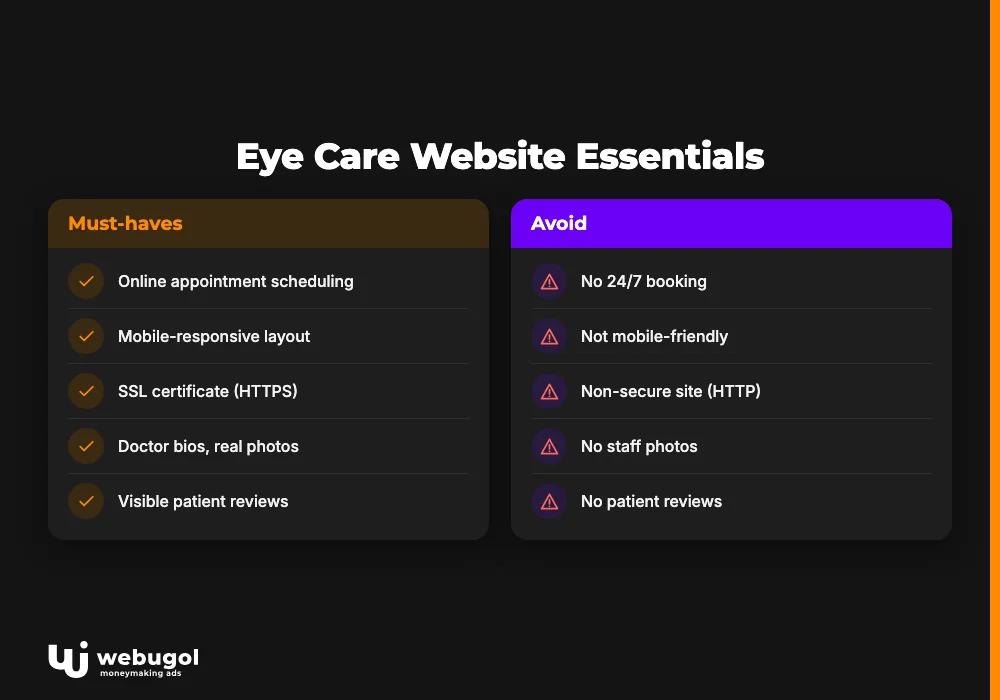
A high-performing medical website for eye clinic owners requires six core features working together. Visual polish alone does not fill a schedule. Every layer matters.
| Feature | Why it matters |
|---|---|
| Online appointment scheduling | Patients expect 24/7 booking; reduces front-desk call volume |
| Mobile-responsive layout | Google indexes mobile-first; over half of all searches happen on phones |
| SSL certificate (HTTPS) | Browsers flag non-secure sites as unsafe, and patients leave immediately |
| Location and hours in the header | Removes friction for patients who are ready to visit |
| Doctor bios with real staff photos | Builds personal trust before anyone walks through the door |
| Visible patient reviews | Social proof shortens the decision cycle |
Beyond the six fundamentals, strong ophthalmology website design also requires:
- Alt text on every image. Screen readers depend on it, and search engines index it for topical relevance.
- High-contrast color schemes and resizable text. Eye care patients include people with low vision. A medical website for an eye clinic that fails basic accessibility checks signals a gap that prospective patients notice.
- Educational content on conditions and treatments. Posts on common eye health topics bring in organic search traffic and reinforce clinical authority. Practices without this content are invisible for the research phase of the patient journey.
- Clear calls-to-action on every page. Every visitor should know what to do next: schedule, call, or read more.
Getting these layers right is where proven patterns for medical site performance begin. Practices that leave even one layer incomplete often cannot identify why traffic does not convert.
How does website design affect patient conversions?
Directly. Patients form trust judgments in seconds. A slow, visually dated, or hard-to-navigate eye care website tells a prospective patient the clinic may be similarly behind in other areas. That impression is unfair. It is also the one that controls the booking decision.
Poor eye care web design loses patients at three predictable moments.
At first load. If a page takes more than three seconds to render, a significant share of visitors leave before seeing any content. Google's PageSpeed Insights identifies exactly where load time is lost and what it costs in ranking terms.
On mobile. A layout that breaks on a smartphone eliminates most potential patients before they read a word about the practice. Google also prioritizes mobile-optimized sites in local search rankings, which doubles the cost of getting this wrong.
At the trust check. Stock photos instead of real staff, no visible reviews, or absent credentials each create hesitation. Hesitation becomes a closed tab and a competitor gaining the booking.
Conversion-focused eye care website design reverses all three moments. Fast load times keep visitors on the page. Speed decides outcomes. Authentic photography and genuine reviews reduce hesitation. Prominent scheduling buttons remove friction between intent and action. Each of these changes is measurable in booked appointments, not just traffic numbers.
What is the best website design for ophthalmology practices?
The best ophthalmology website design matches how a specific patient population searches, decides, and books. The decisions with the highest consistent impact, though, are predictable across practice types.
Clean layout with deliberate white space. Dense, cluttered pages overwhelm visitors. Open, structured eye care web design guides attention and makes information easy to absorb. Navigation belongs at the top; drop-down menus handle service sub-pages without cluttering the main bar.
Mobile-first build. Buttons sized for thumbs, text readable without pinching, and navigation reachable with one hand. For any medical website targeting patients in 2026, mobile-first is a baseline, not a competitive advantage. Most clinics miss this.
Consistent branding across every page. Logo, color palette, and tone should match across the website and the practice's other marketing materials. Consistency builds recognition. Recognition builds trust. Trust drives the first appointment.
Authentic staff photography. Real photos of the team and office consistently outperform stock imagery. Patients form an emotional impression before reading credentials, and stock photos undercut the personal connection that makes one clinic more appealing than another.
Video where natural. A short office tour or a brief doctor introduction answers the "what is this place really like?" question that text alone cannot address. Honest, brief video builds connection with patients who have never visited.
Where healthcare design is heading in 2026 gives useful context for how these standards are shifting across medical practices.
Eye care website design mistakes that cost practices patients
Overly complex design with too many colors or animated elements makes a site look amateurish and overwhelms first-time visitors. Outdated staff pages or incorrect hours erode the trust that a strong layout builds. A site without SSL gets flagged by browsers as "not secure," creating an immediate barrier for any patient who sees the warning.
Ignoring accessibility leaves patients with visual impairments unable to use the site and exposes the practice to legal risk. Every one of these mistakes has a straightforward fix, and all of them are worth addressing before a redesign goes live. Fix them first.

How to optimize an optometry website for local SEO?
Local SEO determines whether patients in your area find your practice or a competitor's. Without it, even excellent optometry website design fails to produce new-patient growth.
Claim and complete your Google Business Profile. This is the single highest-return local action for any eye doctor website. Your name, address, and phone number must be identical across every online directory. Add your hours, photos, and service list. Collect patient reviews actively and respond to them; responses signal to Google that the practice is engaged.
Use location-specific keywords throughout the site. "Eye doctor [city]" and "optometry [neighborhood]" phrases belong in page titles, H1 headings, and meta descriptions. Generic terms without geographic modifiers compete nationally, which a local practice cannot win.
Structure every page with a proper heading hierarchy. One H1 per page, H2 for major sections, H3 for subsections. Search engines read this structure to understand what a page covers. Flat walls of text without heading hierarchy are harder to rank and harder for patients to scan.
Publish locally relevant content. Blog posts tied to seasonal eye health topics or community context build topical authority over time. This work compounds slowly and typically accelerates around the six-month mark of consistent publication.
Audit page speed. Load times under three seconds affect both rankings and the share of visitors who stay long enough to book. Google's PageSpeed Insights is the free starting point for this audit.
For practices that want to accelerate their local rankings beyond these fundamentals, dedicated SEO services provide ongoing keyword tracking, content strategy, and competitive gap analysis.

How much does it cost to build an eye doctor website?
Cost depends on what the practice actually needs. A focused site for a solo optometrist is a completely different scope from a multi-location ophthalmology group requiring online intake forms and patient portal integration.
AI-assisted eye care web development now makes it possible to deliver a fast, SEO-ready, complete site starting around $3,000 to $5,000, a build that a traditional agency would price significantly higher. Practices with custom scheduling workflows, multi-location architecture, or complex integrations will see costs scale from that baseline depending on scope.
The more meaningful benchmark is not the build price. It is the cost per new patient acquired against the lifetime value of a patient whose first contact with the practice was a website that earned their trust. That math is clear.
Practices that treat the site as a one-time purchase and leave it static for five years are not saving money. They are losing patients, one closed tab at a time, to a competitor who made the better investment.
Stop losing patients to a weaker eye care website design
Eye care website design is not an aesthetic decision. It is a patient acquisition decision with design as the delivery mechanism. Practices that treat it as decoration miss the compounding revenue a conversion-optimized, search-ready site generates over months and years.
Webugol builds eye care sites that function as growth infrastructure, not digital brochures. The build comes paired with the marketing system to drive traffic to it. If your current site is not generating measurable new-patient results, that is a problem worth solving now.
Contact us for a no-obligation consultation and a direct assessment of what your current site is costing the practice.
FAQ
What features should an eye care website have?
The six essentials are online appointment scheduling, mobile-responsive layout, SSL security, visible location and hours, real doctor photos, and patient reviews. Accessibility features like alt text, high-contrast design, and resizable text are required additions for any medical website for eye clinic practices, not optional upgrades.
How does website design affect patient conversions?
A slow, mobile-unfriendly, or visually dated site creates an unfavorable impression before a patient reads a word. Friction at load time, on mobile, or in the trust signals a site displays each reduce the probability of a booking. Removing that friction directly increases the share of visitors who schedule.
What is the best website design for ophthalmology practices?
The best ophthalmology website design combines a clean mobile-first layout, authentic staff photography, consistent branding, and a frictionless path to scheduling. Specialty practices benefit most from design choices that reduce patient hesitation, since a first ophthalmology appointment requires more trust than most consumer decisions.
How to optimize an optometry website for local SEO?
Start with your Google Business Profile and verify that your name, address, and phone are consistent across all directories. Add location-specific keywords to page titles and headings, publish locally relevant content regularly, and run a page speed audit. These four steps drive most local search improvements for optometry practices.
How much does it cost to build an eye doctor website?
AI-assisted builds for eye clinics start around $3,000 to $5,000 for a complete, SEO-ready site. Multi-location builds with patient portal integration cost more depending on scope and integrations required. The more useful metric is cost per new patient acquired rather than the upfront build price alone.

