



How to Grow a High-Ticket Peptide Program When Ad Platforms Flag Your Ads
Peptide clinic marketing requires a compliance-first acquisition system because standard paid tactics trigger account suspensions before you hit meaningful scale. Google's Healthcare and Medicines policy prohibits unapproved pharmaceutical claims; Meta's Health and Wellness policy restricts before/after framing and condition-based targeting. This guide covers the platform policy map, claim-safe funnel architecture, HIPAA-compliant tracking setup, realistic CPL benchmarks, and the membership model that converts consults into protocol revenue. Whether you are launching your first peptide program or scaling past a growth plateau, the structural problem is the same: you are running a regulated product through an unregulated acquisition playbook.
Why peptide clinics can't scale paid ads
Paid search and social are the fastest acquisition channels for longevity operators, but peptide clinic marketing sits in a policy gray zone that generic medspa playbooks do not address. The restriction is not abstract. A compliance approver who signs off on a standard weight-loss campaign will block your sermorelin ads at the claim level, not the channel level. Understanding the exact policy lines per platform, per compound, is the prerequisite to building a system that runs without constant friction.
What are Google and Meta's ad policies for peptide therapy?
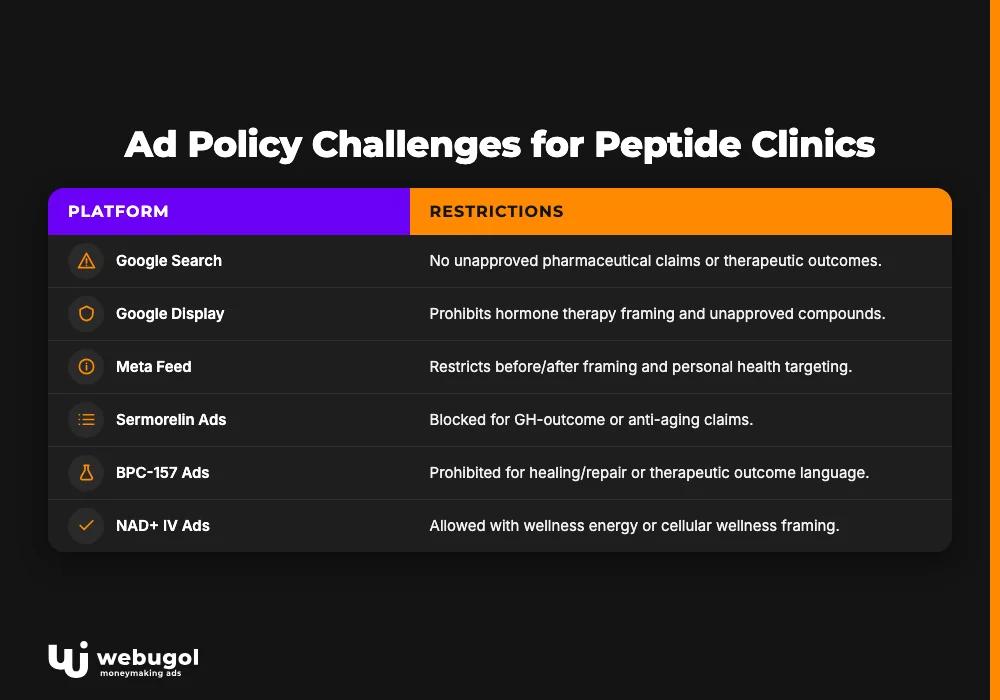
Google's Healthcare and Medicines policy prohibits unapproved pharmaceutical claims and therapeutic outcome language; Meta's Health and Wellness policy restricts before/after framing and personal health condition targeting. The restrictions apply unevenly across compounds, and knowing the map saves you from discovering the hard way that a campaign running clean for three weeks suddenly triggers a cascade of disapprovals.
| Program | Google Search | Google Display | Meta Feed |
|---|---|---|---|
| Sermorelin | Restricted: no GH-outcome claims | Prohibited: hormone therapy framing | Restricted: no anti-aging outcome claims |
| BPC-157 | Restricted: no healing/repair claims | Prohibited: unapproved compound | Prohibited: therapeutic outcome language |
| NAD+ IV | Allowed: wellness energy framing | Restricted: no disease-treatment language | Allowed: cellular wellness framing |
| PT-141 | Prohibited: sexual function claims | Prohibited | Prohibited: sexual health condition |
| Ipamorelin | Restricted: no GH-outcome claims | Prohibited: hormone therapy framing | Restricted: no body composition outcome claims |
| Peptide stacks | Restricted: no combined therapeutic claim | Prohibited | Restricted: no before/after framing |
The practical read: NAD+ IV has the widest allowable claim space. Single-compound peptides require the tightest wellness-only framing. Stacks are the highest-risk creative category across both platforms.
Account suspension risk is higher than most clinics realize
A single ad disapproval is not the problem. The problem is pattern. Google and Meta both use account-level review signals, not just ad-level review. One disapproved ad for a prohibited claim is recoverable. A pattern of unapproved pharmaceutical language across an account, even if each individual ad is eventually corrected, creates an escalating review flag that ends in campaign pause and then account suspension.
The escalation path is roughly: disapproval notice, manual review trigger, campaign pause, account-level review, account suspension. The inflection point from "repairable" to "unrecoverable" happens faster than most clinic owners expect because their ad account contains a mix of compliant medspa campaigns and non-compliant peptide campaigns sharing the same account history. Isolating peptide spend in a dedicated account is not a workaround. It is standard operating procedure.
How do you market a peptide clinic without getting your ad account suspended?
Route traffic to wellness-framed landing pages with no therapeutic claims, import conversions offline through your CRM instead of pixel-firing on condition-specific confirmation pages, and isolate peptide campaigns in a dedicated ad account away from your broader clinic spend. This architecture satisfies platform policy at the ad level, the landing page level, and the tracking level simultaneously. Each layer has to hold independently because platform reviewers check all three.
Claim-safe messaging for sermorelin, BPC-157, and NAD+
Each compound requires a distinct messaging frame because platform algorithms flag specific therapeutic terms differently. The approved frame for sermorelin is "support healthy aging and recovery." Any language referencing growth hormone levels, muscle composition changes, or fat loss triggers a health claims flag. For BPC-157, "support post-workout recovery and resilience" is the safe frame; "repair tissue" or any healing-specific language is prohibited across both platforms. NAD+ IV has the widest allowable claim space: "restore cellular energy and mental clarity" clears both Google and Meta provided no disease-treatment language appears anywhere in the funnel, including the URL.
The conversion rate tradeoff is real in peptide clinic marketing. Wellness-framed copy converts at lower rates than outcome-specific language in an unregulated category. The math for a longevity operator running a longevity marketing agency model still works because the ticket size on a 12-week monitored protocol supports a higher CPL than a standard medspa procedure. The goal is not to maximize click-through rate. It is to maximize qualified consult volume without triggering the account review that shuts everything down.
Landing page compliance checklist
Every landing page in a peptide clinic funnel should clear the following before your compliance approver reviews the paid campaign:
- No before/after outcome claims appear anywhere on the page, including testimonials and image captions.
- No disease-treatment language is used; "support," "promote," and "enhance" are the approved verb tier.
- All efficacy language uses "may support" framing, not "treats," "cures," or "eliminates."
- No testimonials cite specific clinical results such as pounds lost, hormone levels reached, or symptoms resolved.
- A prescriber disclaimer is present and visible without scrolling.
- A medical disclaimer appears above the fold, not just in the footer.
- No condition-specific signals exist in URL parameters that could be read by platform crawlers.
- Mobile load time is under three seconds; slow load is a secondary disapproval trigger for landing page quality.
Every item on this checklist maps to a specific Google landing page review criterion or a standard point a compliance approver will flag before granting sign-off. The same claim-safe framework applies to regenerative medicine marketing more broadly; peptide programs sit at the highest-scrutiny end of that spectrum.
What HIPAA-compliant tracking setup works for peptide clinic funnels?
Consent Mode v2 combined with Google Enhanced Conversions and offline import handles search; Meta Conversions API with no health-condition signals handles social. Together, these four components give you measurable cost-per-consult without exposing protected health information anywhere in the data path. The setup requires deliberate architecture, not just installing a consent banner.
The full tracking checklist:
- A Consent Management Platform banner is live, passing valid consent signals to both Google and Meta before any tags fire.
- Pixels fire only on generic confirmation pages ("your request was received"), never on condition-specific pages such as a sermorelin program confirmation.
- Conversions API sends hashed PII only; no health-condition custom events are included in the event payload.
- Offline conversion import is wired from your CRM to ad platforms, mapping consult bookings and program starts back to the originating click.
- No custom audiences are built on health condition or treatment interest signals; list-based retargeting uses first-party email lists, not condition segments.
- A Business Associate Agreement is signed with your analytics vendor if any health-adjacent data touches their infrastructure.
- A quarterly compliance audit is scheduled to catch configuration drift before it creates a HIPAA exposure.
The pattern in peptide clinic accounts where CPL looks broken is almost always a tracking architecture that fires conversion events on pages a HIPAA-compliant setup would never instrument. Fix the measurement layer first before drawing conclusions about the media. An ad account optimizing toward phantom signals is spending real budget to rank better on bad data.
If your current setup fires pixels anywhere near a health-condition page, your conversion data is wrong and your ad spend is optimizing toward phantom signals. This is the most common measurement failure in peptide clinic marketing, and it silently distorts every media decision downstream. A tracking and funnel audit surfaces the break in under two weeks. Book a funnel audit through the Healthcare Growth System to get a diagnostic before committing to more spend.
CPL and CPA benchmarks in peptide clinic marketing
Generic medspa CPL benchmarks make peptide-specific acquisition look broken when it is not. The eligible keyword set for peptide programs is narrower than for standard aesthetics or weight loss because compliance restrictions remove a significant portion of high-intent search terms from your targeting options. CPL runs higher as a result.
The viable CPL range in peptide clinic marketing depends on three variables: ticket size, protocol length, and whether the program is sold as a one-time procedure or a monitored membership. A high-ticket 12-week sermorelin protocol with renewals supports a materially higher CPL than a one-time NAD+ IV infusion. The payback window a clinic should plan against is 60 to 90 days for initial acquisition, with continuity revenue determining whether the unit economics hold at scale.
TRT programs typically benchmark closer to general men's health CPLs because the keyword set is less restricted. NAD+ IV sits in the middle. Multi-compound peptide stack programs have the highest CPL and the longest consult-to-close cycle because the intake process requires more clinical screening. Clinics that try to apply men's health medspa CPL expectations to a peptide stack program will chronically underfund the channel and conclude it does not work, when the actual problem is the wrong benchmark.
The right frame for a clinic owner evaluating peptide acquisition economics: what is the revenue contribution of a patient who completes one protocol and renews? Work backward from that number to find the defensible CPL. If the math closes, the channel works. If it does not close, the constraint is the offer architecture, not the media.
Converting consults into long-term protocol members
Acquisition economics in peptide clinic marketing only close when consult-to-membership rate holds above 40%. Below that threshold, the CPL required to sustain the program exceeds what the unit economics support. Retention is not a separate system from acquisition. It is the variable that determines whether the acquisition system is viable at all.
Membership framing for 8-12 week peptide protocols
A sermorelin protocol sold as a one-time transaction has a completely different unit economics profile than the same protocol sold as a monitored membership with renewal. The offer structure that converts best positions the program around "ongoing clinical monitoring and protocol optimization" rather than a discrete procedure. Pricing architecture follows: the membership fee covers the monitoring cadence and the refill cycle, not just the compound. This frame also clears platform policy review more cleanly because "monitored wellness program" triggers fewer automated health-claim flags than outcome-specific procedure language.
The intake consent workflow matters here. Patients who understand at intake that the program is designed as a multi-cycle protocol, with an expected monitoring schedule and renewal touchpoints, show higher completion rates and renewal rates than patients who experience renewal as an unexpected upsell. The conversation happens at intake or it does not happen well later.
Win-back for lapsed peptide patients
Patients who completed one protocol and dropped off are the highest-intent reactivation segment a peptide clinic has. They have already cleared intake, they have already prescribed, and they have first-hand experience with the program. The 60 to 90 day win-back window is the highest-yield reactivation period because lapsed patients in this window left for logistical reasons (cost, schedule, life disruption) more often than clinical dissatisfaction.
The compliance-safe reactivation approach avoids any reference to clinical outcomes from the prior protocol in outbound messaging. "It has been 90 days since your last check-in with us, your clinical team is available to review where you left off" is the safe frame. Any message that implies the patient's prior results or health status constitutes a PHI reference in a marketing context. The reactivation sequence lives in your CRM, not in your ad account, and it is one of the highest-ROI programs in peptide clinic marketing because the cost per reactivation is a fraction of new patient acquisition cost. For a deeper look at how this fits into the broader retention picture, patient retention strategy is the structural reference for building this program systematically.
The pattern Webugol sees in longevity practices: renewal and reactivation revenue is leaking quietly while acquisition spend is raised to cover the gap. The fix is not more top-of-funnel spend. It is a structured win-back program that runs automatically from the CRM against a defined lapse window.
Build a compliant peptide clinic marketing system that scales
Peptide clinics that pair a platform-safe acquisition funnel with a membership-framed protocol offer have a clear path to predictable revenue in the longevity space. The system covered here, from tracking foundation through retention, is the structure Webugol deploys for high-ticket longevity programs as the accountable owner of the full path from ad click to recognized revenue. No handoffs between a paid media specialist, a developer, and a CRM vendor where the diagnostic uncertainty lives in the gaps between them.
If your current setup is generating leads but losing them to compliance friction, weak intake, or missing renewal infrastructure, the right starting point is a full funnel and tracking audit. Book a strategy call through the Healthcare Growth System to get a diagnostic before committing to more spend.
Book a Strategy Call
FAQ
Can peptide clinics run Google Ads without getting suspended?
Yes, with the right account architecture. Campaigns framed around wellness outcomes rather than therapeutic claims, routed to compliant landing pages, and isolated from broader clinic spend can run without triggering pattern-based review. A compliance approver must sign off before launch.
What ad policy violations lead to peptide clinic account suspensions?
Repeated disapprovals for prohibited health claims across an account trigger escalating review. Single disapprovals are recoverable; a pattern of unapproved pharmaceutical language, before/after outcome claims, or hormone-therapy framing across multiple ads in the same account is what leads to suspension.
What CPL should a peptide clinic expect from paid search?
CPL for peptide programs on Google Search typically runs higher than general medspa benchmarks because compliance restrictions narrow the eligible keyword set and restrict landing page optimization. The viable range depends on ticket size and protocol length; a high-ticket 12-week program supports a materially higher CPL than a one-time infusion.
Do peptide clinic ads require HIPAA-compliant tracking even without collecting patient records in the ad platform?
Yes. Any pixel or tag that fires on a page where a user has indicated a health condition or treatment interest can constitute a PHI disclosure under HIPAA, regardless of whether patient records are involved. Consent Mode and offline conversion imports are the standard solution.
Is a membership pricing model for peptide protocols a compliance risk?
Membership framing is not itself a compliance risk. The risk lives in the claims made about what the membership delivers. Pricing structured around "ongoing monitoring and clinical support" rather than specific therapeutic outcomes clears both platform policy review and standard healthcare advertising guidelines.

