



SEO trends 2026: ranking in an AI-first search world
The most important SEO trends in 2026 share one root cause: search engines now generate answers, not just rank documents. AI Overviews surface direct responses before the first organic result, reducing the click-through advantage that position one used to guarantee. Zero-click searches let users leave the SERP with the answer without loading a single page. Businesses that adapt their content and technical signals for this environment hold ground. Those running unchanged playbooks from two years ago lose organic share quietly.
If your site is gaining traffic but plateauing, the same structural weaknesses blocking a new site from ranking are what cap your growth at its current ceiling. Getting ahead of the SEO trends 2026 is a revenue decision, not a task to file under "eventually."
What are the most important SEO trends in 2026?
Six shifts define organic performance this year. Each one changes what search engines reward.
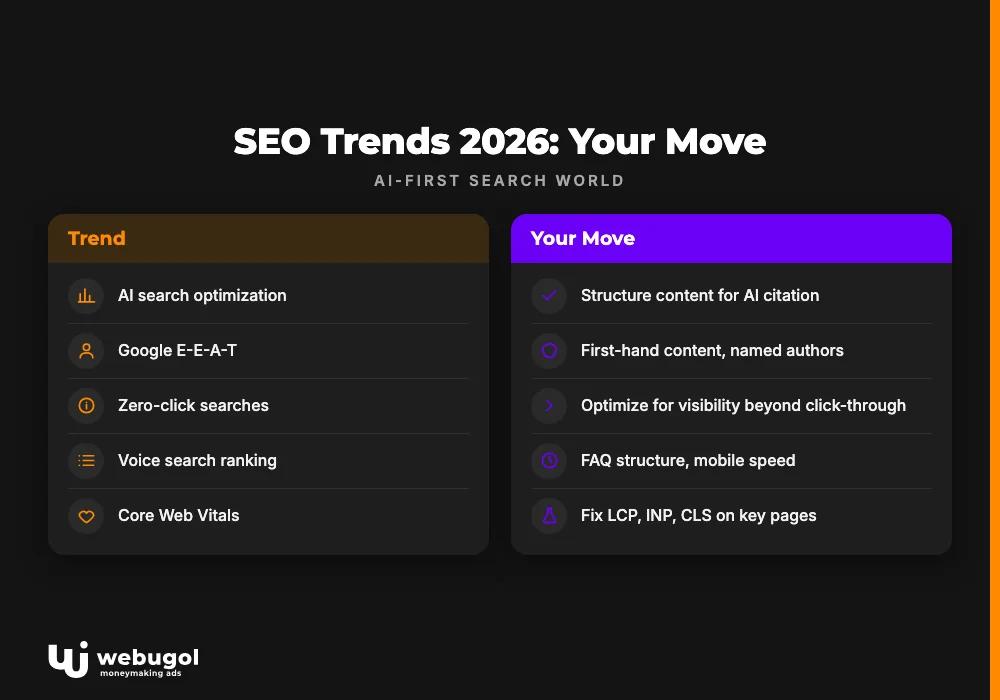
| Trend | What actually changed | Your move |
|---|---|---|
| AI search optimization | Search generates answers, not just link lists | Structure content so AI can cite it directly |
| Google E-E-A-T | Experience added to expertise, authority, trust | First-hand content, named authors, cited sources |
| Zero-click searches | SERP answers the query before organic results | Optimize for visibility beyond click-through |
| Voice search ranking | Queries are longer and conversational | FAQ structure, mobile speed, local intent signals |
| Core Web Vitals | Page experience is a confirmed ranking factor | Fix LCP, INP, and CLS on every key page |
| First-party data SEO | Third-party tracking is structurally weakening | Build owned data infrastructure now |
| Local SEO strategy | AI layers proximity and device context into results | Complete your Google Business Profile, use hyper-local keywords |
The table above is a map. The sections below give you the reasoning behind each shift and the specific moves that follow. Understanding where SEO trends 2026 are taking organic search makes those moves easier to prioritize.
If you are unsure where your current rankings stand against these shifts, a website SEO audit identifies your highest-priority gaps before they compound.
How is AI changing search engine optimization?
Google's AI Overviews, introduced in 2024 and expanded significantly since, changed what it means to rank in position one. AI Mode takes that further: it turns a standard Google search into a dialogue that synthesizes a single response from multiple sources.
Platforms like Perplexity and Microsoft Copilot now capture a measurable share of queries that once flowed exclusively through traditional search.
For business owners, this shift has a concrete implication: the page cited in an AI Overview usually answers the question most directly near the top of the page, uses structured headers the AI can parse as an outline, and has demonstrated domain credibility through consistent publishing.
It is not automatically the longest page or the highest-authority domain. Well-structured smaller sites can compete, but only if the content fundamentals are right.
What SEO trends 2026 mean for content that earns AI citations
Among these SEO trends 2026 surfaces for content teams, AI search optimization demands the most immediate structural response. Content that earns AI citations is:
- Context-driven and structured: Clear H2 and H3 headings signal topic scope. AI reads heading hierarchy as a document outline, not decoration.
- Cited and factually grounded: AI systems avoid citing content that conflicts with known facts or lacks attribution. Named sources and consistent factual accuracy matter more than keyword repetition.
- Schema-marked: Structured data helps AI connect user intent to specific content blocks. Without it, a well-written answer may not surface in an AI Overview.
- Conversational in register: AI search favors content that mirrors how users phrase questions naturally, not content written around exact-match keywords for a crawler.
Understanding how search rankings compare across Google and Bing also matters for AI search optimization. Bing Copilot and Google AI Mode use different underlying models, and what earns citation on one may need adjustment for the other.
How do zero-click searches affect website traffic?
Zero-click searches deliver the answer directly on the SERP. For fact-based queries, informational lookups, and many local searches, users get what they need without loading a single page. That is good for user experience. It is a direct challenge to click-through-dependent traffic strategies.
The opportunity is real, though. A featured snippet or AI Overview citation puts your business name and framing in front of the user at the moment of intent, even if they never visit your site. For high-consideration purchases, that early exposure shapes the eventual decision.
Practical moves for zero-click SERPs:
- Optimize for featured snippets: Concise, direct answers to common questions, structured with clear headers, are what gets pulled into snippets. Vague or over-long answers rarely win them.
- Target long-tail queries: Broad queries generate most zero-click results. Specific, long-tail queries still drive clicks because the user needs more than a one-line answer to act.
- Monitor with Search Console: Impressions without clicks still carry brand signal value. Track which queries pull zero-click impressions and which still drive click-through, then adjust content depth based on what you observe over time.
- Diversify your traffic mix: Organic search alone is a concentration risk. Email, referral, and direct traffic each provide a floor that zero-click shifts cannot erode.
Zero-click pressure is not a reason to abandon SEO. It is reason to rethink what a successful ranking looks like for each query type.
What is E-E-A-T and why does it matter for SEO?
E-E-A-T stands for Experience, Expertise, Authoritativeness, and Trustworthiness. Google's search quality guidelines use this framework to evaluate whether content is worth surfacing to users. The extra "E" for Experience reflects one practical truth: a person who has actually done a thing produces better content about it than someone who researched it secondhand.
In 2026, E-E-A-T functions as the primary filter against AI-generated filler. Among the SEO trends 2026 surfaces for content teams, the emphasis on demonstrated experience is the one most content strategies were least prepared for. Google cannot always detect machine-written text directly, but it can assess whether content demonstrates real knowledge, cites credible sources, and comes from a credibly identified author. Content that fails that test struggles to rank, regardless of keyword coverage.
The "Experience" component is the most actionable of the four. It means including observations, examples, or outcomes from actually working in the subject area. A marketing director reviewing an SEO audit can describe what they found and what changed.
A business owner who migrated from a slow platform to a faster one can describe the specific performance improvements they observed. That specificity is what separates strong E-E-A-T content from competent summaries of published research.
Practical ways to strengthen E-E-A-T signals:
- Assign content to named authors with linked bios that describe their actual background, not just their job title.
- Cite sources for specific claims. "Experts suggest" without a named source is a credibility flag, not a signal.
- Update content regularly so factual claims stay accurate. Outdated information on a live page damages the trust signal the entire domain has built.
- Include original charts, case details, or first-hand observations that only someone with hands-on experience could provide.
E-E-A-T and earning backlinks that build real authority are closely linked. External citations from credible sources tell Google that other informed parties consider your content worth referencing. The two signals reinforce each other directly.
How to optimize for voice search in 2026?
Voice search ranking in 2026 is not a separate discipline. It is what happens when you apply solid SEO principles to conversational queries. It also sits squarely within the SEO trends 2026 is amplifying most on mobile, where the majority of voice queries originate. Voice searches are longer, phrased as full questions, and skew heavily toward local intent and mobile devices.
"Hey Google, what is the best local SEO strategy for a small business?" is a voice query. It has a question structure, a local modifier, and a goal. Content that ranks for it needs to answer directly, in natural language, without burying the answer three paragraphs in.
The connection between featured snippets and voice search is direct. Google's voice assistant reads the featured snippet for most informational queries. Earning the snippet is simultaneously an SEO win, a zero-click visibility gain, and a voice search ranking outcome. All three flow from the same content structure: a direct answer in the first sentence, supporting detail after, and a clear heading that matches the question.
Adding FAQ schema to question-and-answer sections makes it easier for search engines to identify and extract these answers for voice responses. The structure and the markup together increase the probability that your content is what gets read back.
Specific optimizations for voice search ranking:
- FAQ-style sections: Structured as question-and-answer pairs, these match the format of voice queries directly. Voice assistants pull from them because the structure aligns with how the question was asked.
- Long-tail keywords in natural phrasing: "Best local SEO strategy for a small business" is more voice-search-ready than "local SEO small business."
- Mobile page speed: Nearly all voice searches originate on mobile. A slow-loading page will not retain the user long enough to matter, regardless of how well the content is optimized.
- Local intent signals: If your business serves a geographic area, include city names, neighborhood references, and service-area context. Voice queries with local intent carry high conversion intent and are worth optimizing carefully.

Core Web Vitals and SEO trends 2026: page experience as a ranking floor
Core Web Vitals remain a confirmed ranking signal in 2026. Google measures three dimensions of page experience. Largest Contentful Paint (LCP) tracks how fast the main content loads. Interaction to Next Paint (INP), which replaced First Input Delay in March 2024, measures overall input responsiveness. Cumulative Layout Shift (CLS) measures whether the page layout shifts while loading. Pages that score poorly carry a ranking disadvantage that excellent content cannot fully offset.
Google publishes threshold targets for each: LCP under 2.5 seconds, INP under 200 milliseconds, and CLS under 0.1. These are the thresholds that separate pages Google considers "good" from those it marks "needs improvement." Pages in the "needs improvement" band will not compete at the top of competitive SERPs against pages that pass.
For businesses running WordPress or theme-heavy platforms, Core Web Vitals issues are common because many themes load significant CSS and JavaScript regardless of whether the page needs it. Auditing which scripts load on each page template and applying aggressive image optimization addresses most Core Web Vitals failures without a full site rebuild.
The practical culprits by metric:
- LCP failures: Large images and hero blocks that load late are the most common cause. Image compression, lazy loading, and faster hosting address most LCP issues.
- INP failures: Heavy JavaScript that blocks the main thread is the main cause. Deferring non-critical scripts typically resolves it.
- CLS failures: Ads, late-loading images, and embedded fonts that shift layout after initial render. Reserving space for these elements before they load eliminates most CLS problems.
If you have not audited your page experience recently, building your organic traffic forecast will expose the ceiling those scores are quietly imposing on what your content can earn.
Local SEO strategy: proximity, personalization, and AI context
Local SEO strategy in 2026 is shaped by two forces: AI systems that factor in device location, search history, and query context; and users whose "near me" queries carry high intent and expect immediate, accurate results. This is one of the areas where SEO trends 2026 have created the sharpest competitive divide between businesses with complete profiles and those with neglected ones.
Local AI Overviews increasingly pull from Google Business Profile data, review summaries, and local web content in combination. A business with a complete profile, consistent NAP data, and recent positive reviews is more likely to appear in AI-generated local recommendations than a business with better organic rankings but an incomplete profile.
Voice queries and mobile AI queries often bypass traditional organic results entirely, which makes Google Business Profile completeness more consequential than it was two years ago.
Core moves for local SEO:
- Complete and maintain your Google Business Profile: Business hours, service categories, photos, and review responses all feed into local ranking and AI Overview eligibility. Incomplete profiles do not compete.
- Use hyper-local keyword phrases: City names, neighborhood identifiers, and "near me" variations in your content and metadata help AI and traditional ranking systems place you in geographic context.
- Earn and respond to reviews: Reviews are a local ranking factor and a trust signal. Review recency and sentiment both affect where your business appears in local SERPs.
- Build local citations: Consistent NAP (name, address, phone number) across directories, local publications, and niche sites reinforces local authority over time.

First-party data SEO: owning your signal
Third-party tracking is structurally weakening. Browser privacy changes, platform-level restrictions, and tightening regulations have eroded the cross-site behavioral signals many businesses relied on for targeting and attribution. This signal loss is one of the most structurally significant SEO trends 2026 carries forward: it pushes businesses to build owned data infrastructure rather than depend on access to someone else's. The replacement is first-party data: behavioral signals, subscription data, and usage patterns you collect directly from users on your own properties.
For SEO, first-party data informs your content strategy more accurately than third-party tools can. Your site search data, session patterns, and email engagement together reveal not just what users want but how they want it delivered. A topic that generates high page views but high bounce rates is signaling a format mismatch, not necessarily a topic failure. First-party data lets you distinguish between the two and act on it.
It also supports personalization without privacy risk. Customer data platforms that consolidate first-party signals let you tailor content experiences to user segments without depending on external tracking. This aligns with privacy regulations like GDPR and CCPA, both of which place affirmative consent requirements on data collection.
Building first-party data SEO infrastructure means investing in those systems, being transparent about data use, and treating user data ownership as a design constraint from the start. The transition creates a compound advantage for businesses that move early: richer audience signals and faster content iteration cycles than competitors still adjusting to the signal-loss reality.
Ready to stop losing ground to sites that already updated their playbook?
The SEO trends 2026 reward one consistent set of signals: content that is structured clearly, attributed credibly, and built on a technically sound page. If your site ticks those boxes, you are positioned to hold and grow organic share even as AI Overviews shift how users engage with results.
Webugol works with businesses ready to close the gap between where their SEO stands today and where it needs to be. Webugol pairs technical SEO with the development work needed to act on it, so fixes ship instead of staying on a backlog. Book a strategy session to get a clear picture of what is holding your rankings back and what it takes to fix it.
FAQ
What are the most important SEO trends in 2026?
The most critical SEO trends in 2026 center on AI search optimization, Google E-E-A-T, zero-click searches, voice search ranking, Core Web Vitals, local SEO strategy, and first-party data SEO. Each reflects the same shift: search engines now reward well-structured, credibly sourced, technically sound content over pages optimized purely for keyword density.
How is AI changing search engine optimization?
AI search systems like Google AI Overviews and Microsoft Copilot now generate synthesized answers rather than simply ranking pages. Content needs to be structured so AI can extract and cite specific answers, with clear headings, cited claims, and schema markup that connects content to user intent.
What is E-E-A-T and why does it matter for SEO?
E-E-A-T stands for Experience, Expertise, Authoritativeness, and Trustworthiness. Google uses these criteria to assess whether content is reliable enough to surface. Strong E-E-A-T signals, such as named authors with real credentials, cited sources, and regularly updated content, determine whether pages rank or stall in competitive search results.
How do zero-click searches affect website traffic?
Zero-click searches reduce click-through rates for queries where the SERP answers the question directly. The practical response is to optimize for brand visibility in featured snippets and AI Overviews, target long-tail queries that still drive clicks, and diversify traffic sources beyond organic search alone.
How to optimize for voice search in 2026?
Voice search ranking responds to FAQ-structured content, long-tail conversational keyword phrases, fast mobile page speed, and local intent signals. Voice assistants pull answers from featured snippets, so content that earns a snippet for a query will also rank for the voice version of that query.

