



Blog structure for SEO: build posts that rank and convert
A strong blog structure for SEO puts the right elements in the right places: a keyword-driven title, a logical heading hierarchy, natural keyword placement, and deliberate internal links. These choices determine whether a post surfaces on page one or stays buried on page five. That gap is real. The same structural weaknesses that keep new bloggers invisible are what stall scaling businesses when content volume grows but organic traffic does not.
What is the best structure for an SEO blog post?
The best SEO article structure follows a clear hierarchy: one H1 title containing the primary keyword, H2 headings for main sections, H3 for subsections, short focused paragraphs, and a logical flow from introduction to conclusion. This hierarchy gives both readers and crawlers a clear map of the content.
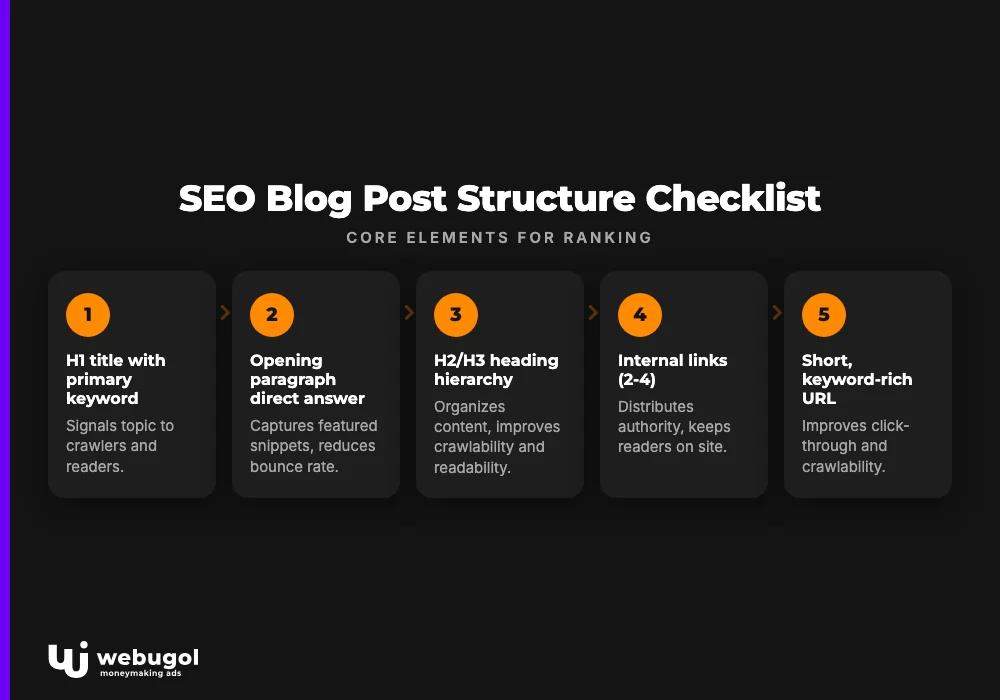
Blog structure for SEO: the core checklist
Every SEO-friendly blog post should cover these elements before it goes live:
| Element | What it does |
|---|---|
| H1 title (primary keyword) | Signals topic to crawlers and readers |
| Opening paragraph (direct answer) | Captures featured snippets, reduces bounce |
| H2/H3 heading hierarchy | Organizes content, improves crawlability |
| Primary keyword in title, intro, 1-2 headings, body | Communicates relevance throughout |
| 2-4 internal links | Distributes authority, keeps readers on site |
| Paragraphs of 2-4 sentences | Improves readability and dwell time |
| Meta description under 145 characters | Increases click-through rate from search results |
| Descriptive image alt text | Improves image indexing and accessibility |
| Short, keyword-rich URL | Improves click-through and crawlability |
A well-organized post is also more likely to earn a featured snippet. Google tends to pull answers from pages that use headers, bullet points, or tables to present information clearly.
How heading tags for SEO structure your content
Heading tags for SEO are more than a formatting choice. They define the content hierarchy that crawlers read to understand topic relationships across your page.
Use H1 once per post for the article title, containing the primary keyword. Use H2 for distinct main sections. Use H3 to break H2 sections into smaller subtopics or step-by-step flows. This three-level structure keeps the hierarchy clean and readable.
A clear heading structure also increases your chances of appearing in featured snippets. Answer a specific question inside an H2 or H3, follow it with a focused paragraph or list, and that block becomes a candidate for Google's answer box. Don't skip heading levels. Moving directly from H2 to H4 creates a structural gap that confuses crawlers and readers alike.
Titles should run between 50 and 60 characters. This range keeps the full title visible in search results without truncation.
Where should keywords be placed in a blog post?
Place your primary keyword in the H1, the first paragraph, one to two subheadings where it fits naturally, and throughout the body at a density of 1 to 2% of total word count. Supporting keywords belong in remaining headings and body paragraphs.
Keyword placement in a blog post works best when it follows the reader's natural attention path:
- H1 and opening paragraph: the first relevance signal for crawlers, the first impression for readers
- Subheadings: distribute keyword signals across the page without clustering them
- Body paragraphs: maintain density at a natural rate; avoid repeating the exact phrase in adjacent sentences
- Image alt text and meta description: reach relevance signals that readers don't see but search engines do
Keyword stuffing hurts both readability and rankings. Tools like SEMrush can flag when density exceeds the useful range so you can adjust before publishing.
How many headings should a blog post have for SEO?
There is no fixed number. A typical 1,000 to 1,500-word post works well with one H1, four to six H2 headings, and H3 subheadings only where a section genuinely needs subdivision. The goal is a hierarchy that reflects the content's actual depth, not one inflated to look thorough.
Each H2 section should contain at least three to five sentences of meaningful content. Thin subheadings with minimal text underneath signal low quality to search engines. Fewer well-developed sections outperform many shallow ones every time.
How long should a blog post be for SEO?
Post length should match what it takes to fully cover the topic, based on what top-ranking pages actually deliver. For most informational topics, 1,000 to 2,000 words is the working range. Longer is not automatically better.
A focused post that completely answers the query will outrank a padded article at any length. The content structure for SEO should deliver topical completeness, then stop. Filler added to hit a word count target works against you.
Does internal linking improve SEO rankings?
Yes. Internal links help search engines discover and understand the relationships between pages on your site. They pass authority from established pages to newer ones and keep readers moving through related content.
A strong internal linking strategy for a blog post includes two to four links per article, each with anchor text that describes what the linked page actually covers. Before restructuring your post strategy, it helps to audit your existing content hierarchy so you can see which pages hold the most authority and where structural gaps exist.
Internal links also reduce bounce rate. Readers who find a relevant next step are more likely to stay on the site, which extends session time and signals engagement to search engines.
URL structure and page speed
URL structure: Keep URLs short, descriptive, and keyword-focused. Use hyphens to separate words. Avoid special characters, numbers, or parameter strings. A clean URL communicates topic clearly to both users and crawlers. Keep it static after publishing; changing URLs forces redirects that dilute link equity.
Page speed: A well-structured post loses ranking ground if it loads slowly. Compress images, use modern formats like WebP, and eliminate unnecessary redirects. How your pages load under real conditions deserves the same attention as content structure itself.
Image file names and alt text tie both concerns together. Use descriptive names like seo-blog-structure.jpg instead of IMG_1234.jpg. Add keyword-relevant alt text that accurately describes the image. This improves image indexing without adding any page weight.
Stop losing traffic to better-structured competitors
Getting the blog structure for SEO right is one piece of a larger growth equation. If your business produces content but isn't seeing compounding organic returns, the structure may look fine on the surface while gaps cost you rankings every month. Webugol builds and optimizes websites with growth built in from the foundation up. Talk to the team about what it would take to turn your blog into a consistent lead source.
FAQ
What is the best structure for an SEO blog post?
The best structure uses one H1 title with the primary keyword, H2 headings for main sections, H3 for subsections, and paragraphs of two to four sentences throughout. The opening paragraph should answer the main query directly. A keyword-rich meta description, two to four internal links, and descriptive image alt text complete the structure.
How many headings should a blog post have for SEO?
A typical 1,000 to 1,500-word post works well with one H1 and four to six H2 headings, with H3 subheadings only where content genuinely needs subdivision. Each heading section should contain at least three to five sentences of substantive content. Thin subheadings over minimal text signal low quality to search engines.
How long should a blog post be for SEO?
Length should match what it takes to fully cover the topic, usually 1,000 to 2,000 words for informational content. Padding an article beyond the point of complete coverage does not improve rankings. Quality and topical completeness matter more than raw word count.
Where should keywords be placed in a blog post?
Place the primary keyword in the H1 title, the first paragraph, one to two subheadings, and naturally throughout the body at 1 to 2% density. Supporting keywords go in remaining headings and body paragraphs. Avoid inserting keywords where they break the natural flow of the sentence.
Does internal linking improve SEO rankings?
Internal links help search engines map your site and distribute authority between pages, which contributes to ranking improvements over time. They also reduce bounce rate by giving readers a clear next step. Aim for two to four contextually relevant internal links per post, with descriptive anchor text.