



How to Start a Weight Loss Clinic: The Operator's Complete Guide
The practical answer to how to start a weight loss clinic in the US is to resolve four things in parallel: legal structure and practitioner licensing, startup cost planning for your chosen delivery model, a compliant service menu anchored to current GLP-1 demand, and a patient acquisition system designed before the first ad dollar is spent. Most resources cover one of these layers in isolation. The collision between all three is where most launches stall, not any single missing piece.
Is the Weight Loss Market Ready for Another Clinic?
The short answer is yes, with conditions. Consumer demand for medically supervised weight loss has never been higher, but that same demand raised the operational floor for what a viable launch actually requires. A founder who opens in 2026 without understanding how GLP-1 drug availability, platform compliance, and acquisition design interact will burn capital fast. The resources that explain how to start a weight loss clinic often address these layers in isolation; the collision between all three is where most launches stall.
What the GLP-1 boom actually changed for new entrants
Semaglutide (Ozempic, Wegovy) and tirzepatide (Mounjaro, Zepbound) fundamentally shifted patient expectations for what a weight loss clinic delivers. Patients now arrive having already researched specific medications. They want a prescribing provider, an ongoing refill pathway, and a monitoring protocol. They are not primarily looking for a lifestyle program.
The FDA compounding landscape added a layer every founder must understand. During declared drug shortages, compounding pharmacies could legally produce semaglutide and tirzepatide equivalents. The FDA shortage status for these drugs has changed multiple times, and compounding rules shift with it. Any clinic that built a business model around compounded GLP-1s without a clear compliance review process carries real regulatory exposure.
What distinguishes a defensible positioning in 2026 is a clinic that can serve GLP-1-eligible patients with compliant prescribing protocols, retain them through a longitudinal monitoring program, and also serve patients who are not GLP-1 candidates through non-medication pathways. Single-service GLP-1 dispensaries face the highest platform advertising restrictions and the highest patient churn when medication supply tightens.
In-person vs. virtual: a 5-factor decision framework
Neither model is strictly better. The right choice depends on the founder's clinical background, capital position, target geography, and long-term revenue model.
| Factor | Virtual | Brick-and-Mortar |
|---|---|---|
| Startup cost | Lower (no lease, minimal build-out) | Higher (lease, equipment, build-out) |
| Compliance burden | Telehealth-specific licensure, multi-state if needed | Single-state, broader procedure scope |
| Patient LTV | Lower initial; higher with subscription model | Higher if adding procedures and diagnostics |
| Scalability ceiling | High (geography-agnostic) | Constrained by location capacity |
| Service scope | GLP-1, behavioral, RPM, nutrition | Adds in-person diagnostics, body composition, minor procedures |
A virtual clinic can launch faster and at lower capital cost, but its long-term revenue model depends heavily on subscription design. A brick-and-mortar location has a higher entry cost but unlocks service lines that command higher per-visit revenue and support stronger patient relationships over time. Many operators launch virtual to prove demand, then add physical presence when patient volume justifies the fixed cost.
How to start a weight loss clinic: defining the model before writing the launch plan
Before drafting a business plan or signing a lease, the foundational question every founder must answer is which delivery model aligns with their capital, clinical credentials, and target market. The model determines cost structure, service scope, licensing requirements, and long-term revenue ceiling.
Who can legally open a weight loss clinic?
An MD, DO, nurse practitioner in an independent-practice state, or physician assistant can open and operate a weight loss clinic as the clinical owner. Non-clinical founders can own the business through a Management Services Organization structure paired with a licensed medical director. All models are viable; the structure determines who signs prescriptions and how supervisory liability is allocated.
Can a nurse practitioner open a weight loss clinic?
Yes, in states with full practice authority. As of 2026, over two dozen states grant NPs independent practice authority without a physician collaborative agreement. In restricted-practice states, an NP must maintain a formal collaborative agreement with a supervising physician, which affects both operational autonomy and cost structure.
Operationally, an NP-led clinic under independent practice authority runs identically to a physician-led clinic for most weight loss services. In collaborative-agreement states, the physician's supervisory role must be documented, the agreement must be renewed per state requirements, and the physician's liability exposure affects how those agreements are priced.
Licensing requirements by practitioner type:
- MD/DO: State medical license, DEA registration for Schedule IV medications if prescribing, NPI, state-specific telehealth registration for virtual delivery
- NP: State APRN license, full practice authority confirmation or executed collaborative agreement, DEA registration, NPI
- PA: State PA license, supervising physician agreement in most states, DEA registration, NPI
- Non-clinical founder via MSO: No practitioner license required for the business entity; licensed medical director must hold all clinical credentials and sign all protocols
Medical director and collaborative agreement structures
For non-clinical founders, the Management Services Organization model creates a legal separation between the business entity and the clinical practice. The founder owns the MSO, which provides administrative, marketing, and operational services to a Professional Corporation or PLLC owned and operated by a licensed clinician.
Medical director compensation ranges from a flat monthly retainer to a per-chart or per-encounter fee, depending on supervisory hours and state requirements. Per-chart models align cost directly with patient volume, which helps early-stage clinics manage fixed overhead. The medical director is not a silent figurehead: minimum supervisory requirements vary by state and must be documented in the services agreement. Liability for clinical decisions rests with the licensed provider, not the MSO owner, but business-level decisions that affect patient care quality can create shared exposure if the MSO-PC agreement is poorly drafted.
How much does it cost to start a weight loss clinic?
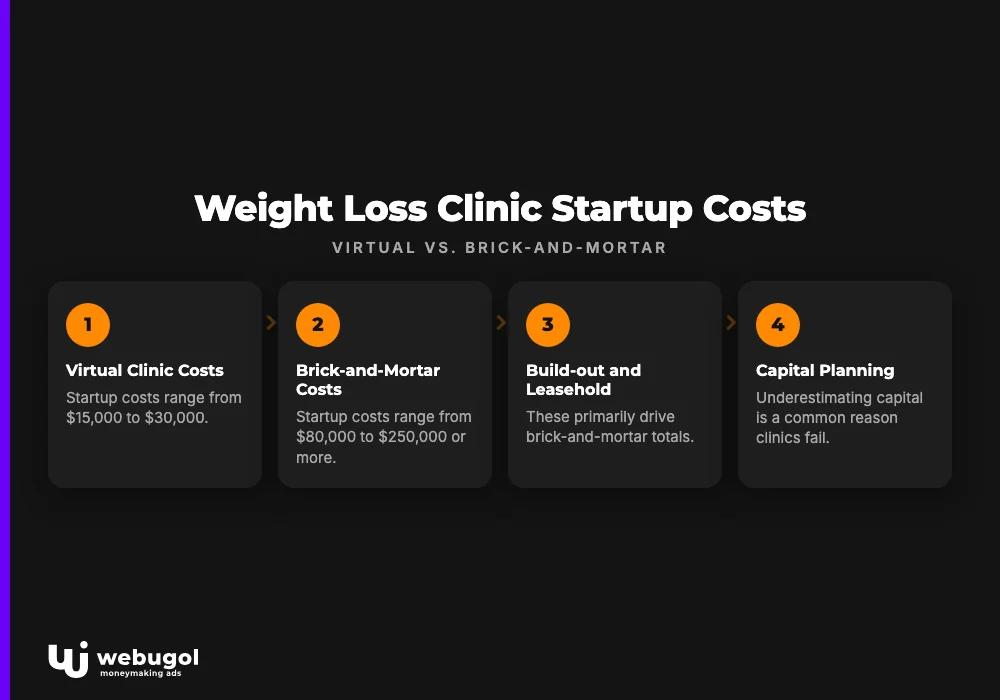
Startup costs range from roughly $15,000 to $30,000 for a virtual clinic to $80,000 to $250,000 or more for a brick-and-mortar location, depending on market, build-out scope, and staffing model. The table below breaks down both models by line item.
Startup cost ranges: virtual vs. brick-and-mortar
| Cost Line | Virtual, Low | Virtual, Mid | Virtual, High | B&M, Low | B&M, Mid | B&M, High |
|---|---|---|---|---|---|---|
| EHR platform | $200/mo | $400/mo | $800/mo | $400/mo | $800/mo | $1,500/mo |
| Telehealth platform | $100/mo | $300/mo | $600/mo | Included or $200/mo | $300/mo | $600/mo |
| Office / lease | $0 | $0 | $0 | $2,000/mo | $5,000/mo | $12,000/mo |
| Build-out (one-time) | $0 | $0 | $0 | $15,000 | $50,000 | $150,000 |
| Staffing (month 1) | $0–$3,000 | $5,000 | $10,000 | $8,000 | $20,000 | $40,000 |
| Marketing (launch) | $2,000 | $5,000 | $10,000 | $3,000 | $8,000 | $20,000 |
| Misc (legal, insurance, licensing) | $3,000 | $5,000 | $8,000 | $5,000 | $10,000 | $15,000 |
Virtual totals at launch typically fall in the $15,000 to $30,000 range for the first 60 to 90 days. Brick-and-mortar totals are driven primarily by build-out and leasehold improvements, with well-equipped locations easily exceeding $200,000 before the first patient books. Capital planning is among the first hard constraints founders encounter when working out how to start a weight loss clinic, and underestimating it at this stage is the single most common reason new clinics burn through their initial runway before proving demand.
Monthly operating costs and break-even timeline
A virtual clinic with one part-time provider and a small tech stack runs on a low monthly burn, so it needs relatively few active patients to break even, depending on program pricing. Brick-and-mortar locations carry higher fixed costs from rent and staffing, which push the break-even patient count significantly higher.
The variable that most founders underestimate is the revenue-per-patient gap between a one-time consultation model and a subscription-based membership program. A GLP-1 membership that includes monthly follow-ups, refill management, and RPM generates meaningfully higher lifetime revenue than a fee-for-service approach at the same patient count.
Break-even timing is ultimately a function of program pricing, patient acquisition cost, and show rate. Calculate it from your own numbers. Contribution margin per active patient is the monthly program price minus what that patient costs you in medication, labs, and provider time. Divide your monthly overhead, recurring ad budget included, by that margin to get your break-even patient count. Then divide the ad budget by your patient acquisition cost, which already reflects your show rate and consult-to-enrollment rate, to see how many patients you add each month. Your break-even timeline is how many months that intake, net of churn, needs to reach the break-even count.
What services should your clinic offer?
The service menu decision is not just clinical, it determines your advertising compliance posture, your revenue model, and which patients you can serve at scale. GLP-1 protocols are the demand anchor for 2026. Non-medication programs are the retention and referral layer. The cash-pay vs. insurance question must be resolved at launch, not after the first billing cycle.
GLP-1 and medication protocols: semaglutide, tirzepatide, and compounding
Semaglutide and tirzepatide are the primary drivers of consumer demand in medical weight loss. Standard eligibility criteria are BMI at or above 30, or BMI at or above 27 with at least one weight-related comorbidity such as type 2 diabetes, hypertension, or dyslipidemia.
For branded medications, patients either pay out of pocket or use manufacturer savings programs where eligible. Insurance coverage for branded GLP-1 medications for weight loss varies considerably and should not be assumed as a revenue path at launch.
GLP-1 service setup checklist:
- Confirm prescribing authority for semaglutide and tirzepatide under your clinical structure
- Establish written eligibility and contraindication screening protocols
- Document informed consent process including side effects and monitoring requirements
- Identify pharmacy partners for branded and, where legally compliant, compounded formulations
- Confirm current FDA shortage status before building any compounding-dependent business model
- Build refill management into the EHR workflow from day one, not as an afterthought
- Establish lab ordering protocols for baseline metabolic panels before initiating therapy
Compounding eligibility shifts with FDA shortage declarations. Any clinic that relies on compounded GLP-1 formulations should have a pharmacist or regulatory counsel review the current compliance posture at least quarterly.
Non-medication programs for lower-BMI patients
Patients with BMI below the GLP-1 eligibility threshold still represent real demand, particularly in employer wellness markets and among patients with physician referrals for metabolic health. Behavioral coaching, registered dietitian consultations, body composition monitoring, and metabolic health assessments form a service tier that serves these patients and generates referral flow back to the medication program as patients' clinical profiles change.
This tier also matters for retention. Patients who complete an initial GLP-1 program and reach a maintenance phase still need ongoing support. A behavioral and nutrition program fills that gap without requiring continued medication prescriptions, which extends the relationship and supports the membership revenue model.
Cash-pay vs. insurance: a decision framework with numbers
Most weight loss clinics launch cash-pay. The decision framework depends on the revenue-per-visit difference, the administrative cost of credentialing, and the billing overhead that insurance introduces.
| Factor | Cash-Pay | Insurance |
|---|---|---|
| Revenue per visit | Full program price, collected at time of service | Contracted rate, net of denials and collections |
| Credentialing timeline | None | 90 to 120 days minimum before first reimbursement |
| Collections rate | Near 100% with upfront payment | Typically lower, with denial and appeals workflow |
| Billing overhead | Minimal | Significant: biller, clearinghouse, denial management |
| Patient volume threshold for ROI | Not applicable | High: credentialing cost only amortizes at volume |
Cash-pay decision criteria:
- If your program pricing supports a GLP-1 membership at a monthly rate that covers costs, cash-pay is almost always the right launch model
- If your target patient population has strong commercial insurance and your service lines map to covered CPT codes, credentialing becomes a 6-to-12-month investment worth planning from day one
- Never credential just for GLP-1 medications: most commercial plans do not cover weight loss drugs, and the administrative burden will not produce ROI at launch volume
Insurance rarely makes financial sense for a weight loss clinic in year one. If credentialing is a strategic goal, begin the process during month two of operations so coverage can begin before you hit the volume threshold that justifies it.
Building your tech stack without overbuilding
The right principle here: configure for the first 50 patients, not a hypothetical 500. Every tool you add before you have patient volume creates maintenance overhead without generating data. Build the minimum system that gets you a compliant patient record, a booking flow, and a follow-up sequence.
EHR and telehealth core
EHR evaluation criteria for weight loss clinics:
- Supports longitudinal medication management with refill tracking built into the workflow
- Integrates with or includes a compliant telehealth module for synchronous video visits
- Supports RPM data import if you plan to use connected devices for weight and metabolic monitoring
- Has a patient portal that handles intake forms, consent documents, and secure messaging
- Offers HIPAA Business Associate Agreements and compliant data handling at the base subscription tier
- Does not require a developer to configure intake workflows or add custom fields
Defer RPM hardware integrations until patient volume creates a clinical demand for the data. Defer AI documentation tools until your EHR workflow is stable. The EHR and a basic telehealth module are the only stack elements you need on day one.
CRM, scheduling, and patient communication
GoHighLevel, HubSpot, and ActiveCampaign are all used in weight loss clinic operations and differ primarily in how much customization they require versus how much is pre-built for healthcare workflows. The choice matters less than the configuration.
Speed-to-lead under five minutes is a contact-rate variable. This is not a growth-stage feature. It is a launch-day configuration. A lead that waits four hours for a callback in a competitive market goes to the next clinic in the Google results. Set up your automated initial response sequence before you run your first ad.
Your patient communication and follow-up system should include an appointment reminder sequence at 48 hours and 2 hours before the consult, an intake form delivery link triggered by booking confirmation, a no-show recovery sequence triggered within 30 minutes of a missed appointment, and a refill reminder sequence timed to the standard medication refill window.
How do I set up compliant marketing tracking for a weight loss clinic?
HIPAA-safe tracking requires consent mode active before any tag fires, server-side GTM to prevent health-condition data from reaching ad platforms, and zero patient identifiers passed in pixel events. This configuration must be in place before your first paid campaign.
HIPAA-compliant tracking setup checklist:
- Implement Google Consent Mode v2 with default denied state; consent triggers tag activation
- Configure server-side Google Tag Manager to intercept events before they reach Google Ads and Meta Pixel
- Audit all pixel events to confirm no health-condition data, diagnosis terms, or service-specific URL parameters are transmitted
- Replace client-side pixels with server-side event forwarding for all conversion events
- Remove or anonymize IP addresses from all ad platform data streams
- Document data handling procedures in your Business Associate Agreement with any tracking vendor that qualifies as a business associate
- Test the full tracking configuration with a consent-denied user before launch
No top-10 competitor article on how to start a weight loss clinic addresses HIPAA-safe tracking configuration. This gap represents real legal and advertising-account risk for founders who launch without it.
For a founder launching right now: the tracking and funnel fragility that caps a new clinic at 20 patients is structurally identical to the system gap that stalls a $500k+/month operator at a revenue plateau. It is the same unintegrated architecture, at different scale. The difference between a clinic that generates predictable patient flow and one that runs ads and hopes is not channel selection, it is the system that connects acquisition to intake to retention.
Webugol's Healthcare Growth System is built around exactly that architecture: tracking-first, conversion-led, and designed so that every dollar of acquisition spend is visible from click to booked consult. Book a strategy call to map what your acquisition system needs to look like before or after launch.

How to get your first 50 patients
Acquisition design is an operational decision. When founders research how to start a weight loss clinic, they typically focus first on the clinical and legal structure, but patient acquisition belongs in the launch plan alongside licensing and tech, not on a "marketing" to-do list you get to after you open. A clinic without a working patient acquisition system is not a clinic waiting for patients; it is a fixed-cost structure burning cash.
Pre-launch demand signals: what works before you open
You do not need to wait for a fully operational clinic to generate demand. These steps run in parallel with licensing and tech setup.
Pre-launch patient acquisition checklist:
- Create and verify your Google Business Profile as soon as you have a physical address or service area established; ranking in local maps takes time, and the clock starts at verification, not at opening day
- Build a waitlist landing page with a clear value proposition and a simple opt-in form; run minimal paid traffic or organic social to it
- Contact five to ten local PCPs, OB-GYNs, or employer HR contacts with a one-page referral introduction; warm referral channels cost nothing and produce high-quality patients
- Set up your intake form and booking flow so that waitlist contacts can self-schedule; the booking infrastructure is what converts interest into revenue
- Configure your CRM with an automated nurture sequence for waitlist members so they stay warm through the licensing and tech setup period
The first patients in many successful clinics come from referral outreach, not paid ads. Paid acquisition amplifies a working funnel; it cannot substitute for one.
Why most clinics stall at 20-30 patients
The funnel failure is almost always structural, not traffic-related.
Common funnel failure points:
- Speed-to-lead measured in hours: a new inquiry sits in an email inbox until a staff member sees it; contact rates drop sharply after the first five to fifteen minutes
- No follow-up sequence: a lead that does not book on the first contact gets one more email; most high-converting clinics follow up five to seven times over ten to fourteen days
- Intake friction that disqualifies eligible patients: a 20-question intake form before the first consultation is a conversion barrier, not a clinical requirement; defer detailed intake to after booking confirmation
- No-show rate with no recovery process: a no-showed appointment without a same-day reschedule outreach attempt is a lost patient; most clinics treat no-shows as closed
- Offer clarity: a landing page that describes services without a clear program price or outcome frame forces every patient to call before deciding; most of them do not call
The structural gap that stalls a new clinic at 30 patients is the same system weakness that blocks an established clinic from scaling past a revenue plateau. Both share the same anatomy: a disconnected intake flow, a CRM that does not trigger recovery sequences, and no attribution data to identify where patients are dropping. Understanding patient retention and follow-up mechanics early prevents the plateau from forming in the first place.
Advertising a weight loss clinic: Google and Meta policy guardrails
Both Google and Meta apply elevated review standards to health-related advertising. Understanding the restrictions before you write your first ad saves you from account suspensions that can pause all acquisition for days or weeks.
Paid advertising compliance checklist:
- Google health advertising: weight loss ads must not make misleading claims about speed or permanence of results; before/after photos are restricted; ads must link to a landing page that accurately represents the service
- Meta sensitive health category: weight loss is a restricted category; condition-based targeting is limited; before/after imagery is prohibited in ad creatives across the platform
- Retargeting limitations: do not build retargeting audiences from site visitors who landed on condition-specific pages (e.g., a page titled "GLP-1 for diabetes"); this transmits health-condition inference to the ad platform
- Consent mode as an ad eligibility requirement: without consent mode configured, your conversion data may be ineligible for use in Smart Bidding campaigns on Google; Meta also requires compliant data handling for health advertisers
- Ad copy that passes compliance review: focus on the consultation or the program; avoid specific weight loss claims tied to timeframes; have your medical/compliance approver review the copy before launch
For a broader view of compliant healthcare advertising across medical verticals, the platform policy constraints are similar, though enforcement patterns vary by specialty.
Mistakes that stall weight loss clinics in year one
Every top competitor covers what to do. This section covers where the capital actually goes.
Year-one failure patterns:
- Launching paid ads before fixing the booking flow: traffic arrives, the booking page requires a phone call, the phone call goes to voicemail. The ad account gets blamed; the actual problem is the intake system. Capital burned: weeks of ad spend at a 2-3% booking rate when the target is 15-20%.
- Building the EHR before confirming the clinical structure: a founder spends 60 hours configuring a clinical EHR only to discover the medical director agreement does not support independent prescribing in their state. Rebuilding the clinical structure after the tech is configured delays launch by months.
- Choosing the wrong payment model at launch: credentialing for insurance before patient volume justifies it ties up staff time in prior authorizations and denials for revenue that will not arrive for 90 to 120 days. Cash-pay at launch, credentialing as a later phase, is almost always the lower-risk sequence.
- Skipping the HIPAA tracking configuration: the first Meta ad campaign transmits health-condition data through a client-side pixel; Meta's automated enforcement flags the account; the account gets restricted mid-campaign. This is not a hypothetical risk, it is the most common compliance failure point for new health advertisers.
- Pricing the GLP-1 program as a one-time service: patients who pay per consultation rather than a monthly membership churn when their initial prescription is filled. A subscription structure with refill management, follow-up visits, and RPM built in generates predictable revenue and reduces acquisition cost per active patient over time.
- Hiring clinical staff before confirming patient volume: a full-time NP at $80,000 to $100,000 annual salary as a first hire, before any patients are booked, turns the first six months into a pure fixed-cost runway with no variable cost flexibility. Part-time or per-chart arrangements during the first 60 to 90 days preserve capital until demand is confirmed.
- Underbuilding the referral network: most weight loss clinics that reach sustainable volume in year one have a primary care or OB-GYN referral source generating 20 to 40 percent of patient flow. This channel takes time to develop. Starting referral outreach on day 90 means the relationship yields results in month six at best.
Ready to build a weight loss clinic that scales past launch?
The decisions you make in the first 60 days of building a weight loss clinic determine whether you compound or plateau. A licensing structure that cannot support your clinical model, a tech stack that was not configured for intake automation, or an acquisition system that was an afterthought will all produce the same outcome: a clinic stalled at 20 to 30 patients with high fixed costs and no clear diagnostic on why growth stopped.
The acquisition architecture made at launch is the same architecture you will either scale or rebuild when you reach the first revenue ceiling. Clinics that reach $500,000 per month do so because their tracking, funnel, intake, and retention systems were designed to compound, not patched together after growth stalled.
Webugol's Healthcare Growth System builds that architecture from day one: end-to-end tracking, a conversion-led funnel, intake automation, and a measurement foundation that tells you what is actually driving bookings. Book a strategy call to map your clinic's acquisition system before or after launch.
Frequently Asked Questions
How much can a weight loss clinic make per month?
Revenue depends on patient volume, program mix, and pricing model. A 50-patient GLP-1 membership practice at a mid-range monthly program price generates meaningfully different revenue than a fee-for-service model at the same volume. A multi-tier clinic with both medication and behavioral programs at 150 to 200 active patients can reach $100,000 or more per month, depending on program pricing and subscription retention rates.
Can I start a weight loss clinic without a medical degree?
Yes, through a Management Services Organization structure paired with a licensed medical director or independent-practice NP. The non-clinical founder owns the business entity, while the licensed provider signs off on all clinical protocols, prescriptions, and patient care decisions.
How do I advertise a weight loss clinic without violating HIPAA?
HIPAA-safe advertising requires no health-condition data transmitted in pixel events, no retargeting audiences built from patient records, and consent mode active before any tracking tag fires. Google and Meta also impose their own health category ad restrictions, independent of HIPAA, that limit condition-based targeting and prohibit before/after imagery in ad creatives.
How long does it take to open a weight loss clinic?
Virtual clinics typically launch in 60 to 90 days with a credentialed provider and a configured tech stack. Brick-and-mortar locations generally require 4 to 9 months, accounting for lease negotiation, build-out permitting, state licensing, and staffing. In both cases, beginning the GBP verification and referral outreach process early shortens the time to first patient.
Can a non-healthcare founder learn how to start a weight loss clinic from scratch?
Yes. The legal, clinical, and operational knowledge required to launch a compliant weight loss clinic is well-documented and learnable. The harder challenge is not the information, it is making the right sequencing decisions under time and capital constraints. Non-clinical founders succeed consistently through the MSO structure, paired with a qualified medical director and properly executed credentialing.

