



Get more patients: the system fix most practices are missing
To get more patients without adding budget, fix four breaks in your acquisition system first: incomplete tracking, intake that responds too slowly, booking friction that loses interested patients, and a retention gap that costs more than you realize. Most practices already run the right channels. The problem is operational, not creative.
This guide maps each break point and shows how to fix it.
Why most patient acquisition strategies plateau
Paid search. Paid social. GBP optimization. Practices running all three still plateau, and the ad account takes the blame. The data rarely supports that.
A practice can show a reasonable cost-per-lead while a two-hour callback window destroys the lead-to-appointment rate. Meanwhile, lapsing patients quietly drain revenue that no new-patient campaign was going to replace anyway. Three breaks account for why practices fail to get more patients despite running the right channels. Tracking ends at the form fill. Intake moves too slowly. Retention runs on hope rather than a managed program.
Each break looks like an ad problem from the inside. None of them is.
The single diagnostic question to ask first
Before adjusting bids, pausing campaigns, or shifting budget, ask one question: where does a new inquiry actually die between the click and the confirmed appointment?
For most practices running a healthcare lead generation audit, the answer sits in the intake flow, not the ad platform. The fix requires a diagnosis before any channel change.
Build your tracking foundation first
Running healthcare marketing campaigns without end-to-end HIPAA-compliant tracking means optimizing toward an incomplete signal. Most Google Ads accounts for medical practices report on form fills. Most bookings happen on a phone call that never gets tied to the originating click. The result is a readable-looking dashboard where the real cost per acquisition stays unknown.
A complete tracking stack for a healthcare practice requires:
- Consent mode configuration covers California-resident traffic and works as best practice for all paid campaigns regardless of geography.
- HIPAA-compliant pixel setup is necessary because the default GA4-plus-Meta-Pixel configuration carries legal risk for health advertisers without restricted data processing flags and proper event filtering.
- Offline conversion import from the CRM connects phone bookings and in-person revenue back to the originating click so revenue attributes to the channel that produced it.
- Call tracking with channel attribution separates calls from Google Search, Meta, organic, and direct so budget decisions reflect actual source distribution.
- CRM stage mapping from lead to kept appointment lets the funnel show where patients are actually lost, not just where leads arrive.
- One dashboard connecting ad spend to booked revenue replaces form fills, sessions, and impressions as the reporting standard.
How does HIPAA-compliant tracking work for healthcare ads?
HIPAA-compliant tracking means no protected health information flows through third-party ad pixels without a Business Associate Agreement in place. In practice, that requires three configuration changes: restricted data processing flags on Meta, consent mode v2 for Google remarketing, and offline conversion import from the CRM so phone bookings register against the originating campaign.
If your analytics platform receives data that could identify a patient's condition or treatment status, it needs a BAA with your practice. What HIPAA requires from your analytics configuration covers where GA4 creates exposure for health advertisers and what the compliant setup looks like in practice.
The CRM handles PHI at every stage from first contact through treatment, and the data it exports to ad platforms must go through compliant pipelines. Connecting intake data to offline conversions through a HIPAA-ready CRM covers what to look for when the system must support both protected data handling and attribution in one place.

How do I calculate patient acquisition cost for a medical practice?
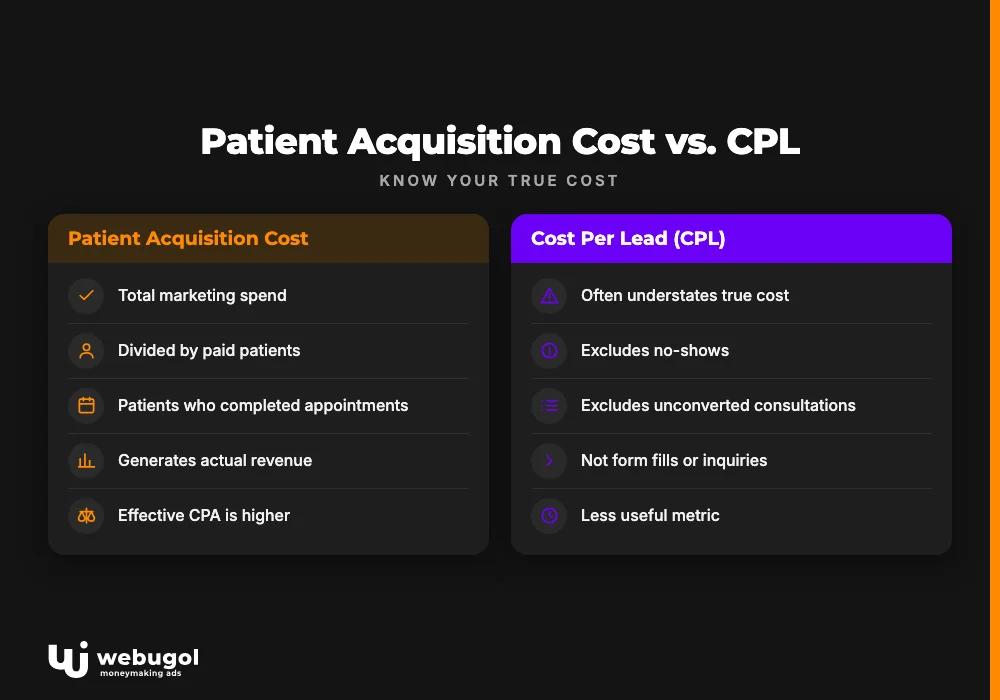
Patient acquisition cost equals total marketing spend divided by the number of patients who showed up and paid. Not form fills. Not inquiries. Patients who completed their appointment and generated revenue. Most practices track cost-per-lead instead, which consistently understates the true cost because it excludes no-shows and unconverted consultations.
The more useful metric is effective CPA: what the practice actually pays per kept appointment. For most practices, effective CPA is materially higher than reported CPL.
| Channel | Typical CPL range | Key compliance constraint | Weeks to first signal |
|---|---|---|---|
| Local SEO | Low, compounding | GBP content guidelines | 8-16 weeks |
| Google Search / LSA | Moderate | Consent mode, health content policies | 2-4 weeks |
| Meta Ads | Variable | Health interest targeting restrictions | 3-6 weeks |
| Referral program | Lowest | HIPAA-compliant data handling at intake | 6-12 weeks |
Your diagnostic reference point is your own trailing 90-day cost per booked appointment, not an industry average. Vertical benchmarks differ widely. Dental practices on Google Search Ads and telehealth weight-loss programs each settle into different ranges. Published averages mix all of them together and produce a number accurate for no one.
Digital channels that reliably produce new patients
A working patient acquisition strategy for a US healthcare practice combines local search, paid search, paid social, and referral systems. Each carries compliance requirements specific to health advertising and produces measurable signals at different time horizons. What matters is knowing which channels produce booked appointments, not just inquiries, when you need to get more patients at a predictable cost.
The channel roles in a functioning healthcare marketing mix:
- Local SEO and Google Business Profile produce organic traffic that compounds over time and capture the highest conversion intent at the point of search.
- Google Search and Local Services Ads reach patients actively searching for a provider, making them the highest-intent paid channel in most markets.
- Meta Ads work for program awareness and offer-driven campaigns, subject to health policy restrictions on targeting.
- Patient reviews and referral programs carry the lowest CPL and the highest trust signal, though they take the longest to scale.
Local SEO and your Google Business Profile
Local search intent is already buying intent. A patient searching "dentist near me" is far closer to booking than someone who sees a display ad. Conversion rates from a local pack click are materially higher than from most paid channels, and the cost per click is zero.
GBP optimization for medical practice growth is not a one-time task. Category selection, service listings, photo cadence, review velocity, and the Q&A section all affect local pack ranking. Citation consistency across directories matters too. NAP discrepancies create ranking friction even when every other signal is strong. Practices that maintain all three signals consistently find they get more patients from organic local search than from any paid channel at an equivalent budget level. A conversion-ready practice website supports local ranking and the conversion rate after the click.
The local SEO guide for healthcare practices covers the full process: GBP category setup, citation management, and the ranking signals that move a practice from page two into the local 3-pack.
Google Search, LSA, and Meta: the compliance guardrails
Healthcare advertisers face restrictions most verticals never encounter. Meta prohibits targeting based on health conditions or inferred medical status. Google's health content policies limit ad creative for certain categories and require consent mode for remarketing audiences. Local Services Ads require background check verification but offer a compliance-safe paid search option for most specialties.
Policy violations rarely produce a warning. They produce an account suspension that cuts new-patient flow to zero overnight. A compliance-first campaign structure separates condition-based messaging from symptom-based messaging, avoids before/after claims that trigger health content flags, and routes remarketing through consent-verified audiences only.
Reviews and referrals: lowest CPL, highest trust signal
Review velocity affects both GBP ranking and new-patient conversion rate. A practice with 20 reviews from 2022 and one with 60 reviews from the past six months are not perceived the same way by a prospective patient. Google's local algorithm weights recency. Automated review requests sent via SMS within 24 hours of an appointment produce materially higher response rates than manual email requests or in-office cards.
Measuring referral output means tracking source in the CRM at intake. Patient-reported attribution consistently undercounts referrals. CRM-tracked referral codes are more reliable. On the provider side, referral relationships with adjacent practices (primary care to specialist, chiropractor to physical therapist) carry a lower CPL than any paid channel when properly structured and measured.
Why are healthcare ads getting clicks but patients not booking?
If a practice does not reach a new inquiry within five minutes of a form fill or missed call, conversion rates drop sharply and the campaign takes the blame for an intake failure. That is the most common cause. Click-to-contact and contact-to-booked-appointment are two separate conversion rates. Most practices only track the first.
The practical steps to get more patients from your current lead volume
Patient intake optimization checklist:
- Speed-to-lead under five minutes is the target, not an aspiration. Response times beyond this produce a significant drop in lead-to-appointment conversion.
- Answer rate management matters because a practice losing more than 30% of inbound calls to voicemail is losing patients it already paid to acquire.
- Callback script quality creates a bottleneck when staff cannot answer basic insurance or scheduling questions, making the problem look like a campaign issue when it is an intake issue.
- Booking confirmation closes the intake loop: confirming the appointment, not just the inquiry, predicts show rate and reduces avoidable no-shows.
- Automated reminder sequence should run three touches before every appointment: 72 hours, 24 hours, and same-day. Practices with persistently high no-show rates often run none.
Speed-to-lead: the five-minute window
In high-consideration healthcare decisions, response time is the single strongest predictor of lead-to-appointment conversion. Research published in the Harvard Business Review found companies responding to leads within an hour were nearly seven times more likely to qualify the prospect than those responding later. In healthcare, where a patient often evaluates two or three practices simultaneously, the first response sets the standard everyone else is measured against.
After-hours coverage is the operational change most practices resist. A form fill at 9pm does not wait until 9am. An automated SMS confirming receipt and setting a callback expectation buys time. A live response wins outright.
Reducing no-shows before they happen
No-shows inflate the effective cost per acquired patient and are largely predictable from friction in the booking confirmation flow. A practice sending one confirmation email two days before the appointment will see a higher no-show rate than one running a three-touch reminder sequence with a response mechanism.
Pre-visit friction compounds the problem. New patients completing intake paperwork on arrival carry a cognitive burden that correlates with higher cancellation rates. Digital intake forms sent the day before reduce no-shows and shorten chair-time, affecting the unit economics of every patient in the acquisition funnel. How digital intake workflows reduce no-shows and lower your cost per acquisition covers the setup in detail.
What is a good patient retention rate for a healthcare practice?
Retention rates vary significantly by specialty and market, making cross-industry benchmarks largely meaningless for individual practice decisions. The actionable measure is your own historical recall window by specialty. A practice falling below its own baseline is losing patients faster than new-patient campaigns can replace them cost-effectively.
Many practices raise ad spend to compensate for patients quietly lapsing when a structured reactivation program would recover the same revenue at a fraction of the cost. The most efficient way to get more patients onto your schedule without adding budget is often reactivation. A win-back campaign to a former patient who completed intake, knows the practice, and had a positive outcome converts at a rate no new-patient campaign can match.
Patient retention tactics like recall automation and win-back SMS sequences cost a fraction of what paid channels charge for an equivalent acquisition. The lapse point is predictable by specialty. Dental patients lapse after the six-month recall window. Chiropractic patients lapse after the initial treatment plan ends. Med spa patients lapse after the first service cycle without a re-booking prompt. Identify that window, build a reactivation flow around it, and retention becomes a managed program rather than a passive outcome.
Specialty-specific tactics to get more patients
The core system for medical practice growth applies across specialties, but channel mix, CPL benchmarks, and compliance constraints differ meaningfully by vertical. The following gives focused playbooks for three verticals with distinct acquisition patterns.
Dental practices
Dental practices see the strongest new-patient volume from a combination of GBP optimization, Google Search Ads targeting new-patient queries, and an automated post-appointment review program. The combination that moves volume fastest in the short term: new-patient search campaign, GBP service-area and category setup, and an automated review request within 24 hours of every appointment.
Case acceptance is part of the acquisition equation. A new patient who books a consultation but does not accept the treatment plan is a conversion that never generated revenue. A two-to-three-touch follow-up sequence for unconverted consultations over 30 days recovers a measurable share of those cases without additional ad spend. For orthodontic and oral surgery practices, both consideration timelines and average ticket values are higher, so the nurture sequence must extend accordingly.
Chiropractic and physical therapy
Chiropractic practices face a shorter patient lifecycle than dental. A patient presents for an acute episode, resolves, and exits. The question is not just how to get more patients through acquisition but how to bring former patients back before the lapse becomes permanent, because reactivating a former patient costs less and converts at a higher rate than acquiring a new one.
Condition-triggered search intent drives most new chiropractic patients. Queries like "back pain relief [city]" represent patients in acute need. Google Search and GBP are the strongest acquisition channels for this intent. The intake speed requirement is tighter than most specialties. A patient in acute pain who cannot reach the practice on the first attempt will book elsewhere.
Telehealth and virtual clinics
Telehealth patient acquisition operates across wider geographies and under stricter ad platform policies than physical practices. HIPAA compliant tracking is more critical at this scale. Without compliant offline conversion import, a telehealth program running GLP-1 or men's health offers cannot distinguish which channel produces patients who complete the program from which produces high-volume, low-retention signups.
The channel stack for telehealth: Google Search for high-intent queries, compliant Meta targeting for program-awareness campaigns, and email and SMS nurture for offer-based programs with longer consideration timelines. Offer structure matters as much as channel selection. A free consultation consistently outperforms a percentage discount in high-consideration healthcare categories. What telehealth operators must verify about their video platform's compliance posture covers the specific requirements for video tools used in clinical workflows.
How long does healthcare SEO take to show results?
Most practices see measurable organic ranking movement within 8 to 16 weeks of consistent technical optimization, on-page changes, and citation building. The timeline depends on domain age, competition level, and whether technical issues are blocking crawl and indexing. Paid search signals appear in 2 to 4 weeks. Referral programs take 6 to 12 weeks to produce a readable volume of attributed patients.
Local SEO compounds. A practice that builds GBP authority, review velocity, and citation consistency over 12 months will outperform its paid channels on cost per booked appointment. The compounding is invisible for the first two months. Practices underestimate the return because they measure the wrong time horizon.

Measure what is actually working
A functioning acquisition system produces readable data: which channel produced the lead, whether the patient booked, whether they showed, and what revenue that visit generated. Most healthcare practice dashboards answer "how much did we spend" and "how many leads came in." Neither question tells you whether the system is working.
What data you need to track to consistently get more patients at a lower cost
The metrics that matter at each funnel stage:
- Ad spend to lead shows cost per inquiry by channel and reveals where volume originates.
- Lead to booked appointment measures intake conversion rate and shows where patients are lost after the click.
- Booked to show tracks show rate by channel and offer type, connecting funnel output to actual patient arrivals.
- Show to revenue captures case acceptance and average ticket, connecting acquisition activity to recognized business outcome.
When a metric moves, the question is whether the cause is the ad account, the intake team, the offer, the market, or a tracking break. Practices that successfully get more patients on a predictable budget connect all four metrics in one place. A practice with separate ad-platform reports and a CRM that does not communicate with either cannot.
Get more patients: start with a full funnel diagnostic
Most practices already run the right channels. The gap is the system connecting them: tracking, funnel, intake, and retention measured in one place and owned by one accountable team. The full path from click to recognized revenue must be visible and managed as a single system.
Most practices run two to five vendors simultaneously, each optimizing their own scope, none accountable for what happens at the handoffs between them. Patient volume leaks between the ad click and the CRM, between the CRM and the intake team, between the intake team and the booked appointment. One team owning the full path removes the coordination gap.
The Healthcare Growth System is a 90-day sprint that builds this system, from tracking foundation and market intelligence through daily campaign optimization and retention flows. Clients in this program include Valhalla Vitality (telehealth, +287% monthly revenue, 45% reduction in CAC) and UberDoc (virtual clinic, 4.2x ROAS, +120% leads). Both results came from fixing the system behind the campaigns.
Start with a full acquisition system diagnostic before any budget changes are made. The team at Webugol reviews the complete funnel before recommending channel changes.
FAQ
Why are healthcare ads getting clicks but patients not booking?
The most common cause is speed-to-lead: if the practice does not respond within five minutes of a form fill or missed call, lead-to-appointment conversion drops sharply and the campaign takes the blame for an intake failure. The second most common cause is a booking flow with more steps than a new patient is willing to complete before confirming an appointment.
How do I calculate patient acquisition cost for a medical practice?
Divide total marketing spend by the number of patients who showed up and paid during the same period. Form fills and inquiries are not acquired patients: tracking CPL instead of effective CPA consistently overstates performance. Your trailing 90-day cost per kept appointment is the only benchmark that reflects what the practice actually paid.
What is a good patient retention rate for a healthcare practice?
Retention benchmarks differ by specialty and are most useful when compared against your own historical recall windows rather than cross-industry averages. A practice dropping below its own historical baseline is almost certainly losing patients faster than new-patient campaigns can replace them cost-effectively. The practical target is to track lapse timing by specialty and build automated reactivation flows around those windows.
How does HIPAA-compliant tracking work for healthcare ads?
HIPAA-compliant tracking requires that no protected health information flows through third-party ad pixels without a Business Associate Agreement. In practice, that means restricted data processing flags on Meta, consent mode v2 for Google remarketing, and offline conversion import from a HIPAA-compliant CRM so phone bookings and in-person revenue attribute back to the originating campaign.
How long does healthcare SEO take to show results?
Most practices see measurable organic ranking improvement within 8 to 16 weeks of consistent optimization, depending on domain authority and competition level. Paid search produces signals in 2 to 4 weeks. Local SEO compounds over 12 or more months, and practices that commit to it typically outperform their paid channels on cost per booked appointment over that horizon.

