



HIPAA compliant texting: rules, consent, and compliance
HIPAA compliant texting uses encrypted platforms, signed Business Associate Agreements, and documented patient consent to protect PHI while your team follows up quickly. Standard SMS is not compliant by default. It carries no encryption, no audit trail, and no control over where a message is stored or forwarded. Compliance requires a dedicated patient texting platform that satisfies all three HIPAA safeguard categories under a signed BAA.
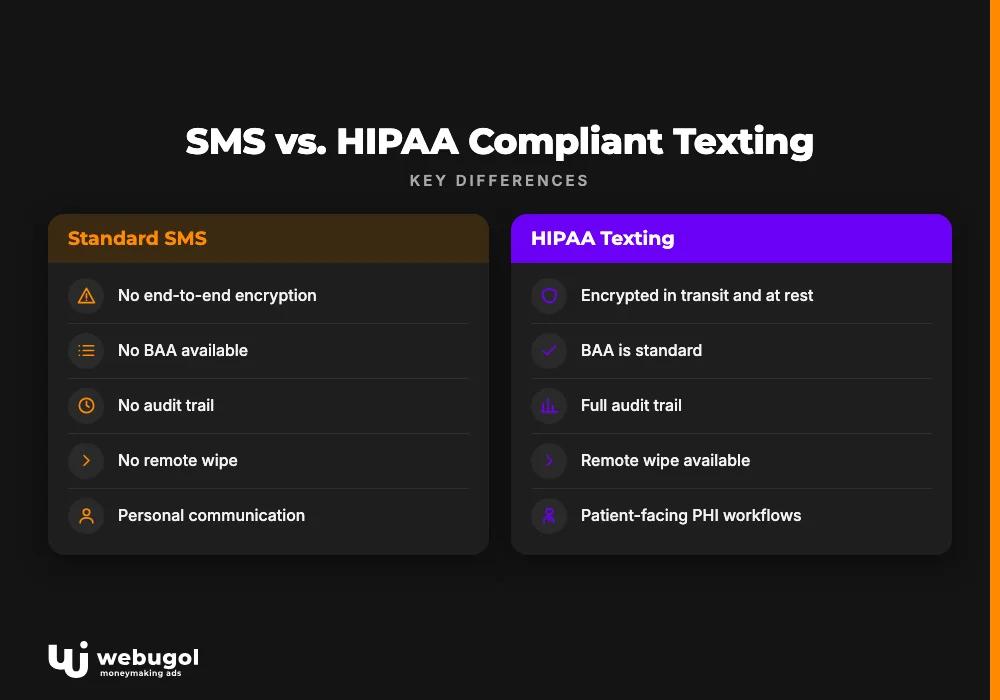
What is the difference between SMS and HIPAA compliant texting?
To a patient, both look identical. The compliance gap is entirely on the backend.
| Feature | Standard SMS | HIPAA texting platform |
|---|---|---|
| End-to-end encryption | No | Yes (transit + at rest) |
| BAA availability | No | Yes (standard) |
| Audit trail | No | Full |
| Remote wipe | No | Yes |
| Best use | Personal communication | Patient-facing PHI workflows |
SMS messages travel unencrypted across carrier infrastructure, sit on servers the provider cannot control, and cannot be remotely wiped if a device is lost. Each gap maps to a specific HIPAA technical safeguard requirement that carrier SMS structurally cannot meet. No policy layer fixes this. Only a purpose-built HIPAA compliant texting platform qualifies.
Is texting HIPAA compliant?
Not by default. HIPAA compliant texting requires the platform, staff policies, consent documentation, and BAA coverage to all be in place simultaneously. The "HIPAA compliant" label is not federally regulated, which means any vendor can apply it to any product. A texting platform is one piece; your workflow is the rest.
What are the HIPAA rules for texting patients?
HIPAA texting rules require three safeguard categories to be satisfied before any PHI reaches a patient. Each maps to specific documentation and platform configuration:
- Encryption: Messages containing PHI must be encrypted in transit and at rest using AES-256 or equivalent, with written documentation from the vendor.
- Access controls: Role-based permissions must restrict which staff can view, send, or export patient messages. Shared credentials are a violation regardless of access frequency.
- Audit log: Every message event, including sent, received, read, and deleted, must be timestamped and logged with a user ID for potential OCR review.
- Staff training: Annual training records must cover secure texting procedures, device policies, and breach response protocols.
- Device management: BYOD policies must address minimum security requirements; practice-owned devices require a documented lock, password, and remote wipe procedure.
- Retention: Message records must be retained for a minimum of six years under HIPAA, with a documented policy governing storage and access.
These healthcare SMS compliance requirements apply across specialties and practice sizes.
How do you get patient consent for texting?
Consent must be documented, specific to purpose, and stored in the patient record before the first message is sent.
Each message category requires its own authorization. Appointment reminders, billing updates, and health information are separate. A patient who authorized appointment reminders has not authorized marketing texts. Adding a new category requires a new consent form. Digital signatures are acceptable under most state laws; the signed record must be retrievable within 24 hours of an OCR request.
Every marketing sequence must also include a STOP opt-out in the first message, as required under both HIPAA and the Telephone Consumer Protection Act. Texting patients legally requires the HIPAA authorization to be completed before any message references a specific health service. Design your intake flow so authorization comes before personalized outreach begins.
What makes a texting app HIPAA compliant?
Five features separate a genuinely compliant texting platform from one that merely claims the label. Verify each from technical documentation, not marketing copy:
- End-to-end encryption: TLS 1.2 or higher in transit, AES-256 at rest.
- Full audit trail: Every message event logged and exportable for OCR review.
- BAA as standard: Not an enterprise upsell or a separate negotiation.
- Granular access controls: Different staff roles with different message access levels.
- Remote wipe: Triggerable immediately when a device is lost or stolen.
The BAA itself requires equal scrutiny. Some vendors exclude message archives from BAA scope by default. The agreement must list all sub-processors handling PHI, require breach notification within 60 days, and specify how data is returned or destroyed at contract end. Per HHS, OCR civil monetary penalties range from $100 to $50,000 per violation, with annual caps up to $1.9 million per violation category. A BAA that caps vendor liability below that range leaves the practice exposed.
Behavioral health providers carry additional risk. A reminder naming a provider's specialty, such as "Your appointment with Dr. Smith, Licensed Therapist," can constitute a PHI disclosure even without a diagnosis. Message content must be stripped to date, time, and a neutral clinic name that does not signal specialty.
Six patterns that trigger HIPAA texting violations
Most violations are not intentional. Staff using personal phones, marketing teams sending SMS without consent documentation, and platforms adopted without BAA review are the most common sources.
- SMS from personal devices: A staff member texting a patient from a personal phone is a violation regardless of content. There is no audit trail and no organizational control over the device.
- Promotional messages without separate consent: Clinical appointment consent does not cover marketing SMS. Each type requires its own signed authorization.
- Non-BAA platforms for scheduling: Using a consumer app for appointment coordination creates exposure even when no diagnosis is mentioned.
- PHI in first follow-up to a new lead: Referencing a condition or service before a HIPAA authorization is signed is a violation. Keep the first message condition-agnostic.
- Reminders naming a condition or service: "Your GLP-1 consultation is tomorrow" is not compliant. "Your appointment is confirmed for Thursday at 10am" is.
- No opt-out in marketing sequences: Every marketing SMS must include a STOP opt-out in the first message, or it violates both HIPAA and TCPA simultaneously.
Practices running a HIPAA-compliant CRM alongside a texting stack should align consent records across both platforms. How your CRM and texting stack share compliance coverage covers where these systems typically create gaps. For telehealth providers, video compliance for HIPAA-covered telehealth practices addresses the adjacent risk in your communication stack.
Secure messaging in healthcare requires every platform handling PHI to carry its own signed BAA. One uncovered sub-processor breaks the chain for the entire stack.
Get your HIPAA texting workflow audit-ready
A compliant texting stack requires the right platform, documented consent, verified BAA coverage, and aligned lead routing all working as one system. One gap and the rest carries risk. At Webugol, our healthcare growth team audits your full acquisition funnel and communication stack, closes compliance gaps, and builds workflows that move at the speed patient acquisition demands. Request a review before your next paid campaign.
FAQ
Is texting HIPAA compliant?
Texting patients is not HIPAA compliant by default. Any message containing PHI must go through a platform with end-to-end encryption, a full audit trail, and a signed BAA. Staff policies and documented consent must also be in place before PHI is transmitted.
What are the HIPAA rules for texting patients?
HIPAA requires PHI sent via text to be encrypted in transit and at rest, transmitted through a platform under a signed BAA, and preceded by documented patient consent. Audit logs must be maintained and message records retained for a minimum of six years.
What makes a texting app HIPAA compliant?
A HIPAA compliant texting app must provide end-to-end encryption, a full exportable audit trail, a standard BAA, role-based access controls, and remote wipe for mobile devices. The BAA must cover message storage, list all sub-processors, and include a breach notification timeline.
How do you get patient consent for texting?
Consent must be documented before the first message is sent, specific to the message type, and stored in the patient chart. Each message category requires its own authorization. Every marketing sequence must include a STOP opt-out in the first message.
What is the difference between SMS and HIPAA compliant texting?
Standard SMS has no encryption, no audit trail, and no remote wipe capability. A HIPAA compliant texting platform provides all of these alongside a signed BAA. The compliance gap cannot be closed by policy alone; it requires a purpose-built platform.

