



Direct Primary Care Marketing: The Complete Growth Playbook for DPC Practices
Direct primary care marketing works differently from standard medical marketing because DPC sells a monthly membership, not individual visits. The goal is enrolling members who stay for 12, 18, or 24 months, not driving appointment bookings. Every channel decision flows from that structural difference, and every tactic that ignores it wastes budget. This playbook covers the acquisition systems, employer partnerships, compliance guardrails, and retention mechanics that actually fill a DPC panel.
Why DPC marketing is different from standard medical marketing
Standard primary care marketing optimizes for booked appointments. DPC marketing optimizes for enrolled memberships. That shift in unit economics changes which channels make sense, which metrics matter, and when a campaign is actually profitable.
A DPC owner who runs marketing like a fee-for-service practice will consistently overpay for members and have no visibility into which channels are responsible. The same budget that looks inefficient by cost-per-lead looks excellent by cost-per-enrolled-member, once LTV enters the calculation.
The membership model changes your acquisition math
As an illustrative example: if a member stays 18 months at an $89 monthly fee, a $350 acquisition cost delivers solid unit economics. That same spend acquiring a fee-for-service patient who visits twice a year may never recoup. Work through your own membership fee and average tenure to find your actual CAC ceiling, because that number is the anchor for every channel decision you make.
The math runs differently in concierge models. A concierge medicine marketing approach built around high-ticket retainer structures carries a different CAC ceiling than DPC's flat-fee panel model. Knowing which math governs your model determines which channels are worth scaling and at what spend level.
How to build a DPC member acquisition system (not just campaigns)
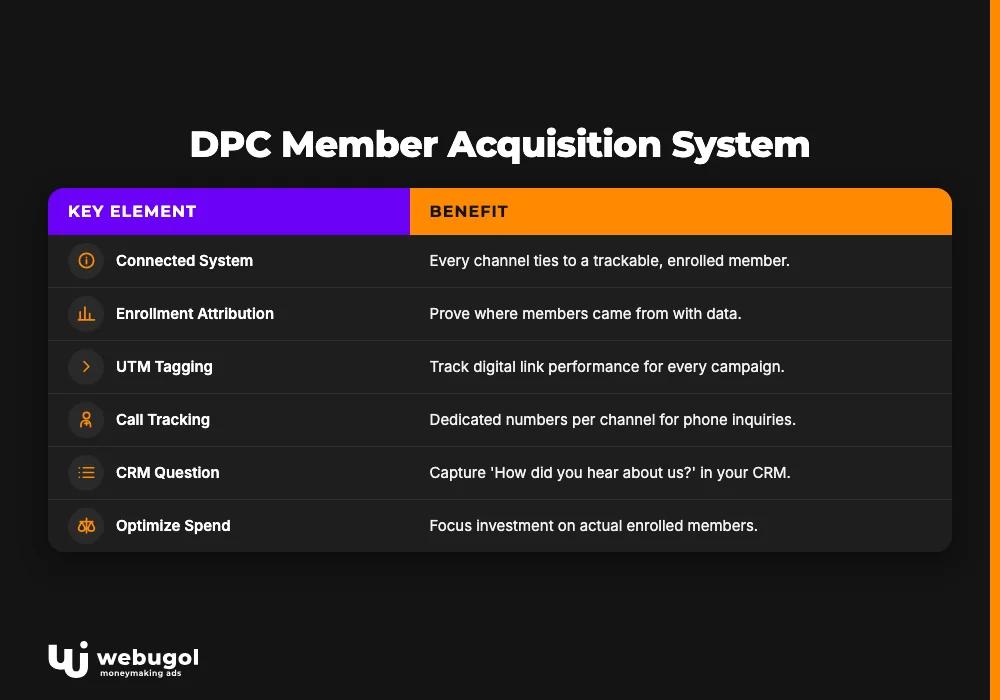
The practices that fill their panels do not run isolated campaigns. They build a connected system where every channel ties back to a trackable, enrolled member. Without that connection, you optimize for signals that may have no relationship to actual panel growth.
The structural weakness that stalls most growing DPC practices is the same one that stalls mature clinics at revenue plateaus: activity is tracked, but enrollment attribution is not. You have rough impressions of where members came from, but you cannot prove it in data or isolate what actually moves the panel number. Practices that break through that plateau are the ones that stop managing campaigns and start owning the full path from first click to enrolled member.
Tracking where members actually come from
Most DPC owners have a rough sense of their top acquisition sources. Few can prove it with data. Without UTM tagging on every digital link, call tracking on phone inquiries, and offline conversion imports into your ad platforms, you make channel investment decisions on intuition.
The fix is not complicated, but it requires deliberate setup. UTM parameters on every link, a dedicated call tracking number per acquisition channel, and a simple intake question captured in your CRM ("How did you hear about us?") create the attribution layer most practices skip. Once that foundation exists, you stop guessing and start optimizing spend to actual enrolled members.
| Channel | Avg. time-to-member | Est. CAC range | Compliance complexity |
|---|---|---|---|
| Organic search (SEO) | 3-6 months to consistent volume | Lower long-term | Low |
| Patient or physician referral | 1-4 weeks | Very low | Minimal |
| Employer partnership | 2-8 weeks per deal | Low per enrolled head | Moderate |
| Paid search (Google) | 2-6 weeks | Moderate | High |
| Paid social (Meta) | 2-8 weeks | Moderate to high | High |
| Community events | Weeks to months | Variable | Low |
Can DPC practices run Google or Facebook ads?
Yes, and both platforms carry specific restrictions most DPC operators do not know about. The restrictions are real; the goal is working within them, not around them.
Meta requires healthcare advertisers to select the Special Ad Category for health and wellness, which limits audience segmentation. Google's health advertising policies restrict personalized advertising tied to specific health conditions. Both platforms prohibit retargeting users based on implied or explicit medical conditions. Running a HIPAA-compatible setup requires server-side conversion tracking, a signed Business Associate Agreement (BAA) with your pixel vendor, and consent mode implementation on your site.
HIPAA-compliant tracking and paid ad setup checklist:
- Implement consent mode on your website before firing any analytics or ad pixels
- Sign a BAA with your analytics provider and pixel vendor prior to passing conversion data
- Switch to server-side tracking via Meta Conversions API or Google Enhanced Conversions to reduce browser-side data exposure
- Set all Meta campaigns to Special Ad Category: Health and Wellness
- Build custom audiences only from your enrolled member list, not from site visitor health-intent signals
- Exclude audience segments built on symptoms, diagnoses, or condition-related site content
- Route all ad inquiries through a HIPAA-compliant booking form, not a standard contact form
The employer channel: your highest-ROI DPC growth lever
A single employer partnership can add 5 to 30 panel members at once. That makes B2B outreach the highest-return channel by cost-per-enrolled-member in most DPC markets. Yet almost no DPC marketing content gives it more than a paragraph.
Employer partnerships work because DPC memberships map directly onto a benefit small businesses struggle to provide affordably: accessible primary care that reduces ER visits, sick days, and total healthcare spend per employee. You are not selling medical care to an HR director; you are selling a predictable monthly cost per head with a clear employee benefit.
How do you pitch DPC to a local employer?
Frame DPC as a benefit that replaces high-deductible copay friction and reduces absenteeism, and bring a per-employee monthly cost comparison to the first meeting. The decision-maker at a business under 50 employees is typically the owner or an HR director, not a benefits administrator. They want a simple number and a one-page summary they can share with staff.
Employer partnership pitch checklist:
- Target businesses within 5 miles with 10 to 50 employees as your initial outreach list
- Request a 20-minute meeting with the owner or HR director directly, not an HR generalist
- Lead with the monthly per-employee cost and the projected reduction in urgent care visits and absenteeism
- Bring a single-page benefit summary the employer can distribute internally
- Offer a group enrollment session at the employer's office or a 30-minute team call
- Pre-configure an enrollment link or intake form for each employer partner
- Define the annual renewal process upfront to protect the relationship long-term
If your acquisition system cannot tell you how many members came from employer partnerships versus organic search, that attribution gap comes first. The Healthcare Growth System includes an attribution audit and employer channel activation as part of its month-one foundation work, so you know your cost-per-enrolled-member from day one.
Patient-facing channels that actually drive DPC memberships
Content marketing, local SEO, and patient referrals all work in direct primary care marketing when the copy speaks to membership value rather than appointment availability. The mistake is treating these channels as awareness tactics rather than enrollment conversion tools.
Local SEO should target searches with explicit or implicit membership intent: "direct primary care near me," "DPC membership [city]," and condition-specific searches tied to the practice's niche. A well-optimized Google Business Profile with clear pricing and service areas generates qualified inquiries at near-zero incremental cost once it ranks. Patient referral programs with a structured ask and a simple enrollment link for referred prospects consistently outperform passive word-of-mouth.
Pricing transparency as a conversion tool
Publishing a clear monthly membership fee filters unqualified inquiries and accelerates decisions from price-conscious prospects. Hiding the price raises abandonment and draws in members who churn when they encounter an unexpected cost.
Transparent pricing pages reduce CAC by cutting the back-and-forth inquiry cycle before the intake call. The same principle holds across panel-based specialty practices: when a prospect can evaluate the monthly cost before they ever contact you, only motivated leads reach your intake team. Conversion rates improve; staff time per enrolled member drops.

Retention is marketing: preventing churn before it kills your CAC math
Every member who cancels raises the effective CAC of every member who joined before them. Churn is a marketing metric, not a clinical one. A practice with strong acquisition and weak retention spends more each month just to hold panel size steady.
The practices that scale past 200 members consistently run proactive retention programs: a 30-day welcome sequence, a 90-day engagement check-in, and a re-engagement trigger for members who have not logged a visit or contact in 90 days. Exit surveys on every cancellation close the diagnostic loop. You need to know whether members leave because of price, service quality, or a life change, because each root cause points to a different fix.
Understanding patient retention mechanics gives you the framework to build renewal triggers that keep your CAC math from compounding against you.
DPC marketing mistakes that inflate CAC:
- No UTM tagging or call tracking, so attribution remains guesswork after the fact
- Running ads without HIPAA-compliant pixel setup and consent mode in place
- Publishing pricing only on request, which filters out qualified price-conscious prospects before they engage
- Treating employer outreach as occasional rather than a structured monthly channel
- No exit survey on cancellations, so churn reasons stay invisible
- No re-engagement sequence for members who go quiet before canceling
- Scaling paid spend before confirming the attribution layer is accurate
- Evaluating channel performance by lead count rather than by enrolled members
When should a DPC practice hire a marketing agency?
Hire a direct primary care marketing agency when tracking is broken and campaigns are scaling blind, or when internal bandwidth is the bottleneck and you need a partner accountable for enrolled members rather than a vendor accountable for clicks. Generic healthcare marketing agencies underperform in DPC because they optimize for appointment volume, not membership enrollment, and they have no framework for employer channel activation.
The right agency brings HIPAA-aware tracking configuration, a cost-per-enrolled-member methodology across channels, and explicit accountability for retention, not just acquisition. An agency that reports CPL without reporting churn is leaving half the CAC math invisible.
This is where the handoff problem compounds. A media buyer owns the campaign. A developer owns the page. A CRM specialist owns the workflow. Each is correct inside their own scope. No one is paid to look at the enrollment drop between ad click and confirmed member. Webugol operates as a digital marketing agency that owns that full path from click to enrolled member to renewal, as one accountable system rather than a coordinated set of vendors.
Questions to ask a DPC marketing agency:
- How do you define and track cost-per-enrolled-member, not just cost-per-lead?
- Have you run employer partnership outreach as a structured acquisition channel before?
- How do you configure HIPAA-compliant pixels, consent mode, and server-side tracking for healthcare advertisers?
- Who is accountable when a member churns within 90 days of enrollment?
- What does your reporting show at the enrollment and renewal stages, not just the lead stage?
- Do you work within the practice's existing CRM, or do you require a migration to your own stack?
Ready to fill your DPC panel with a system that tracks every member back to source?
The gap between a DPC practice that fills its panel and one that stalls at 80 members is almost never the quality of the care. It is the absence of a connected system where acquisition channels are measured by enrolled members, the employer channel is treated as a structured program, and retention is a marketing metric with owners and triggers.
The Healthcare Growth System is a 90-day sprint that builds that system: attribution setup, enrollment funnel, employer channel activation, HIPAA-compliant paid campaign launch, and proactive retention mechanics. Book a strategy call to start with a full acquisition audit and find out exactly what your current cost-per-enrolled-member actually is.
FAQ
How do I get more members for my direct primary care practice?
The fastest path combines employer partnerships for bulk enrollment with a transparent pricing page that filters and converts individual prospects. Both require a working attribution system so you can measure cost-per-enrolled-member rather than website traffic or raw lead volume.
What is the most cost-effective direct primary care marketing channel?
Patient referrals have the lowest CAC because acquisition cost is near zero, but volume ceiling is limited. Employer partnerships deliver the best cost-per-enrolled-member at scale because a single deal adds multiple members in a short window. Organic search builds sustainable long-term volume at declining marginal cost once your SEO foundation is in place.
Can a DPC practice run Facebook or Google ads without violating HIPAA?
Yes, with a compliant technical setup in place. Both platforms require server-side conversion tracking, a BAA with your tracking vendor, and audience rules that exclude health condition signals from targeting and retargeting. Running standard browser pixels on a healthcare site without consent mode is the most common compliance gap in DPC paid campaigns.
How long does it take to fill a DPC panel from scratch?
Timeline depends heavily on channel mix. Referral and employer channels can generate enrolled members within weeks of activation. Organic search and content typically take 3 to 6 months to produce consistent volume. A multi-channel system combining quick-turn channels with long-term organic is the standard approach for practices with a panel target between 300 and 600 members.
What should I look for in a direct primary care marketing agency?
Look for an agency that measures cost-per-enrolled-member rather than cost-per-lead, has direct experience configuring HIPAA-compliant tracking for healthcare advertisers, and includes retention metrics in its reporting scope. An agency optimizing clicks without accountability for enrollment and churn is solving the wrong problem.

