



Sports medicine marketing: strategies to grow your practice
Sports medicine marketing is the combination of digital and community tactics that positions your practice in front of athlete patients before and after injury. Done right, it stops the slow leak. Clinics that combine local search optimization, paid search, injury prevention content, and community referral programs consistently outcompete larger hospital networks and general orthopedists who simply appear more often in local searches.
This guide covers each channel and how they compound into a consistent patient acquisition system.
What is sports medicine marketing?
Sports medicine marketing is the deliberate process of making your clinic visible and trusted to athletes, active adults, coaches, and team trainers who need specialized musculoskeletal care. It differs from general medical advertising because the audience makes decisions around season schedules, performance goals, and sport-specific injury risk. Acute pain is just one trigger.
The sports medicine market is growing, and so is the number of clinics competing for the same patients in your area. More clinics means more noise. Practices that build consistent digital acquisition systems today capture the referral volume that newer entrants will compete for later.
What are the best sports medicine marketing strategies?
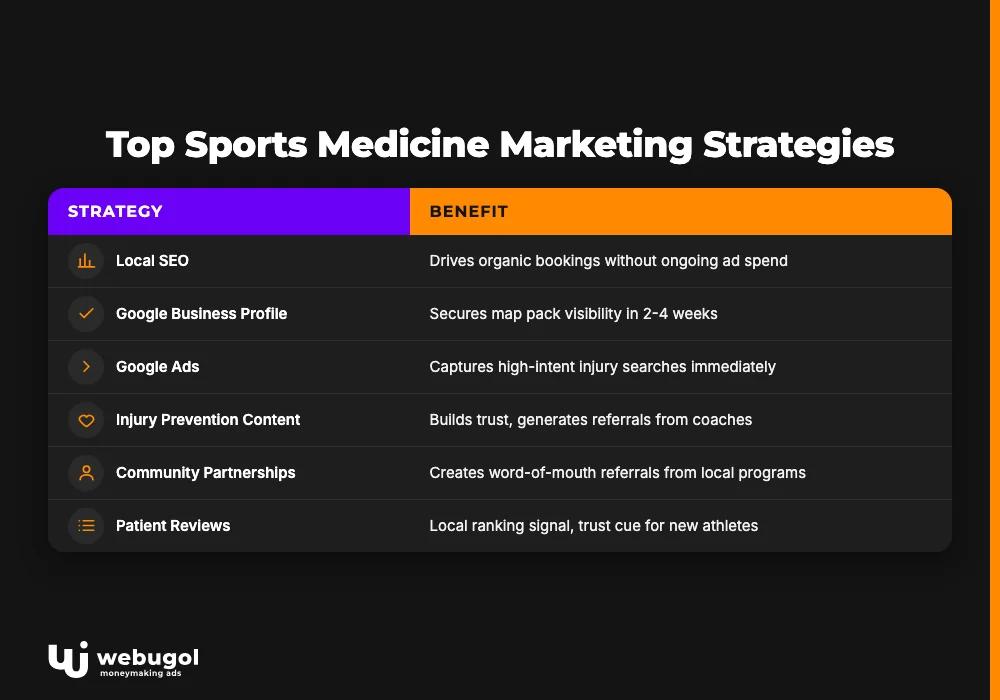
The highest-impact channels for athlete patient acquisition:
- Sports clinic local SEO targets athletes searching "sports medicine near me" or injury-specific queries and drives organic appointment bookings without ongoing ad spend.
- Google Business Profile optimization secures map pack visibility within two to four weeks and consistently outperforms neglected competitor profiles.
- Sports medicine Google Ads captures high-intent injury searches immediately and complements the slower organic build.
- Injury prevention content builds trust with athletes before injury forces a clinic visit, generating referrals from coaches and trainers who share your material.
- Medical practice social media on Instagram and YouTube keeps your practice visible in the athletic community and supports brand recall at the moment a patient finally needs care.
- Community partnerships with local gyms and school athletic programs create word-of-mouth referrals from coaches, trainers, and parents.
- Patient review generation turns each satisfied patient into a local ranking signal and a trust cue for the next athlete researching your practice.
The right mix depends on your growth stage. A newer practice should prioritize the Google Business Profile and local SEO foundation first. A clinic looking to scale athlete patient acquisition faster should layer Google Ads and a community referral program on top of an organic base that is already producing results.
Sports clinic local SEO: owning the searches that matter
When an athlete types "ACL specialist near me" or "sports physio [city]", they have already decided to seek care. Local search optimization determines whether your practice appears in those results. That gap costs appointments.
The complete strategy for local search visibility in healthcare rests on three pillars: an optimized Google Business Profile with individual services listed as separate treatments rather than a generic catch-all, consistent NAP data across every directory, and city-specific landing pages for each primary service.
Structured FAQ schema that directly answers common injury queries gives Google a clear signal of your clinical focus and earns rich snippet visibility for condition-specific searches.
Patient reviews accelerate the process. A profile with 50 or more recent reviews at 4.8 stars consistently outranks a competitor that stopped at 20 reviews from three years ago. Automating a post-appointment review request is maintenance for your local ranking, not a one-time project.
Athlete patients search on mobile from gyms and fields. A page that loads in more than three seconds loses a measurable share of those visits before they can convert.
Building trust before the injury: injury prevention content
Athletes research training load, recovery protocols, and injury risk long before pain drives them to a clinic. Content covering injury risks and training load positions your practice as the resource they trust during that research phase. Trust builds over time. When the appointment becomes necessary, your name is already on the shortlist.
Content that earns athlete attention:
- Sport-specific injury risk guides explain shoulder impingement patterns in swimmers and hamstring load management for sprinters.
- Return-to-play protocols lay out week-by-week milestones that coaches and athletes can track together.
- Video breakdowns of movement mechanics address common injury patterns and earn passive search traffic from coaches and parents.
- Downloadable warm-up and training load checklists give coaches a shareable resource with your clinic's name on it.
Each piece answers a question athletes are already searching, not a description of your services. A video explaining anterior knee pain in runners builds more referral trust among coaches than a services page ever will.
That same long-form article on hamstring strain prevention can generate a short-form Instagram series, a Google Ads landing page, and an email sequence for past patients, all from a single content investment.

Medical practice social media: what platforms move the needle
Instagram and YouTube are the primary channels for sports medicine digital marketing. Instagram performs for short injury mechanics clips, before-and-after movement comparisons, and community recognition posts for local athletes. YouTube earns passive search traffic from longer rehabilitation demonstrations and movement education videos that athletes and coaches search explicitly.
Facebook remains effective for targeted local ad campaigns directed at recreational athletes over 30. This demographic tends to have higher appointment values and lower no-show rates than younger patients.
The role of social media for healthcare practices depends on matching content to platform expectations. Posts answering specific athlete questions consistently outperform posts that announce services, because the former addresses what the audience is already thinking.
LinkedIn serves a different goal: building referral relationships with team physicians, corporate fitness programs, and athletic directors. It is not for direct patient acquisition. It produces institutional partnerships that send consistent monthly patient volume.
Sports medicine Google Ads: targeting intent, not category
Paid search for sports medicine produces the fastest new patient results of any channel here. That speed comes with a condition. Campaigns must target specific injury queries rather than broad category terms.
Generic "sports medicine" campaigns attract wide traffic that converts poorly. Campaigns built around "rotator cuff specialist [city]" or "ACL recovery therapy [city]" attract patients who have already identified their condition and are ready to book.
The campaign structure that works for online marketing for physicians:
- Separate campaigns by injury type and service, such as rotator cuff, ACL, or stress fractures.
- Bid on condition-plus-location query pairs rather than broad category terms.
- Direct each ad to a dedicated landing page by injury type, not the homepage.
- Track ad clicks through to booked appointments, not just website sessions.
Google Ads should complement an organic base, not replace it. A clinic investing in paid search without local SEO working already is paying for traffic it could own organically within six months.

How to attract more athlete patients to a clinic?
Consistent athlete patient acquisition comes from combining visibility with trust. Visibility comes from local SEO, paid search, and a maintained Google Business Profile. Trust comes from injury prevention content, patient reviews, and a community presence that athletes recognize before they ever need to book.
Clinics that grow reliably treat sports medicine marketing as a system. Each channel reinforces the others: a patient who found the clinic through Google, read injury prevention articles, and saw a coach's endorsement on Instagram converts faster and refers more actively than one acquired from a single touchpoint.
Partnerships with local gyms and school athletic programs extend the system into the community. Gym members who attend a free injury screening remember the clinic when they need care. Athletic directors who know your team refer injured student athletes without hesitation.
Ready to turn athlete searches into a full appointment calendar?
If your practice is not generating a consistent flow of new athlete patients each month, the gap is almost always structural: visible in one channel, invisible in three others.
Webugol builds sports medicine marketing systems that connect local SEO, paid search, and content into a single acquisition engine. Explore our sports medicine SEO and digital marketing services or request a discovery call for a channel audit specific to your practice.
FAQ
How to market a sports medicine practice?
The most effective approach combines sports clinic local SEO, an optimized Google Business Profile, and injury prevention content that builds athlete trust before they need care. Adding paid search ads for high-intent injury queries and a patient review generation system accelerates the organic base. Running these as a connected system produces compounding results that isolated tactics cannot match.
What social media platforms work best for sports medicine?
Instagram and YouTube deliver the most consistent return for sports medicine practices. Instagram works for short visual content on injuries and recovery mechanics; YouTube earns search traffic from longer rehabilitation and movement education videos. Facebook supports targeted local ad campaigns for recreational athletes aged 30 and above.
Does sports medicine Google Ads deliver measurable results?
Paid search campaigns produce the fastest new patient results when they target condition-specific and location-specific queries rather than broad category searches. Return improves significantly when each ad group links to a dedicated landing page by injury type and when a tracking system connects ad clicks to booked appointments.

